Petition to End Rape Immunity in India

Avaaz is organizing a global petition to help reduce the incidence of rape in India following the rape and death of the 23-year old medical student in New Delhi. According to their website Avaaz “is a global web movement to bring people-powered politics to decision-making everywhere.”

This international human rights organization has created a petition that will be delivered to Indian Home Minister Sushilkumar Shinde. Mr. Shinde will be meeting with other government officials on January 4 to discuss the issue of India’s rampant rape crisis. There is some fear that without global pressure—as well as the internal pressure—little may come from this meeting. Here’s what the petition says:

For too long, violent criminals have attacked India’s women and girls with no fear of consequences. It is time to bring an end to the war on women. We call on you to take immediate action to set up fast-track courts for victims of sexual violence across the country, and take every step necessary to protect India’s women and ensure justice is done.

As of 11:25 am Eastern Standard Time, 37,342 people from around the world have signed on to this call for reform. If you are interested in joining this global chorus, please go to the Avaaz petition site and sign on.

Thanks.

The Indian Gang Rape-Murder Just Scratched the Surface

This is a great summary of the history of gender-cleansing in India in the wake of the gang rape and murder of the 23-year old female medical student in New Delhi, India.  It was written by feminist Phyllis Chesler, Emerita Professor of Psychology and Women’s Studies at City University of New York. Thought I’d share her thoughts with you.

The Indian Gang Rape-Murder Just Scratched the Surface.


Fiscal Cliff, Sandy, VAWA and Congress’s Adjournment

Last night, I stayed up to watch the final vote on the Biden-McConnell compromise Fiscal Cliff bill in the US House of Representatives on C-Span. The final vote was 257-167 on the bill. Most of the Republicans voted against the bill and most of the Democrats voted for the bill.

No one on either side of the aisle was particularly happy with this compromise. Yet it was a bipartisan vote, albeit a reluctant one. As economist Joseph LaVorgna of Deustche Bank said after the vote,

“Nothing really has been fixed. There are much bigger philosophical issues that we aren’t even addressing yet.” 

Concerns that were raised by the progressive Democrats who voted against the bill include:

This deal mostly focused on tax cuts, leaving the issue of spending cuts to be handled about two months from now.  This will lead to another fiscal cliff as we butt up against the debt ceiling just like did in August 2011 as well as the sequestration fight that was put off because of this vote.

  1. This deal mostly focused on tax cuts, leaving the issue of spending cuts to be handled about two months from now.  This will lead to another fiscal cliff as we butt up against the debt ceiling just like did in August 2011 as well as the sequestration fight that was put off because of this vote.
    1. The debt ceiling fight will likely occur as early as February when we hit the $16.4 trillion federal borrowing limit so the government can keep paying its bills.
    2. The sequestration battle will occur in March as a direct result of the three-month delay of dealing with spending cuts that was written into the Biden-McConnell bill.
  2. Tax cuts were made permanent while funding for unemployment, a delay in cutbacks on Medicare payments, and an extension of the Farm bill that stopped the price of milk from automatically doubling are only temporary.  As Rep. Rosa DeLuca (D-CT) said on the floor, this bill did not do enough to benefit working families.
  3. Only those making above $400,000 ($450,000 for federally recognized marriages) rather than those making above $250,000 will see an increase in their marginal tax rate. This reduces the amount of additional revenue for balancing the budget. As Senator Tom Harkin said during the Senate debate, the billions lost by raising the threshold to $400,000 will come out of the pockets of grandparents and working families across the nation.”
  4. As a result of this bill, now law, even more draconian cuts to government-sponsored programs will ultimately be seen.  This includes funding for programs like education for our children, job training, and other critical supports for the middle class. And more funds for emergencies are likely to disappear or will be quashed as with what happened with the Sandy relief bill immediately after the fiscal cliff vote.

Philosophical questions about what the federal government should or ought to be paying for can be seen, for example, in two issues of concern to families across the country. Both of these issues failed to be addressed by the House of Representatives before they adjourned just after midnight this morning. They must now start negotiations all over again when the new 2013-2014 Congressional session begins on Thursday, January 4, 2013.

The first issue the House failed to fully address was the passage of the Violence Against Women Act (VAWA). VAWA is the law that provides funding to the Office of Violence against Women (OVW), to law enforcement, and to the judicial system to deal with all forms of interpersonal violence such as domestic violence, sexual assault, and stalking. VAWA was originally created in 1995. The bill must be reauthorized every 5 years. This means that the last reauthorization should have occurred in 2010! The hold back? Rather than improving the bill, many members of Congress, particularly Republicans in the US House of Representatives called for both cutbacks in funding and in who will be covered.

Over a belief that any person experiencing interpersonal violence be protected, the US Senate stood firm and refused to consider the exclusionary House VAWA bill that eliminated coverage of college students, immigrants, Native Americans, and LGBTQ people. Since the House refused to take up the Senate bill, reauthorizing VAWA will now have to start all over again in both houses when the new Congress convenes. Meanwhile victims and survivors of interpersonal violence are surviving on a temporary funding basis through March 2013 to cover anti-violence programs to save and improve their lives. Additionally, with the new “fiscal cliff,” – i.e. sequestration – will result in nearly 200,000 fewer victims receiving lifesaving and cost-effective services if both VAWA and sequestration are not resolved by March.

The second issue that the House failed to address was emergency appropriations to assist the victims of last October’s Super Storm Sandy. The vote on the fiscal cliff bill occurred at about 11:45 pm last night. Immediately after that, the Presiding Chair of the House, Rep. Steve Womack (R-AR), called for one-minute speeches. The second speaker was Rep. Steny Hoyer (D-MD). He announced that Speaker of the House John Boehner had pulled the bill and that as a result there would be no emergency funding for the victims of Hurricane Sandy forthcoming from this session of Congress.

At that point, Representatives from both parties from across the country began speaking out in anger and frustration that the people who were victimized by this natural disaster would not receive the emergency funding desperately needed to put food and warm housing over their heads at this winter time. Here are some of the comments made some of the Representatives of both parties on the floor and again this morning:

“This Congress is apparently leaving town without responding to [the Sandy] emergency. I am deeply disappointed … and the people who have been damaged by Sandy, including Gov. [Chris] Christie, a Republican, and Gov. [Andrew] Cuomo, a Democrat, should be deeply disappointed, and yes, angry, that this Congress would adjourn without addressing the pain of our fellow citizens.” – Steny Hoyer (D-MD) in his opening comment.

“To those who say FEMA has not yet disbursed all the funds it has to assist families and businesses, I would tell them, they deeply underestimate the damage in these areas and the wide range of assistance required to alleviate the pain and suffering.” – Steny Hoyer (D-MD) in a comment made about nine hours later in response to Rep. Eric Canter’s (R-VA) remark that funds weren’t urgently needed.

“I can’t imagine that type of indifference, that type of disregard, that cavalier attitude being shown to any other part of the country.” – Peter King (R-NY)

“I don’t think I’ve ever been as angry as I am tonight. For us in the Northeast to be treated this way is absolutely unconscionable. Tonight I am ashamed. Shame on you, Mr. Speaker.”Eliot Engel (D-NY)

“It is with an extremely heavy heart that I stand here, almost in disbelief and somewhat ashamed. It’s inexcusable. And I am here tonight saying to myself, for the first time, that I’m not proud of the decision my team has made.”Michael Grimm (R-NY)

For more comments from other representatives and a video of what happened, check out the ABC News article and video.

Adjournment without dealing with pressing issues of our citizenry. Philosophical differences resulting in gridlock and endangerment to people across the country. We need to stop throwing people under the bus. Shame on the 112th Congress!

We need to have a Congress that cares. Hopefully the new 113th Congress will be more willing to see and work on the concerns and needs of our country.

That’s my wish for the New Year.

Violence against Women and Children: A Worldwide, National, and Local Epidemic

Violence against women and children is a worldwide, national, and local epidemic.

Yesterday, a 23-year-old medical student died in a Singapore hospital of injuries she sustained December 16, 2012 in a gang rape and severe beating on a bus in New Delhi, India. She was attacked by six men who took turns raping her and beating both her and her male friend, stripping both of them, and then throwing them off the bus.  This is just one of many forms of femicide that have occurred in India, which include rape, sexual assault, honor killings, killing of girls 5 years and younger by starvation and violence, and dowry-related murders, among others.

This is just part of the world-wide epidemic of violence against women.  According to One Billion Rising, one in three women will be beaten or raped during her lifetime.  According to the United Nations,

Violence against women takes a dismaying variety of forms, from domestic abuse and rape to child marriages and female circumcision. All are violations of the most fundamental human rights.

Forms of violence vary by country, from sex-selection abortions in countries that value men over women, to female genital mutilation that leaves women maimed and traumatized, to forced marriages, to sexual harassment and intimidation at work, to trafficking and prostitution, to rape, incest, domestic violence, murder, and rape as a weapon of war. Some of this violence occurs within the family home.  Some of this violence occurs within the community.  And some of this violence is perpetrated by the state.  It can be physical, sexual, and/or psychological.  All forms are traumatic and in some instances, deadly.

UniFem’s data on violence against women is even starker than that presented by One Billion Rising.  They report that up to 70 percent of women and girls experience sexual or physical violence during their lifetime. Among women ages 15-44, the incidence of this form of violence – mostly perpetrated by husbands, intimate partners, or people the women know – accounts for more disability and deaths than occur from cancer, malaria, traffic accidents, and war combined.

In the United States, the Centers for Disease Control reports a pervasive problem of “intimate partner violence (IPV).”  This is defined as rape, physical violence, and stalking by a current or former intimate partner, either gay or straight of either sex or gender identity.  On average, 24 people experience some form of IPV every minute in the US.  This is over 12 million women (mostly) and some men each year, including 1 million women who are raped each year.

This violence occurs against both children and adults.  The majority of victims are women and girls, but they also include some men and young boys, such as the young boys here in Centre County, PA who were victimized by former PSU football coach Jerry Sandusky.  As a women’s rights activist, I have been speaking out against all forms of violence against women and children since at least 1994.  You can see a history of the local issues on the National NOW website here, and here as well as in The Nation.

There is a question that this info raises in my mind. What is the status of protections to reduce violence against women locally, in the US, and around the world? The picture/answer to this question is not great.

Locally, two cases of violence have made national news.  The most well-known case is that of former PSU football coach Jerry Sandusky; he was found guilty on 45 of 48 charges related to child sexual assault and is now essentially serving a life sentence in the state penitentiary.  Penn State University received a 60 million dollar sanction from the NCAA for failure to properly handle intimate partner violence, particularly child sexual abuse  within the Athletic department, and Judge Louis Freeh issued a scathing indictment against PSU’s upper administration, the Athletics’ department, and the Board of Trustees for covering up, failing to protect potential and actual victims of sexual violence, and failing to provide appropriate board oversight. And the University could face severe fines for failure to report IPV incidences to the US Department of Education under the Clery Act.  Despite these sanctions, violence on campus still continues.  The other case is the murder here in Centre County of PSU alumna Amy Homan McGee in 2001 by her husband, Vincent.  What happened in this domestic violence case was made into a 2010 PBS documentary titled “Telling Amy’s Story.”

These cases are just two examples among many that occur here at the local level. According to the State College, PA police department, there were 76 reported cases of domestic violence and 29 cases of sexual assault in the borough alone in 2011-2012.  Yet the incidence appears to be much higher.  According to the Centre County Women’s Resource Center, over 1,000 people in the county were known to be affected by domestic violence and another 200 reported being sexually assaulted throughout the entire county during the same time period.

To assist victims of stalking, domestic violence, and sexual assault, our local community created a county-wide task force of service providers and advocates to assist, education, and advocate for the reduction and elimination of all forms of IPV.  This task force has been in existence for 20+ years.  This task force is doing a decent job of working on IPV issues and providing services and education to the community, but is now facing ever increasing funding issues.

Funding for programs at the local level come largely from state and national governments.  Both levels of funding are in jeopardy.  Here in PA, for example, Governor Corbett eliminated General Assistance funding for everyone on August 1, 2012; a larger plurality of the recipients of this very limited funding were women fleeing domestic violence who used the minimal monies available to find housing for themselves and their children.

At the national level, Congress has failed to reauthorize the Violence Against Women Act (VAWA), which provides funding to the Office of Violence against Women (OVW), to law enforcement, and to the judicial system to deal with all forms of IPV.  VAWA was originally created in 1995.  The bill must be reauthorized every 5 years. This means that the last reauthorization should have occurred in 2010!  The holdback?  Rather than improving the bill, many members of Congress, particularly Republicans in the US House of Representatives are calling for both cutbacks in funding and who will be covered.  We are now at a standstill since, appropriately, the US Senate is standing firm on ensuring that all victims of domestic violence, sexual assault, and stalking – including college students, immigrants, Native Americans, and LGBTQ people – are covered.  The new session of Congress will convene in January 2013 and an entirely new bill will have to be crafted.  Meanwhile victims and survivors of IPV are surviving on a temporary funding basis through March 2013 to cover anti-violence programs to save and improve their lives.  Additionally, the looming “fiscal cliff,” sequestration will result in nearly 200,000 fewer victims receiving lifesaving and cost-effective services.

And returning to the international level, the UN Convention on the Elimination of All Forms of Discrimination against Women (CEDAW) has a clear statement that all countries that have signed the treaty take “appropriate” steps to eliminate violence against women and girls.  The US signed the treaty in 1980 but never ratified it.  India ratified CEDAW in 1993, but as can be seen from recent events there, doesn’t enforce this obligation.

So where does this leave us?

Action is needed.  We need to get out on the streets and call for full funding of programs designed to reduce and eliminate violence.  Eve Ensler is organizing One Billion Rising on February 14, 2013.  Her call states,

We are calling on ONE BILLION women and those who love them to WALK OUT, DANCE, RISE UP, and DEMAND an end to this violence.

It is a one-day strike and an “invitation to dance” that calls for the end of all forms of violence against women and children. If you are interested in joining women and those who love them from around the world, you can download the One Billion Rising toolkit to plan your event here.

You can also take action by telling leaders here in India as well as here in the US and in your state that enough is enough.

  1. Tell the Indian Prime Minister to meet the three demands of the women of India – 1) talk directly to the women of India about how you will deal with this violence, 2) begin expediting cases against Indian politicians who have records of alleged rape and other charges of violence against women, and 3) immediately reinstate Police Woman Damayanti Sen who was fired after she protected a gang-rape victim;
  2. Contact your US Representative and US Senators. Tell them to immediately introduce a new bill similar to the 2011-2012 Senate bill (S.1925) that covers ALL victims of violence.  This needs to be passed before March 2013 when the temporary funding extension that passed in November ends.  The new bill needs to be comprehensive and include all current victims of violence as well as battered immigrant women, Native American Women, LGBTQ persons, and violence survivors on college campuses.  You can find out more information about this issue on the National NOW website, including several links to action alerts on VAWA.  Also, tell your US Senators to finally vote for and ratify CEDAW without any reservations.
  3. Learn more about what your state’s laws and funding for programs on violence against women provide.  A good source of information for each state can be found on the OVW website; there is a page on that website that links you to resources in each state.  Once you get to your state’s links, you should be able to find action alerts and information to help improve funding and programs within your state.

The NRA, Schools, and More Shootings and Threats of Shootings

I live in central Pennsylvania where there are a large number of hunters, many of whom are members of the National Rifle Association (NRA). It is also a place where this week, one man was immediately arrested after allegedly making terroristic threats that he would go on a “shooting spree” and where this morning in Blair County (the county immediately southwest of where I live), four people were killed and three others wounded after another man went on a shooting spree.

In both of these cases, there was no school targeted. In the first case, a man from Breezewood told a bank teller that he would go on a shooting spree “like at the school the other day ” by killing everyone at the local Weis Market (a grocery store) where he works and would then return to the bank and kill everyone there. The bank teller immediately notified police and he was arrested within hours for making terroristic threats, which is a felony.

In the second case, a woman was shot and killed at a church in Gesseytown—a small rural town 70 miles west of Harrisburg near Altoona, PA. Three others—including the shooter—were also killed in the area after he left the church. Two police officers were wounded by the shooter and a third officer was injured in a head-on collision during the shooting rampage. According to the Blair County District Attorney, these shootings occurred over a large area of the county but were apparently perpetrated by, once again, a lone gunman.

In all of these cases—in Newtown, Breezewood, and Gesseytown—there was a lone shooter or person threatening to go on a rampage. In each case, these men expressed their frustration, anger, and or manifestation of a mental illness by threatening or carrying out a shooting spree.

And what did the NRA have to say? Just two suggestions to further arm the country and stigmatize a vulnerable part of the population – both of which, I believe could make matters even worse.

Put armed security guards in every single school in the country.

Create a mental health registry and mandate that anyone who has ever seen a psychologist or psychiatrist or a social worker be placed into this registry.

Let’s look at both of these suggestions. First, the NRA recommended that armed security guards be placed in every single school in the country. This suggestion turns our schools from a place of learning to a fortification or day-prison for children. As Governor Chris Christie (R-NJ) said right after the NRA press conference,

“You don’t want to make this an armed camp for kids. I don’t think that’s a positive example for children. We should be able to figure out other ways to enhance safety.”

This recommendation seems to be based on the idea that if every entry into the school were protected, then a shooter could not get into the school. How many schools only have one entry? Even one-room schools usually have at least two doors. The high school I went to had at least 8 doorways. The high school my son goes to has at least 8 entrances in addition to the doorways to the auditorium and gymnasium. The elementary school he attended has 10 entryways throughout the school.

What I hear the NRA saying is that had there been an armed guard at the door to the Sandy Hook Elementary School, there would not have been a mass shooting. This might only be true if there was a guard at every single entrance into the building since any potential shooter could just go around the building and shoot or enter through an entrance where there is no guard. So is the NRA suggesting that every school district in the country hire as many full-time, armed security guards as there are doors into their school buildings? I doubt it.

Second, the NRA suggested creating a mental health registry so that anyone who has any form of mental health issue would, like convicted sex-offenders, be listed in a registry. This is an overly broad and discriminatory suggestion. According to the National Association of Mental Illness, approximately one in four people in the United States experience a mental health issue in any year. This includes, for example, people experiencing depression, anxiety, post-traumatic stress (think of soldiers or crime victims or survivors of domestic violence and sexual assault), and people with brain injuries or illnesses that result in some form of mental health issue. Yet only a small minority of people who have ever experienced a mental disorder become violent, according to a study issued by the Surgeon General over a decade ago.

Currently, less than one-third of those needing mental health care receive that care. There are many reasons for this, including, but not limited to:

  1. The lack of health care coverage for mental health issues. Depending on the regulations implemented under the Affordable Care Act, this will likely improve, but only if the regulations make it clear that this new law clearly mandates mental health parity coverage.
  2. A lack of screening for mental health issues across the life span. Currently many health insurance policies do not pay for screening for mental health problems and thus screenings are not done. Routine mental health screening should become part of standard practice so mental health conditions are identified early when they can most effectively be treated.
  3. A lack of training of professionals and the public on how to recognize potential mental health issues. School professionals, law enforcement, community service providers, families and the general public need to be educated and trained on identifying potential problems and sources of help. Public education should also be provided to help reduce the stigmatizing of people needing and seeking out mental health services.
  4. Under IDEA – the Individuals with Disabilities Education Act – students with emotional disorders are supposed to receive services in school so that they can remain in school and succeed in life. However due to the high cost of these services, school budgetary cuts, and the lack of knowledge by parents that these programs are mandated, but not fully implemented, many young people drop out or do not receive the services they need.

Stigmatizing mental illness by placing people on a registry if they have ever sought services will result in more people not seeking the services they need or referring their family members for treatment. And doctors and other professionals may not do screenings for mental  health issues either because they are afraid their clients’ records will be confiscated without cause (which is a violation of HIPPA – the Health Information Patient Privacy Act) or that their clients will disappear and not receive needed treatment. In addition, once a mental health registry is created, people on that list (and their family members) could and will be discriminated against in work, housing, and other forms of public accommodations whenever their name is found on such a registry.

We live in the most violent country in the world. We also have the greatest access to guns. Some of these guns are rapid fire, semi-automatic guns. According to Tom Diaz, a policy analyst for the Violence Policy Center, these weapons were designed by the military to spray bullets into crowds by soldiers who were not sharpshooters. These guns were never intended for hunting, but for shooting people. According to many sports hunters, shooting game with semi-automatic assault weapons results in little, if any, animal trophies or game food. These are the types of assault weapons that were banned in 1994; the ban lasted for ten years, but failed to be continued in 2004. Since then, these forms of weapons have proliferated.

Let’s work for a safer America. A better America. Let’s not give in to the fear mongers. There is a better route than fortifying all public places (which is where this NRA suggestion leads us) and forcing people with mental health issues underground.

There IS a better route. Ban all assault weapons – any weapon that allows high-capacity magazines (e.g., 20, 40, 60, 100, 110 + rounds of ammunition). Teach tolerance and peace-oriented forms of conflict resolution rather than arming and fortifying our schools. And make sure that mental health services and training for professionals to recognize potential mental health problems are provided through the ACA and professional training programs so that those with mental health problems can both seek out services and be helped.

Friday, Dec. 21: National Moment of Silence for Victims of the Shooting at Sandy Hook Elementary School


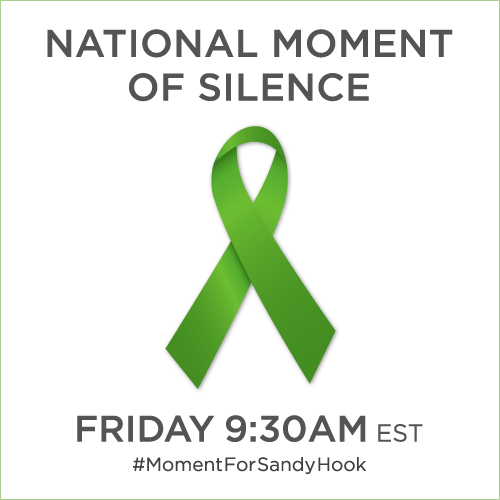
Moment of Silence for Sandy Hook Victims on Dec. 21
Please join in a national moment of silence in honor of the Sandy Hook victims called for by Connecticut Governor Dannel Malloy. At 9:30 a.m. EST, spend several minutes reflecting quietly on this terrible tragedy and take a five minute pause from all online activity.

Talking to Children

Tragically this morning, at least 20 young children and 7 adults were shot and killed at the Sandy Hook Elementary School and home of the alleged shooter in Newtown, CT. This is a very sad day for the families and community of Newtown as well as with the rest of the country. My heart goes out to these families.

And my concern also goes out to all of the children across the country who hear about what happened and start questioning “why,” “could this happen at my school,” “who can we trust,” etc. Parents and other that deal directly with young children may also be asking similar questions.

How do you answer these hard questions when violence occurs like this? What do tell your child or the children next door?

As a member of the Board of Directors, I have a connection with one woman who works directly with children. Her name is Nancy Baskett. She also serves as a member of the National NOW Board of Directors. Her main job is as a 4-H Extension Educator in Pierce County (Tacoma), Washington. After this tragedy this morning, she emailed out a help sheet entitled “Talking to Kids About Violence, Terrorism, and War.” I’m posting the link to this help sheet so that those of you who read this can use it and/or spread the information in case you have any children that are asking questions.

Highlights from this sheet include the following suggestions:

  • Listen to the kids and don’t overwhelm them with what you know
  • Ask them what they are worried about, what information they have and don’t have, and encourage them to share their thoughts and feelings
  • Listen and listen some more
  • Model open discussion
  • Ask thoughtful, open-ended questions that can’t easily be answered with a yes or no
  • Ask clarifying questions about what the kid means since their ideas of violence may be very different from yours
  • Answer the questions they ask to the best of your ability.
  • Acknowledge their feelings and don’t deny or play down either the seriousness of the situation or the feelings they present
  • Help them to feel physically safe. This includes:
    • Maintaining normal routines and schedules
    • Stop them (or yourself) from stereotyping people from different backgrounds, cultures, or countries
  • Help kids maintain a sense of hope by helping them to take action when they feel the need to do so. This could be things they want to do like writing a letter or finding their own unique way to support their schoolmates or communities either locally OR in this case, providing support for the kids in Sandy Hook, CT.

There are many more suggestions on this help sheet. Please take the time to read and help others.

This is a sad day in the lives of everyone. Please take a moment to hug your family and friends. And listen.