Equal Pay Day 2015: Same Old Same Old – Unfortunately

For the last three years, my local NOW chapter—Ni-Ta-Nee NOW—has organized community education events surrounding Equal Pay Day and paycheck fairness.  We have focused on this issue because of the continuing inequity in women’s wages as compared to the male coworkers.

A frequent question we have is, “What’s Equal Pay Day and why should I care?”  To help answer that question, we have done op-eds and interviews with the local press in the past (See here and here).  We also create a flyer that we update each year.  As President of Pennsylvania NOW, I wrote another blog on this issue in 2011. And last year, I commented on Equal Pay Day 2014  as well as the need for fairness in pay.

Like last year, my local NOW chapter will once again be distributing Equal Pay Day flyers in front of the gates of The Pennsylvania State University during the afternoon.

Why today? Because Equal Pay Day moves from year to year. For 2015, that day is today, April 14.

The following is a web-based version of this flyer updated from 2014 to reflect today’s stats and information. The hard-copy version focuses on Pennsylvania. I have kept that information here and added additional commentary and links for information and contacts in other states.

TUESDAY APRIL 14, 2015 is EQUAL PAY DAY

IT’S THE DAY ON WHICH WOMEN’S WAGES CATCH UP WITH MEN’S WAGES FROM THE PREVIOUS YEAR.

The wage gap is the ratio of women’s to men’s median annual earnings for full-time, full-year workers. Based on these earnings, women across the US earned just 83% of what men earned (IWPR, 2015).

Equal Pay Day symbolizes how far into the year a woman must work, on average, to earn as much as a man earned the previous year. Tuesday, April 14, 2015 is the day on which women’s wages catch up with men’s wages from the previous year. FYI, this is 6 days more than 2014, 5 days more than in 2013 and 1 day more than in 2011 when Ni-Ta-Nee NOW started tracking this date!

At the current rate of progress, the Institute for Women’s Policy Research estimates that it will be 2058 before women’s wages reach parity and Equal Pay Day will finally be on December 31 rather than somewhere in April of the following year!

THE WAGE GAP
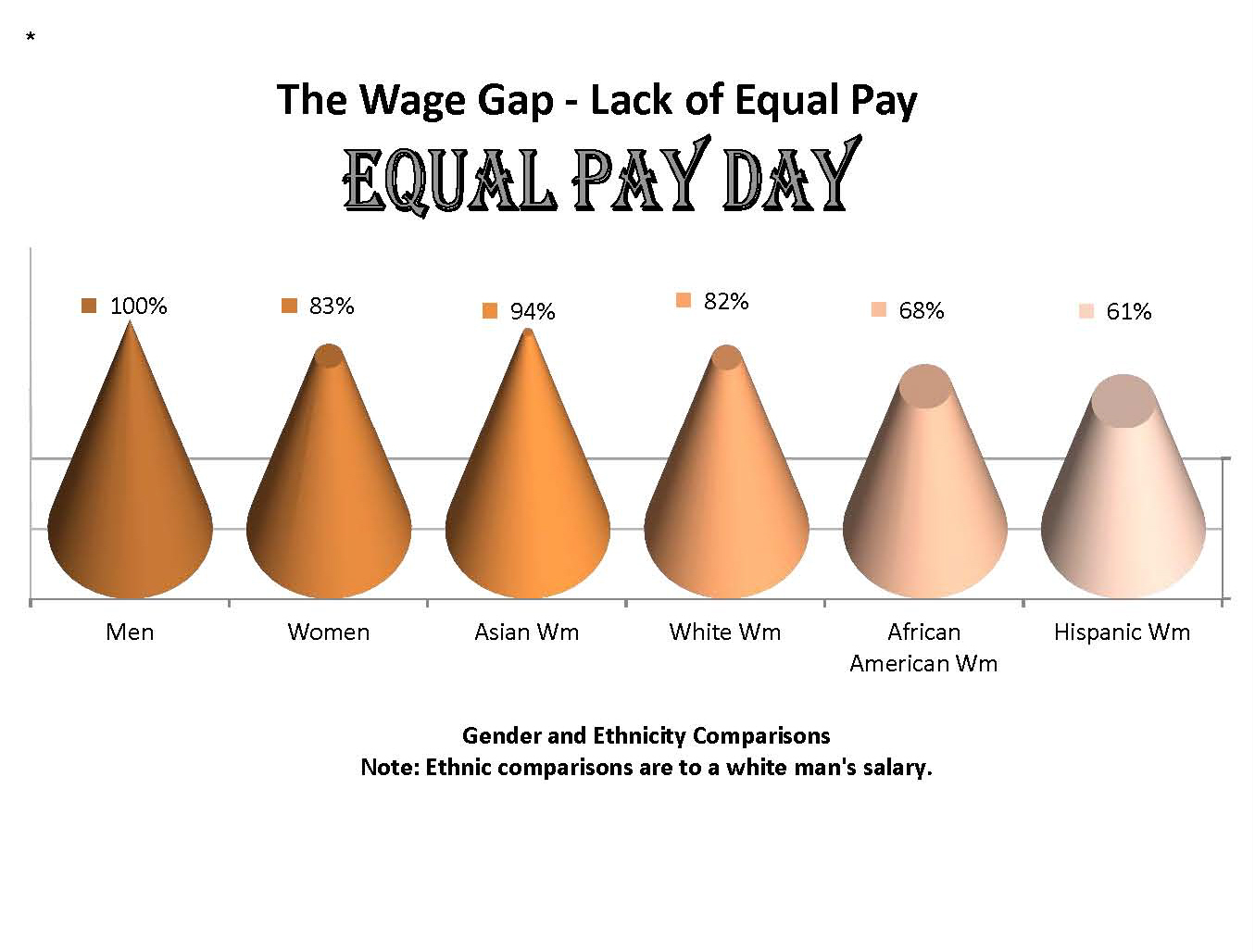
Graphic of Women's wage inequity broken down by race and ethnicity

Equal Pay Day: How Women Fare

Nationally, Asian American women have the smallest wage gap, earning 94 percent of what the average white man earned in 2012. White women are next, earning approximately 82 percent of white men’s average income, African-American women (68 percent), and Hispanic women (61 percent) have the largest wage gaps as compared to white men (IWPR, 2015). A typical woman earns $431,000 less in pay over 40 years due to this wage gap. (Center for American Progress, 2012).

THE WAGE GAP IN PENNSYLVANIA

The wage gap is even worse in Pennsylvania. When ranked among the other 50 states plus the District of Columbia, Pennsylvania’s wage gap placed it 40th among the states (AAUW, 2015).

The median annual income for a woman working full-time, year round in Pennsylvania in 2014 was $38,368 compared to men’s $50,231 or 76% of what a man earns. This is a wage gap of 22 % (AAUW, 2015).

Centre County is part of Pennsylvania’s 5th Congressional District (CD). Women in the 5th CD earn    $31,615 compared to the $42,782 that men earn or 74% of what a man earns. We rank 15 out of 18 in the state in terms of the wage gap. This is a wage gap of 26%. Philadelphia’s 1st CD fares better than the rest of the state with a gap of just 1% (AAUW, 2015).

A typical woman in PA earns $459,000 less in pay over 40 years due to this wage gap. This gap rises to $722,000 for women who have earned college degrees (Center for American Progress, 2010).

WHAT CAN I DO??

If You are an Employer

If you are an employer, you can get help in examining pay practices by conducting an equal pay self-audit using the guidelines from the US Department of Labor (available at www.pay-equity.org/cando-audit.html).

If You Believe You Are Experiencing Wage-Based Discrimination

Tell your employer if you are being paid less than your male co-workers. Click here for some tips on negotiating for pay equity.

If there’s a union at your place of work, ask for their help.

If discrimination persists: There are three places to file complaints – at the federal level, at the state level, and at the local level.

At the Federal Level

You can file under federal law with the Equal Employment Opportunity Commission (EEOC). Go to this link and follow the instructions.

At the State Level

You can find your state’s anti-discrimination agency website and contact information in a pdf file created by Legal Momentum starting on page 28. Most of the agencies have a website address that you can copy and paste into your browser. All of the agencies have a phone number that you can call for assistance.

If you live in Pennsylvania, you can file a complaint with the PA Human Relations Commission in Harrisburg. Contact information is available by region.  Just go to their website and look for your county’s name.  The phone number and address for your regional office is listed directly above the names of the counties served by each office.

You should also check to see if your local county, city, or community has an ordinance providing similar protections for wage-based discrimination. You can also file under federal law with the Equal Employment Opportunity Commission (EEOC).

At the Local Level

There are a few communities throughout the country that have created local ordinances that include the state-based anti-discrimination protections and have also expanded coverage to other areas (such as protections based on sexual orientation, family status, and/or family responsibilities across the life-span). If so, you can more conveniently file a wage-based complaint at the local level. Check with your state’s anti-discrimination agency to see if there is a local ordinance in your community.

In Pennsylvania, there are about 30 communities with such an ordinance. Your regional office of the Pennsylvania Human Relations Commission can give you this information, along with whom to contact. Check with your state’s anti-discrimination office if you live in another state to determine if your state allows such local ordinances and if such an ordinance exists in your community.

As I just stated, there are about 30 communities in Pennsylvania that have such a local ordinance. One of the most progressive and expansive ordinances is in State College, PA, home of the main campus of The Pennsylvania State University. Their ordinance covers wage-based discrimination based on sex as well as color (race), religion, ancestry, national origin, sexual orientation, gender identity or expression, familial status, marital status, age, mental or physical disability, use of guide or support animals and/or mechanical aids. Four of these categories – sexual orientation, gender identity or expression, familial status and family responsibilities across the lifespan, and marital status—are not covered under state law. State College is the only locality in Pennsylvania (and one of only a handful nationwide) that protects you in employment if you have family responsibilities for adult members of your family whether or not they live in the home with you. If you work within the State College, PA borough, you can file a complaint with the State College Borough under their Employment Anti-Discrimination Ordinance at 814.234.7110814.234.7110 (Side note: I was one of the people instrumental in crafting this ordinance).

If You Want to Support and Advocate for Pay Equity

Both the federal and many state legislatures are attempting to address the issue of pay equity.

The following summarizes the current status of the bills currently moving through Congress and the Pennsylvania General Assembly.

The Federal Paycheck Fairness Act

Ask your Congressional representatives to co-sponsor the Paycheck Fairness Act – HR 1619 in the US House of Representatives and both S 83—the Republican version entitled “End Pay Discrimination Through Information Act”— and S 862 —the”Paycheck Fairness Act”  identical to the House version—in the US Senate). These bills update and strengthen the Equal Pay Act of 1963. It gives women the tools they need to challenge the wage gap itself. HR 1619 was introduced by Rep. DeLaura (D-CT-3) on March 25, 2015 and currently has 190 sponsors; S 83 was introduced by Sen. Dean Heller (R-NV) on January 7, 2015 and has five sponsors; and S 862 was introduced on March 25, 2015 by Sen. Barbara Mikulski  (D-MD) and currently has 25 sponsors.

Minimum Wage

Another method of reducing pay inequity is to raise the minimum wage since women are more likely to work in jobs paying either the minimum wage or work for tipped wages. If you are among the 75% of Americans who believe the minimum wage should be raised to at least $12.50/hour, you should take action.  So…

Tell your state & federal legislators to raise the minimum wage & the tipped minimum wage.   The minimum wage bill at the federal level is called “The Original Living Wage Act of 2015 (HR 122). It was introduced by Rep. Al Green (D-TX-9) on January 6, 2015 and currently has 19 sponsors.

Since states and local communities can set minimum wages higher than that required by the federal government, you might also advocate for higher minimum wages for all workers in your state  and/or community.

At the state level, California (SB 3), Colorado (House Concurrent Resolution 1001 and House Bill 1300), Connecticut (S.B. 858), Delaware, Illinois, Maine (L.D. 843), Massachusetts (SD 852/HD 2835), New York, Oregon (H.B. 2009), Pennsylvania, Rhode Island (H.B. 5074), and Washington state (H.B. 1355) either have bills introduced (links to these bills are shown here) or there have been campaigns initiated in the state to advocate for raising the minimum wage to either phase out the lower tipped minimum wage and/or to raise the overall minimum wage to at least $10.00/hour. Some of these bills and/or advocates urge raising the minimum wage up to $15.50/hour in high cost cities within their state. Links to all of these campaigns can be found at http://www.raisetheminimumwage.com/pages/campaigns/.

At the local level,  the first community to raise the minimum wage to $15.00/hour (more than double the current federal minimum wage which hasn’t risen in over a decade) was SeaTac, Washington; this new wage went into effect on January 1, 2014. After nine months of this higher minimum wage, the Washington Post reported that those that had originally opposed this increase admit that “there has been no calamity so far.” Since then, both Seattle and San Fransisco increased wages in 2014 in their cities to $15.00/hour; Washington, DC is considering doing the same thing.

For more information on the raising concerns about the minimum wage and what you can do, go to RaiseTheMinimumWage.com.

Finally…For More Information

Visit http://www.pay-equity.org – the website created by the National Committee on Pay Equity (NCPE). NCPE is a coalition of women’s and civil rights organizations; labor unions; religious, professional, legal, and educational associations, commissions on women, state and local pay equity coalitions and individuals.” They are dedicated to ending wage-based discrimination and achieving pay equity.

Congressional Briefing on Cyber Stalking Announcement

picture of a sign that says "Stop Hate Crime"

Stop Cyber Bullying and Stalking

The National Task Force to End Sexual and Domestic Violence,

The National Organization for Women

and

The National Council of Women’s Organizations

Invite you to a Special Briefing

 Cyberstalking and Online Threats

 Wednesday, April 15, 2015

10:00 a.m.

2237 Rayburn House Office Building, Washington, DC

 In coordination with The Victims’ Rights Caucus (Representatives Judge Poe (R-TX) and Jim Costa (D-CA), co-chairs) and Representative Katherine Clark (D-Mass)

Presenters Include:

Michelle Garcia, Director of the Stalking Resource Center

Zoe Quinn, Video Game Developer and Co-founder of Crash Override

John Wilkinson, Attorney Adviser at AEquitas: The Prosecutors’ Resource on Violence Against Women

Danielle Keats Citron, Lois K. Macht Research Professor and Professor of Law at the University of Maryland Francis King Carey School of Law and author of Hate Crimes in Cyberspace

For information and to RSVP:  Rachel Graber at rgraber@ncadv.org, (202)467-8714

 * Interested advocates who can’t attend the meeting can watch a live stream via twitter.  On Wednesday morning at 10 a.m., tune into the National Center for Victim’s of Crime’s twitter site @CrimeVictimsOrg. Go to the link in the post that says #Periscope and click on the random letters and the video should appear.

For folks who do not use Twitter, go to www.twitter.com and follow the instructions on the website to create an account. Once you have logged in, type @CrimeVictimsOrg into the search box in the upper right corner to find NCVC’s page. Each Tweet is similar to a Facebook post, but the number of characters are limited. Click on the link in the post that says #Periscope to view the video. Do NOT click directly on #Periscope; the link you want to click on is the string of random characters following the word.


Thanks to Pat Reuss, who works for both the National Task Force and NOW for forwarding this information regarding the briefing and for her work with members of NOW, the National Coalition Against Domestic Violence, the National Council of Women’s Organizations, and the National Task Force to End Sexual and Domestic Violence that are helping to spread the word about cyber stalking and bullying of women and who are advocating for improved legislation and law enforcement to end this form of abuse against women and girls.

Helping Reduce Rape Culture: Two Legislative Ideas

Picture of a sign at the Window of Opportunity rally that says "End Rape Culture."

What we need to do to reduce/eliminate sexual assault, stalking, and harassment in our community.

I live close Penn State University where the Kappa Delta Rho fraternity’s online cyber bullying activities using Facebook to show explicit pictures of nude and/or inebriated women occurred. As a result of this action and the now ongoing investigations by both Penn State University and the State College Police, Erin Matson’s idea of reducing the legal age for alcohol consumption might be something that states might want to consider. I don’t know where I stand on this, but Erin does make a decent argument here.

Drinking age is a state, not a federal issue. So, if the drinking age were to be lowered, it would have to go through the state legislatures and be signed into law. Just like when the drinking age was raised back in the 1980’s.

To some extent, the same is true for any law that might be enacted to deal with online cyber-bullying and stalking, often known as revenge porn. If interstate commerce is involved in the bullying and stalking, federal law can and has been created (see here and here). If not, then this issue has to be dealt with at the state level.

States across the country have recently enacted or are considering bills to punish perpetrators of revenge porn and online cyber bullying or stalking. Here in Pennsylvania, legislators passed a “revenge porn” bill known as the “UNLAWFUL DISSEMINATION OF INTIMATE IMAGE AND DAMAGES IN ACTIONS FOR UNLAWFUL DISSEMINATION OF INTIMATE IMAGE Act;” it became law on September 8, 2014. It however does not cover online bullying outside of dating or marriage relationships since the law restricts coverage to a victim who is a “current or former sexual or intimate partner.” This law makes the non-consensual dissemination of such images a misdemeanor offense.

I understand that the PA legislature may now revisit this bill to expand the law to cover such types of bullying activities outside of an intimate relationship as a result of the KDR incident. When they do, I would recommend that they expand the law to all forms of cyber bullying and stalking in addition to any non-consensual dissemination of such images. This would include severe harassment and bullying threats that place a person in reasonable fear of death or serious bodily injury.

This proposal would, I believe, help create a state-based law similar to federal law (18 U.S.C. 875 and 18 U.S.C. 2261a) that “ makes it a federal crime to transmit threats of bodily injury in interstate commerce and criminalizes the use of electronic communication to place a person in reasonable fear of death or serious bodily injury.”

Finally, there will be a Congressional hearing on on-line cyber-bullying and stalking on April 15. This hearing is being set up by Representative Katherine Clark (D-MA) with the assistance of the National Coalition Against Domestic Violence. This hearing will focus on concerns about gender violence in all forms of social media. I’ll post a comment here once I find out where and at what time the hearing will be held.

Dealing with Frat Boys Who “Hold Women in Contempt”

Picture of a sign at the Window of Opportunity rally that says "End Rape Culture."

The theme of the Window of Opportunity Rally and March. This informal coalition was created last week as a “window of opportunity” to impact town and gown policies and programs to reduce/eliminate sexual assault, stalking, and harassment in our community.

A couple of days ago I reported on my participation in a rally and march on ending the rape culture at Penn State University and in the fraternity environment as expressed by the recent social media cyber bullying conducted by some members of the Kappa Delta Rho fraternity.

This morning, a member of a committee  I’m working with (thank you Bonnie) that is focusing on the cyber bullying issue sent me a link to an article in Salon that asks the question, “Why do some men hold women in contempt?”

In this article, Michael Kimmel, a professor of sociology at Stonybrook University discusses his research on men and masculinity and how perceptions of masculinity can and do result in behaviors such as what happened with Penn State University’s Kappa Delta Rho.

Kimmel argues that men often hold two views of masculinity. One view is that of the “good” man. The other is that of the “real” man.

The “good” man is a man who values honor and sacrifice and is willing to stand up for the little guy. And that “little guy” could be anyone, including women and others who are not part of their brotherhood.

The “real” man is a man who supports or values the view that to be this “real man” (a view often held by fraternity members according to Kimmel), you need to “man up.” Manning up includes things like never showing your emotions, never giving up, winning no matter what the cost, being a good “bro,” getting rich and getting laid.

Both views of what a man should be are often held by fraternity members. Mission statements of fraternities point to the “good” man ideal. Peer pressure within a fraternity leads the brother to “man up” and hold women in contempt with the negative behaviors linked to this view of what a “real” man should do.

Kimmel explains this disconnect between the values associated with the “good” man and the behaviors shown when women are held in contempt “as a kind of compensation for all of that manly sacrifice and teamwork” associated with being a member of the fraternity.

And this disconnect needs to be changed.

Men need to be held accountable for their contempt of women. Re-educating and adjudicating misdeeds of misbehaving frat boys within the university judicial system both need to be done. Dr. Kimmel has the right idea about this accountability. Here’s what he says,

My position on this is very simple. I think that we have to find ways to hold them to account. If you do something that is so disrespectful of others and you have basically violated something about the student code of conduct about the way you’re supposed to behave… these are the kind of things that I think campus judiciary committees should be talking about. I want to say to these guys, “You have broken something about the community, you have betrayed this community.You signed an agreement when you came to Penn State that you would abide by the student code of conduct. Well, you violated that. We now believe that you need to repair the damage you have done to this community.You’ve rent the fabric of the community and you have to repair it in some way.”

Frankly, this is something that campus judiciary can do because it’s a legal procedure, you have a constitutional right to due process in a criminal case.But you don’t have a constitutional right to go to Penn State. Penn State can decide you’ve blown it, you have now done something we find so egregious that we will now say you should separate yourself from this school; do something educational around the issues for which we are asking you to separate yourself, and then we will consider bring you back.

You have damaged the community, and now you have to do something proactive to repair it.

I agree. Penn State University, like every other university, has a Student Judicial Conduct Board. The Board has a written set of policies on student conduct that all students receive when they are admitted and which they agree to follow while at the university.

As I stated in the last blog, a full review of the policies at the university surrounding on-line cyber bullying needs to be conducted. Hopefully these policies currently  deal with such forms of misconduct. If the Judicial Conduct Standards are weak in this area, they need to be beefed up. Either way, the Board should follow Dr. Kimmel’s recommendations to the letter of the code with this current case and with all future acts of cyber bullying at the university.

Repair the damage you have done to the community. Educate yourself. Then and only then should you be allowed to come back.

Social Media Attacks on Women: Rape Culture at Penn State and Kappa Delta Rho

Picture of a sign at the Window of Opportunity rally that says "End Rape Culture."

The theme of the Window of Opportunity Rally and March. This informal coalition was created last week as a “window of opportunity” to impact town and gown policies and programs to reduce/eliminate sexual assault, stalking, and harassment in our community.

A little over two weeks ago, Penn State University’s Kappa Delta Rho fraternity was suspended by the national fraternity’s office and by the university after it was announced that the State College police were investigating the fraternity for possible criminal activity related to hazing, drug use, and the sexual exploitation of college women though the use of a private Facebook page.

The town and gown are now in an uproar.  Once again, the university is in the national spotlight for another instance of sexual misconduct.  This time via the use of social media.

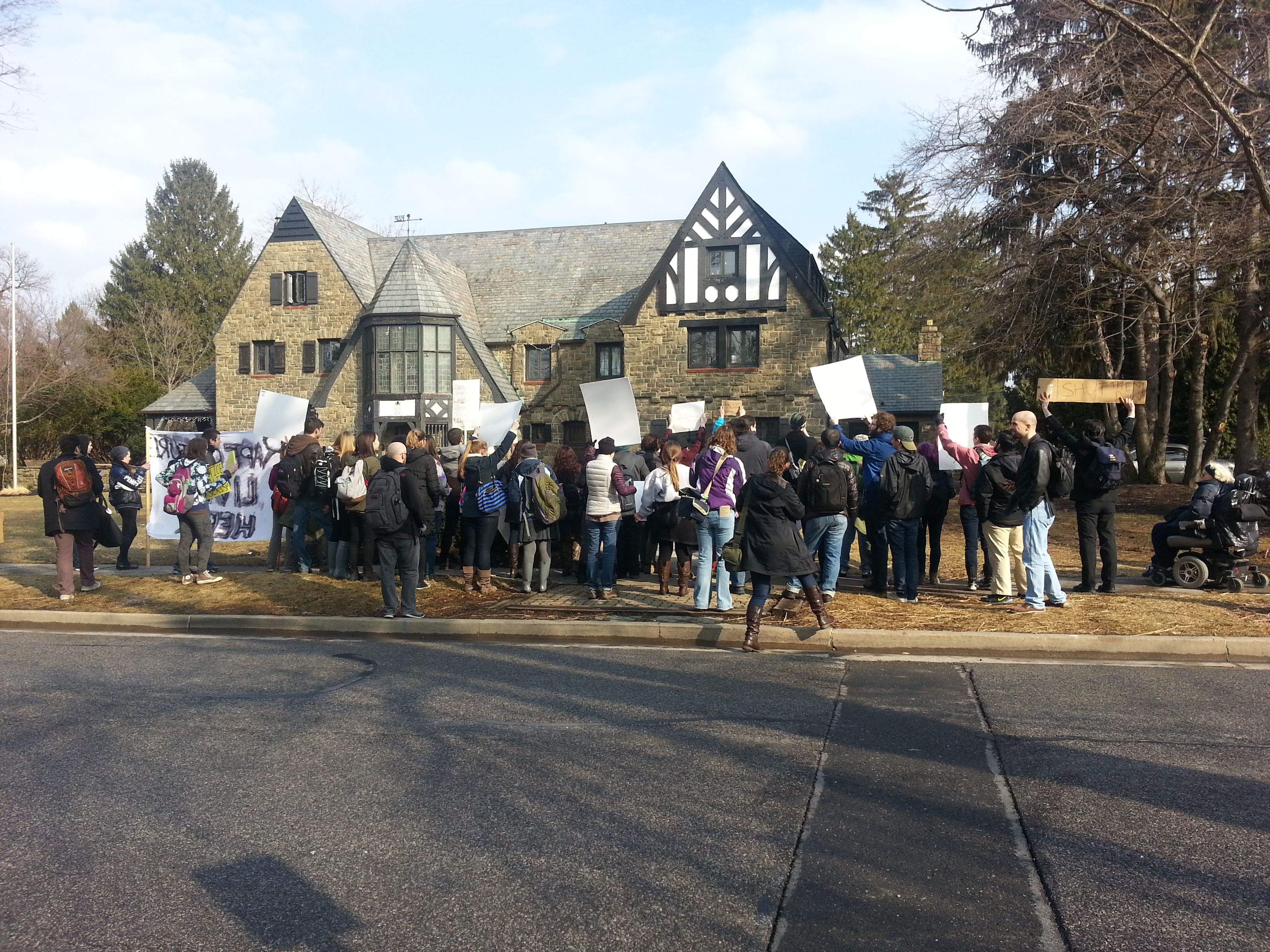
So far two rallies have been held protesting the rape culture that pervades this town and campus.  One of the rallies was held yesterday. It included a speakout and then a march from the entrance gates of the University Park campus to Fraternity Row where the Kappa Delta Rho House is located.

I was the first speaker at the rally.  The following is the written version of my speech. Thank you to Michele Hamilton, NOW Mid-Atlantic Region Board Member, Vice President of Pennsylvania NOW, and President of Ni-Ta-Nee NOW and Marian Bradley, NOW Northwest Regional Director and Past President of Montana NOW for their assistance in putting these ideas together.

Once again, PSU has garnered a national demerit in the public’s view due to allegedly inappropriate sexual misbehavior.

We’re concerned that this mistreatment of women continues to happen in the PSU community.

These actions by KDR have resulted in the appropriate suspension of the fraternity. It also resulted in both police and campus declarations to further investigate what and how this happened. We applaud the University and the national office of KDR for taking these actions. We also applaud the State College police for their pro-active investigation.

We also believe that these types of sexist activities need to be reviewed within the greater milieu of the Penn State environment. This review needs to determine what additional policies and protocols should be implemented to prevent such future acts by members of the community and to hold perpetrators accountable for their misogynistic actions.

The PSU President’s Task Force on Sexual Assault and Sexual Harassment was charged by President Barron to “[combat] sexual misconduct and to [engage] all employees and students in a direct call to action.”   We call on PSU to add this social media bullying type of assaults to this review.

In addition to calling upon PSU to review their policies, we are also asking the public here and across the country to view these actions within the larger scope of online harassment of women. Here’s what we are talking about.

Gamergate. Doxing. Revenge Pornography. Swatting. Posting of pictures of hazing and of nude and unconscious women without their consent. Threats of rape and death via social media. These are all forms of cyber bullying that we have recently heard about across the country. And most of the victims have been women.

In light of these social media attacks, Pennsylvania NOW and Ni-Ta-Nee NOW ( the local NOW chapter) have signed on as organizational supporters of Representative Katherine Clark’s (D-MA) “Dear Colleague” letter sent to her Congressional colleagues in an effort to highlight concerns about gender violence on all forms of social media. This letter, through Congress’ oversight and review process, urges the US Department of Justice to “intensify their efforts to combat cyber stalking, harassment, and threats.”

After the speak-out, we marched to the Kappa Delta Rho House about 12 blocks away.  During the march several reporters came up to me for additional comments.  One of the reporters – Hannah Sarisohn for the PSU Daily Collegian asked me about the Task Force appointed by President Barron that I mentioned in my speech.

During our conversation, she asked me what I thought of the make-up of the student portion of the oversight committee. She told me that the only two student representatives are a sorority sister and a fraternity brother.  No other part of the student community is represented on this task force.  I said, “that’s not right. That’s not enough.”  She then used part of what I said in the article she wrote:

Joanne Tosti-Vasey, resident of Bellefonte and regional director for the Mid-Atlantic region of the National Organization for Women, said while the task force is a good step, more than fraternity life needs to be looked in to.

“We have students not in greek life who need representation. [Undergraduate students, graduate students, students of color,] LGBTA students and students with disabilities, everyone needs representation,” Tosti-Vasey said. “The task force needs to include people from all of these backgrounds.”

Finally, here are some of the pictures I took at the Rally and March:

Signs at that protest rally that say "Kick down rape culture" and "This is not satire."

The protest started and ended at the entrance gates to the Penn State University. About 50 people participated. These are a few of the signs seen at the rally.

picture of more protesters and signage at the Window of Opportunity Speak Out and March

More protesters and signage at the Window of Opportunity Speak Out and March

Picture of a toddler and her mother carrying a sign that says, "I want to grow up in a town what I know I am safe."

The youngest protester (three years old) at the rally carried her own sign on the shoulders of her mother. Here she is with her mother Gina Thompson of Bellefonte, PA who is speaking to one of the reporters that covered the event.

Picture of protesters shouting "Shame on You" in front of the Kappa Delta Rho House in State College, PA

After the speak-out, most of the protesters marched about 12 blocks to Fraternity Row to bring our protest to the front door of Kappa Delta Rho, the fraternity whose members created the online Facebook page that is now under investigation for potential criminal activities. Afterward we marched back to the Gates at PSU to wrap up the rally.

Dueling Gun Bills in Congress

I agree totally with the last two sentences of Nel’s New Day blog posting:

The Second Amendment: “A well regulated militia, being necessary to the security of a free state, the right of the people to keep and bear arms, shall not be infringed.”

The meaning of the Second Amendment: you can bear your arms, but you need to be trained, and carrying those arms is to be regulated by the government.

“Well regulated” means that you balance the safety of the community with the right to keep and bear arms.

I believe that the 2nd Amendment provides for an individual right to own and use firearms but that we need to balance that right with the safety of our families. I believe that common-sense laws help create a safe environment for all. This includes laws encouraging the use of trigger locks and laws like the Brady law that require background checks for the purchase of firearms and prohibitions of having a gun in the home when under a protection from abuse order,

This article by Nel gives a good summary of the issue of gun safety regulations and the bills currently being proposed in Congress on both sides of the issue.  Do we have an unsafe free for all or do we had a rational set of gun safety rules?  I believe in the latter.

trp2011's avatarNel's New Day

Proposed gun laws have been mostly flying under the radar with the wild debacles of the new GOP-controlled Congress, but congressional members on both sides of the issue are proposing gun laws. Former Rep. Gabrielle Giffords (D-AZ), whose career took a radical shift after she was seriously wounded by a shooter four years ago, went Capital Hill to support reintroduction of legislation in the House to strengthen background checks for gun buyers.  Co-sponsor Peter King of New York has been joined by three other Republicans.

The federal bill would require background checks on private sales at gun shows, over the Internet, and through classified ads, transactions during which a check is not usually run through the National Instant Criminal Background Check System. It would also strengthen the National Instant Criminal Background Check System by providing states with incentives to improve reporting of criminals and people with dangerous mental illnesses to be included in…

View original post 1,156 more words

10 Female Revolutionaries That You Probably Didn’t Learn About In History class

The one woman whom I recognize in this list of ten is Asmaa Mahfouz. She helped spark the Egyptian uprising in January 2011. Which one of these forgotten female revolutionaries do you recognize?

Universal Health Care: Let’s Do It!

I am not an economist. But I am a strong advocate for universal access to healthcare in the United States. See why here.

A couple of days ago, Thom Hartmann at The Big Picture RT posted a YouTube video on why economists are demanding a universal national healthcare plan. In this video he reports that more than 100 economists sent an open letter to Vermont’s Governor Peter Shumlin (D) after Shumlin “bailed” on implementing Vermont’s state-based single-payer healthcare plan.

Governor Shumlin stated that he was stopping the implementation process because he believes that “This is not the right time” for enacting single payer. He stated that there were too many costs associated with the program and could not go forward with the plan “at this time.”

The economists argued otherwise:

As economists, we understand that universal, publicly financed health care is not only economically feasible but highly preferable to a fragmented market-based insurance system…. Public financing is not a matter of raising new money, but of distributing existing payments more equitably and efficiently. Especially when combined with provider payment reforms, public financing can lower administrative costs, share health care cost much more equitably, and ensure comprehensive care for all.

We support publicly and equitably financed health care at federal and state level, and we encourage the government of the state of Vermont to move forward with implementing a public financing plan for the universal health care system envisioned by state law.

Hartman then goes on to say that part of the economic concerns about Vermont’s single-payer healthcare plan arises from its small population base. He believes that the economy of scale makes it harder for a small state to go it alone in “innovating” new healthcare plans as allowed by the Affordable Care Act starting in 2017. Then he goes on to urge the federal government to expand Medicare to all citizens over a 10-year period of time.

I agree that it would be great to have universal Medicare for All across the United States. But I also believe that the only way that will happen is if some states implement single-payer healthcare at a state level to concretely show that a universal healthcare plan is economically viable and distributes existing healthcare payments more efficiently and equitably while lowering administrative costs WITHOUT raising the overall cost to individuals, businesses or communities. In fact, in many instances, cost would be lower.

Studies on how this might happen have been done by well-known economists across the country. For example, Dr. Gerald  Friedman, Professor of Economics and Department Head at the University of Massachusetts-Amherst has done several of these studies, including one for Pennsylvania, one for Maryland, and one for expanding Medicare to all at the national level. Every economic impact study on implementing universal healthcare plans that I have read indicates that “A single-payer health care finance system would produce substantial health and economic gains” when implemented at either a state or the national level.

At least 14 statesCalifornia, Colorado, Hawaii, Illinois, Maine, Maryland, Minnesota, Missouri, New York, Ohio, Oregon, Pennsylvania, Vermont, and Washington—have community advocates and state legislators working towards implementing a state-level form of universal healthcare. And advocates across the nation continue to work for Medicare for All at the national level.

Whichever way comes first is fine with me. We just need to get moving and create healthcare for all in the USA.  Let’s make it sooner rather than later.

The Women’s Movement Is for Everyone

Feminism is for Everyone

Credit: Art Crimes on Flickr, under Creative Commons

This is Women’s History Month.  And today is International Women’s Day.

In celebration of these two events, Women’s eNews Commentator Mary S. Hartman wrote an article entitled “This Women’s Movement, Now, Is for Everyone | Womens eNews.”

In this article, she links Betty Friedan’s views on the early days of the National Organization for Women and the Feminist movement to today’s movements and actions.

In her 2002 interview with Hartman, Friedan was asked what she envisioned the women’s movement to look like mid-century.  She said,

Well, I hope that by then our focus will not long have to be on women as such, or women vis a vis men… [that] we will have achieved what at the moment we seem to be achieving — real equality between women and men.

Friedan then went on to say that we needed “something larger,” namely a “people’s movement” with “diverse leaders of both sexes acting together and championing not just women’s rights but civil rights, unions, youth movements and more.”

I believe we are moving in that direction with coalitions, with the Occupy and Ferguson movements, and with people coming together on social media to raise our collective voices for civil rights.

What do you think? Read Hartman’s article and then comment.

Happy International Women’s Day and Women’s History Month!

Diversity and Inclusion – Love Has No Label

Diversity & Inclusion – Love Has No Labels

Love.

It’s not about gender, race, disability, age, or religion.

Be yourself.

Love one another.

And respect that love.

It’s universal.

via @YouTube