Special Report: IRS Scandal Shakes Washington (OR IS IT?)

I just read this blog by Michael J. Rosen about the extra scrutiny of conservative groups seeking tax-exempt status. I decided to repost his blog with three sets of comments. My comments give thought to three different sets of questions:

  1. What else besides what we’ve heard about might have helped lead to this “scandal?”
  2. Is it really a “scandal?” Do we know?
  3. Is this issue likely to go away soon?

What else might be behind this scandal?

Besides a lack of training and oversight that we’ve heard about, I think another part of this whole problem is the backlog of applications in the non-profit division of the IRS. I talked to them the other day about a non-profit I work with that is attempting to get its 501(c)4 status reinstated due to the 990-N issue. The agent I talked to said that they are getting over 5,000 applications every month and are working on them on a first come, first serve basis.

The IRS website says that with the small staff they have, there is an even greater backlog on applications than what the agent told me. Here’s that IRS statement.

“All [non-profit] applications are sent to the IRS Determinations Office in Cincinnati. This office receives approximately 70,000 applications for tax-exempt status of all kinds each year [that averages out to 5,833 new applicants each month]. This includes applications from section 501(c)(3) and section 501(c)(4) organizations. This office, which includes fewer than 200 people working directly on applications, is primarily responsible for working determination applications.”

The agent helped me to figure out the current status of this VERY SMALL non-profit that I’m working with (if it brings in $400/year for this group, it’s doing well). He told me that the records show that all of the paperwork at our end is basically complete, but the application won’t be reviewed until the office gets to the applications marked as “complete” as of September 2012 (when he says my group officially completed the paperwork). And, directing me to another section of the website, he pointed out that the office is currently working on applications from early May 2012 – i.e., over a 1 year delay in processing!

The aforementioned web page also goes into more detail, from the official IRS viewpoint, of what happened with the Tea Party organizations. It says that approximately 70 Tea Party groups were put into the in-depth “centralized” review; that out of a total of, currently, about 470 organizations being given similar treatment.

Is it a Scandal? Do We Really Know?

A scandal is defined as “a circumstance or action that offends propriety or established moral conceptions or disgraces those associated with it.” A political scandal is “an instance of government wrongdoing” that offends or disgraces those directly associated with that wrongdoing.
In this case, so far, it doesn’t appear to be a scandal that rises to the level of the White House. According to the Washington Post, based on increasing evidence, the IRS issue is very bad press for the Obama administration. According to their report,

If we believe the agency inspector general’s report, a group of employees in a division called the “Determinations Unit…” started giving tea party groups extra scrutiny, were told by agency leadership to knock it off, started doing it again, and then were reined in a second time and told that any further changes to the screening criteria needed to be approved at the highest levels of the agency.

The White House fired the acting director of the agency [this week] on the theory that somebody had to be fired and he was about the only guy they had the power to fire. They’re also instructing the IRS to implement each and every one of the IG’s recommendations to make sure this never happens again.

And from all the evidence obtained so far, there is no evidence of any connection between the “Determinations Unit” and the Obama administration. So unless there is a smoking gun hidden somewhere, there is no political scandal within the White House. Time will tell.

Is this issue likely to go away anytime soon?

No, I personally doubt that the issue will “go away” anytime soon.

Three reasons:

  1. partisan politics to continue attacking Obama’s executive branch;
  2. long history of spying and intrusiveness; and
  3. free-speech issues.

The first issue is purely partisan. Issues that Republicans think will make President Obama look bad are brought up again and again even when the public, to some extent (but not the base) has moved on. Has the Benghazi issue died? How many times will the Republican-dominated House vote to revoke Obamacare before they give up?

The second issue is spying and intrusiveness that, for the first time in a long time, concerns both sides of the aisle. There has been a long history of the feds, usually the FBI, targeting non-profits. Think of the Friends (Quakers) peace-related work for example or the Communist-baiting of the 1950s. Usually it’s the more progressive, left-leaning groups that are targeted. These groups have a long memory and I think may, in this case, support the concerns raised in this non-profit scrutiny case. And since there were progressive groups in this list of targeted non-profits, both sides have some ammunition to push back against the actions of the IRS.

The third is a First Amendment issue. Combine these IRS actions with the free press concerns over the Justice Department’s review of press reporters’ phone logs; both sides have screamed NO. What you have here are two different departments of the executive branch allegedly intruding on the First Amendment: one department—the IRS—may be attacking an individual’s free speech rights and another department—the Justice Department—may be attacking freedom of the press. Both protections are contained within the First Amendment of the US Constitution.

So no, based on all three routes of concern, I don’t think this issue will go away anytime soon.

Michael J. Rosen's avatarMichael Rosen Says...

This week, the US Internal Revenue Service acknowledged and apologized for behavior that had long been rumored. The IRS improperly targeted for extra scrutiny conservative groups seeking tax-exempt status.

IRS logoThe IRS did not ultimately deny tax-exempt status to a single group receiving extra scrutiny. Some say this proves that the actions of the IRS were baseless.

The scandal has now shaken the nation’s capital:

President Barack Obama directed Jack Lew, Secretary of the Treasury, to request the resignation of Steven Miller, Acting IRS Commissioner.

Miller resigned and Lew accepted the resignation.

The Justice Department has initiated a criminal investigation.

Exercising its oversight responsibility, Congress has begun its own probe of the IRS scandal.

Obama addressed the nation on television saying, “It’s inexcusable and Americans are right to be angry about it and I am angry about it. I will not tolerate this kind of behavior in any agency, but particularly…

View original post 371 more words

Call for Paycheck Fairness Act Co-Sponsorship

The wage gap shows that women, particularly women of color are paid significantly less than white men.

The Wage Gap: Lack of Equal Pay

On April 9, I did a blog on Equal Pay Day discussing the lack of equity in pay between men and women’s work.  In that blog, I discussed the need to pass the federal Paycheck Fairness Act.

Part of the process of obtaining passage of a bill is to get as many legislators as possible to sign on as a co-sponsor of the bill you are interested in.  In the US House of Representatives, there are currently 206 co-sponsors of the House version of the bill – H.R. 377. In the US Senate, there are currently 46 co-sponsors of the Senate version, S. 84.

The main coalition pushing for paycheck fairness and pay equity is the National Committee on Pay Equity.  This morning, I opened up an email from a listserv I’m on regarding the Paycheck Fairness Act. Michele Leber, Chair of the National Committee on Pay Equity sent out the following message, asking everyone to spread the word to their friends and colleagues in Virginia. Here’s what she said:

“We learned yesterday [April 24] from the office of Rosa DeLauro, our pay equity champion in the House of Representatives, that every Democrat in the House is now a PFA cosponsor! To reach that goal in the Senate, we need just a few more Democrats, among them Mark Warner of Virginia.

At a meeting yesterday in Warner’s office, his legislative aide said the best way to get Warner’s cosponsorship was to send the senator messages of support for the bill. So please rally any contacts, groups, or chapters that you have in Virginia, asking persons to contact Sen. Warner’s office by phone at 202-224-2023 and/or by e-mail at http://www.warner.senate.gov/public//index.cfm?p=ContactPage, asking him to cosponsor the Paycheck Fairness Act, S.84.

With the 50th anniversary of the signing of the Equal Pay Act coming up on June 10, this is particularly important now.”

So…

If you live in Virginia and are a constituent, please follow Michelle’s request and contact Senator Warner regarding co-sponsorship.

If you don’t live in Virginia, you can find out where your US legislators stand on the Paycheck Fairness Act by going to http://thomas.loc.gov/home/thomas.php. In the search box in the middle of the page, type in “Paycheck Fairness Act” and click search.  On the next page, two bills will show up—S. 84 and H.R. 377.  This page provides several links to information about both of these bills—text, bill history, co-sponsors, etc. If you click on “cosponsors” for each bill, you can determine if your representatives are publicly supporting the bill or not. If they are a sponsor, thank them and then ask them to call for a hearing and vote on the bill.  If they are not, ask them to sign on.

Thanks.

What is Equal Pay Day and Why Should I Care?

For the last three years, my local NOW chapter—Ni-Ta-Nee NOW—has organized community education events surrounding Equal Pay Day and paycheck fairness.

A frequent question we have is, “What’s Equal Pay Day and why should I care?”  To help answer that question, we have done op-eds and interviews with the local press (See here and here).  We also create a flyer that we update each year.  As President of Pennsylvania NOW, I wrote another blog on this issue in 2011. And elsewhere on my blog site, I have commented on the need for fairness in pay.

Today, we will once again be distributing Equal Pay Day flyers in front of the gates of The Pennsylvania State University over the dinner hour today.

Why today? Because Equal Pay Day moves from year to year. For 2013, that day is April 9.

The following is a web-based version of this flyer.  The hard-copy version focuses on Pennsylvania.  I have kept that information here; I’ve also added commentary and links for information and contacts in other states.

TUESDAY APRIL 9TH 2013

EQUAL PAY DAY

IT’S THE DAY ON WHICH WOMEN’S WAGES CATCH UP WITH MEN’S WAGES FROM THE PREVIOUS YEAR.

Equal Pay Day symbolizes how far into the year a woman must work full-time, on average, to earn as much as a man earned the previous year.  In 2013, it took 2 days MORE than in 2011 and 8 days LESS than in 2012 for a woman to earn as much as a man earned in the entire year.

THE WAGE GAP

National Perspective

The wage gap shows that women, particularly women of color are paid significantly less than white men.

The Wage Gap: Lack of Equal Pay

The wage gap is the ratio of women’s to men’s median annual earnings for full-time, full-year workers. Based on these earnings, women earned just 82% of what men earned (US Bureau of Labor Statistics, 2013).

Nationally, Asian American women have the smallest wage gap, earning 88% of what the average white man earned in 2012. White women are next, earning approximately 81% of white men’s average income. African-American women (68%) and Hispanic women (59%) have the largest wage gaps compared to white men (Institute for Women’s Policy Research, March 2013).

A typical woman earns $431,000 less in pay over 40 years due to this wage gap. (Center for American Progress, 2012)

At the current rate of progress, the Institute for Women’s Policy Research estimates that it will be 2057 before women’s wages reach parity and Equal Pay Day will finally be on December 31 rather than somewhere in April of the following year!

Pennsylvania Perspective

The wage gap is just as bad, if not worse, in our state. When ranked among the other 50 states, the District of Columbia, and Puerto Rico, Pennsylvania’s wage gap placed it 34th (Women’s Law Center calculation based on American Community Survey Briefs, April 2013).  You can look up your state’s pay equity ranking at this site as well if you don’t live in Pennsylvania.

The median annual income for a woman working full-time, year round in Pennsylvania in 2011 was $37,089, compared to men’s $47,956. This is a wage gap of 77% (Women’s Law Center calculation based on American Community Survey Briefs, April 2013). A typical woman in PA earns $459,000 less in pay over 40 years due to this wage gap. This gap rises to $722,000 for women who have earned college degrees. (Center for American Progress, 2010)

WHAT CAN I DO??

If You are an Employer

If you are an employer, you can get help in examining pay practices by conducting an equal pay self-audit using the guidelines from the US Department of Labor (available at www.pay-equity.org/cando-audit.html).

If You Believe You Are Experiencing Wage-Based Discrimination

Tell your employer if you are being paid less than your male co-workers. Click here for some tips on negotiating for pay equity.

If there’s a union, ask for their help.

If discrimination persists: There are three places to file complaints – at the federal level, at the state level, and at the local level.

At the Federal Level

You can file under federal law with the Equal Employment Opportunity Commission (EEOC). Go to this link and follow the instructions.

At the State Level

You can find your state’s anti-discrimination agency website and contact information in a pdf file created by Legal Momentum starting on page 28.  Most of the agencies have a website address that you can copy and paste into your browser.  All of the agencies have a phone number that you can call for assistance.

If you live in Pennsylvania, you can file a complaint with the Pennsylvania Human Relations Commission in Harrisburg.  Contact information is available by region.  Just go to their website and look for your county’s name.  The phone number and address for your regional office is listed directly above the names of the counties served by each office.

At the Local Level

There are a few communities throughout the country that have created local ordinances that include the state-based anti-discrimination protections and have also expanded coverage to other areas (such as protections based on sexual orientation, family status, and/or family responsibilities across the life-span).

You should therefore check to see if your local county, city, or community has an ordinance providing similar protections for wage-based discrimination. If so, you can more conveniently file a wage-based complaint at the local level.  Check with your state’s anti-discrimination agency (see info above under “At the State Level”) to see if there is a local ordinance in your community.

In Pennsylvania, there are about 30 communities with such an ordinance. Your regional office of the Pennsylvania Human Relations Commission can give you this information, along with whom to contact.

One of these 30 communities in Pennsylvania is State College, PA, where the main campus of The Pennsylvania State University is located. Their ordinance covers wage-based discrimination based on sex as well as color (race), religion, ancestry, national origin, sexual orientation, gender identity or expression, familial status, marital status, age, mental or physical disability, use of guide or support animals and/or mechanical aids.  If you work within the State College, PA borough, you can file a complaint with them under their Employment Anti-Discrimination Ordinance at 814.234.7110 (Side note: I was one of the people instrumental in crafting this ordinance).

Supporting and Advocating for Paycheck Fairness

Ask your Congressional representatives to co-sponsor the Paycheck Fairness Act – HR 377 in the US House of Representatives and S 84 in the US Senate).  The Paycheck Fairness Act updates and strengthens the Equal Pay Act of 1963. It gives women the tools they need to challenge the wage gap itself.

You can find out where your representatives stand on the Paycheck Fairness Act by going to http://thomas.loc.gov/home/thomas.php. In the search box in the middle of the page, type in “Paycheck Fairness Act” and click search.  On the next page, two bills will show up—SR 84 and HR 377.  This page provides several links to information about both of these bills—text, bill history, co-sponsors, etc. If you click on “cosponsors” for each bill, you can determine if your representatives are publicly supporting the bill or not. If they are a sponsor, thank them and then ask them to call for a hearing on vote on the bill.  If they are not, ask them to sign on.

And For More Information

Visit http://www.pay-equity.org – the website created by the National Committee on Pay Equity (NCPE).  NCPE is a coalition of women’s and civil rights organizations; labor unions; religious, professional, legal, and educational associations, commissions on women, state and local pay equity coalitions and individuals.”  They are dedicated to ending wage-based discrimination and achieving pay equity. If you like what they are doing, you can join and become a member.

US Congress passes Violence Against Women Act: Article via AFP

This article was first posted on Thursday, February 28, 2013 2:12:14 PM.  It gives a very good summary of how the Violence Against Women Act passed and why it took so long.

US Congress passes Violence Against Women Act (via AFP)

After months of partisan delay, the US Congress passed the Violence Against Women Act on Thursday, reauthorizing protections from domestic violence and sexual assault for millions of women. The bill — a reauthorization of legislation first enacted in 1994 but which includes new protections — passed…

About AFP: AFP is a global news agency delivering fast, in-depth coverage of the events shaping our world from wars and conflicts to politics, sports, entertainment and the latest breakthroughs in health, science and technology.

Rising in Celebration of the Passage of VAWA

Rising in Celebration of the Passage of VAWA

Today, the US House of Representatives passed the comprehensive Senate version of the Violence Against Women reauthorization Act of 2013 (VAWA) by a vote of 286-138. The Senate passed the same bill on February 12 by a bipartisan vote of 78-22.  President Obama will sign the bill into law in the next couple of days.

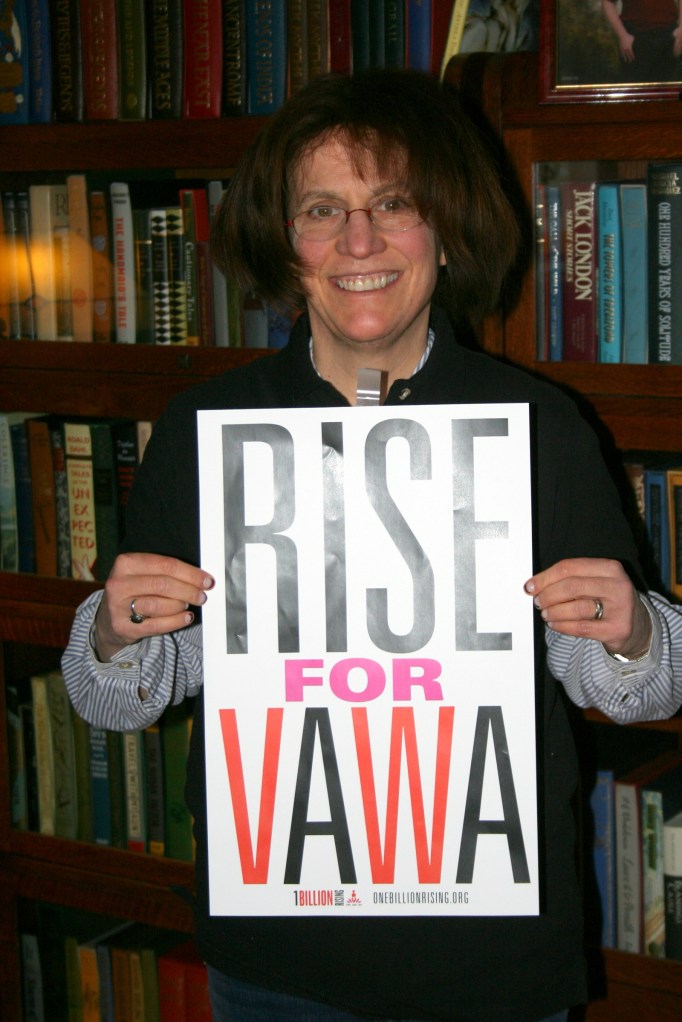
This was my way of celebrating! Yippee!

Update on the Status of VAWA in the US House of Representatives

This is an update from my friend Pat Reuss who wrote yesterday’s blog on the House version of the Violence Against Women Act (VAWA):

Dear Friends,

There has been an important and TIME SENSITIVE development with VAWA.

  • On WEDNESDAY, February 27th, the House will vote on a rule to proceed with consideration of VAWA.  We want them to vote YES on the Rule because that rule allows a vote on the Senate VAWA if the substitute is defeated.
  • On THURSDAY, February 28th, the vote on the actual bill will occur.  We want them to vote NO on the House substitute bill, which will come up first,  and YES on the ensuing Senate version of VAWA.

Your Congress Members are listening to you!  We only have a few hours to act so please call today and tomorrow morning. Members must hear loud and clear that they need to defeat the substitute and pass the bipartisan Senate version of VAWA!  Your work has gotten us this far – let’s get this done!

URGENT ACTION ITEM: 

To reach your Congress Member, call the Capitol switchboard at (202) 224-3121 or look them up here http://www.house.gov/representatives/.   When you’re connected to their offices, ask to speak to the staff person who handles VAWA.

MESSAGE: 

I am a constituent from (city and state) and my name is _________.  I’m calling about the Violence Against Women Act (VAWA).  I urge Congress Member ________ to vote NO on the House substitute bill and then vote YES on the bipartisan Senate version of S. 47.  VAWA can and must protect all victims.

Tweet to your Congress Member:

@[congress person’s handle]: On 2/28 vote NO on the House substitute bill and then vote YES on the bipartisan Senate version of S. 47. #VAWA

Institutional Corruption and the Influence of Money and Politics on People’s Lives

Fountain Pen and SignThis morning, I was scanning Tweets that came into my Twitter account. One of the Tweets said,

“Why the phrase ‘Supreme Court to hear campaign-finance case’ should scare you.”

It contained a link to an article in the Daily Beast. This article said that the US Supreme Court has decided to take another look at campaign financing in a case from the United States District Court in DC called McCutcheon v. Federal Election Commission. I read the article.

And yes this case scares me. McCutcheon argues that there should be no limits at all on campaign financing.  It scares me because I believe that if the Supreme Court rules in favor of McCutchen, there will be more influence and therefore more institutional corruption on our public policy.  This will then allow the creation of more holes in the safety net for people’s lives due to the corrupting influence of big money. For clarification, institutional corruption is defined as:

[T]he consequence of an influence within an economy of influence that illegitimately weakens the effectiveness of an institution especially by weakening the public trust of the institution.

Why? Because I do not trust the members of the current Supreme Court to openly and fairly take into account that elected officials need to answer to their constituents and not to the people and companies and lobbyists that influence them by throwing lots of money and offering consulting jobs to these elected officials (a form of “money”) once they leave office.

My mistrust results from their decision in the 2009 Citizens’ United case.  They held that the First Amendment to the US Constitution prohibits the government from restricting independent political campaign expenditures from corporations and unions.  The aftermath of this decision has been devastating. Immediately after this decision, the DC Circuit Court (which handles cases involving federal regulations) ruled that

“individuals could make unlimited contributions to so-called Super PACs, which supported individual candidates.”

And what did we see?  In the 2010 elections, Super PACs—mostly funded by the mega-rich—assisted conservative Tea Party candidates at all levels of government to win seats that they would not have otherwise been able to win.  This resulted in a lot of gerrymandering around the country for the incumbents’ self-interest.  And in 2012, $6.2 billion was spent on elections; over $10 million of these funds were given to a small number of Super Pacs by a very small number of mega-wealthy individuals—including the Koch brothers—to influence the outcome of the elections.

If this case overturns what few limits on campaign financing are left, the doors for institutional corruption will be thrown wide open.  Candidates will spend even more time chasing money, mostly soliciting funds from large, non-constituent individuals and corporations.  Most of these individuals are heads of corporations whose special interest is their bottom-line profits and not the interests of the “47%.”

Fred Wertheimer is President of Democracy 21. It is a non-partisan group that works to eliminate the undue influence of big money in the public arena.  He agrees with me that big money corrupts our public institutions. In a press statement on February 19, he said that the

“[A]ggregate limit on contributions by individuals is necessary to prevent circumvention of the limits on contributions to candidates and political parties and the prohibition on federal officeholders soliciting huge corrupting contributions.”

And further, if the Supreme Court either completely guts or weakens campaign financing, this decision

“…would open the door to $1 million and $2 million dollar contributions from an individual buying corrupting influence with a powerful officeholder soliciting these contributions, and with the political party and federal candidates benefiting from these seven figure contributions.”

I believe that it is the local constituent who should be influencing their representatives.  Not corporations. Not big money. And not the 1% at the top of the income ladder who do not live or experience the lives of the people who live in each of our communities.

I am one of the 85% of Americans who view Congress unfavorably because of what they have NOT been doing for people’s lives. Like allowing funds for critical domestic programs to be cut due to the budgetary stalling and delays of the Fiscal Cliff and Hurricane Sandy debates and resulting Sequestration that now looks like it will become reality this coming Friday. Like delaying passage of the Violence Against Women Act (VAWA) from being reauthorized for over two years (which, may change tomorrow when and if the House FINALLY votes on the Senate-passed VAWA Act of 2013).  Like talking about but not taking any comprehensive action, so far, to deal with violence and gun safety (for more information on this gun safety issue, read my blogs here and here).

No, I don’t trust the US Supreme Court.  And no, I do not trust Congress. All because of the influence of money on the decisions the do and do not make.

Institutional Corruption is a problem.  We need to reduce that corruption.  We need to empower the small donors.  New York City, as well as Los Angeles and San Francisco have done this.  And in a plan put together by Brennan Center for Justice at New York University School of Law and Democracy 21, we could do the same thing as well across the country. Look at the plan and then lobby your legislator, even if you don’t trust him or her. Vote for candidates in the future who pledge to listen to their constituents and not to big money.

This will take a long time.  But it is necessary. Then and only then do I believe that we can and will be able to trust our elected officials to truly represent us and our concerns.

For More Information on Institutional Corruption

For more information, watch the video below. In this 2009 presentation, Lawrence Lessig defines institutional corruption.  He then discusses the probable effects of this undue influence of money (broadly defined) not only on elected officials but its effect on other institutions, such as the EPA and medical research.

House Republicans Introduce Partisan VAWA that Fails to Protect ALL Victims

NOW Board Supporting VAWA 2-24-13 editedToday, I am presenting a guest blog by my dear friend and colleague Pat Reuss. Pat describes herself as “a longtime women’s rights activist pretending to be retired and currently serving as a policy adviser to NOW [National Organization for Women] and the National Task Force [to End Sexual and Domestic Violence Against Women].”

Pat has a history several decades-long advocating for a comprehensive Violence Against Women Act (VAWA). She first started working on this issue in the early 1990’s.  At that time, she worked as the policy director for what was then called the NOW Legal Defense and Education Fund (now known as Legal Momentum).  In that capacity, she worked very closely with then Senator, now Vice-President Joe Biden to write the first VAWA passed by Congress and signed into law in 1994.

This is Pat’s statement calling on anti-violence advocates to contact their representative in the US House of Representatives to vote for the comprehensive Senate-passed version to reauthorize VAWA:

The Republican’s version of VAWA, which substitutes the Senate’s inclusive, comprehensive version of S.47 for a bill that excludes effective protections for LGBT, immigrant, tribal and campus victims, will likely be on the House floor this Thursday.  The National Task Force [to End Sexual and Domestic Violence Against Women] (NTF) and NOW oppose this [House substitute] bill.  We need to call our Representatives and firmly ask them to vote against the House Republican Leader’s substitute VAWA and ask them to vote for the field-approved VAWA passed in the Senate.

Tomorrow [February 27], Representatives Issa (R-CA) and Cole (R-OK) will ask the Rules committee to allow them to offer an amendment to replace the House’s flawed tribal provisions with improved language that will provide effective, constitutionally sound protections for Native victims of domestic violence. Call your Representatives and ask them to tell House leadership to accept these amendments.

78 Senators from both parties and over 1,300 local, state and national professional and policy organizations support the Senate-passed bill as do law enforcement officials, health care professionals, community program and service providers, and the tens of millions of survivors and their families, friends and loved ones who rely on and have benefited from and used the services and resources provided by the 19-year-old law.

It must be noted that after months of tireless efforts by advocates working with the Republican leadership staff, there are some small but very important improvements in this substitute and the bill is not the punitive version of last year’s House bill. 

That said, the [House] Republican version of the bill  fails victims in a number of critical ways:

  • Fails to include the LGBT provisions from the Senate bill. 
  • Fails to include “stalking” among the list of crimes covered by the U visa (a critical law enforcement tool that encourages immigrant victims to assist with the investigation or prosecution of certain enumerated crimes); current law already includes domestic violence and sexual assault, among others, and the Senate bill’s inclusion of “stalking” recognizes the serious threat this crime poses to safety.
  • Provides non-tribal batterers with additional tools to manipulate the justice system, takes away existing protections for Native women by limiting existing tribal power to issue civil orders of protection against non-Native abusers, while weakening protections for Native women.
  • Contains harsh administrative penalties and hurdles for small struggling programs and an additional layer of bureaucracy through the office of the Attorney General.
  • Drops important provisions in the Senate bill that deal with improving campus safety and that work toward erasing the rape kit backlog.
  • Weakens protections for victims in public housing.

We must oppose this partisan substitute and pass the Senate version of VAWA.  201 Democrats are sponsors of H.R. 11, the House replica of the Senate bill as introduced. 19 Republican Representatives have asked the House Republican leaders to pass a bipartisan bill that “reaches all victims” and dozens more Republicans support some or all of the Senate provisions that are not included in the Republican VAWA imposter.

BIPARTISAN ACTION ITEM: Call your Democratic House members to ensure that they will oppose the Republican leadership’s substitute and support the “real” S. 47, the Senate passed bill.

Find out if your Republican Representative is one of the 19 who supports a bipartisan, inclusive VAWA and ask them step up and to oppose the Republican leader’s substitute and demand and support a vote on the Senate bill:

  1. Call or email the 19 (Poe R-TX and Ros-Lehtinen R-FL have added their names) who signed the letter to House leadership. See letter and signatories here. Names and contact information here.
  2. Call or email the 7 Members who voted against last years’ harmful, non-inclusive Republican VAWA.
  3. Call or write the 26 House members who have interest in one or some of the Senate’s inclusive provisions.

Update Wednesday evening February 26:

Thanks to your calls and emails and tweets (or however you interacted with your US Rep,), it looks like our push-back to stop the watered-down version of VAWA is starting to work.

A Politico.com report at 6:48 this evening (February 26) states that “House Republicans seem to be resigned that their version of the Violence Against Women Act is a loser with their own members and are likely to pass the Senate bill this week without changes.”

Let’s keep up the pressure. Call your Representative tomorrow and tell him/her to vote for the original Senate version of S.47.

This blog today by Erin Matson focuses, like my blog today, on pay equity and the Paycheck Fairness Act.  These are just some of the several issues we are both passionate about. In addition to providing another perspective on paycheck fairness, she also goes into some detail about introducing yourself to and talking to members of Congress. As this is part of my recommendations in the blog I just wrote and posted, I decided to reblog her so that you have more information to help successfully advocate for pay equity and civil rights for all.

erintothemax's avatarErin Matson

This is the first in what will be a regular series, Your Activism Guide, designed to make feminist activism more accessible and help you take the power you deserve. 

Purpose: Introduce yourself to your members of Congress.

Process: Set up meetings now to drop by local offices (even if you don’t have a specific request, even if the legislator tends to vote against your interests).

Payoff: Existing relationships can bring the most unexpected of benefits.

A few days ago, the American Association of University Women and National Women’s Law Center hosted a Tweet Chat to commemorate the fourth anniversary of the Lilly Ledbetter Fair Pay Act, which reversed a Supreme Court decision that had effectively gutted the ability to sue for wage discrimination under Title VII of the Civil Rights Act. Joining the conversation to answer questions was Lilly Ledbetter herself.

This is a topic that gets me all hot…

View original post 1,246 more words