Powerful UN CSW57 Document on Ending Gender-Based Violence Created

On March 14, I wrote a blog entitled “The “Unholy Alliance” that May Defeat Comprehensive UN Call to End Gender-Based Violence.” I talked about an alliance between the Vatican, Iran, Russia and a couple of other countries that were attempting to eviscerate the comprehensive plan being created at the 57th session of the United Nations Commission on the Status of Women (CSW57) to end gender-based violence and fully comply with all of the universally agreed-upon agreements (treaties, resolutions, and statements). These previous agreements include the Women’s Rights Treaty (commonly known as CEDAW or the Convention on the Elimination of Discrimination Against Women (1993)) as well as the Beijing Platform for Action (1995), and UN Security Council Resolution 1325 (2000).

I am happy to say that this didn’t happen.  Thanks to the bloggers, news media, Tweeters, NGO’s attending CSW57, and several official Member States, the amendments to the document were voted down on Friday during the final day of the 2-week convention.

Iran was the only country that voted against the final, comprehensive document. The Vatican did not get to vote because of its status as a “Permanent Observer State” rather than as a voting “Member State”. And Russia backed down and voted for the final document along with all of the remaining UN Member States.

People around the world heard about these attempts to deny women and girls safety from all forms of violence.  We spoke out and acted.

As a result, unlike last year, we FINALLY have a strong document that

“condemns in the strongest terms the pervasive violence against women and girls, and calls for increased attention and accelerated action for prevention and response.” (Source)

This document has a strong prevention focus since the best way to end violence against women and children is to stop it BEFORE it happens.  It also addresses inequalities in the political, economic, and social spheres that engender violence. And it takes action to provide services and justice for victims of violence around the world.

Ms. Michelle Bachelet, United Nations Under-Secretary-General and Executive Director of UN Women summarized the comprehensive coverage of this powerful statement to end this type of human rights violation in her closing statement of the conference:

During the past two weeks, discussions centred on matters of urgency to people around the world — eliminating all forms of violence against women and girls, ending impunity for perpetrators, fully engaging men and boys, and advancing women’s empowerment and gender equality to prevent and end these human rights violations….

Important and timely matters were addressed — ending child and early forced marriage, protecting the rights of persons with disabilities, and providing justice and critical services for survivors of violence.

There were debates on ending sexual violence in conflict, tackling human trafficking, protecting sexual and reproductive rights, and on the role of culture, religion and the family.

You had many intense late-night negotiations, going over every single word and paragraph, debating long and hard in order to come to [this] strong agreement.

UN Secretary-General Ban Ki-moon, immediately after CSW57, released a statement showing the commitment of the United Nations to fully implement this new document. It says, in part:

Violence against women is a heinous human rights violation, global menace, a public health threat and a moral outrage.  No matter where she lives, no matter what her culture, no matter what her society, every woman and girl is entitled to live free of fear.  She has the universal human right to be free from all forms of violence so as to fulfill her full potential and dreams for the future.

States have a corresponding responsibility to turn that right into reality.  The Secretary-General hopes that all the partners who came together at this historic session and others around the world will now translate this agreement into concrete action to prevent and end violence against women and girls.  The United Nations system is fully committed to leading this global effort.

So now I say, THANK YOU! Thank you for creating this statement. It is one more step  towards realizing the rights, dignity, and humanity of girls and women throughout the world.

Picture of Joanne Tosti-Vasey standing with sign that says "I AM Ending Violence"

Joanne Tosti-Vasey “Refusing to be Silent” and calling for an end to gender-based violence

The “Unholy Alliance” that May Defeat Comprehensive UN Call to End Gender-Based Violence

Last week, on International Women’s Day (March 8), I participated in the 24-hour Global Tweet-a-Thon to end gender-based violence.  This event was held in conjunction with the 57th session of the United Nations Commission on the Status of Women (CSW57) that is being held in New York City.  The theme of this year’s session is the “Elimination and prevention of all forms of violence against women and girls.”

I participated as a host for one hour of this event to facilitate the global conversation between people around the world and those attending the unofficial Non-Governmental Organization (NGO) programs at the UN as well as to send a message to the official UN delegation. Our message was that advocates around the world are looking for a strong draft statement calling for the full elimination and prevention of all forms of violence against women and girls as directed by the theme of this two-week conference.

Here are a few of the many tweets I sent out that either addresses the situation of violence in countries around the world OR that calls on governments, including the UN, to create best practices to end gender-based violence:

@JoeBiden “40% of all mass shootings started with the murderer targeting their girlfriend, or their wife, or their ex-wife.” #EndVAW #CSW57 #IWD2013

The first sexual experience for 24% of women in rural Peru was forced. #EndVAW #CSW57 #IWD2013

In Latin America & the Caribbean, abused women reported higher incidents of miscarriage and induced abortion. #EndVAW #CSW57 #IWD2013 (Source)

In South Africa, women who were abused by their partners are 48% more likely to be infected with HIV than those who were not. #EndVAW #CSW57 #IWD2013

To #EndVAW, governments must enact legislation that addresses violence based on sexual orientation and gender identity. #CSW57 #IWD2013

To #EndVAW governments must fully fund health services for survivors of violence, including #HIV screening & emergency contraception. #CSW57 #IWD2013

To #EndVAW, governments must ensure girls and women have access to abortion in cases of rape and incest. #CSW57 #IWD2013

Providing young people with human rights-based, comprehensive sexual and reproductive health services and information helps #EndVAW. #CSW57 #IWD2013

Respecting, protecting, and fulfilling girls’ and women’s sexual rights can minimize the violence they face. #EndVAW #CSW57 #IWD2013

Promoting girls’ and women’s sexual rights is a key tool to #EndVAW, address women’s inequality, and achieve sustainable development. #CSW57 #IWD2013

Domestic laws to #EndVAW should align with international best practice and reinforce the protections found in #humanrights treaties. #CSW57 #IWD2013

And

There is no country where women and men are equal in all spheres of life. You have the power to can change that! #EndVAW #CSW57 #IWD2013

That last tweet is a call for individuals, organizations, countries, and the United Nations to pull together to create and execute a comprehensive plan to end gender-based violence and fully comply with all of the universally agreed-upon agreements (treaties, resolutions, and statements), including the Women’s Rights Treaty (commonly known as CEDAW or the Convention on the Elimination of Discrimination Against Women (1993)) as well as the Beijing Platform for Action (1995), and UN Security Council Resolution 1325 (2000)

I had hoped the draft document that is supposed to be finalized and signed on March 15 – the final day of the two-week deliberation – would help strengthen these treaties.  Instead on Tuesday, March 12, 2013, I received an email from two NGOs – the Center for Women’s Global Leadership (CWGL) at Rutger’s University and International Women’s Rights Action Watch Asia Pacific (IWRAW Asia Pacific)—indicating that

“the United Nations Commission on the Status of Women (CSW) is wavering in its commitment to advance women’s human rights as demonstrated in the constant negotiation of the language in the outcome document.”

The next morning, I saw a New York Times editorial called “Unholy Alliance.”  This article clearly lays out what was going on in the official deliberations.  Apparently, the Vatican (which, btw, is a “Permanent Observer,” not a “Member State”), Iran, Russia, and a few other Member States have spent the their entire time at CSW57 trying to eliminate language in the draft communiqué to “duck” their obligations – and thus the obligations agreed to by most of the world – to eliminate all gender-based violence.

Their excuses?  Religion. Custom. Tradition.

What are they objecting to specifically?  Any reference to abortions or contraception.  Any mention of reproductive or sexual health. Any reference to forced sex as rape by either a spouse or other intimate partner.  And even any reference to women’s rights in general from the aforementioned international agreements; in this case, they claim that either religious or cultural traditions must take precedence over ending any form of gender-based violence.

These “reservations,” by the way, are the same reservations raised by essentially the same countries at the 56th session of the CSW conference in 2012.  As a result, that session ended without any agreement and women, once again, were left without a comprehensive UN plan to help improve their lives.

I am appalled. Gender-based violence is a crime against humanity.  Whether that crime is perpetrated by a government (for example, when military units carry out gang rapes and other gender-based war crimes for ethnic intimidation, ethnic cleansing and terrorizing a community).  Or when that crime of violence is perpetrated by individuals.

After learning all of this, I contacted the National Organization for Women (NOW) chapters in Pennsylvania.  Within 24 hours, Pennsylvania NOW along with South Hills NOW (Pittsburgh area), East End NOW (part of Allegheny County just east of Pittsburgh), Northeast Williamsport NOW, Ni-Ta-Nee NOW (my chapter here in Centre County), and Montgomery County NOW all co-signed the letter created by CWGL and IWRAW Asia Pacific.

This letter was signed by 281 organizations from 57 countries and 129 people from around the world and delivered to the conference on March 14.  FYI, since some of the organizations do not include the country of origin in their names, there may be — and probably are — more than 57 countries represented on this letter.

Here’s the letter that we signed.

IWD Statement on Concerns of Women’s Organizations Over Negotiations on CSW 57 Outcome Document 3-14-13

I along with all of these organizations and individuals want to see a comprehensive UN program to end violence against women and girls.  We want to strong enforcement of all international agreements.

Patriarchy has no right to quash human rights.  Let’s hope that the official delegates hear our voice and stop this “unholy alliance.” If allowed, the result will be more, not less gender-based violence.

If not, then I believe that like last year there should be no UN document signed by the United States or any other Member State participating in the 57th CSW conference.  Going forward with a strong plan to end all forms of violence is the best plan.  Going backwards is appalling and should not be condoned.  Better nothing than something that moves us backwards.

Let’s just hope they hear our voice and “do the right thing.”

We Did It! White House ERA Petition Receives Over 25,000 Signatures

Between 1:30 and 1:54 pm EST today the Equal Rights Amendment (ERA) ratification petition received the required minimum 25,000 signatures that triggers a response from the White House. This means that White House staff will review it, send it to the appropriate policy experts, and issue an official response in the very near future.

Luanne J. Smith, one of the organizers for the petition drive, sent out this congratulations announcement as soon as we passed the 25,000 mark:

Yes!!!! We have passed the 25,000-signature mark, and with 3 1/2 days to spare!!!! Congratulations to Tammy Simkins, who initiated the petition and coordinated the petition drive, and to the entire team of ERA supporters who have worked so hard to see us reach this milestone!!! If you haven’t already joined the team by signing and sharing the petition, please do so NOW! Let’s get the Equal Rights Amendment moving forward! ERA NOW!!!

And here’s a screen shot at 1:54 pm EST today, February 6, 2013 showing 34 signatures over the 25,000 signature threshold.

Screenshot of "We the People" website showing more 25,034 signatures on ERA petition.

Screenshot of “We the People” website showing more than 25,000 signatures on ERA petition.

Signature number 25,000 was from Knoxville, TN.  Which by the way is rather neat.  It was Tennessee’s ratification of 19th amendment on August 24 1920 that gave women the right to vote. And that ratification vote was by a majority of one vote. So having signature 25,000 come from someone from Tennessee is appropriate.

The ERA petition to the White House will remain open for signing until 11:59 pm EST February 9, 2013.  Please add your name to the groundswell for this historic petition. For more information on the petition, check out my earlier blogs here and here.

Congratulations everyone for all your hard work!

Paycheck Fairness Act and the ERA

Yesterday, a reporter from the local newspaper contacted me regarding a press conference that was held by Senator Robert Casey, Jr. (D-PA). During that press conference, Senator Casey discussed a report highlighting the fact that women in Pennsylvania earn 18.3 percent less than their male peers.

This earning differential is known as the Pay or Wage Gap.  The commonly used measure to determine the wage gap is the ratio of women’s to men’s median annual earnings for full-time, full-year workers.  Nationally, in 2011, women earned just 77 percent of what men earned.  That’s a national wage gap of 23 percent.  Although Pennsylvania appears to be doing better than the nation on pay equity, we are still being short-changed.

For women of color, the wage gap is even worse.  According to the Institute for Women’s Policy Research, Asian American women have the smallest wage gap, earning 91 percent of what the average white man earned in 2010. White women are next, earning approximately 81 percent of white men’s average income. African-American women (70 percent) and Hispanic women (60 percent) have the largest wage gaps as compared to white men.

So why did Jessica VanderKolk call me for a comment about Senator Casey’s press conference? The message she left on the phone was that she was interested in what I thought of Casey’s stance on pay inequity, partly as a follow-up to an article she did on this issue in May 2012, where I was also quoted.  She wanted to know why I thought there had been almost no change in wage gap in the last year and what I thought needed to happen in order to eliminate this problem.

My first statement to her was that pay inequity is unfair and unjust.  She quoted me in the news article this morning,

“It takes just as much to feed a woman’s family as a man’s family and put a roof over your head,” Tosti-Vasey said. “Gender should have no basis [in determining] your salary.”

We then went on to discuss the main point of Senator Casey’s press conference: his support and co-sponsorship of the Paycheck Fairness Act.  This bill was introduced again for the fourth time on January 23, 2013 (Casey signed on as a co-sponsor on January 30, 2013 right after announcing his support of S.R. 84).

The Paycheck Fairness Act updates and strengthens the Equal Pay Act of 1963. It gives women the tools they need to challenge the wage gap itself.  According to the ACLU, both S.R. 84 and H.R. 377 include the following remedies and programs to help remove pay inequity:

  • Require employers to demonstrate that wage differentials between men and women holding the same position and doing the same work stem from factors other than sex.
  • Prohibit retaliation against workers who inquire about their employers’ wage practices or disclose their own wages.
  • Permit reasonable comparisons between employees within clearly defined geographical areas to determine fair wages.
  • Strengthen penalties for equal pay violations. The bill’s measured approach levels the playing field by ensuring that women can obtain the same remedies as those subject to discrimination on the basis of race or national origin.
  • Encourage proactive enforcement of equal pay laws by re-instating the collection of wage-related data and providing for training for the workers who enforce our equal pay laws.
  • Modernize the Equal Pay Act to make it more in line with the class action procedures available under Title VII. It would not extend class action protections beyond what is available under other anti-discrimination laws.
  • provide important safeguards for businesses, including:
    • providing an exemption for small businesses;
    • instituting a six months waiting period from the time of enactment and requiring the Department of Labor to assist small businesses with compliance; and
    • Recognizing employers for excellence in their pay practices and strengthening federal outreach and assistance to all businesses to help improve equal pay practices.

Yet if people in general understand that paying someone less for doing the same job is unfair, why is this bill now in its fourth iteration? I was asked this question by Jessica Vandervolk during our phone call.  She paraphrased my comment, stating that Senator Casey and I agree on this issue:

[Tosti-Vasey] said the lack of action so far may have to do with the conservative climate, and Casey added that he hopes the 2012 election makes a difference.

The paraphrase is accurate, but somewhat incomplete.  I said that I believed that the lack of passage was mostly due to conservative legislators.  I continued by stating that this is particularly true in the US House of Representatives but also occurs among conservatives in the US Senate.  Why?  Just follow the campaign money.  These legislators listen to lobbyists and business honchos who want full control over how much they pay others. If employers can get away with paying less and discriminating against one segment of their workforce, then they will lobby and work to defeat any effort to change this scenario.  When elected officials’ campaign war-chests depend upon funds from uncaring, well-financed business owners and lobbyists, they vote no.

So I agree with Casey.  We have a slightly more caring House and Senate as a result of the November election and maybe we can get the Paycheck Fairness Act to become law during this session of Congress.  As constituents, let all of your legislators–both Senators and your US Representative—know that you want them to cosponsor (if they are not already a sponsor) and vote for the Paycheck Fairness Act as soon as possible.

You can find out where your representatives stand on the Paycheck Fairness Act by going to http://thomas.loc.gov/home/thomas.php. In the search box in the middle of the page, type in “Paycheck Fairness Act” and click search.  On the next page, 2 bills will show up—SR 84 and HR 377.  If you then click on “cosponsors” for each bill, you can determine if your representatives are publicly supporting the bill or not.

Meanwhile this might never have come up as an issue to fight in Congress OVER and OVER and OVER again if the Equal Rights Amendment (ERA) had been ratified by 38 states and was now part of the US Constitution.  I recently blogged about why having an ERA is important, so check that out as well.  Once you have done that, go to the White House petition site and tell President Obama that you want him to work with Congress to finally get the ERA ratified.

President Barack Obama’s Inauguration Speech: Standing for Equality

This morning, on the holiday celebration of Martin Luther King’s birthday, President Barack Obama was publicly sworn into office for his second term as President of the United States.  His inaugural speech was 2,095 words long. It covered many different issues from the role of government to freedom, poverty, the military, education, international interactions, and climate change.

Its over-arching message to me is that as a country and as individuals, we need come together to stand up for equality for all.

President John F. Kennedy, Jr. said something similar in his 1961 inaugural speech when he asked all Americans to help each other. He said then, “And so, my fellow Americans: ask not what your country can do for you—ask what you can do for your country.”

Martin Luther King expressed similar sentiments in his “I Have a Dream Speech” in 1963:

I have a dream that one day this nation will rise up and live out the true meaning of its creed: ‘We hold these truths to be self-evident, that all men are created equal.’

I have a dream that one day on the red hills of Georgia, the sons of former slaves and the sons of former slave owners will be able to sit down together at the table of brotherhood. I have a dream that one day even the state of Mississippi, a state sweltering with the heat of injustice, sweltering with the heat of oppression, will be transformed into an oasis of freedom and justice. I have a dream that my four little children will one day live in a nation where they will not be judged by the color of their skin but by the content of their character….I have a dream that one day, down in Alabama, with its vicious racists, with its governor having his lips dripping with the words of ‘interposition’ and ‘nullification’ — one day right there in Alabama little black boys and black girls will be able to join hands with little white boys and white girls as sisters and brothers….I have a dream that one day every valley shall be exalted, and every hill and mountain shall be made low, the rough places will be made plain, and the crooked places will be made straight; ‘and the glory of the Lord shall be revealed and all flesh shall see it together.’

I hope that Barack Obama’s words resonate as well. In that vein, here is how I think he best spoke about equality for all. Maybe part of this will become part of the lexicon of great Presidential speeches in the future.

We, the people, declare today that the most evident of truths – that all of us are created equal – is the star that guides us still; just as it guided our forebears through Seneca Falls, and Selma, and Stonewall; just as it guided all those men and women, sung and unsung, who left footprints along this great Mall, to hear a preacher say that we cannot walk alone; to hear a King proclaim that our individual freedom is inextricably bound to the freedom of every soul on Earth.

It is now our generation’s task to carry on what those pioneers began. For our journey is not complete until our wives, our mothers, and daughters can earn a living equal to their efforts. Our journey is not complete until our gay brothers and sisters are treated like anyone else under the law – for if we are truly created equal, then surely the love we commit to one another must be equal as well. Our journey is not complete until no citizen is forced to wait for hours to exercise the right to vote. Our journey is not complete until we find a better way to welcome the striving, hopeful immigrants who still see America as a land of opportunity; until bright young students and engineers are enlisted in our workforce rather than expelled from our country. Our journey is not complete until all our children, from the streets of Detroit to the hills of Appalachia to the quiet lanes of Newtown, know that they are cared for, and cherished, and always safe from harm.

Our journey is not complete until every one is equal, cared for, cherished, and safe from harm.  Thank you for your inspiring words, Mr. President. May all of usfrom you as leader of the US to each of us in our homes and communitieswork together  to create a better, more accepting country and world.

Why We are Pushing for Ratification of the ERA (the Equal Rights Amendment)

Today at noon, President Barack Obama was sworn into office in a private ceremony.  Tomorrow, he will be publicly sworn in for and give his second-term Inaugural speech on the western steps of the US Capitol. He won his second term much to the efforts and votes of women and people of color.

We have come a long way since the 14th Amendment was ratified, ending slavery and adding people of color to full protections under our US Constitution.  Yet after all this time, the women who helped put President Obama into office for his second term do not yet have that same level of protection.

Women worked to end slavery and put men of color on the same constitutional footing as white, land-owning men. It’s now our turn.

I have been working with an amazing online group of women and men dedicated to equality for all. Our current effort is to gain 25,000 signatures on a White House ERA petition by February 10, 2012.  There are now three weeks left before this deadline is reached; so far, we have gathered over one quarter of the necessary signatures required.  When we reach the 25,000 signatures, President Obama’s administration has agreed to respond to our request to

Vigorously support women’s rights by fully engaging in efforts to ratify the 1972 Equal Rights Amendment (ERA).

Many people have asked, “Why this amendment is needed,” or “Isn’t it already part of the US Constitution?”  The bottom-line question being asked, “Why should I sign this in the first place?”

One of my colleagues has put together a well-written, cogent argument to answer these questions and I asked her to submit a guest blog.

Marti J. Sladek graciously agreed.  Ms. Sladek is an attorney in Chicago. She owns “Speaking Up & Speaking Out” through which she speaks, writes and advocates on women’s issues, work, the law and public policy. You can find her on Twitter, Facebook and Linked In. Here’s what she has to say…

Yes, the Equal Rights Amendment is back. No, it is not already the law of the land, although 3/4 of Americans believe it is. A new generation of feminist leaders has joined and breathed new life into the fight to put equality and equal protection for women and girls into the US Constitution. The first version, written in suffragette days and resurrected by the 70s “women’s libbers’, was passed by 2/3 of Congress then fell three states short of the necessary 3/4 for ratification. That is why you see references to the “three-state strategy” in efforts to resurrect the Amendment.

There was very little activity surrounding the effort on this amendment for more than three decades. This raises questions about whether, even if three more states vote for it, the ratification would be valid, because the legislation that began it did not address whether there was a deadline; some say that after such a long dormancy, the issue was DOA. Others, including some formal legal opinions, say if no deadline was part of the law, then the amendment still lives. Note: if you want to refresh your knowledge on how the Constitution gets modified, read Article V.

One way or the other, we have to get it done. Justice Scalia himself underscored the need when he told a legal publication in the fall of 2011 that the 14th Amendment does not protect women as its intent was only racial equality.

Did you know that “gender” was inserted into some civil rights bills in the 60s as a protected class for discrimination purposes primarily in a failed effort to defeat civil rights legislation? So some of the protections we women have are somewhat accidental!

Lately, we have seen serious attacks on gains women have made through legislation such as the Civil Rights Act of 1964–Title VII, employment discrimination; Title IX, discrimination in education at all levels; Title X, gender equity in health care, including reproductive rights–and even laws governing equal pay. Wisconsin rescinded their state Equal Pay Act last year. As we saw during the 2012 campaign season, efforts to limit or gut these and other civil rights laws such as the Voting Rights Act are underway at the state and federal level.

Courts have further eroded the impact of these laws. The Congress is less likely to overturn negative decisions from the Supreme Court than in even the recent past. Some GOP members who used to sponsor ERA have withdrawn support for fear of the Tea Party. New state legislatures could even try to rescind previous ratification of ERA! “Personhood” for embryos and eggs–but of course, not sperm–as well as restrictions on plain vanilla birth control, redefining rape, forced vaginal probes…the list goes on.

The arguments against ERA in the 1970s were speculative then and have been proven silly over the last thirty years. The horror of unisex washrooms? Give me a break: they exist all over the world, both public and in all our homes. Drafting women? No more military draft, and women are serving, yes, even in combat, albeit unofficially. The list goes on. And some bugaboos have been superseded by discrimination cases and the economic reality of women working outside the home. Plus the states that do have equal protection for females in their own constitutions are doing fine, thank you. It will be interesting, entertaining and angering to watch opponents claim, oh so wrongly, that we simply don’t need it.

Why do we need Equal Rights Amendment? Because, as we have seen, state and federal laws can be changed relatively easily. Because the courts do not give as much consideration to gender as they do to race, which is specifically mentioned in the (amended) constitution. When a government body has a policy that tends to treat one race differently than another, there is a high level of scrutiny: they have to have a truly compelling reason to get away with that kind of discrimination, along the lines of legal analysis for violating freedom of speech. Gender only gets “intermediate” scrutiny. Just a pretty good reason for treating women differently suffices. ERA could well change that.

Likewise, that kind of “logic” is reflected in analysis of issues such as sexual harassment, civil cases that generally involve private employers, landlords, etc. When a person is singled out because of race, called names, etc. the cases reflect the presumption that such conduct was unwanted and is inherently offensive (the “N” word for example). In sexual harassment, the victim must meet an initial of burden of proof that the inappropriate behavior (the “B” or even “C” word) is unwelcome and creates a hostile work environment, an extra legal hoop to jump through compared to other kinds of discrimination. The ERA could help change that, too.

So the ERA is NOT “just” symbolic, as important and critical as the symbol is. Think the symbolism is not important? Then think of how we wear religious icons as jewelry, or wave the flag on the Fourth of July. And think of that symbolism as we try to tell emerging democracies to give a fair shake to women. Such hypocrisy when we don’t have equality even on paper here! How do we explain this to them, let alone our own daughters and granddaughters? (I had a tough time trying to explain this in Cuba where women have had legal equality for decades, albeit aligned against cultural machismo; A Cuban legislator advised me, “Keep fighting!”)

The ultimate decision is with the States, generally your state legislatures. Believe it or not, it is buried in committee again if it exists at all in many states and was actually defeated in Arkansas, Florida and Virginia in the last two legislative sessions. The old red herrings about gay agendas, ordaining women as pastors in conservative religions, and, in Virginia, admitting women into the Citadel military academy prevailed. Or simply “too costly” or “not a high priority.” Even in a blue state such as Illinois, it doesn’t get out of committee despite being reintroduced year after year in the General Assembly; ironically, Illinois put gender equality into our new state constitution in 1971 but did not pass the federal one in 1982–go figure!

For those who think all this women’s rights stuff is passé here, think about something that struck me recently. My Mom is still alive, old but going strong, and an active voter in a swing state. (Oh, how we agree to disagree on politics!) Women got to vote in the federal election for the first time in HER lifetime, only one generation back. How far have we really come, baby? I believed back-in-the-day that I would be around long enough to see a woman in the White House, long enough to see the Constitution specifically address my rights. I have waited long enough. Have you?

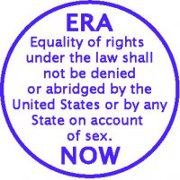
ERA words button

Equality of rights under the law shall not be denied or abridged by the United States or by any State on account of sex.

This is all it says; why such controversy?

So… take a moment, go to http://wh.gov/P6gP, sign in (or create) your White House account, and then sign the petition.  Once done, please spread the word to your friends, colleagues, and family to do the same.

Meeting in New Delhi January 10, 2013 on Preventing Violence against Women

I have received a few emails from a friend in the last couple of weeks following the gang rape and death of the 23-year old female medical student in New Dehli. These emails have been a joint announcement with updates from PUCL-CFD – the People’s Union for Civil Liberties and Citizens for Democracy—about a planning meeting to discuss what needs to be done to prevent rape and other forms of violence against women in New Delhi and throughout India. Here’s the latest update for tomorrow’s first meeting.

Film Show on ‘Rape’ at PUCL-CFD meeting on 10th Jan.2013 and discussion how to prevent violence against women.

Dear friends,
PUCL (Delhi), in association with Citizens For Democracy, has organized a meeting on the subject “How to Prevent Rape and other forms of violence against women” to be held on 10thJanuary, 2013.

A film ‘NOW, I WILL SPEAK’ on RAPE shall be shown in the beginning. ‘Now, I Will Speak’ produced and directed by writer, film-maker and social activist, Sagari Chhabra is a documentary on rape. It deals with rape as a tool of political oppression, used by the police to displace villagers whose village is going under water, in the wake of a dam. It deals with Child rape and custodial rape. The film is a testimony of courage and encourages the survivors to speak out. It has been awarded by the International Association of Women In Radio and Television, and the NIFA ‘Award Of Excellence’ in production and direction. It is 40 minutes long and has a commentary in English with subtitles.
Discussion will follow the film to find out ways and means as how to achieve gender equality and justice for women.

Dr. Gopa Joshi, Shri Sanjay Parikh, Advocate, Ms.Shabnam Hashmi, Dr. Jugal Kishore and Ms. Sagari Chhabra form the panel of speakers. Justice Rajinder Sachhar and Shri Kuldip Nayar shall also contribute.

Programme is as follows:
Time & Date: 2 to 5 PM, Thursday, 10th January, 2013
Venue: Gandhi Peace Foundation, 223, Deen Dayal Upadyay Marg,
New Delhi-110002 (Ph.011-23237491, 23237493)

You are requested to make it convenient to attend.

Satyendra Ranjan
Secretary, CFD
(M) 9811999269

Shivakant
Secretary, PUCL (Delhi)
(M) 9868505324, 9811099532