US Congress passes Violence Against Women Act: Article via AFP

This article was first posted on Thursday, February 28, 2013 2:12:14 PM.  It gives a very good summary of how the Violence Against Women Act passed and why it took so long.

US Congress passes Violence Against Women Act (via AFP)

After months of partisan delay, the US Congress passed the Violence Against Women Act on Thursday, reauthorizing protections from domestic violence and sexual assault for millions of women. The bill — a reauthorization of legislation first enacted in 1994 but which includes new protections — passed…

About AFP: AFP is a global news agency delivering fast, in-depth coverage of the events shaping our world from wars and conflicts to politics, sports, entertainment and the latest breakthroughs in health, science and technology.

Rising in Celebration of the Passage of VAWA

Rising in Celebration of the Passage of VAWA

Today, the US House of Representatives passed the comprehensive Senate version of the Violence Against Women reauthorization Act of 2013 (VAWA) by a vote of 286-138. The Senate passed the same bill on February 12 by a bipartisan vote of 78-22.  President Obama will sign the bill into law in the next couple of days.

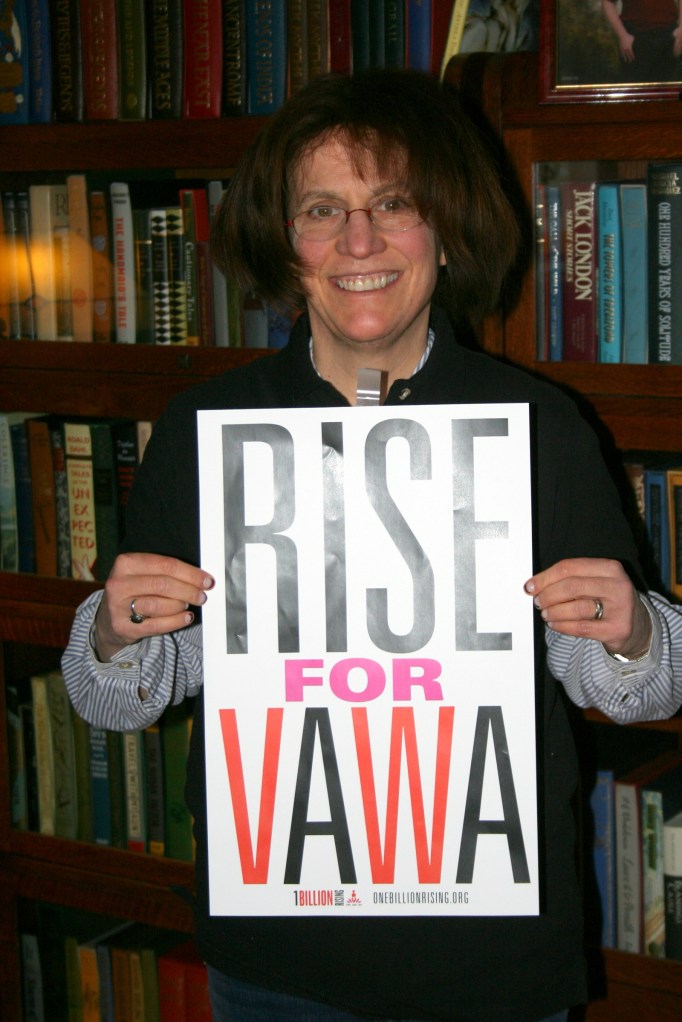
This was my way of celebrating! Yippee!

Update on the Status of VAWA in the US House of Representatives

This is an update from my friend Pat Reuss who wrote yesterday’s blog on the House version of the Violence Against Women Act (VAWA):

Dear Friends,

There has been an important and TIME SENSITIVE development with VAWA.

  • On WEDNESDAY, February 27th, the House will vote on a rule to proceed with consideration of VAWA.  We want them to vote YES on the Rule because that rule allows a vote on the Senate VAWA if the substitute is defeated.
  • On THURSDAY, February 28th, the vote on the actual bill will occur.  We want them to vote NO on the House substitute bill, which will come up first,  and YES on the ensuing Senate version of VAWA.

Your Congress Members are listening to you!  We only have a few hours to act so please call today and tomorrow morning. Members must hear loud and clear that they need to defeat the substitute and pass the bipartisan Senate version of VAWA!  Your work has gotten us this far – let’s get this done!

URGENT ACTION ITEM: 

To reach your Congress Member, call the Capitol switchboard at (202) 224-3121 or look them up here http://www.house.gov/representatives/.   When you’re connected to their offices, ask to speak to the staff person who handles VAWA.

MESSAGE: 

I am a constituent from (city and state) and my name is _________.  I’m calling about the Violence Against Women Act (VAWA).  I urge Congress Member ________ to vote NO on the House substitute bill and then vote YES on the bipartisan Senate version of S. 47.  VAWA can and must protect all victims.

Tweet to your Congress Member:

@[congress person’s handle]: On 2/28 vote NO on the House substitute bill and then vote YES on the bipartisan Senate version of S. 47. #VAWA

House Republicans Introduce Partisan VAWA that Fails to Protect ALL Victims

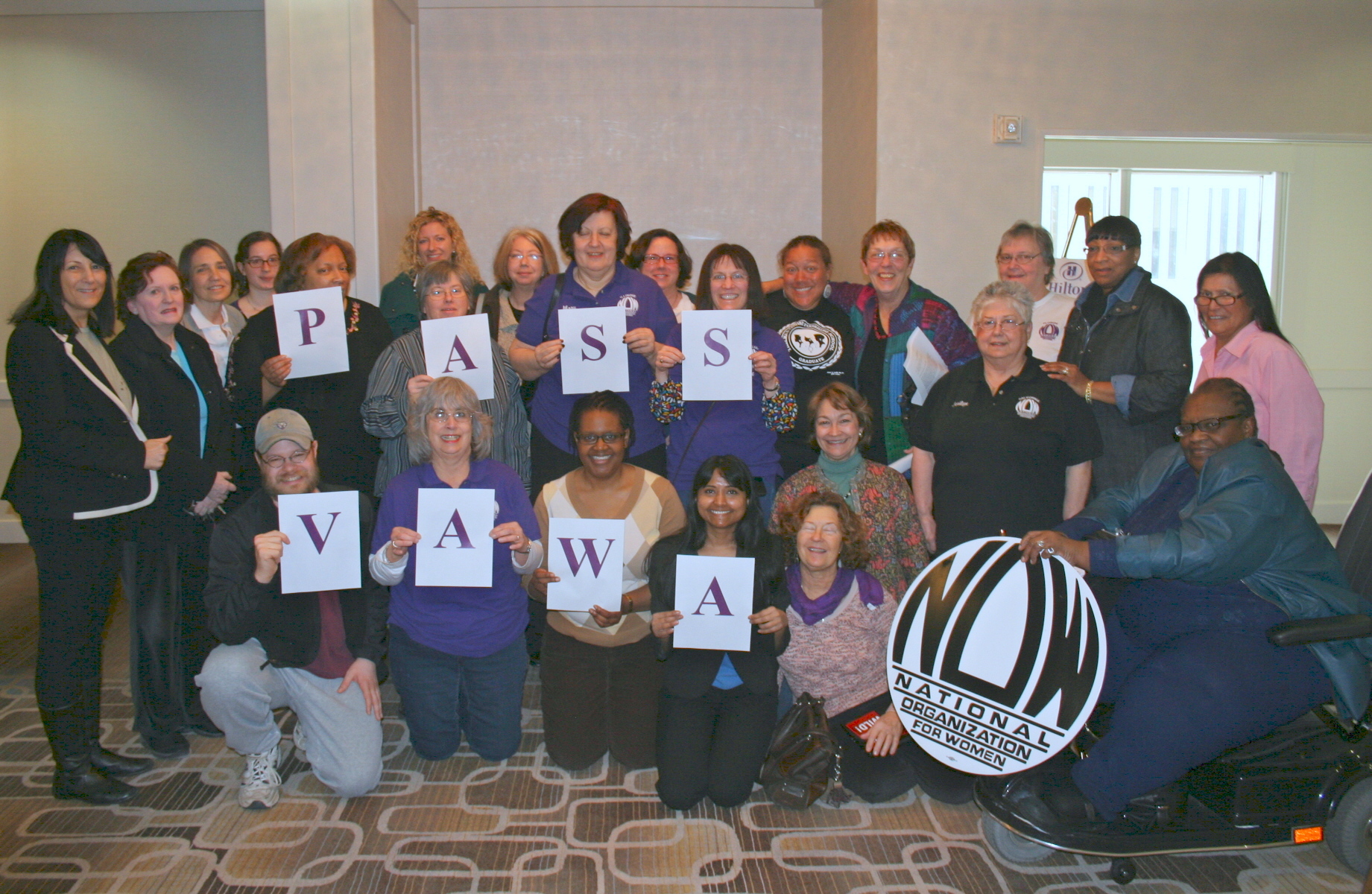
NOW Board Supporting VAWA 2-24-13 editedToday, I am presenting a guest blog by my dear friend and colleague Pat Reuss. Pat describes herself as “a longtime women’s rights activist pretending to be retired and currently serving as a policy adviser to NOW [National Organization for Women] and the National Task Force [to End Sexual and Domestic Violence Against Women].”

Pat has a history several decades-long advocating for a comprehensive Violence Against Women Act (VAWA). She first started working on this issue in the early 1990’s.  At that time, she worked as the policy director for what was then called the NOW Legal Defense and Education Fund (now known as Legal Momentum).  In that capacity, she worked very closely with then Senator, now Vice-President Joe Biden to write the first VAWA passed by Congress and signed into law in 1994.

This is Pat’s statement calling on anti-violence advocates to contact their representative in the US House of Representatives to vote for the comprehensive Senate-passed version to reauthorize VAWA:

The Republican’s version of VAWA, which substitutes the Senate’s inclusive, comprehensive version of S.47 for a bill that excludes effective protections for LGBT, immigrant, tribal and campus victims, will likely be on the House floor this Thursday.  The National Task Force [to End Sexual and Domestic Violence Against Women] (NTF) and NOW oppose this [House substitute] bill.  We need to call our Representatives and firmly ask them to vote against the House Republican Leader’s substitute VAWA and ask them to vote for the field-approved VAWA passed in the Senate.

Tomorrow [February 27], Representatives Issa (R-CA) and Cole (R-OK) will ask the Rules committee to allow them to offer an amendment to replace the House’s flawed tribal provisions with improved language that will provide effective, constitutionally sound protections for Native victims of domestic violence. Call your Representatives and ask them to tell House leadership to accept these amendments.

78 Senators from both parties and over 1,300 local, state and national professional and policy organizations support the Senate-passed bill as do law enforcement officials, health care professionals, community program and service providers, and the tens of millions of survivors and their families, friends and loved ones who rely on and have benefited from and used the services and resources provided by the 19-year-old law.

It must be noted that after months of tireless efforts by advocates working with the Republican leadership staff, there are some small but very important improvements in this substitute and the bill is not the punitive version of last year’s House bill. 

That said, the [House] Republican version of the bill  fails victims in a number of critical ways:

  • Fails to include the LGBT provisions from the Senate bill. 
  • Fails to include “stalking” among the list of crimes covered by the U visa (a critical law enforcement tool that encourages immigrant victims to assist with the investigation or prosecution of certain enumerated crimes); current law already includes domestic violence and sexual assault, among others, and the Senate bill’s inclusion of “stalking” recognizes the serious threat this crime poses to safety.
  • Provides non-tribal batterers with additional tools to manipulate the justice system, takes away existing protections for Native women by limiting existing tribal power to issue civil orders of protection against non-Native abusers, while weakening protections for Native women.
  • Contains harsh administrative penalties and hurdles for small struggling programs and an additional layer of bureaucracy through the office of the Attorney General.
  • Drops important provisions in the Senate bill that deal with improving campus safety and that work toward erasing the rape kit backlog.
  • Weakens protections for victims in public housing.

We must oppose this partisan substitute and pass the Senate version of VAWA.  201 Democrats are sponsors of H.R. 11, the House replica of the Senate bill as introduced. 19 Republican Representatives have asked the House Republican leaders to pass a bipartisan bill that “reaches all victims” and dozens more Republicans support some or all of the Senate provisions that are not included in the Republican VAWA imposter.

BIPARTISAN ACTION ITEM: Call your Democratic House members to ensure that they will oppose the Republican leadership’s substitute and support the “real” S. 47, the Senate passed bill.

Find out if your Republican Representative is one of the 19 who supports a bipartisan, inclusive VAWA and ask them step up and to oppose the Republican leader’s substitute and demand and support a vote on the Senate bill:

  1. Call or email the 19 (Poe R-TX and Ros-Lehtinen R-FL have added their names) who signed the letter to House leadership. See letter and signatories here. Names and contact information here.
  2. Call or email the 7 Members who voted against last years’ harmful, non-inclusive Republican VAWA.
  3. Call or write the 26 House members who have interest in one or some of the Senate’s inclusive provisions.

Update Wednesday evening February 26:

Thanks to your calls and emails and tweets (or however you interacted with your US Rep,), it looks like our push-back to stop the watered-down version of VAWA is starting to work.

A Politico.com report at 6:48 this evening (February 26) states that “House Republicans seem to be resigned that their version of the Violence Against Women Act is a loser with their own members and are likely to pass the Senate bill this week without changes.”

Let’s keep up the pressure. Call your Representative tomorrow and tell him/her to vote for the original Senate version of S.47.

Why I Support Universal Health Care: A Right, Not a Privilege

Congressman John Conyers Jr. (D-MI) has reintroduced his National Health Care plan bill HR 676, “The Expanded and Improved Medicare for All Act.” I strongly support a universal national health care program such as HR 676. I also support any effort by any state to implement a state-based single-payer health care plan. Why?  For many reasons.

My life was threatened by the multi-company, private health insurance system we currently have.

I received a bone marrow transplant in 1989 from my identical twin sister. Although I had no problem finding a match, I had to jump through many hoops and barriers put up by the two health insurance companies covering my sister and myself. In the case of my insurance provider, I was refused coverage of the donor portion of the transplant because my twin sister wasn’t on my health insurance plan. In the case of my twin sister’s insurance provider, they refused to cover her portion of the transplant because she “wasn’t sick.” Then the hospital administration said that they would not perform the transplant until this conflict between the two insurance agencies was resolved with a guarantee of payment by either or both companies. And my doctors said that if the resolution did not occur rapidly, I would be dead within the year due to the seriousness of the form of leukemia that I had.

According to Health Care for America, health insurance companies profit by denying–not by providing–healthcare. Health insurance CEOs of the top 10 health insurance companies today typically enjoy an average of $10,000,000 in annual compensation–salary, bonuses, stock options, etc.

Back to my story. I went into battle mode against the insurance companies when I was told that they would let me die because of their bottom line and attempts to deny coverage. Because of the support and advocacy I had through the organization where I self-purchased my health insurance (the National Organization for Women), we were finally able to get me the life-saving transplant that I needed. And I am here today.

This experience is why I became an advocate for a single-payer health care system rather than the current system that allows private companies the ability to deny critical health care to “save” their bottom line for profit only.

Other Reasons why I support a Universal Health Care Plan at Either the National or State Level.

It is the ethical and moral to treat all people, regardless of economics or status when they are sick.

A 2009 article in the Journal of Public Health reports that approximately 45,000 people on average die each year due to lack of health insurance. One of the goals of The Affordable Care Act (ACA) is to reduce the number of people without health insurance, so that premature deaths from lack of coverage would also be reduced.

People will continue to struggle to receive health care coverage and treatment with both passage of the ACA and the Supreme Court’s decision declaring the ACA as constitutional while allowing states to opt out of the expanded Medicaid program for low-income people.

The Centers for Disease Control acknowledges that access to coverage will improve under the ACA. But that acknowledgement holds a caveat; they state, “Even after ACA is implemented fully, some persons eligible for coverage might go uninsured.” The ACA will not fully resolve this ethical and moral threat to peoples’ lives. 

Some states are threatening people’s health care and lives based on decisions either by their legislature and/or their governors.

These states place people who could have been covered under the Expanded Medicaid program in continued jeopardy since they will neither be able to sign up for Medicaid nor be able to afford private health insurance through the ACA’s health care exchanges. The 13 states that have already threatened the healthcare of their citizens are Alabama, Georgia, Idaho, Louisiana, Maine, Mississippi, North Carolina, South Carolina, South Dakota, Oklahoma, Pennsylvania, Texas, and Wisconsin. Five states – Iowa, Nebraska, New Jersey, Virginia, and Wyoming—are leaning towards opting out of coverage. Kentucky, New York and Oregon haven’t yet made their decision, but do appear to be leaning towards opting into full ACA with the expanded Medicaid coverage. All remaining 22 states plus the District of Columbia have opted into full ACA with the expanded Medicaid coverage.


Where the States Stand

Via: The Advisory Board Company

For the low-income people living in the 18 states that have either opted out of or are considering opting out of the expanded Medicaid coverage, nothing changes for them since most of these individuals will not be able to afford private health insurance in the new health care exchanges under the ACA.

A Single Payer, Universal Healthcare program would cover everyone.

According to predictions by the Congressional Budget Office and the Joint Commission on Taxation, we will we still have 30 million uninsured in 2023 under Obamacare. At the same time, health care costs for our nation, states, and families will continue to increase. A single-payer, universal healthcare program could cover everyone at lower cost. Everyone in and no one out regardless of income or health status.

The BETTER Alternatives: National and State-Based Single-Payer Plans

The plan introduced by Representative Conyers is basically an expansion of the efficient and cost-effective Medicare system currently used by the elderly and people with disabilities. Its overhead (all costs other than for healthcare) is much lower–and patient satisfaction is much higher–than under for-profit healthcare. And it would cover everyone regardless of their economic or health status without fear of an insurance company denying coverage to save their bottom line.

Similarly, legislation is being considered in about half of the states to create state-based single-payer healthcare programs. Some of these states’  legislatures have held hearings and/or had votes on universal healthcare. Vermont has already passed a law that sets in place the possibility of a single-payer healthcare program by 2017. 2017 is the year that the ACA—aka “Obamacare”—allows states to try other healthcare plans IF they cover at least the same number of people with at least the minimum coverage under the ACA.

Obamacare is now the law of the land. It is an improvement over what we had before 2009. It is also the basis from which we can work towards a comprehensive healthcare program. We could do it nationally, such as with HR 676. Or, like Canada, we can start at the state level.

So check out HR 676. See if your Representative is one of the 40 current co-sponsors. If not, meet with him/her, tell your personal story about why you support an expanded and improved Medicare for All, and ask them to co-sponsor the bill. If he/she is already a co-sponsor, ask your Representative to take the next step. They can hold a town-hall meeting on universal healthcare to hear from their constituents. They can also call on the chairs of the three committees reviewing HR 676 to hold Congressional hearings on HR 676. These three committees are the House Energy and Commerce Committee, the House Ways and Means Committee, and the House Natural Resources Committee.

Also get active with your state-based single-payer organization. These local and state-based single-payer health care groups will let you know how can help with your state-based legislation. Healthcare NOW has a full listing of state- and local-based organizations. If your state does not have a single-payer chapter yet, contact Healthcare NOW at their national office in Philadelphia, PA; they can help you to organize a plan for your state.

All other “advanced” nations have already adopted comprehensive healthcare systems. All deliver better health outcomes at a lower per capita cost than the USA. Let’s get cracking. Let’s do it here in the US of A as well.

A Further Comment on Violence Against Women and Children on V-Day

I received a comment on LinkedIn this morning in response to my posting titled VAWA Passes Senate: One Step Toward Ending the Climate of Indifference Towards Violence Against Women.  My status statement said, “Feb 14 is V-Day. Rise to end indifference towards violence against women.”  A man in one of the groups I am a member of responded with a question:

So, please explain how we are being “indifferent” towards violence against women. There are laws against violent attacks on any human being – women included. Are these laws being ignored in cases where a woman is the victim?

I think not.

What we see here is another group who wishes to reap the benefits of victim status whether the facts bear them out or not. Beware of those who believe that they deserve special treatment – especially when that special treatment comes at the expense of others.

His question deserves a response.  Which I gave him within LinkedIn.  Since there are many others how might have a similar question but aren’t on LinkedIn, I’m commenting here as well.

The Violence Against Women Re-Authorization Act (VAWA S.47) does not call for special treatment of anyone. VAWA is calling on fair treatment of ALL victims of violence.

A climate of indifference is a climate where attacks against others – sexual assault, acquaintance or domestic violence, sexual harassment, and stalking– are ignored, covered up, or made light of. And in some instances, the climate of indifference is perpetuated when the alleged perpetrator is treated more lightly than someone else who may have committed the assault simply because of his status or affiliation.

That’s what has partially been happening with the Athletics program at Penn State University since 1994 and which helped lead to the situation of the child sexual assaults done by Jerry Sandusky. That’s part of what is happening in Steubenville, OH in the rape case where perpetrators made a video of themselves and others carrying a teenage girl from one house to another and raping her. That’s what led to the DC police refusing to take a police report last week from a friend of mine after a man exposed himself to her and masturbated because she didn’t stay with the man until the police came!

In addition, VAWA’s re-authorization has been delayed for over two years because some legislators – mostly Republican, including the majority of the US House of Representatives – are indifferent to the violence perpetrated on Native Americans, immigrants, and gays, lesbians, bisexual, and transgendered persons. This “indifference” towards violence against specific people is based solely on the victim’s status, is disparate treatment, and IMO is discriminatory.

Yes there are laws in place. Yet, until all victims are treated fairly and in a timely fashion, I will continue to call out people and communities for creating a climate of indifference that allows this to continue. All people need to live in safe communities and homes.

Ending this climate of indifference wherever it occurs is a start towards caring for our loved ones.  PASS VAWA NOW!

VAWA Passes Senate: One Step Toward Ending the Climate of Indifference Towards Violence Against Women

The climate of indifference that I talked about in my blog on February 10 is pervasive both here in the US and around the world.  Which is why Eve Ensler has called for a worldwide day of action to recognize and end violence against women around the world.  Thursday, February 14, 2014 is V-Day, aka One Billion Rising. V-Day calls for people around the world to Rise, Strike, and Dance to end violence against women.

Today, the US Senate by an overwhelming majority, passed the comprehensive version of the Violence Against Women ReAuthorization Act of 2013 (VAWA, S.47). We all can speak out. We all can rise and call for the end to this indifference by funding this law and allowing the Office on Violence Against Women to fully do their job in collaboration with advocates and service providers throughout the country.

If you haven’t done so already, do so on February 14. You can find your Representatives phone number here. Call him/her on V-Day.  Say that they need to have a heart, they need to have compassion, and they CAN help end this Climate of Indifference by passing and fully funding VAWA.

This blog today by Erin Matson focuses, like my blog today, on pay equity and the Paycheck Fairness Act.  These are just some of the several issues we are both passionate about. In addition to providing another perspective on paycheck fairness, she also goes into some detail about introducing yourself to and talking to members of Congress. As this is part of my recommendations in the blog I just wrote and posted, I decided to reblog her so that you have more information to help successfully advocate for pay equity and civil rights for all.

erintothemax's avatarErin Matson

This is the first in what will be a regular series, Your Activism Guide, designed to make feminist activism more accessible and help you take the power you deserve. 

Purpose: Introduce yourself to your members of Congress.

Process: Set up meetings now to drop by local offices (even if you don’t have a specific request, even if the legislator tends to vote against your interests).

Payoff: Existing relationships can bring the most unexpected of benefits.

A few days ago, the American Association of University Women and National Women’s Law Center hosted a Tweet Chat to commemorate the fourth anniversary of the Lilly Ledbetter Fair Pay Act, which reversed a Supreme Court decision that had effectively gutted the ability to sue for wage discrimination under Title VII of the Civil Rights Act. Joining the conversation to answer questions was Lilly Ledbetter herself.

This is a topic that gets me all hot…

View original post 1,246 more words

Paycheck Fairness Act and the ERA

Yesterday, a reporter from the local newspaper contacted me regarding a press conference that was held by Senator Robert Casey, Jr. (D-PA). During that press conference, Senator Casey discussed a report highlighting the fact that women in Pennsylvania earn 18.3 percent less than their male peers.

This earning differential is known as the Pay or Wage Gap.  The commonly used measure to determine the wage gap is the ratio of women’s to men’s median annual earnings for full-time, full-year workers.  Nationally, in 2011, women earned just 77 percent of what men earned.  That’s a national wage gap of 23 percent.  Although Pennsylvania appears to be doing better than the nation on pay equity, we are still being short-changed.

For women of color, the wage gap is even worse.  According to the Institute for Women’s Policy Research, Asian American women have the smallest wage gap, earning 91 percent of what the average white man earned in 2010. White women are next, earning approximately 81 percent of white men’s average income. African-American women (70 percent) and Hispanic women (60 percent) have the largest wage gaps as compared to white men.

So why did Jessica VanderKolk call me for a comment about Senator Casey’s press conference? The message she left on the phone was that she was interested in what I thought of Casey’s stance on pay inequity, partly as a follow-up to an article she did on this issue in May 2012, where I was also quoted.  She wanted to know why I thought there had been almost no change in wage gap in the last year and what I thought needed to happen in order to eliminate this problem.

My first statement to her was that pay inequity is unfair and unjust.  She quoted me in the news article this morning,

“It takes just as much to feed a woman’s family as a man’s family and put a roof over your head,” Tosti-Vasey said. “Gender should have no basis [in determining] your salary.”

We then went on to discuss the main point of Senator Casey’s press conference: his support and co-sponsorship of the Paycheck Fairness Act.  This bill was introduced again for the fourth time on January 23, 2013 (Casey signed on as a co-sponsor on January 30, 2013 right after announcing his support of S.R. 84).

The Paycheck Fairness Act updates and strengthens the Equal Pay Act of 1963. It gives women the tools they need to challenge the wage gap itself.  According to the ACLU, both S.R. 84 and H.R. 377 include the following remedies and programs to help remove pay inequity:

  • Require employers to demonstrate that wage differentials between men and women holding the same position and doing the same work stem from factors other than sex.
  • Prohibit retaliation against workers who inquire about their employers’ wage practices or disclose their own wages.
  • Permit reasonable comparisons between employees within clearly defined geographical areas to determine fair wages.
  • Strengthen penalties for equal pay violations. The bill’s measured approach levels the playing field by ensuring that women can obtain the same remedies as those subject to discrimination on the basis of race or national origin.
  • Encourage proactive enforcement of equal pay laws by re-instating the collection of wage-related data and providing for training for the workers who enforce our equal pay laws.
  • Modernize the Equal Pay Act to make it more in line with the class action procedures available under Title VII. It would not extend class action protections beyond what is available under other anti-discrimination laws.
  • provide important safeguards for businesses, including:
    • providing an exemption for small businesses;
    • instituting a six months waiting period from the time of enactment and requiring the Department of Labor to assist small businesses with compliance; and
    • Recognizing employers for excellence in their pay practices and strengthening federal outreach and assistance to all businesses to help improve equal pay practices.

Yet if people in general understand that paying someone less for doing the same job is unfair, why is this bill now in its fourth iteration? I was asked this question by Jessica Vandervolk during our phone call.  She paraphrased my comment, stating that Senator Casey and I agree on this issue:

[Tosti-Vasey] said the lack of action so far may have to do with the conservative climate, and Casey added that he hopes the 2012 election makes a difference.

The paraphrase is accurate, but somewhat incomplete.  I said that I believed that the lack of passage was mostly due to conservative legislators.  I continued by stating that this is particularly true in the US House of Representatives but also occurs among conservatives in the US Senate.  Why?  Just follow the campaign money.  These legislators listen to lobbyists and business honchos who want full control over how much they pay others. If employers can get away with paying less and discriminating against one segment of their workforce, then they will lobby and work to defeat any effort to change this scenario.  When elected officials’ campaign war-chests depend upon funds from uncaring, well-financed business owners and lobbyists, they vote no.

So I agree with Casey.  We have a slightly more caring House and Senate as a result of the November election and maybe we can get the Paycheck Fairness Act to become law during this session of Congress.  As constituents, let all of your legislators–both Senators and your US Representative—know that you want them to cosponsor (if they are not already a sponsor) and vote for the Paycheck Fairness Act as soon as possible.

You can find out where your representatives stand on the Paycheck Fairness Act by going to http://thomas.loc.gov/home/thomas.php. In the search box in the middle of the page, type in “Paycheck Fairness Act” and click search.  On the next page, 2 bills will show up—SR 84 and HR 377.  If you then click on “cosponsors” for each bill, you can determine if your representatives are publicly supporting the bill or not.

Meanwhile this might never have come up as an issue to fight in Congress OVER and OVER and OVER again if the Equal Rights Amendment (ERA) had been ratified by 38 states and was now part of the US Constitution.  I recently blogged about why having an ERA is important, so check that out as well.  Once you have done that, go to the White House petition site and tell President Obama that you want him to work with Congress to finally get the ERA ratified.

Why We are Pushing for Ratification of the ERA (the Equal Rights Amendment)

Today at noon, President Barack Obama was sworn into office in a private ceremony.  Tomorrow, he will be publicly sworn in for and give his second-term Inaugural speech on the western steps of the US Capitol. He won his second term much to the efforts and votes of women and people of color.

We have come a long way since the 14th Amendment was ratified, ending slavery and adding people of color to full protections under our US Constitution.  Yet after all this time, the women who helped put President Obama into office for his second term do not yet have that same level of protection.

Women worked to end slavery and put men of color on the same constitutional footing as white, land-owning men. It’s now our turn.

I have been working with an amazing online group of women and men dedicated to equality for all. Our current effort is to gain 25,000 signatures on a White House ERA petition by February 10, 2012.  There are now three weeks left before this deadline is reached; so far, we have gathered over one quarter of the necessary signatures required.  When we reach the 25,000 signatures, President Obama’s administration has agreed to respond to our request to

Vigorously support women’s rights by fully engaging in efforts to ratify the 1972 Equal Rights Amendment (ERA).

Many people have asked, “Why this amendment is needed,” or “Isn’t it already part of the US Constitution?”  The bottom-line question being asked, “Why should I sign this in the first place?”

One of my colleagues has put together a well-written, cogent argument to answer these questions and I asked her to submit a guest blog.

Marti J. Sladek graciously agreed.  Ms. Sladek is an attorney in Chicago. She owns “Speaking Up & Speaking Out” through which she speaks, writes and advocates on women’s issues, work, the law and public policy. You can find her on Twitter, Facebook and Linked In. Here’s what she has to say…

Yes, the Equal Rights Amendment is back. No, it is not already the law of the land, although 3/4 of Americans believe it is. A new generation of feminist leaders has joined and breathed new life into the fight to put equality and equal protection for women and girls into the US Constitution. The first version, written in suffragette days and resurrected by the 70s “women’s libbers’, was passed by 2/3 of Congress then fell three states short of the necessary 3/4 for ratification. That is why you see references to the “three-state strategy” in efforts to resurrect the Amendment.

There was very little activity surrounding the effort on this amendment for more than three decades. This raises questions about whether, even if three more states vote for it, the ratification would be valid, because the legislation that began it did not address whether there was a deadline; some say that after such a long dormancy, the issue was DOA. Others, including some formal legal opinions, say if no deadline was part of the law, then the amendment still lives. Note: if you want to refresh your knowledge on how the Constitution gets modified, read Article V.

One way or the other, we have to get it done. Justice Scalia himself underscored the need when he told a legal publication in the fall of 2011 that the 14th Amendment does not protect women as its intent was only racial equality.

Did you know that “gender” was inserted into some civil rights bills in the 60s as a protected class for discrimination purposes primarily in a failed effort to defeat civil rights legislation? So some of the protections we women have are somewhat accidental!

Lately, we have seen serious attacks on gains women have made through legislation such as the Civil Rights Act of 1964–Title VII, employment discrimination; Title IX, discrimination in education at all levels; Title X, gender equity in health care, including reproductive rights–and even laws governing equal pay. Wisconsin rescinded their state Equal Pay Act last year. As we saw during the 2012 campaign season, efforts to limit or gut these and other civil rights laws such as the Voting Rights Act are underway at the state and federal level.

Courts have further eroded the impact of these laws. The Congress is less likely to overturn negative decisions from the Supreme Court than in even the recent past. Some GOP members who used to sponsor ERA have withdrawn support for fear of the Tea Party. New state legislatures could even try to rescind previous ratification of ERA! “Personhood” for embryos and eggs–but of course, not sperm–as well as restrictions on plain vanilla birth control, redefining rape, forced vaginal probes…the list goes on.

The arguments against ERA in the 1970s were speculative then and have been proven silly over the last thirty years. The horror of unisex washrooms? Give me a break: they exist all over the world, both public and in all our homes. Drafting women? No more military draft, and women are serving, yes, even in combat, albeit unofficially. The list goes on. And some bugaboos have been superseded by discrimination cases and the economic reality of women working outside the home. Plus the states that do have equal protection for females in their own constitutions are doing fine, thank you. It will be interesting, entertaining and angering to watch opponents claim, oh so wrongly, that we simply don’t need it.

Why do we need Equal Rights Amendment? Because, as we have seen, state and federal laws can be changed relatively easily. Because the courts do not give as much consideration to gender as they do to race, which is specifically mentioned in the (amended) constitution. When a government body has a policy that tends to treat one race differently than another, there is a high level of scrutiny: they have to have a truly compelling reason to get away with that kind of discrimination, along the lines of legal analysis for violating freedom of speech. Gender only gets “intermediate” scrutiny. Just a pretty good reason for treating women differently suffices. ERA could well change that.

Likewise, that kind of “logic” is reflected in analysis of issues such as sexual harassment, civil cases that generally involve private employers, landlords, etc. When a person is singled out because of race, called names, etc. the cases reflect the presumption that such conduct was unwanted and is inherently offensive (the “N” word for example). In sexual harassment, the victim must meet an initial of burden of proof that the inappropriate behavior (the “B” or even “C” word) is unwelcome and creates a hostile work environment, an extra legal hoop to jump through compared to other kinds of discrimination. The ERA could help change that, too.

So the ERA is NOT “just” symbolic, as important and critical as the symbol is. Think the symbolism is not important? Then think of how we wear religious icons as jewelry, or wave the flag on the Fourth of July. And think of that symbolism as we try to tell emerging democracies to give a fair shake to women. Such hypocrisy when we don’t have equality even on paper here! How do we explain this to them, let alone our own daughters and granddaughters? (I had a tough time trying to explain this in Cuba where women have had legal equality for decades, albeit aligned against cultural machismo; A Cuban legislator advised me, “Keep fighting!”)

The ultimate decision is with the States, generally your state legislatures. Believe it or not, it is buried in committee again if it exists at all in many states and was actually defeated in Arkansas, Florida and Virginia in the last two legislative sessions. The old red herrings about gay agendas, ordaining women as pastors in conservative religions, and, in Virginia, admitting women into the Citadel military academy prevailed. Or simply “too costly” or “not a high priority.” Even in a blue state such as Illinois, it doesn’t get out of committee despite being reintroduced year after year in the General Assembly; ironically, Illinois put gender equality into our new state constitution in 1971 but did not pass the federal one in 1982–go figure!

For those who think all this women’s rights stuff is passé here, think about something that struck me recently. My Mom is still alive, old but going strong, and an active voter in a swing state. (Oh, how we agree to disagree on politics!) Women got to vote in the federal election for the first time in HER lifetime, only one generation back. How far have we really come, baby? I believed back-in-the-day that I would be around long enough to see a woman in the White House, long enough to see the Constitution specifically address my rights. I have waited long enough. Have you?

ERA words button

Equality of rights under the law shall not be denied or abridged by the United States or by any State on account of sex.

This is all it says; why such controversy?

So… take a moment, go to http://wh.gov/P6gP, sign in (or create) your White House account, and then sign the petition.  Once done, please spread the word to your friends, colleagues, and family to do the same.