PA’s Dueling Marriage Equality and Gay Marriage Ban Bills

Logo of Freedomt to Marry, Inc.

“working to win the freedom to marry in more states, grow the national majority for marriage, and end federal marriage discrimination. ” http://www.freedomtomarry.org/pages/about-us

On April 15, Pennsylvania State Representative Mark Cohen (D-102 Philadelphia) introduced legislation (HB 1178) that would legalize civil unions and extend all state laws applicable to marriage to any civil union created anywhere and to any marriage performed and recognized outside of the state.  Less than one month later, on May 7, Pennsylvania State Representative Daryl Metcalfe (R-12 Butler County) introduced his legislation (HB 1349) to create a constitutional amendment defining marriage OR its “substantial equivalent” solely as a union between a man and a woman.

So we once again have a legislative dual going on in Pennsylvania between those that believe in equality for all and those that want to enshrine discrimination into the state Constitution.

Side 1: For Equality

What does Cohen’s bill do?  Very simply, it takes us on the path toward equality for lesbian and gays.  As Rep. Cohen says,

 “This bill would define a civil union as a union between two members of the same sex.  It would make all state laws applicable to marriage also applicable to a civil union.  The bill would also provide for reciprocity of civil unions performed legally in other states and the recognition of same sex marriage in other states as civil unions in Pennsylvania.”

Civil unions represent the middle-of-the-road compromise position between constitutionally banning and permitting gay marriages and have been embraced by both advocates for LGBT rights and a growing number of conservatives.

Nothing in this bill would require any religion or any clergyman to perform any ceremony uniting people in a civil union.  This legislation will merely offer committed gay couples the same legal rights that are bestowed upon married people without the status of marriage.”

I would prefer full marriage equality.  Just like all gay and straight couples in 10 states (plus Minnesota and Delaware if their legislatures pass their marriage equality bills as expected) already have.  And  just like the majority of people in Pennsylvania desire.

In a poll released on May 8 by Franklin and Marshal University, 54% of Pennsylvanians “generally” support while 41% “generally” oppose legalizing same-sex marriage.  In that same poll, 65% support passage of a state law that would allow same-sex couples to legally form civil unions that give them some, if not all, of the marriage rights given to heterosexual couples who marry.

This bill is a compromise.  It currently has 28 cosponsors and was referred to the House Judiciary Committee when it was introduced on April 15.

Side 2: For Discrimination

Meanwhile, Daryl Metcalfe has seen fit to once again try to enshrine discrimination into the state constitution.  It is a one-sentence amendment that has severe ramifications.  Here’s the constitutional amendment as written in HB 1349:

“Marriage is the legal union of only one man and one woman as husband and wife and no other legal union that is treated as marriage or the substantial equivalent thereof shall be valid or recognized.”

Metcalfe justifies this discrimination by invoking partisan politics, a right-wing encroachment on the separation of church and state, and a denial of the protections given to us under the US Constitution:

Pennsylvania does not need to wait for the United States Supreme Court to rule on what natural law already declares as self-evident … Marriage is a sacred bond that can only be fulfilled by one man and one woman, as established by God. Final passage of my legislation will allow state lawmakers to exercise their rightful responsibility and obligation to uphold the rule of law and the will of the people.

The definition of marriage as ‘the union of one man and one woman,’ defended and upheld by this legislation, is the traditional definition of marriage that has been recognized and accepted throughout history and the world for centuries. Neither homosexual special interests gathered under the immoral umbrella of the ACLU, nor the Obama administration’s Department of Justice or any activist court should decide this critical issue for our Commonwealth.  House Bill 1349 is specifically written to empower Pennsylvania voters, and only Pennsylvania voters, with the authority to decide how marriage will be defined in the Keystone State.

News reports indicate that Metcalfe may be on the downside of this battle and that combined with the aforementioned Franklin and March poll, there is now less support for this discrimination.  According to the Philly Magazine,

His support system is fleeting. In the last session, the bill had 40 supporters, but today [May 8], according to a rep from [Rep] Brian Sims’ office, there are only 27. And this is the first time it’s been introduced with zero Democratic backers. To top it off, his bill’s lackluster show of support comes on the heels of yesterday’s announcement that a record number of legislators on both sides of the fence sponsor[ed] legislation that ban[s] discrimination against LGBT people in the workplace and housing and public accommodations [emphasis in original].

Discrimination and inequality are not the principles Pennsylvania was founded upon.

Discrimination and inequality are not the principles this state was founded upon. Metcalfe’s discriminatory amendment, in contrast to Cohen’s call for equality and respect for recognizing loving relationships, denies unmarried heterosexual, lesbian, gay, bisexual and transgender families the protections and fairness they deserve.

Heterosexual married couples and their families are afforded more than 1,000 legal protections and economic benefits provided through state and federal law, benefits and protections that are currently inaccessible to unmarried couples.  Passage of Metcalfe’s amendment would therefore subject same-sex couples and their families to exclusion, discrimination and inequality.

Gay and lesbian Pennsylvanians are our neighbors, co-workers, friends, and family member.  They pay taxes.  LGBT people should not be bullied.  They deserve the same rights, protections, and responsibilities that all residents desire and have.

If the US Supreme Court declares this summer that marriage is a right across the country just like they did in Loving v. Virginia in 1967 (see my earlier blogs here and here on this issue) then we won’t need this interim step of civil unions and Metcalfe’s bill will immediately become moot.  A great way, in my opinion to end this duel.  In Pennsylvania and across the country.

So, let’s hope that the US Supreme Court overturns Proposition 8 this summer under the equal protection and due process protections given to us under the US Constitution’s 14th amendment and therefore—like Loving v. Commonwealth of Virginia in 1967—protect marriage rights for everyone. If they stop short of that, then let’s hope and advocate for the passage of Representative Cohen’s civil union bill.

Meanwhile, to keep up-to-date on these dueling bills as well as other LGBTQ legislation, check out Equality Pennsylvania’s website.

Taxes as a “Blessing of Liberty”

April 15 is Tax Day

April 15 is Tax Day

Today is the day that individual taxes are due in the United States.  Many of us spend hours, if not days, preparing our paperwork to report our income and pay taxes/get a refund from our federal, state, and local governments.  April 15 is the day that all of these payments are due.

Lloyd E. Sheaffer a community columnist for Pennlive/The Patriot-News wrote an op-ed on Sunday, April 14 entitled “Taxes are the price we pay to protect our ‘blessings of liberty’: As I See It.”

Mr. Sheaffer makes an excellent argument as to why we have taxes and even if we don’t like doing the paperwork, we as a society need to pay for our “blessings of liberty” through our taxes.  As he states:

Our tax bill is the tab we pay to live in a democracy that allows all to live as free people, even free to criticize the very system that protects and supports its citizenry.

This support  includes funding for a wide variety of programs and institutions including maintaining our infrastructure (like roads and rail), ensuring our safety (like firefighters and police), improving and maintaining our health (like clean water and air and public health), ensuring justice (like funding courts and civil rights oversight), and creating “a greater chance for material and emotional prosperity if public education is fully funded and appropriately conducted.”

I fully agree with Mr. Schaeffer’s sentiments and suggest that you take a moment and read the full opinion piece.

Here are his closing comments.  I hope you take them to heart:

Nonetheless, if our citizenry can set aside the acrimony felt toward much of our constituted and ordained government and encourage elected officials at all levels to bring genuine reform to our maimed tax system, the day may come when citizens see paying taxes, not as an onerous legal obligation, but as a moral obligation that promotes a “more perfect Union” and truly “secures the Blessings of Liberty to ourselves and our Posterity.”

Until that time comes, sooner rather than later for the sake of us all, I hope you won’t mind paying your duty, even though you don’t like doing so.

“Happy” Tax Day.

North Carolina: What Have You Been Drinking?

As a long-time activist, I’ve been watching the news around the country on many different issues.  Climate change. Racial equality. Gender equality. Same-sex marriage. Separation of church and state.  States rights.

Yesterday it really hit me.  What kind of Kool-Aid have the legislators and many of the citizens in North Carolina been drinking?  Whatever it is, it appears to have greatly impaired their view of the world and how we all fit (or don’t fit) together.  Here are three actions taken within the state in the last year that stretch credulity and appear to be sending the state back at least two centuries.

First, on May 8, 2012, the citizens of the state once again added discrimination to their constitution when they approved Amendment One. This amendment denies gays and lesbians the right to marry.  Fortunately it was the last state to do this and is now being questioned in the US Supreme Court in two cases – Hollinsgworth v. Perry and United States v. Windsor.

This is the second time North Carolina has written discrimination into the state constitution. The last time discrimination reared its ugly head was in 1875 when a miscegenation ban was added to the state constitution that made it a crime for people of color and whites to marry each other.  That anti-miscegenation ban lasted until 1967 when the Supreme Court unanimously overturned all anti-miscegenation laws around the country in a case known as Loving v. Virginia.

Then in June 2012, legislators decided that reality doesn’t need to be acknowledged.  Climate change, in their opinion, doesn’t exist and must be publicly denied or ignored.  In this case, scientists within the state are banned from accurately predicting sea-level rise. Replacement House Bill 819 states that scientists would be required to predict sea level rise by just using a linear model based on trends seen since 1900.  This bill  specifically says in section 2, paragraph e:

 “These rates [in sea level rise] shall only be determined using historical data, and these data shall be limited to the time period following the year 1900. Rates of seas-level rise may be extrapolated linearly. …”

Let’s bring this down to something concrete. Say it’s been sunny for the last three weeks with one day of rain and very little wind on two of those 21 days. Using a linear, straight-line model, one would predict that it will continue to be sunny and calm into the foreseeable future.  Even if Doppler radar and satellite pictures show a growing storm with 75 mile-per-hour winds headed in the direction of the NC coast.  This is ludicrous.  Where is the reality here? And where is the reality in North Carolina’s ban on accurate sea level rise predictions?

And now this week, two legislators who sponsored and/or voted for both of these thoughtless actions have taken another poisonous sip.  This time Reps. Carl Ford (R-China Grove) and H. Warren (R-Salisbury)—a co-sponsor of the house companion bill to the senate bill that became Amendment One—have introduced another constitutional amendment proposal.  If they get their way, North Carolina will declare that the state is exempt from the US Constitution and all court rulings regarding establishment of a religion.  The text of this amendment reads:

SECTION 1. The North Carolina General Assembly asserts that the Constitution of the United States of America does not prohibit states or their subsidiaries from making laws respecting an establishment of religion.

SECTION 2. The North Carolina General Assembly does not recognize federal court rulings which prohibit and otherwise regulate the State of North Carolina, its public schools, or any political subdivisions of the State from making laws respecting an establishment of religion.

This proposal goes hand-in-hand with another part of the NC Constitution that says that people who do not believe in God cannot hold public office. And that part of their Constitution is unenforceable because of a 1961 Supreme Court decision in Torcaso v. Watkins that bans such prohibitions.  Why? Because such a ban

“unconstitutionally invades [one’s] freedom of belief and religion guaranteed by the First Amendment and protected by the Fourteenth Amendment from infringement by the States.”

So would this newest proposal.

Sounds to me like North Carolina is setting the stage to try once again to secede from the United States of America.

Shades of the 19th Century, the Civil War and Post-Civil War era.  Climate change. Marriage rights. Religious freedom.

North Carolina. Really! What Kool-Aid HAVE you been drinking?!

Loving and Marriage Equality

Logo of Freedomt to Marry, Inc.

“working to win the freedom to marry in more states, grow the national majority for marriage, and end federal marriage discrimination. ” http://www.freedomtomarry.org/pages/about-us

Today at noon, the US Supreme Court wrapped up a hearing on the right of same-sex couples to marry.  The case is called Hollingsworth v. Perry. If broadly held in favor of the plaintiffs, it will prohibit states from denying lesbian and gay people the right to marry each other. If narrowly held, it would not affect cases outside California; it would only overturn Proposition 8 and allow gay and lesbian people within California to marry each other.

Tomorrow, the US Supreme Court will hear a case called Windsor v. United States. This case appeals the constitutionality of the federal Defense Of Marriage Act (DOMA). DOMA denies any benefit, such as tax deductions, for married couples who are not of the opposite sex.

Jointly, these cases are, IMO, about  fairness, equality, and family. What constitutes a family?  Is it right to deny a couple the rights, privileges, and responsibilities of marriage granted all other loving adults?  Does prejudice trump the protections of due process and equal protection clauses of the 14th amendment to the US Constitution?

These questions have come up before. There are a total of 14 previous marriage-equality cases that have reached the US Supreme Court. All of these cases have declared that marriage is a fundamental right for all.  The most famous case—and one that will be part of the argument for same-sex marriage in today’s case—is Loving v. Commonwealth of Virginia.

In 1967, Chief Justice Earl Warren, in an unanimous decision, overturned Virginia’s miscegenation law that bans marriage “solely on the basis of racial classifications [because it violates] the Equal Protection and Due Process Clauses of the Fourteenth Amendment.”

When you read further into the opinion you can see that it was prejudice that was the sole basis for Virginia’s (and 15 other states) laws banning interracial marriage. The argument that the state made for keeping the miscegenation law on the books was highlighted in the Court’s opinion. Chief Justice Warren quoted the judge who had sentenced Mildred and Richard Loving to either 1 year in jail or 25 years of exile from Virginia:

“Almighty God created the races white, black, yellow, malay and red, and he placed them on separate continents. And but for the interference with his arrangement there would be no cause for such marriages. The fact that he separated the races shows that he did not intend for the races to mix.”

Then Warren overturned the statute stating that there is no legal, “rational” basis to deny someone the constitutional right of marriage equally granted to all other heterosexual couples. And in one simple statement, he basically said that marriage is an issue of equality for all. He said,

“The freedom to marry has long been recognized as one of the vital personal rights [emphasis added] essential to the orderly pursuit of happiness by free men.” 

What happened after this decision?

Interracial Marriages

The result of this opinion was that all anti-miscegenation laws throughout the country became unenforceable. And in the case of Virginia, the state was ordered, among other things, to remove this law from their books. They did it kicking and screaming. It took them until 1971–four years after the Court’s decision–to finally comply.

And I was in the room when it happened. And as far as I can find, they made as sure as they could that the legislators’ prejudicial behavior wouldn’t appear in the history books.

I grew up in Virginia. During my senior year in high school, our Government Class took a trip to the Capitol in Richmond. It just happened to be the day that the legislature rescinded the law banning intermarriage between people of color and Caucasians. There were six of us in the class who wanted to see the vote occur. The guards at the entrance to the visitors’ gallery shut the doors and wouldn’t let anyone in. The six of us decided to question this action and held a sit-in in front of the doors. After much consternation on the part of the guards as to what to do with us, they finally opened the doors and let us in.

We then watched an all-white, male legislature grudgingly vote to rescind this law. In Virginia, the House voted using a board of red and green lights – red for a no vote and green for a yes vote. The question on the floor was basically, “Should we remove the two statutes in our code that prohibit and punish interracial marriages?” 

The speaker put the question to a vote. The board started lighting up. All but a couple of lights were red, meaning that they almost all wanted to keep this prejudiced law on the books. About 30 seconds prior to recording the vote, the speaker again said that he would be closing the vote and asked everyone once again to vote. Just before he closed the vote for the record, all but a couple of the red lights turned green. What got recorded was a grudging acknowledgement that loving someone and getting married is a right that could no longer be denied because of animus towards the couple.

Same-Sex Marriages

In the case of gay and lesbian couples, we once again have an issue of animus towards the freedom to marry in some but not all states. Thirty-nine states limit marriage to heterosexual couples only via statute or state constitutional amendment.

Ten states and three Native American tribes believe otherwise. The states supporting marriage equality are Connecticut, Iowa, Maine, Maryland, Massachusetts, New Hampshire, New York, Vermont, Washington, and the District of Columbia. The tribes supporting marriage equality are the Coquille Tribe in Oregon, the Suquamish tribe in Washington, and the Little Traverse Bay Bands of Odawa Indians in Michigan.

New Mexico and Rhode Island recognize marriages that occur in other states and countries, but don’t allow them to be performed within the state.  And California, unless Proposition 8 is overturned, currently and will continue to recognize only the same-sex marriages that occurred between the May 2008 CA State Supreme Court’s decision legalizing same-sex marriage and the November 4, 2008 passage of Proposition 8.

Polls also tell a story as does Mildred Loving

At the time of the Loving decision, 80% of the country felt that it was wrong for interracial couple to marry. In 2011 (the most recent poll I could find), a record 86% of the public supported interracial marriage.

According to FreedomToMarry.org, popular opinion on gay marriage has also dramatically shifted in the last nine years. A poll addressing the issues being argued in the Proposition 8 case was released on March 18, 2013; it indicates that 58% of respondents support same-sex marriage; only 36% say they are opposed. A poll addressing the issues being argued in the DOMA case was released on March 7, 2013; it shows that 59% of respondents oppose the “denial of equal benefits and protections for legally married same-sex couples.”  And regardless of support for same-sex marriage in either federal or state law, even more people—83 percent—believe that there is a constitutional right to marriage (poll released on February 19, 2013).

I agree. And so did Mildred Loving in one of her few public statements on marriage equality. On the 40th anniversary of the Loving v. Commonwealth of Virginia decision (June 12, 2007), she linked the freedom to marry for same-sex couples to the freedom to marry for interracial couples:

I believe all Americans, no matter their race, no matter their sex, no matter their sexual orientation, should have that same freedom to marry.

I am still not a political person, but I am proud that Richard’s and my name is on a court case that can help reinforce the love, the commitment, the fairness and the family that so many people, black or white, young or old, gay or straight, seek in life. I support the freedom to marry for all. That’s what Loving, and loving, are all about.

Let’s listen to Mildred. Let’s listen to the public. Let’s stand up to the animus similar to that expressed by those all-white legislators in the 1971 Virginia General Assembly.

Like Chief Justice Warren and all of his colleagues did back in 1967, the current US Supreme court needs to stand for freedom, fairness, and the family.  They should  broadly rule for marriage equality as suggested by People for the American Way Foundation by supporting the freedom to marry for all. Overturn Prop 8, DOMA, and all the restrictive marriage laws across the country.

As Mildred said,

That’s what Loving, and loving, are all about.

Institutional Corruption and the Influence of Money and Politics on People’s Lives

Fountain Pen and SignThis morning, I was scanning Tweets that came into my Twitter account. One of the Tweets said,

“Why the phrase ‘Supreme Court to hear campaign-finance case’ should scare you.”

It contained a link to an article in the Daily Beast. This article said that the US Supreme Court has decided to take another look at campaign financing in a case from the United States District Court in DC called McCutcheon v. Federal Election Commission. I read the article.

And yes this case scares me. McCutcheon argues that there should be no limits at all on campaign financing.  It scares me because I believe that if the Supreme Court rules in favor of McCutchen, there will be more influence and therefore more institutional corruption on our public policy.  This will then allow the creation of more holes in the safety net for people’s lives due to the corrupting influence of big money. For clarification, institutional corruption is defined as:

[T]he consequence of an influence within an economy of influence that illegitimately weakens the effectiveness of an institution especially by weakening the public trust of the institution.

Why? Because I do not trust the members of the current Supreme Court to openly and fairly take into account that elected officials need to answer to their constituents and not to the people and companies and lobbyists that influence them by throwing lots of money and offering consulting jobs to these elected officials (a form of “money”) once they leave office.

My mistrust results from their decision in the 2009 Citizens’ United case.  They held that the First Amendment to the US Constitution prohibits the government from restricting independent political campaign expenditures from corporations and unions.  The aftermath of this decision has been devastating. Immediately after this decision, the DC Circuit Court (which handles cases involving federal regulations) ruled that

“individuals could make unlimited contributions to so-called Super PACs, which supported individual candidates.”

And what did we see?  In the 2010 elections, Super PACs—mostly funded by the mega-rich—assisted conservative Tea Party candidates at all levels of government to win seats that they would not have otherwise been able to win.  This resulted in a lot of gerrymandering around the country for the incumbents’ self-interest.  And in 2012, $6.2 billion was spent on elections; over $10 million of these funds were given to a small number of Super Pacs by a very small number of mega-wealthy individuals—including the Koch brothers—to influence the outcome of the elections.

If this case overturns what few limits on campaign financing are left, the doors for institutional corruption will be thrown wide open.  Candidates will spend even more time chasing money, mostly soliciting funds from large, non-constituent individuals and corporations.  Most of these individuals are heads of corporations whose special interest is their bottom-line profits and not the interests of the “47%.”

Fred Wertheimer is President of Democracy 21. It is a non-partisan group that works to eliminate the undue influence of big money in the public arena.  He agrees with me that big money corrupts our public institutions. In a press statement on February 19, he said that the

“[A]ggregate limit on contributions by individuals is necessary to prevent circumvention of the limits on contributions to candidates and political parties and the prohibition on federal officeholders soliciting huge corrupting contributions.”

And further, if the Supreme Court either completely guts or weakens campaign financing, this decision

“…would open the door to $1 million and $2 million dollar contributions from an individual buying corrupting influence with a powerful officeholder soliciting these contributions, and with the political party and federal candidates benefiting from these seven figure contributions.”

I believe that it is the local constituent who should be influencing their representatives.  Not corporations. Not big money. And not the 1% at the top of the income ladder who do not live or experience the lives of the people who live in each of our communities.

I am one of the 85% of Americans who view Congress unfavorably because of what they have NOT been doing for people’s lives. Like allowing funds for critical domestic programs to be cut due to the budgetary stalling and delays of the Fiscal Cliff and Hurricane Sandy debates and resulting Sequestration that now looks like it will become reality this coming Friday. Like delaying passage of the Violence Against Women Act (VAWA) from being reauthorized for over two years (which, may change tomorrow when and if the House FINALLY votes on the Senate-passed VAWA Act of 2013).  Like talking about but not taking any comprehensive action, so far, to deal with violence and gun safety (for more information on this gun safety issue, read my blogs here and here).

No, I don’t trust the US Supreme Court.  And no, I do not trust Congress. All because of the influence of money on the decisions the do and do not make.

Institutional Corruption is a problem.  We need to reduce that corruption.  We need to empower the small donors.  New York City, as well as Los Angeles and San Francisco have done this.  And in a plan put together by Brennan Center for Justice at New York University School of Law and Democracy 21, we could do the same thing as well across the country. Look at the plan and then lobby your legislator, even if you don’t trust him or her. Vote for candidates in the future who pledge to listen to their constituents and not to big money.

This will take a long time.  But it is necessary. Then and only then do I believe that we can and will be able to trust our elected officials to truly represent us and our concerns.

For More Information on Institutional Corruption

For more information, watch the video below. In this 2009 presentation, Lawrence Lessig defines institutional corruption.  He then discusses the probable effects of this undue influence of money (broadly defined) not only on elected officials but its effect on other institutions, such as the EPA and medical research.

We Did It! White House ERA Petition Receives Over 25,000 Signatures

Between 1:30 and 1:54 pm EST today the Equal Rights Amendment (ERA) ratification petition received the required minimum 25,000 signatures that triggers a response from the White House. This means that White House staff will review it, send it to the appropriate policy experts, and issue an official response in the very near future.

Luanne J. Smith, one of the organizers for the petition drive, sent out this congratulations announcement as soon as we passed the 25,000 mark:

Yes!!!! We have passed the 25,000-signature mark, and with 3 1/2 days to spare!!!! Congratulations to Tammy Simkins, who initiated the petition and coordinated the petition drive, and to the entire team of ERA supporters who have worked so hard to see us reach this milestone!!! If you haven’t already joined the team by signing and sharing the petition, please do so NOW! Let’s get the Equal Rights Amendment moving forward! ERA NOW!!!

And here’s a screen shot at 1:54 pm EST today, February 6, 2013 showing 34 signatures over the 25,000 signature threshold.

Screenshot of "We the People" website showing more 25,034 signatures on ERA petition.

Screenshot of “We the People” website showing more than 25,000 signatures on ERA petition.

Signature number 25,000 was from Knoxville, TN.  Which by the way is rather neat.  It was Tennessee’s ratification of 19th amendment on August 24 1920 that gave women the right to vote. And that ratification vote was by a majority of one vote. So having signature 25,000 come from someone from Tennessee is appropriate.

The ERA petition to the White House will remain open for signing until 11:59 pm EST February 9, 2013.  Please add your name to the groundswell for this historic petition. For more information on the petition, check out my earlier blogs here and here.

Congratulations everyone for all your hard work!

White House Petition for the Equal Rights Amendment: Deadline to Sign is February 9

Please go to the White House’s “We the People” website & sign the Equal Rights Amendment (ERA) ratification petition; just 4 days left. Here’s an email I received from NOW and the Feminist Majority indicating that we can make this deadline IF each and every one of us acts now. For more details on why the ERA is needed, check out my earlier blog, “Why We are Pushing for Ratification of the ERA (the Equal Rights Amendment).”

ERA YES antique button

Dear Joanne ,

A petition for Equal Rights Amendment (ERA) ratification is currently collecting signatures through the We the People petition process on the White House website.

The ERA petition has over 18,000 signatures. If the petition has 25,000 signatures by 11:59pm on February 9, the White House staff will review it, send it to the appropriate policy experts, and issue an official response. (Currently, the We the People process requires over 100,000 signatures, but the ERA petition was filed before the increased requirement.)

It is time to get the ERA back high on the national agenda. This petition asks the White House to support lifting the deadline on the original 1972 ERA. Women would only need three more states to get full rights if the deadline was lifted. Thirty-five states have already ratified the ERA. We need you to go to the White House website and sign the petition.

Sign it today. Women have waited long enough for equality.

For equality,

   
Eleanor Smeal
President
Feminist Majority Foundation
  Terry O’Neill
President
National Organization for Women

Paycheck Fairness Act and the ERA

Yesterday, a reporter from the local newspaper contacted me regarding a press conference that was held by Senator Robert Casey, Jr. (D-PA). During that press conference, Senator Casey discussed a report highlighting the fact that women in Pennsylvania earn 18.3 percent less than their male peers.

This earning differential is known as the Pay or Wage Gap.  The commonly used measure to determine the wage gap is the ratio of women’s to men’s median annual earnings for full-time, full-year workers.  Nationally, in 2011, women earned just 77 percent of what men earned.  That’s a national wage gap of 23 percent.  Although Pennsylvania appears to be doing better than the nation on pay equity, we are still being short-changed.

For women of color, the wage gap is even worse.  According to the Institute for Women’s Policy Research, Asian American women have the smallest wage gap, earning 91 percent of what the average white man earned in 2010. White women are next, earning approximately 81 percent of white men’s average income. African-American women (70 percent) and Hispanic women (60 percent) have the largest wage gaps as compared to white men.

So why did Jessica VanderKolk call me for a comment about Senator Casey’s press conference? The message she left on the phone was that she was interested in what I thought of Casey’s stance on pay inequity, partly as a follow-up to an article she did on this issue in May 2012, where I was also quoted.  She wanted to know why I thought there had been almost no change in wage gap in the last year and what I thought needed to happen in order to eliminate this problem.

My first statement to her was that pay inequity is unfair and unjust.  She quoted me in the news article this morning,

“It takes just as much to feed a woman’s family as a man’s family and put a roof over your head,” Tosti-Vasey said. “Gender should have no basis [in determining] your salary.”

We then went on to discuss the main point of Senator Casey’s press conference: his support and co-sponsorship of the Paycheck Fairness Act.  This bill was introduced again for the fourth time on January 23, 2013 (Casey signed on as a co-sponsor on January 30, 2013 right after announcing his support of S.R. 84).

The Paycheck Fairness Act updates and strengthens the Equal Pay Act of 1963. It gives women the tools they need to challenge the wage gap itself.  According to the ACLU, both S.R. 84 and H.R. 377 include the following remedies and programs to help remove pay inequity:

  • Require employers to demonstrate that wage differentials between men and women holding the same position and doing the same work stem from factors other than sex.
  • Prohibit retaliation against workers who inquire about their employers’ wage practices or disclose their own wages.
  • Permit reasonable comparisons between employees within clearly defined geographical areas to determine fair wages.
  • Strengthen penalties for equal pay violations. The bill’s measured approach levels the playing field by ensuring that women can obtain the same remedies as those subject to discrimination on the basis of race or national origin.
  • Encourage proactive enforcement of equal pay laws by re-instating the collection of wage-related data and providing for training for the workers who enforce our equal pay laws.
  • Modernize the Equal Pay Act to make it more in line with the class action procedures available under Title VII. It would not extend class action protections beyond what is available under other anti-discrimination laws.
  • provide important safeguards for businesses, including:
    • providing an exemption for small businesses;
    • instituting a six months waiting period from the time of enactment and requiring the Department of Labor to assist small businesses with compliance; and
    • Recognizing employers for excellence in their pay practices and strengthening federal outreach and assistance to all businesses to help improve equal pay practices.

Yet if people in general understand that paying someone less for doing the same job is unfair, why is this bill now in its fourth iteration? I was asked this question by Jessica Vandervolk during our phone call.  She paraphrased my comment, stating that Senator Casey and I agree on this issue:

[Tosti-Vasey] said the lack of action so far may have to do with the conservative climate, and Casey added that he hopes the 2012 election makes a difference.

The paraphrase is accurate, but somewhat incomplete.  I said that I believed that the lack of passage was mostly due to conservative legislators.  I continued by stating that this is particularly true in the US House of Representatives but also occurs among conservatives in the US Senate.  Why?  Just follow the campaign money.  These legislators listen to lobbyists and business honchos who want full control over how much they pay others. If employers can get away with paying less and discriminating against one segment of their workforce, then they will lobby and work to defeat any effort to change this scenario.  When elected officials’ campaign war-chests depend upon funds from uncaring, well-financed business owners and lobbyists, they vote no.

So I agree with Casey.  We have a slightly more caring House and Senate as a result of the November election and maybe we can get the Paycheck Fairness Act to become law during this session of Congress.  As constituents, let all of your legislators–both Senators and your US Representative—know that you want them to cosponsor (if they are not already a sponsor) and vote for the Paycheck Fairness Act as soon as possible.

You can find out where your representatives stand on the Paycheck Fairness Act by going to http://thomas.loc.gov/home/thomas.php. In the search box in the middle of the page, type in “Paycheck Fairness Act” and click search.  On the next page, 2 bills will show up—SR 84 and HR 377.  If you then click on “cosponsors” for each bill, you can determine if your representatives are publicly supporting the bill or not.

Meanwhile this might never have come up as an issue to fight in Congress OVER and OVER and OVER again if the Equal Rights Amendment (ERA) had been ratified by 38 states and was now part of the US Constitution.  I recently blogged about why having an ERA is important, so check that out as well.  Once you have done that, go to the White House petition site and tell President Obama that you want him to work with Congress to finally get the ERA ratified.

Women’s Health and Roe at 40

Today is the 40th anniversary of the Supreme Court’s Roe v. Wade decision declaring that women have a constitutional right to privacy and reproductive justice, including access to abortions. In recognition of this milestone, I participated in a local NOW chapter round-table reproductive justice discussion on the impact of Roe over the last 40 years at a local café and bookstore. We had a great discussion on the history of Roe, reproductive justice through the lens of class and race, and expected Pennsylvania-based legislation on reproductive health during the 2013-2014 legislative session.

In addition I wrote an op-ed piece for the Centre Daily Times Opinion page. It was printed in this morning’s paper. You can see the original piece by clicking here. I am also embedding it in this blog since my local paper archives articles starting about a week after they have first been published. Just click on the link below to see and read a pdf version of this op-ed.

CDT Joanne Tosti-Vasey _ Women’s health a voter issue _ Opinion _ 1-22-2013

Why We are Pushing for Ratification of the ERA (the Equal Rights Amendment)

Today at noon, President Barack Obama was sworn into office in a private ceremony.  Tomorrow, he will be publicly sworn in for and give his second-term Inaugural speech on the western steps of the US Capitol. He won his second term much to the efforts and votes of women and people of color.

We have come a long way since the 14th Amendment was ratified, ending slavery and adding people of color to full protections under our US Constitution.  Yet after all this time, the women who helped put President Obama into office for his second term do not yet have that same level of protection.

Women worked to end slavery and put men of color on the same constitutional footing as white, land-owning men. It’s now our turn.

I have been working with an amazing online group of women and men dedicated to equality for all. Our current effort is to gain 25,000 signatures on a White House ERA petition by February 10, 2012.  There are now three weeks left before this deadline is reached; so far, we have gathered over one quarter of the necessary signatures required.  When we reach the 25,000 signatures, President Obama’s administration has agreed to respond to our request to

Vigorously support women’s rights by fully engaging in efforts to ratify the 1972 Equal Rights Amendment (ERA).

Many people have asked, “Why this amendment is needed,” or “Isn’t it already part of the US Constitution?”  The bottom-line question being asked, “Why should I sign this in the first place?”

One of my colleagues has put together a well-written, cogent argument to answer these questions and I asked her to submit a guest blog.

Marti J. Sladek graciously agreed.  Ms. Sladek is an attorney in Chicago. She owns “Speaking Up & Speaking Out” through which she speaks, writes and advocates on women’s issues, work, the law and public policy. You can find her on Twitter, Facebook and Linked In. Here’s what she has to say…

Yes, the Equal Rights Amendment is back. No, it is not already the law of the land, although 3/4 of Americans believe it is. A new generation of feminist leaders has joined and breathed new life into the fight to put equality and equal protection for women and girls into the US Constitution. The first version, written in suffragette days and resurrected by the 70s “women’s libbers’, was passed by 2/3 of Congress then fell three states short of the necessary 3/4 for ratification. That is why you see references to the “three-state strategy” in efforts to resurrect the Amendment.

There was very little activity surrounding the effort on this amendment for more than three decades. This raises questions about whether, even if three more states vote for it, the ratification would be valid, because the legislation that began it did not address whether there was a deadline; some say that after such a long dormancy, the issue was DOA. Others, including some formal legal opinions, say if no deadline was part of the law, then the amendment still lives. Note: if you want to refresh your knowledge on how the Constitution gets modified, read Article V.

One way or the other, we have to get it done. Justice Scalia himself underscored the need when he told a legal publication in the fall of 2011 that the 14th Amendment does not protect women as its intent was only racial equality.

Did you know that “gender” was inserted into some civil rights bills in the 60s as a protected class for discrimination purposes primarily in a failed effort to defeat civil rights legislation? So some of the protections we women have are somewhat accidental!

Lately, we have seen serious attacks on gains women have made through legislation such as the Civil Rights Act of 1964–Title VII, employment discrimination; Title IX, discrimination in education at all levels; Title X, gender equity in health care, including reproductive rights–and even laws governing equal pay. Wisconsin rescinded their state Equal Pay Act last year. As we saw during the 2012 campaign season, efforts to limit or gut these and other civil rights laws such as the Voting Rights Act are underway at the state and federal level.

Courts have further eroded the impact of these laws. The Congress is less likely to overturn negative decisions from the Supreme Court than in even the recent past. Some GOP members who used to sponsor ERA have withdrawn support for fear of the Tea Party. New state legislatures could even try to rescind previous ratification of ERA! “Personhood” for embryos and eggs–but of course, not sperm–as well as restrictions on plain vanilla birth control, redefining rape, forced vaginal probes…the list goes on.

The arguments against ERA in the 1970s were speculative then and have been proven silly over the last thirty years. The horror of unisex washrooms? Give me a break: they exist all over the world, both public and in all our homes. Drafting women? No more military draft, and women are serving, yes, even in combat, albeit unofficially. The list goes on. And some bugaboos have been superseded by discrimination cases and the economic reality of women working outside the home. Plus the states that do have equal protection for females in their own constitutions are doing fine, thank you. It will be interesting, entertaining and angering to watch opponents claim, oh so wrongly, that we simply don’t need it.

Why do we need Equal Rights Amendment? Because, as we have seen, state and federal laws can be changed relatively easily. Because the courts do not give as much consideration to gender as they do to race, which is specifically mentioned in the (amended) constitution. When a government body has a policy that tends to treat one race differently than another, there is a high level of scrutiny: they have to have a truly compelling reason to get away with that kind of discrimination, along the lines of legal analysis for violating freedom of speech. Gender only gets “intermediate” scrutiny. Just a pretty good reason for treating women differently suffices. ERA could well change that.

Likewise, that kind of “logic” is reflected in analysis of issues such as sexual harassment, civil cases that generally involve private employers, landlords, etc. When a person is singled out because of race, called names, etc. the cases reflect the presumption that such conduct was unwanted and is inherently offensive (the “N” word for example). In sexual harassment, the victim must meet an initial of burden of proof that the inappropriate behavior (the “B” or even “C” word) is unwelcome and creates a hostile work environment, an extra legal hoop to jump through compared to other kinds of discrimination. The ERA could help change that, too.

So the ERA is NOT “just” symbolic, as important and critical as the symbol is. Think the symbolism is not important? Then think of how we wear religious icons as jewelry, or wave the flag on the Fourth of July. And think of that symbolism as we try to tell emerging democracies to give a fair shake to women. Such hypocrisy when we don’t have equality even on paper here! How do we explain this to them, let alone our own daughters and granddaughters? (I had a tough time trying to explain this in Cuba where women have had legal equality for decades, albeit aligned against cultural machismo; A Cuban legislator advised me, “Keep fighting!”)

The ultimate decision is with the States, generally your state legislatures. Believe it or not, it is buried in committee again if it exists at all in many states and was actually defeated in Arkansas, Florida and Virginia in the last two legislative sessions. The old red herrings about gay agendas, ordaining women as pastors in conservative religions, and, in Virginia, admitting women into the Citadel military academy prevailed. Or simply “too costly” or “not a high priority.” Even in a blue state such as Illinois, it doesn’t get out of committee despite being reintroduced year after year in the General Assembly; ironically, Illinois put gender equality into our new state constitution in 1971 but did not pass the federal one in 1982–go figure!

For those who think all this women’s rights stuff is passé here, think about something that struck me recently. My Mom is still alive, old but going strong, and an active voter in a swing state. (Oh, how we agree to disagree on politics!) Women got to vote in the federal election for the first time in HER lifetime, only one generation back. How far have we really come, baby? I believed back-in-the-day that I would be around long enough to see a woman in the White House, long enough to see the Constitution specifically address my rights. I have waited long enough. Have you?

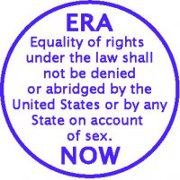
ERA words button

Equality of rights under the law shall not be denied or abridged by the United States or by any State on account of sex.

This is all it says; why such controversy?

So… take a moment, go to http://wh.gov/P6gP, sign in (or create) your White House account, and then sign the petition.  Once done, please spread the word to your friends, colleagues, and family to do the same.