PA’s Dueling Marriage Equality and Gay Marriage Ban Bills

Logo of Freedomt to Marry, Inc.

“working to win the freedom to marry in more states, grow the national majority for marriage, and end federal marriage discrimination. ” http://www.freedomtomarry.org/pages/about-us

On April 15, Pennsylvania State Representative Mark Cohen (D-102 Philadelphia) introduced legislation (HB 1178) that would legalize civil unions and extend all state laws applicable to marriage to any civil union created anywhere and to any marriage performed and recognized outside of the state.  Less than one month later, on May 7, Pennsylvania State Representative Daryl Metcalfe (R-12 Butler County) introduced his legislation (HB 1349) to create a constitutional amendment defining marriage OR its “substantial equivalent” solely as a union between a man and a woman.

So we once again have a legislative dual going on in Pennsylvania between those that believe in equality for all and those that want to enshrine discrimination into the state Constitution.

Side 1: For Equality

What does Cohen’s bill do?  Very simply, it takes us on the path toward equality for lesbian and gays.  As Rep. Cohen says,

 “This bill would define a civil union as a union between two members of the same sex.  It would make all state laws applicable to marriage also applicable to a civil union.  The bill would also provide for reciprocity of civil unions performed legally in other states and the recognition of same sex marriage in other states as civil unions in Pennsylvania.”

Civil unions represent the middle-of-the-road compromise position between constitutionally banning and permitting gay marriages and have been embraced by both advocates for LGBT rights and a growing number of conservatives.

Nothing in this bill would require any religion or any clergyman to perform any ceremony uniting people in a civil union.  This legislation will merely offer committed gay couples the same legal rights that are bestowed upon married people without the status of marriage.”

I would prefer full marriage equality.  Just like all gay and straight couples in 10 states (plus Minnesota and Delaware if their legislatures pass their marriage equality bills as expected) already have.  And  just like the majority of people in Pennsylvania desire.

In a poll released on May 8 by Franklin and Marshal University, 54% of Pennsylvanians “generally” support while 41% “generally” oppose legalizing same-sex marriage.  In that same poll, 65% support passage of a state law that would allow same-sex couples to legally form civil unions that give them some, if not all, of the marriage rights given to heterosexual couples who marry.

This bill is a compromise.  It currently has 28 cosponsors and was referred to the House Judiciary Committee when it was introduced on April 15.

Side 2: For Discrimination

Meanwhile, Daryl Metcalfe has seen fit to once again try to enshrine discrimination into the state constitution.  It is a one-sentence amendment that has severe ramifications.  Here’s the constitutional amendment as written in HB 1349:

“Marriage is the legal union of only one man and one woman as husband and wife and no other legal union that is treated as marriage or the substantial equivalent thereof shall be valid or recognized.”

Metcalfe justifies this discrimination by invoking partisan politics, a right-wing encroachment on the separation of church and state, and a denial of the protections given to us under the US Constitution:

Pennsylvania does not need to wait for the United States Supreme Court to rule on what natural law already declares as self-evident … Marriage is a sacred bond that can only be fulfilled by one man and one woman, as established by God. Final passage of my legislation will allow state lawmakers to exercise their rightful responsibility and obligation to uphold the rule of law and the will of the people.

The definition of marriage as ‘the union of one man and one woman,’ defended and upheld by this legislation, is the traditional definition of marriage that has been recognized and accepted throughout history and the world for centuries. Neither homosexual special interests gathered under the immoral umbrella of the ACLU, nor the Obama administration’s Department of Justice or any activist court should decide this critical issue for our Commonwealth.  House Bill 1349 is specifically written to empower Pennsylvania voters, and only Pennsylvania voters, with the authority to decide how marriage will be defined in the Keystone State.

News reports indicate that Metcalfe may be on the downside of this battle and that combined with the aforementioned Franklin and March poll, there is now less support for this discrimination.  According to the Philly Magazine,

His support system is fleeting. In the last session, the bill had 40 supporters, but today [May 8], according to a rep from [Rep] Brian Sims’ office, there are only 27. And this is the first time it’s been introduced with zero Democratic backers. To top it off, his bill’s lackluster show of support comes on the heels of yesterday’s announcement that a record number of legislators on both sides of the fence sponsor[ed] legislation that ban[s] discrimination against LGBT people in the workplace and housing and public accommodations [emphasis in original].

Discrimination and inequality are not the principles Pennsylvania was founded upon.

Discrimination and inequality are not the principles this state was founded upon. Metcalfe’s discriminatory amendment, in contrast to Cohen’s call for equality and respect for recognizing loving relationships, denies unmarried heterosexual, lesbian, gay, bisexual and transgender families the protections and fairness they deserve.

Heterosexual married couples and their families are afforded more than 1,000 legal protections and economic benefits provided through state and federal law, benefits and protections that are currently inaccessible to unmarried couples.  Passage of Metcalfe’s amendment would therefore subject same-sex couples and their families to exclusion, discrimination and inequality.

Gay and lesbian Pennsylvanians are our neighbors, co-workers, friends, and family member.  They pay taxes.  LGBT people should not be bullied.  They deserve the same rights, protections, and responsibilities that all residents desire and have.

If the US Supreme Court declares this summer that marriage is a right across the country just like they did in Loving v. Virginia in 1967 (see my earlier blogs here and here on this issue) then we won’t need this interim step of civil unions and Metcalfe’s bill will immediately become moot.  A great way, in my opinion to end this duel.  In Pennsylvania and across the country.

So, let’s hope that the US Supreme Court overturns Proposition 8 this summer under the equal protection and due process protections given to us under the US Constitution’s 14th amendment and therefore—like Loving v. Commonwealth of Virginia in 1967—protect marriage rights for everyone. If they stop short of that, then let’s hope and advocate for the passage of Representative Cohen’s civil union bill.

Meanwhile, to keep up-to-date on these dueling bills as well as other LGBTQ legislation, check out Equality Pennsylvania’s website.

The Tension Heard in SCOTUS Hearings on Marriage Equality

Logo of Freedomt to Marry, Inc.

“working to win the freedom to marry in more states, grow the national majority for marriage, and end federal marriage discrimination. ” http://www.freedomtomarry.org/pages/about-us

As a quick follow-up to my brush with history with the Loving v. Commonwealth of VA case and on interracial and same-sex marriage equality, I thought I’d provide some links to what happened this week in the US Supreme Court.

You can hear the oral arguments as well as read the transcript of the hearings on the Supreme Court’s website.

  • To hear or read the arguments in Hollingsworth v. Perry (the Prop 8 case) from Tuesday, March 26, click here.
  • To hear or read the arguments in United States v Windsor (the DOMA case) from Wednesday, March 27, click here.

And for some other commentary on the possible outcomes of these two cases, you might want to check out SCOTUS Blog.

The commentary I think is particularly good was written by Tom Goldstein. He gives a great summary of the tension between these two cases entitled “The Relationship between DOMA and Proposition 8.

Overturning DOMA argues that the federal government can’t deny benefits to individuals whenever a state has said that a same-sex couple has a civil right to marry (a 10th amendment states’ rights argument).  In contrast, overturning Proposition 8 is an argument for equal protection and due process (an 14th amendment anti-discrimination argument) and would therefore—like Loving v. Commonwealth of Virginia in 1967—trump states’ rights.

Based on this blog, I have two sets of questions.

  1. Will both amendments be upheld or will one trump the other? If one trumps the other, which one will “win out?” OR
  2. Will the Supreme Court just dodge this conflict by deciding not to decide?  i.e., Will they declare that they can’t rule on this case because the proponents arguing to uphold Proposition didn’t have “standing” or the right to bring the case in the first place?

Loving and Marriage Equality

Logo of Freedomt to Marry, Inc.

“working to win the freedom to marry in more states, grow the national majority for marriage, and end federal marriage discrimination. ” http://www.freedomtomarry.org/pages/about-us

Today at noon, the US Supreme Court wrapped up a hearing on the right of same-sex couples to marry.  The case is called Hollingsworth v. Perry. If broadly held in favor of the plaintiffs, it will prohibit states from denying lesbian and gay people the right to marry each other. If narrowly held, it would not affect cases outside California; it would only overturn Proposition 8 and allow gay and lesbian people within California to marry each other.

Tomorrow, the US Supreme Court will hear a case called Windsor v. United States. This case appeals the constitutionality of the federal Defense Of Marriage Act (DOMA). DOMA denies any benefit, such as tax deductions, for married couples who are not of the opposite sex.

Jointly, these cases are, IMO, about  fairness, equality, and family. What constitutes a family?  Is it right to deny a couple the rights, privileges, and responsibilities of marriage granted all other loving adults?  Does prejudice trump the protections of due process and equal protection clauses of the 14th amendment to the US Constitution?

These questions have come up before. There are a total of 14 previous marriage-equality cases that have reached the US Supreme Court. All of these cases have declared that marriage is a fundamental right for all.  The most famous case—and one that will be part of the argument for same-sex marriage in today’s case—is Loving v. Commonwealth of Virginia.

In 1967, Chief Justice Earl Warren, in an unanimous decision, overturned Virginia’s miscegenation law that bans marriage “solely on the basis of racial classifications [because it violates] the Equal Protection and Due Process Clauses of the Fourteenth Amendment.”

When you read further into the opinion you can see that it was prejudice that was the sole basis for Virginia’s (and 15 other states) laws banning interracial marriage. The argument that the state made for keeping the miscegenation law on the books was highlighted in the Court’s opinion. Chief Justice Warren quoted the judge who had sentenced Mildred and Richard Loving to either 1 year in jail or 25 years of exile from Virginia:

“Almighty God created the races white, black, yellow, malay and red, and he placed them on separate continents. And but for the interference with his arrangement there would be no cause for such marriages. The fact that he separated the races shows that he did not intend for the races to mix.”

Then Warren overturned the statute stating that there is no legal, “rational” basis to deny someone the constitutional right of marriage equally granted to all other heterosexual couples. And in one simple statement, he basically said that marriage is an issue of equality for all. He said,

“The freedom to marry has long been recognized as one of the vital personal rights [emphasis added] essential to the orderly pursuit of happiness by free men.” 

What happened after this decision?

Interracial Marriages

The result of this opinion was that all anti-miscegenation laws throughout the country became unenforceable. And in the case of Virginia, the state was ordered, among other things, to remove this law from their books. They did it kicking and screaming. It took them until 1971–four years after the Court’s decision–to finally comply.

And I was in the room when it happened. And as far as I can find, they made as sure as they could that the legislators’ prejudicial behavior wouldn’t appear in the history books.

I grew up in Virginia. During my senior year in high school, our Government Class took a trip to the Capitol in Richmond. It just happened to be the day that the legislature rescinded the law banning intermarriage between people of color and Caucasians. There were six of us in the class who wanted to see the vote occur. The guards at the entrance to the visitors’ gallery shut the doors and wouldn’t let anyone in. The six of us decided to question this action and held a sit-in in front of the doors. After much consternation on the part of the guards as to what to do with us, they finally opened the doors and let us in.

We then watched an all-white, male legislature grudgingly vote to rescind this law. In Virginia, the House voted using a board of red and green lights – red for a no vote and green for a yes vote. The question on the floor was basically, “Should we remove the two statutes in our code that prohibit and punish interracial marriages?” 

The speaker put the question to a vote. The board started lighting up. All but a couple of lights were red, meaning that they almost all wanted to keep this prejudiced law on the books. About 30 seconds prior to recording the vote, the speaker again said that he would be closing the vote and asked everyone once again to vote. Just before he closed the vote for the record, all but a couple of the red lights turned green. What got recorded was a grudging acknowledgement that loving someone and getting married is a right that could no longer be denied because of animus towards the couple.

Same-Sex Marriages

In the case of gay and lesbian couples, we once again have an issue of animus towards the freedom to marry in some but not all states. Thirty-nine states limit marriage to heterosexual couples only via statute or state constitutional amendment.

Ten states and three Native American tribes believe otherwise. The states supporting marriage equality are Connecticut, Iowa, Maine, Maryland, Massachusetts, New Hampshire, New York, Vermont, Washington, and the District of Columbia. The tribes supporting marriage equality are the Coquille Tribe in Oregon, the Suquamish tribe in Washington, and the Little Traverse Bay Bands of Odawa Indians in Michigan.

New Mexico and Rhode Island recognize marriages that occur in other states and countries, but don’t allow them to be performed within the state.  And California, unless Proposition 8 is overturned, currently and will continue to recognize only the same-sex marriages that occurred between the May 2008 CA State Supreme Court’s decision legalizing same-sex marriage and the November 4, 2008 passage of Proposition 8.

Polls also tell a story as does Mildred Loving

At the time of the Loving decision, 80% of the country felt that it was wrong for interracial couple to marry. In 2011 (the most recent poll I could find), a record 86% of the public supported interracial marriage.

According to FreedomToMarry.org, popular opinion on gay marriage has also dramatically shifted in the last nine years. A poll addressing the issues being argued in the Proposition 8 case was released on March 18, 2013; it indicates that 58% of respondents support same-sex marriage; only 36% say they are opposed. A poll addressing the issues being argued in the DOMA case was released on March 7, 2013; it shows that 59% of respondents oppose the “denial of equal benefits and protections for legally married same-sex couples.”  And regardless of support for same-sex marriage in either federal or state law, even more people—83 percent—believe that there is a constitutional right to marriage (poll released on February 19, 2013).

I agree. And so did Mildred Loving in one of her few public statements on marriage equality. On the 40th anniversary of the Loving v. Commonwealth of Virginia decision (June 12, 2007), she linked the freedom to marry for same-sex couples to the freedom to marry for interracial couples:

I believe all Americans, no matter their race, no matter their sex, no matter their sexual orientation, should have that same freedom to marry.

I am still not a political person, but I am proud that Richard’s and my name is on a court case that can help reinforce the love, the commitment, the fairness and the family that so many people, black or white, young or old, gay or straight, seek in life. I support the freedom to marry for all. That’s what Loving, and loving, are all about.

Let’s listen to Mildred. Let’s listen to the public. Let’s stand up to the animus similar to that expressed by those all-white legislators in the 1971 Virginia General Assembly.

Like Chief Justice Warren and all of his colleagues did back in 1967, the current US Supreme court needs to stand for freedom, fairness, and the family.  They should  broadly rule for marriage equality as suggested by People for the American Way Foundation by supporting the freedom to marry for all. Overturn Prop 8, DOMA, and all the restrictive marriage laws across the country.

As Mildred said,

That’s what Loving, and loving, are all about.

US Congress passes Violence Against Women Act: Article via AFP

This article was first posted on Thursday, February 28, 2013 2:12:14 PM.  It gives a very good summary of how the Violence Against Women Act passed and why it took so long.

US Congress passes Violence Against Women Act (via AFP)

After months of partisan delay, the US Congress passed the Violence Against Women Act on Thursday, reauthorizing protections from domestic violence and sexual assault for millions of women. The bill — a reauthorization of legislation first enacted in 1994 but which includes new protections — passed…

About AFP: AFP is a global news agency delivering fast, in-depth coverage of the events shaping our world from wars and conflicts to politics, sports, entertainment and the latest breakthroughs in health, science and technology.

House Republicans Introduce Partisan VAWA that Fails to Protect ALL Victims

NOW Board Supporting VAWA 2-24-13 editedToday, I am presenting a guest blog by my dear friend and colleague Pat Reuss. Pat describes herself as “a longtime women’s rights activist pretending to be retired and currently serving as a policy adviser to NOW [National Organization for Women] and the National Task Force [to End Sexual and Domestic Violence Against Women].”

Pat has a history several decades-long advocating for a comprehensive Violence Against Women Act (VAWA). She first started working on this issue in the early 1990’s.  At that time, she worked as the policy director for what was then called the NOW Legal Defense and Education Fund (now known as Legal Momentum).  In that capacity, she worked very closely with then Senator, now Vice-President Joe Biden to write the first VAWA passed by Congress and signed into law in 1994.

This is Pat’s statement calling on anti-violence advocates to contact their representative in the US House of Representatives to vote for the comprehensive Senate-passed version to reauthorize VAWA:

The Republican’s version of VAWA, which substitutes the Senate’s inclusive, comprehensive version of S.47 for a bill that excludes effective protections for LGBT, immigrant, tribal and campus victims, will likely be on the House floor this Thursday.  The National Task Force [to End Sexual and Domestic Violence Against Women] (NTF) and NOW oppose this [House substitute] bill.  We need to call our Representatives and firmly ask them to vote against the House Republican Leader’s substitute VAWA and ask them to vote for the field-approved VAWA passed in the Senate.

Tomorrow [February 27], Representatives Issa (R-CA) and Cole (R-OK) will ask the Rules committee to allow them to offer an amendment to replace the House’s flawed tribal provisions with improved language that will provide effective, constitutionally sound protections for Native victims of domestic violence. Call your Representatives and ask them to tell House leadership to accept these amendments.

78 Senators from both parties and over 1,300 local, state and national professional and policy organizations support the Senate-passed bill as do law enforcement officials, health care professionals, community program and service providers, and the tens of millions of survivors and their families, friends and loved ones who rely on and have benefited from and used the services and resources provided by the 19-year-old law.

It must be noted that after months of tireless efforts by advocates working with the Republican leadership staff, there are some small but very important improvements in this substitute and the bill is not the punitive version of last year’s House bill. 

That said, the [House] Republican version of the bill  fails victims in a number of critical ways:

  • Fails to include the LGBT provisions from the Senate bill. 
  • Fails to include “stalking” among the list of crimes covered by the U visa (a critical law enforcement tool that encourages immigrant victims to assist with the investigation or prosecution of certain enumerated crimes); current law already includes domestic violence and sexual assault, among others, and the Senate bill’s inclusion of “stalking” recognizes the serious threat this crime poses to safety.
  • Provides non-tribal batterers with additional tools to manipulate the justice system, takes away existing protections for Native women by limiting existing tribal power to issue civil orders of protection against non-Native abusers, while weakening protections for Native women.
  • Contains harsh administrative penalties and hurdles for small struggling programs and an additional layer of bureaucracy through the office of the Attorney General.
  • Drops important provisions in the Senate bill that deal with improving campus safety and that work toward erasing the rape kit backlog.
  • Weakens protections for victims in public housing.

We must oppose this partisan substitute and pass the Senate version of VAWA.  201 Democrats are sponsors of H.R. 11, the House replica of the Senate bill as introduced. 19 Republican Representatives have asked the House Republican leaders to pass a bipartisan bill that “reaches all victims” and dozens more Republicans support some or all of the Senate provisions that are not included in the Republican VAWA imposter.

BIPARTISAN ACTION ITEM: Call your Democratic House members to ensure that they will oppose the Republican leadership’s substitute and support the “real” S. 47, the Senate passed bill.

Find out if your Republican Representative is one of the 19 who supports a bipartisan, inclusive VAWA and ask them step up and to oppose the Republican leader’s substitute and demand and support a vote on the Senate bill:

  1. Call or email the 19 (Poe R-TX and Ros-Lehtinen R-FL have added their names) who signed the letter to House leadership. See letter and signatories here. Names and contact information here.
  2. Call or email the 7 Members who voted against last years’ harmful, non-inclusive Republican VAWA.
  3. Call or write the 26 House members who have interest in one or some of the Senate’s inclusive provisions.

Update Wednesday evening February 26:

Thanks to your calls and emails and tweets (or however you interacted with your US Rep,), it looks like our push-back to stop the watered-down version of VAWA is starting to work.

A Politico.com report at 6:48 this evening (February 26) states that “House Republicans seem to be resigned that their version of the Violence Against Women Act is a loser with their own members and are likely to pass the Senate bill this week without changes.”

Let’s keep up the pressure. Call your Representative tomorrow and tell him/her to vote for the original Senate version of S.47.

This blog is a wonderful essay on abelism and how it affects one woman’s access to the the world and loving relationships. Like racism, sexism, and homophobia, this blog clearly speaks power to the truth on the intersection of all forms of discrimination and how it can personally affect someone. In this case, a queer, adopted, woman of color who has a physical disability. Through the lens of living in an ableist world, she describes how she has survived and thrived despite all of the isms she has experienced.
Thank you for your posting. I hear you and hope others do as well.

A Further Comment on Violence Against Women and Children on V-Day

I received a comment on LinkedIn this morning in response to my posting titled VAWA Passes Senate: One Step Toward Ending the Climate of Indifference Towards Violence Against Women.  My status statement said, “Feb 14 is V-Day. Rise to end indifference towards violence against women.”  A man in one of the groups I am a member of responded with a question:

So, please explain how we are being “indifferent” towards violence against women. There are laws against violent attacks on any human being – women included. Are these laws being ignored in cases where a woman is the victim?

I think not.

What we see here is another group who wishes to reap the benefits of victim status whether the facts bear them out or not. Beware of those who believe that they deserve special treatment – especially when that special treatment comes at the expense of others.

His question deserves a response.  Which I gave him within LinkedIn.  Since there are many others how might have a similar question but aren’t on LinkedIn, I’m commenting here as well.

The Violence Against Women Re-Authorization Act (VAWA S.47) does not call for special treatment of anyone. VAWA is calling on fair treatment of ALL victims of violence.

A climate of indifference is a climate where attacks against others – sexual assault, acquaintance or domestic violence, sexual harassment, and stalking– are ignored, covered up, or made light of. And in some instances, the climate of indifference is perpetuated when the alleged perpetrator is treated more lightly than someone else who may have committed the assault simply because of his status or affiliation.

That’s what has partially been happening with the Athletics program at Penn State University since 1994 and which helped lead to the situation of the child sexual assaults done by Jerry Sandusky. That’s part of what is happening in Steubenville, OH in the rape case where perpetrators made a video of themselves and others carrying a teenage girl from one house to another and raping her. That’s what led to the DC police refusing to take a police report last week from a friend of mine after a man exposed himself to her and masturbated because she didn’t stay with the man until the police came!

In addition, VAWA’s re-authorization has been delayed for over two years because some legislators – mostly Republican, including the majority of the US House of Representatives – are indifferent to the violence perpetrated on Native Americans, immigrants, and gays, lesbians, bisexual, and transgendered persons. This “indifference” towards violence against specific people is based solely on the victim’s status, is disparate treatment, and IMO is discriminatory.

Yes there are laws in place. Yet, until all victims are treated fairly and in a timely fashion, I will continue to call out people and communities for creating a climate of indifference that allows this to continue. All people need to live in safe communities and homes.

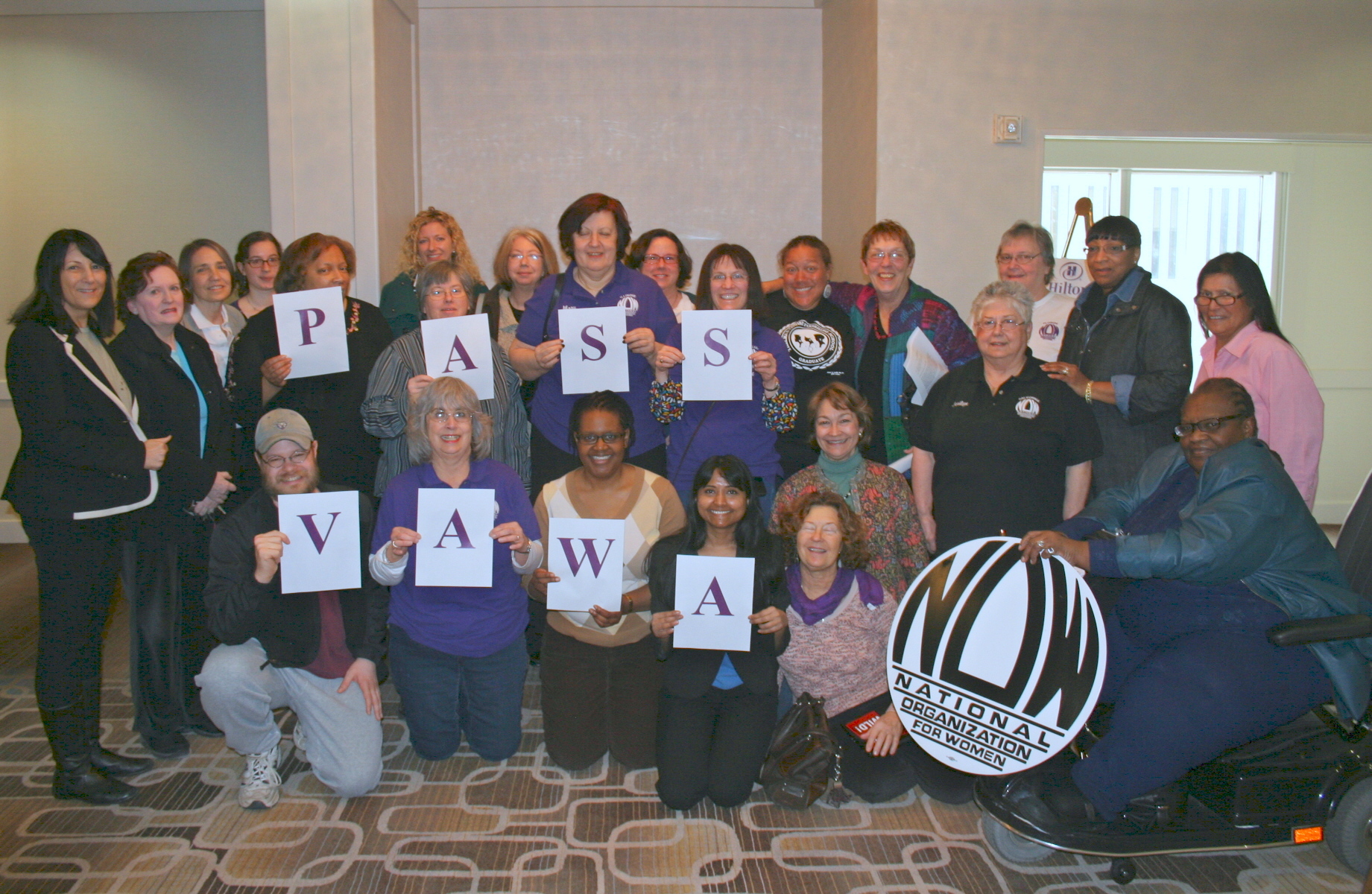
Ending this climate of indifference wherever it occurs is a start towards caring for our loved ones.  PASS VAWA NOW!

President Barack Obama’s Inauguration Speech: Standing for Equality

This morning, on the holiday celebration of Martin Luther King’s birthday, President Barack Obama was publicly sworn into office for his second term as President of the United States.  His inaugural speech was 2,095 words long. It covered many different issues from the role of government to freedom, poverty, the military, education, international interactions, and climate change.

Its over-arching message to me is that as a country and as individuals, we need come together to stand up for equality for all.

President John F. Kennedy, Jr. said something similar in his 1961 inaugural speech when he asked all Americans to help each other. He said then, “And so, my fellow Americans: ask not what your country can do for you—ask what you can do for your country.”

Martin Luther King expressed similar sentiments in his “I Have a Dream Speech” in 1963:

I have a dream that one day this nation will rise up and live out the true meaning of its creed: ‘We hold these truths to be self-evident, that all men are created equal.’

I have a dream that one day on the red hills of Georgia, the sons of former slaves and the sons of former slave owners will be able to sit down together at the table of brotherhood. I have a dream that one day even the state of Mississippi, a state sweltering with the heat of injustice, sweltering with the heat of oppression, will be transformed into an oasis of freedom and justice. I have a dream that my four little children will one day live in a nation where they will not be judged by the color of their skin but by the content of their character….I have a dream that one day, down in Alabama, with its vicious racists, with its governor having his lips dripping with the words of ‘interposition’ and ‘nullification’ — one day right there in Alabama little black boys and black girls will be able to join hands with little white boys and white girls as sisters and brothers….I have a dream that one day every valley shall be exalted, and every hill and mountain shall be made low, the rough places will be made plain, and the crooked places will be made straight; ‘and the glory of the Lord shall be revealed and all flesh shall see it together.’

I hope that Barack Obama’s words resonate as well. In that vein, here is how I think he best spoke about equality for all. Maybe part of this will become part of the lexicon of great Presidential speeches in the future.

We, the people, declare today that the most evident of truths – that all of us are created equal – is the star that guides us still; just as it guided our forebears through Seneca Falls, and Selma, and Stonewall; just as it guided all those men and women, sung and unsung, who left footprints along this great Mall, to hear a preacher say that we cannot walk alone; to hear a King proclaim that our individual freedom is inextricably bound to the freedom of every soul on Earth.

It is now our generation’s task to carry on what those pioneers began. For our journey is not complete until our wives, our mothers, and daughters can earn a living equal to their efforts. Our journey is not complete until our gay brothers and sisters are treated like anyone else under the law – for if we are truly created equal, then surely the love we commit to one another must be equal as well. Our journey is not complete until no citizen is forced to wait for hours to exercise the right to vote. Our journey is not complete until we find a better way to welcome the striving, hopeful immigrants who still see America as a land of opportunity; until bright young students and engineers are enlisted in our workforce rather than expelled from our country. Our journey is not complete until all our children, from the streets of Detroit to the hills of Appalachia to the quiet lanes of Newtown, know that they are cared for, and cherished, and always safe from harm.

Our journey is not complete until every one is equal, cared for, cherished, and safe from harm.  Thank you for your inspiring words, Mr. President. May all of usfrom you as leader of the US to each of us in our homes and communitieswork together  to create a better, more accepting country and world.

Fiscal Cliff, Sandy, VAWA and Congress’s Adjournment

Last night, I stayed up to watch the final vote on the Biden-McConnell compromise Fiscal Cliff bill in the US House of Representatives on C-Span. The final vote was 257-167 on the bill. Most of the Republicans voted against the bill and most of the Democrats voted for the bill.

No one on either side of the aisle was particularly happy with this compromise. Yet it was a bipartisan vote, albeit a reluctant one. As economist Joseph LaVorgna of Deustche Bank said after the vote,

“Nothing really has been fixed. There are much bigger philosophical issues that we aren’t even addressing yet.” 

Concerns that were raised by the progressive Democrats who voted against the bill include:

This deal mostly focused on tax cuts, leaving the issue of spending cuts to be handled about two months from now.  This will lead to another fiscal cliff as we butt up against the debt ceiling just like did in August 2011 as well as the sequestration fight that was put off because of this vote.

  1. This deal mostly focused on tax cuts, leaving the issue of spending cuts to be handled about two months from now.  This will lead to another fiscal cliff as we butt up against the debt ceiling just like did in August 2011 as well as the sequestration fight that was put off because of this vote.
    1. The debt ceiling fight will likely occur as early as February when we hit the $16.4 trillion federal borrowing limit so the government can keep paying its bills.
    2. The sequestration battle will occur in March as a direct result of the three-month delay of dealing with spending cuts that was written into the Biden-McConnell bill.
  2. Tax cuts were made permanent while funding for unemployment, a delay in cutbacks on Medicare payments, and an extension of the Farm bill that stopped the price of milk from automatically doubling are only temporary.  As Rep. Rosa DeLuca (D-CT) said on the floor, this bill did not do enough to benefit working families.
  3. Only those making above $400,000 ($450,000 for federally recognized marriages) rather than those making above $250,000 will see an increase in their marginal tax rate. This reduces the amount of additional revenue for balancing the budget. As Senator Tom Harkin said during the Senate debate, the billions lost by raising the threshold to $400,000 will come out of the pockets of grandparents and working families across the nation.”
  4. As a result of this bill, now law, even more draconian cuts to government-sponsored programs will ultimately be seen.  This includes funding for programs like education for our children, job training, and other critical supports for the middle class. And more funds for emergencies are likely to disappear or will be quashed as with what happened with the Sandy relief bill immediately after the fiscal cliff vote.

Philosophical questions about what the federal government should or ought to be paying for can be seen, for example, in two issues of concern to families across the country. Both of these issues failed to be addressed by the House of Representatives before they adjourned just after midnight this morning. They must now start negotiations all over again when the new 2013-2014 Congressional session begins on Thursday, January 4, 2013.

The first issue the House failed to fully address was the passage of the Violence Against Women Act (VAWA). VAWA is the law that provides funding to the Office of Violence against Women (OVW), to law enforcement, and to the judicial system to deal with all forms of interpersonal violence such as domestic violence, sexual assault, and stalking. VAWA was originally created in 1995. The bill must be reauthorized every 5 years. This means that the last reauthorization should have occurred in 2010! The hold back? Rather than improving the bill, many members of Congress, particularly Republicans in the US House of Representatives called for both cutbacks in funding and in who will be covered.

Over a belief that any person experiencing interpersonal violence be protected, the US Senate stood firm and refused to consider the exclusionary House VAWA bill that eliminated coverage of college students, immigrants, Native Americans, and LGBTQ people. Since the House refused to take up the Senate bill, reauthorizing VAWA will now have to start all over again in both houses when the new Congress convenes. Meanwhile victims and survivors of interpersonal violence are surviving on a temporary funding basis through March 2013 to cover anti-violence programs to save and improve their lives. Additionally, with the new “fiscal cliff,” – i.e. sequestration – will result in nearly 200,000 fewer victims receiving lifesaving and cost-effective services if both VAWA and sequestration are not resolved by March.

The second issue that the House failed to address was emergency appropriations to assist the victims of last October’s Super Storm Sandy. The vote on the fiscal cliff bill occurred at about 11:45 pm last night. Immediately after that, the Presiding Chair of the House, Rep. Steve Womack (R-AR), called for one-minute speeches. The second speaker was Rep. Steny Hoyer (D-MD). He announced that Speaker of the House John Boehner had pulled the bill and that as a result there would be no emergency funding for the victims of Hurricane Sandy forthcoming from this session of Congress.

At that point, Representatives from both parties from across the country began speaking out in anger and frustration that the people who were victimized by this natural disaster would not receive the emergency funding desperately needed to put food and warm housing over their heads at this winter time. Here are some of the comments made some of the Representatives of both parties on the floor and again this morning:

“This Congress is apparently leaving town without responding to [the Sandy] emergency. I am deeply disappointed … and the people who have been damaged by Sandy, including Gov. [Chris] Christie, a Republican, and Gov. [Andrew] Cuomo, a Democrat, should be deeply disappointed, and yes, angry, that this Congress would adjourn without addressing the pain of our fellow citizens.” – Steny Hoyer (D-MD) in his opening comment.

“To those who say FEMA has not yet disbursed all the funds it has to assist families and businesses, I would tell them, they deeply underestimate the damage in these areas and the wide range of assistance required to alleviate the pain and suffering.” – Steny Hoyer (D-MD) in a comment made about nine hours later in response to Rep. Eric Canter’s (R-VA) remark that funds weren’t urgently needed.

“I can’t imagine that type of indifference, that type of disregard, that cavalier attitude being shown to any other part of the country.” – Peter King (R-NY)

“I don’t think I’ve ever been as angry as I am tonight. For us in the Northeast to be treated this way is absolutely unconscionable. Tonight I am ashamed. Shame on you, Mr. Speaker.”Eliot Engel (D-NY)

“It is with an extremely heavy heart that I stand here, almost in disbelief and somewhat ashamed. It’s inexcusable. And I am here tonight saying to myself, for the first time, that I’m not proud of the decision my team has made.”Michael Grimm (R-NY)

For more comments from other representatives and a video of what happened, check out the ABC News article and video.

Adjournment without dealing with pressing issues of our citizenry. Philosophical differences resulting in gridlock and endangerment to people across the country. We need to stop throwing people under the bus. Shame on the 112th Congress!

We need to have a Congress that cares. Hopefully the new 113th Congress will be more willing to see and work on the concerns and needs of our country.

That’s my wish for the New Year.

Violence against Women and Children: A Worldwide, National, and Local Epidemic

Violence against women and children is a worldwide, national, and local epidemic.

Yesterday, a 23-year-old medical student died in a Singapore hospital of injuries she sustained December 16, 2012 in a gang rape and severe beating on a bus in New Delhi, India. She was attacked by six men who took turns raping her and beating both her and her male friend, stripping both of them, and then throwing them off the bus.  This is just one of many forms of femicide that have occurred in India, which include rape, sexual assault, honor killings, killing of girls 5 years and younger by starvation and violence, and dowry-related murders, among others.

This is just part of the world-wide epidemic of violence against women.  According to One Billion Rising, one in three women will be beaten or raped during her lifetime.  According to the United Nations,

Violence against women takes a dismaying variety of forms, from domestic abuse and rape to child marriages and female circumcision. All are violations of the most fundamental human rights.

Forms of violence vary by country, from sex-selection abortions in countries that value men over women, to female genital mutilation that leaves women maimed and traumatized, to forced marriages, to sexual harassment and intimidation at work, to trafficking and prostitution, to rape, incest, domestic violence, murder, and rape as a weapon of war. Some of this violence occurs within the family home.  Some of this violence occurs within the community.  And some of this violence is perpetrated by the state.  It can be physical, sexual, and/or psychological.  All forms are traumatic and in some instances, deadly.

UniFem’s data on violence against women is even starker than that presented by One Billion Rising.  They report that up to 70 percent of women and girls experience sexual or physical violence during their lifetime. Among women ages 15-44, the incidence of this form of violence – mostly perpetrated by husbands, intimate partners, or people the women know – accounts for more disability and deaths than occur from cancer, malaria, traffic accidents, and war combined.

In the United States, the Centers for Disease Control reports a pervasive problem of “intimate partner violence (IPV).”  This is defined as rape, physical violence, and stalking by a current or former intimate partner, either gay or straight of either sex or gender identity.  On average, 24 people experience some form of IPV every minute in the US.  This is over 12 million women (mostly) and some men each year, including 1 million women who are raped each year.

This violence occurs against both children and adults.  The majority of victims are women and girls, but they also include some men and young boys, such as the young boys here in Centre County, PA who were victimized by former PSU football coach Jerry Sandusky.  As a women’s rights activist, I have been speaking out against all forms of violence against women and children since at least 1994.  You can see a history of the local issues on the National NOW website here, and here as well as in The Nation.

There is a question that this info raises in my mind. What is the status of protections to reduce violence against women locally, in the US, and around the world? The picture/answer to this question is not great.

Locally, two cases of violence have made national news.  The most well-known case is that of former PSU football coach Jerry Sandusky; he was found guilty on 45 of 48 charges related to child sexual assault and is now essentially serving a life sentence in the state penitentiary.  Penn State University received a 60 million dollar sanction from the NCAA for failure to properly handle intimate partner violence, particularly child sexual abuse  within the Athletic department, and Judge Louis Freeh issued a scathing indictment against PSU’s upper administration, the Athletics’ department, and the Board of Trustees for covering up, failing to protect potential and actual victims of sexual violence, and failing to provide appropriate board oversight. And the University could face severe fines for failure to report IPV incidences to the US Department of Education under the Clery Act.  Despite these sanctions, violence on campus still continues.  The other case is the murder here in Centre County of PSU alumna Amy Homan McGee in 2001 by her husband, Vincent.  What happened in this domestic violence case was made into a 2010 PBS documentary titled “Telling Amy’s Story.”

These cases are just two examples among many that occur here at the local level. According to the State College, PA police department, there were 76 reported cases of domestic violence and 29 cases of sexual assault in the borough alone in 2011-2012.  Yet the incidence appears to be much higher.  According to the Centre County Women’s Resource Center, over 1,000 people in the county were known to be affected by domestic violence and another 200 reported being sexually assaulted throughout the entire county during the same time period.

To assist victims of stalking, domestic violence, and sexual assault, our local community created a county-wide task force of service providers and advocates to assist, education, and advocate for the reduction and elimination of all forms of IPV.  This task force has been in existence for 20+ years.  This task force is doing a decent job of working on IPV issues and providing services and education to the community, but is now facing ever increasing funding issues.

Funding for programs at the local level come largely from state and national governments.  Both levels of funding are in jeopardy.  Here in PA, for example, Governor Corbett eliminated General Assistance funding for everyone on August 1, 2012; a larger plurality of the recipients of this very limited funding were women fleeing domestic violence who used the minimal monies available to find housing for themselves and their children.

At the national level, Congress has failed to reauthorize the Violence Against Women Act (VAWA), which provides funding to the Office of Violence against Women (OVW), to law enforcement, and to the judicial system to deal with all forms of IPV.  VAWA was originally created in 1995.  The bill must be reauthorized every 5 years. This means that the last reauthorization should have occurred in 2010!  The holdback?  Rather than improving the bill, many members of Congress, particularly Republicans in the US House of Representatives are calling for both cutbacks in funding and who will be covered.  We are now at a standstill since, appropriately, the US Senate is standing firm on ensuring that all victims of domestic violence, sexual assault, and stalking – including college students, immigrants, Native Americans, and LGBTQ people – are covered.  The new session of Congress will convene in January 2013 and an entirely new bill will have to be crafted.  Meanwhile victims and survivors of IPV are surviving on a temporary funding basis through March 2013 to cover anti-violence programs to save and improve their lives.  Additionally, the looming “fiscal cliff,” sequestration will result in nearly 200,000 fewer victims receiving lifesaving and cost-effective services.

And returning to the international level, the UN Convention on the Elimination of All Forms of Discrimination against Women (CEDAW) has a clear statement that all countries that have signed the treaty take “appropriate” steps to eliminate violence against women and girls.  The US signed the treaty in 1980 but never ratified it.  India ratified CEDAW in 1993, but as can be seen from recent events there, doesn’t enforce this obligation.

So where does this leave us?

Action is needed.  We need to get out on the streets and call for full funding of programs designed to reduce and eliminate violence.  Eve Ensler is organizing One Billion Rising on February 14, 2013.  Her call states,

We are calling on ONE BILLION women and those who love them to WALK OUT, DANCE, RISE UP, and DEMAND an end to this violence.

It is a one-day strike and an “invitation to dance” that calls for the end of all forms of violence against women and children. If you are interested in joining women and those who love them from around the world, you can download the One Billion Rising toolkit to plan your event here.

You can also take action by telling leaders here in India as well as here in the US and in your state that enough is enough.

  1. Tell the Indian Prime Minister to meet the three demands of the women of India – 1) talk directly to the women of India about how you will deal with this violence, 2) begin expediting cases against Indian politicians who have records of alleged rape and other charges of violence against women, and 3) immediately reinstate Police Woman Damayanti Sen who was fired after she protected a gang-rape victim;
  2. Contact your US Representative and US Senators. Tell them to immediately introduce a new bill similar to the 2011-2012 Senate bill (S.1925) that covers ALL victims of violence.  This needs to be passed before March 2013 when the temporary funding extension that passed in November ends.  The new bill needs to be comprehensive and include all current victims of violence as well as battered immigrant women, Native American Women, LGBTQ persons, and violence survivors on college campuses.  You can find out more information about this issue on the National NOW website, including several links to action alerts on VAWA.  Also, tell your US Senators to finally vote for and ratify CEDAW without any reservations.
  3. Learn more about what your state’s laws and funding for programs on violence against women provide.  A good source of information for each state can be found on the OVW website; there is a page on that website that links you to resources in each state.  Once you get to your state’s links, you should be able to find action alerts and information to help improve funding and programs within your state.