Message from VP Joe Biden on Gun Safety

I received an email this morning from Vice President Joe Biden that he wrote yesterday, January 16, 2013 after President Obama announced his Gun Safety Plan called “Now is the Time to Do Something About Gun Violence.”  Here’s the message with his Call to Action:

White House Logo

Hello —

Today President Obama announced a plan to help protect our kids and communities from gun violence. You’re going to hear a lot about it, but I wanted to make sure you got a chance to get the facts, straight from me.

After hearing from Americans from across the political spectrum, we decided to focus on some key priorities: closing background check loopholes, banning military-style assault weapons, making our schools safer, and increasing access to mental health services.

The ideas we sent to President Obama are straightforward. Each of them honors the rights of law-abiding, responsible Americans to bear arms. Some of them will require action from Congress; the President is acting on others immediately. But they’re all commonsense and will help make us a little safer.

Now is the time for all of us to act.

Read about the events that brought us to this point, learn about the plan we’ve proposed to help protect our kids, and then add your name in support to help build momentum for this plan.

Here’s what we’ve put together:

We’re calling for requiring background checks for all gun sales and closing the loopholes that allow dangerous individuals to make their purchase without going through one of these checks.

We’re asking for a new, stronger ban on military-style assault weapons and high-capacity magazines that allow a shooter to fire dozens of bullets as quickly as he can pull a trigger. And we’re asking Congress to help protect law enforcement by make it illegal for members of the public to possess armor-piercing bullets.

We’re going to give law enforcement more tools and resources to prevent and prosecute gun crimes, and we’re going to end the freeze on gun violence research that prevents the Center from Disease Control from looking at the causes of gun violence.

We’re calling on Congress to help make schools safer by putting up to 1,000 school resource officers and mental health professionals in schools and ensuring they have comprehensive emergency management plans in place.

And we’re going to increase coverage so that students and young adults can get access to the mental health treatment they may need.

We know that no policy we enact or law we enforce can prevent every senseless act of violence in our country. But if we can save the life of even one child, we have a deep responsibility to act.

Now is the time to come together to protect our kids. Learn about the plan, then add your name alongside mine:

http://www.whitehouse.gov/now-is-the-time

Thanks,

Vice President Joe Biden


We Can Do It! Alice Paul and a New White House ERA Petition

If she was alive today, Alice Paul would be 138 years old.  Ms. Paul was born on January 11, 1875. After the 19th Amendment to the US Constitution granting women the right to vote was ratified in 1920, many of the suffragettes thought women’s rights were won.  Alice Paul disagreed, saying that until women were fully written into the US Constitution, our rights would always be at risk and we could (and would) be treated as second-class citizens.  In 1923, Ms. Paul introduced and then continued working for passage of what became known as the Equal Rights Amendment (ERA) for the rest of her life.

The ERA passed Congress in 1972. It has not yet been ratified by three-quarters of the state; it needs three more states to sign on.  It is short but to the point:

Section 1. Equality of rights under the law shall not be denied or abridged by the United States or by any state on account of sex.
Section 2. The Congress shall have the power to enforce, by appropriate legislation, the provisions of this article.
Section 3. This amendment shall take effect two years after the date of ratification.

In honor of Alice Paul’s birthday, a group of women supporting the Madison Amendment or “three-state” approach for passage of the Equal Rights Amendment started a second petition on the White House petition website.

I recently wrote about the ERA and the first of these petitions. Unfortunately because of the lack of organization surrounding the first petition, it is highly unlikely that it will receive the 25,000 signatures required by its January 17 deadline in order to get a response from the White House.

This new petition, in contrast, looks like it has a much better chance of reaching the 25,000 signature threshold.  In the first 6 days of this petition drive, there have been over 4800 signatures received.  That’s an average of 800 signatures each day.  With 25 days left (deadline is February 10)—and if the momentum keeps up—we could make it.  Between now and then we need to average a total of 840 additional signatures each day.  Your help is needed.

So I am once more asking people to sign on and tell President Obama that you want him to:

Vigorously support women’s rights by fully engaging in efforts to ratify the 1972 Equal Rights Amendment (ERA).

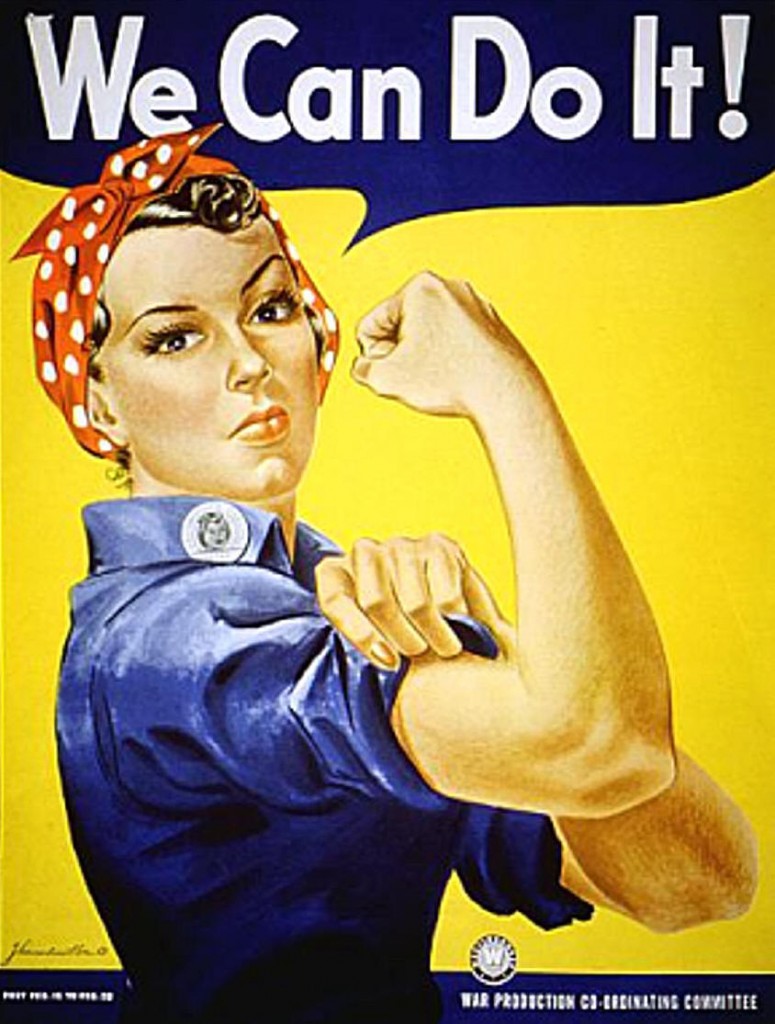
Once you sign the petition, please let your friend, family members, and colleagues know about the petition and ask them to sign as well.  Like the WWII poster says, “WE CAN DO IT!”

We Can Do It poster

“We Can Do It!” poster created by J. Howard Miller for the War Production Co-Ordinating Committee during World War II and later associated with “Rosie the Riveter”

Petition to End Rape Immunity in India

Avaaz is organizing a global petition to help reduce the incidence of rape in India following the rape and death of the 23-year old medical student in New Delhi. According to their website Avaaz “is a global web movement to bring people-powered politics to decision-making everywhere.”

This international human rights organization has created a petition that will be delivered to Indian Home Minister Sushilkumar Shinde. Mr. Shinde will be meeting with other government officials on January 4 to discuss the issue of India’s rampant rape crisis. There is some fear that without global pressure—as well as the internal pressure—little may come from this meeting. Here’s what the petition says:

For too long, violent criminals have attacked India’s women and girls with no fear of consequences. It is time to bring an end to the war on women. We call on you to take immediate action to set up fast-track courts for victims of sexual violence across the country, and take every step necessary to protect India’s women and ensure justice is done.

As of 11:25 am Eastern Standard Time, 37,342 people from around the world have signed on to this call for reform. If you are interested in joining this global chorus, please go to the Avaaz petition site and sign on.

Thanks.

Fiscal Cliff, Sandy, VAWA and Congress’s Adjournment

Last night, I stayed up to watch the final vote on the Biden-McConnell compromise Fiscal Cliff bill in the US House of Representatives on C-Span. The final vote was 257-167 on the bill. Most of the Republicans voted against the bill and most of the Democrats voted for the bill.

No one on either side of the aisle was particularly happy with this compromise. Yet it was a bipartisan vote, albeit a reluctant one. As economist Joseph LaVorgna of Deustche Bank said after the vote,

“Nothing really has been fixed. There are much bigger philosophical issues that we aren’t even addressing yet.” 

Concerns that were raised by the progressive Democrats who voted against the bill include:

This deal mostly focused on tax cuts, leaving the issue of spending cuts to be handled about two months from now.  This will lead to another fiscal cliff as we butt up against the debt ceiling just like did in August 2011 as well as the sequestration fight that was put off because of this vote.

  1. This deal mostly focused on tax cuts, leaving the issue of spending cuts to be handled about two months from now.  This will lead to another fiscal cliff as we butt up against the debt ceiling just like did in August 2011 as well as the sequestration fight that was put off because of this vote.
    1. The debt ceiling fight will likely occur as early as February when we hit the $16.4 trillion federal borrowing limit so the government can keep paying its bills.
    2. The sequestration battle will occur in March as a direct result of the three-month delay of dealing with spending cuts that was written into the Biden-McConnell bill.
  2. Tax cuts were made permanent while funding for unemployment, a delay in cutbacks on Medicare payments, and an extension of the Farm bill that stopped the price of milk from automatically doubling are only temporary.  As Rep. Rosa DeLuca (D-CT) said on the floor, this bill did not do enough to benefit working families.
  3. Only those making above $400,000 ($450,000 for federally recognized marriages) rather than those making above $250,000 will see an increase in their marginal tax rate. This reduces the amount of additional revenue for balancing the budget. As Senator Tom Harkin said during the Senate debate, the billions lost by raising the threshold to $400,000 will come out of the pockets of grandparents and working families across the nation.”
  4. As a result of this bill, now law, even more draconian cuts to government-sponsored programs will ultimately be seen.  This includes funding for programs like education for our children, job training, and other critical supports for the middle class. And more funds for emergencies are likely to disappear or will be quashed as with what happened with the Sandy relief bill immediately after the fiscal cliff vote.

Philosophical questions about what the federal government should or ought to be paying for can be seen, for example, in two issues of concern to families across the country. Both of these issues failed to be addressed by the House of Representatives before they adjourned just after midnight this morning. They must now start negotiations all over again when the new 2013-2014 Congressional session begins on Thursday, January 4, 2013.

The first issue the House failed to fully address was the passage of the Violence Against Women Act (VAWA). VAWA is the law that provides funding to the Office of Violence against Women (OVW), to law enforcement, and to the judicial system to deal with all forms of interpersonal violence such as domestic violence, sexual assault, and stalking. VAWA was originally created in 1995. The bill must be reauthorized every 5 years. This means that the last reauthorization should have occurred in 2010! The hold back? Rather than improving the bill, many members of Congress, particularly Republicans in the US House of Representatives called for both cutbacks in funding and in who will be covered.

Over a belief that any person experiencing interpersonal violence be protected, the US Senate stood firm and refused to consider the exclusionary House VAWA bill that eliminated coverage of college students, immigrants, Native Americans, and LGBTQ people. Since the House refused to take up the Senate bill, reauthorizing VAWA will now have to start all over again in both houses when the new Congress convenes. Meanwhile victims and survivors of interpersonal violence are surviving on a temporary funding basis through March 2013 to cover anti-violence programs to save and improve their lives. Additionally, with the new “fiscal cliff,” – i.e. sequestration – will result in nearly 200,000 fewer victims receiving lifesaving and cost-effective services if both VAWA and sequestration are not resolved by March.

The second issue that the House failed to address was emergency appropriations to assist the victims of last October’s Super Storm Sandy. The vote on the fiscal cliff bill occurred at about 11:45 pm last night. Immediately after that, the Presiding Chair of the House, Rep. Steve Womack (R-AR), called for one-minute speeches. The second speaker was Rep. Steny Hoyer (D-MD). He announced that Speaker of the House John Boehner had pulled the bill and that as a result there would be no emergency funding for the victims of Hurricane Sandy forthcoming from this session of Congress.

At that point, Representatives from both parties from across the country began speaking out in anger and frustration that the people who were victimized by this natural disaster would not receive the emergency funding desperately needed to put food and warm housing over their heads at this winter time. Here are some of the comments made some of the Representatives of both parties on the floor and again this morning:

“This Congress is apparently leaving town without responding to [the Sandy] emergency. I am deeply disappointed … and the people who have been damaged by Sandy, including Gov. [Chris] Christie, a Republican, and Gov. [Andrew] Cuomo, a Democrat, should be deeply disappointed, and yes, angry, that this Congress would adjourn without addressing the pain of our fellow citizens.” – Steny Hoyer (D-MD) in his opening comment.

“To those who say FEMA has not yet disbursed all the funds it has to assist families and businesses, I would tell them, they deeply underestimate the damage in these areas and the wide range of assistance required to alleviate the pain and suffering.” – Steny Hoyer (D-MD) in a comment made about nine hours later in response to Rep. Eric Canter’s (R-VA) remark that funds weren’t urgently needed.

“I can’t imagine that type of indifference, that type of disregard, that cavalier attitude being shown to any other part of the country.” – Peter King (R-NY)

“I don’t think I’ve ever been as angry as I am tonight. For us in the Northeast to be treated this way is absolutely unconscionable. Tonight I am ashamed. Shame on you, Mr. Speaker.”Eliot Engel (D-NY)

“It is with an extremely heavy heart that I stand here, almost in disbelief and somewhat ashamed. It’s inexcusable. And I am here tonight saying to myself, for the first time, that I’m not proud of the decision my team has made.”Michael Grimm (R-NY)

For more comments from other representatives and a video of what happened, check out the ABC News article and video.

Adjournment without dealing with pressing issues of our citizenry. Philosophical differences resulting in gridlock and endangerment to people across the country. We need to stop throwing people under the bus. Shame on the 112th Congress!

We need to have a Congress that cares. Hopefully the new 113th Congress will be more willing to see and work on the concerns and needs of our country.

That’s my wish for the New Year.

Violence against Women and Children: A Worldwide, National, and Local Epidemic

Violence against women and children is a worldwide, national, and local epidemic.

Yesterday, a 23-year-old medical student died in a Singapore hospital of injuries she sustained December 16, 2012 in a gang rape and severe beating on a bus in New Delhi, India. She was attacked by six men who took turns raping her and beating both her and her male friend, stripping both of them, and then throwing them off the bus.  This is just one of many forms of femicide that have occurred in India, which include rape, sexual assault, honor killings, killing of girls 5 years and younger by starvation and violence, and dowry-related murders, among others.

This is just part of the world-wide epidemic of violence against women.  According to One Billion Rising, one in three women will be beaten or raped during her lifetime.  According to the United Nations,

Violence against women takes a dismaying variety of forms, from domestic abuse and rape to child marriages and female circumcision. All are violations of the most fundamental human rights.

Forms of violence vary by country, from sex-selection abortions in countries that value men over women, to female genital mutilation that leaves women maimed and traumatized, to forced marriages, to sexual harassment and intimidation at work, to trafficking and prostitution, to rape, incest, domestic violence, murder, and rape as a weapon of war. Some of this violence occurs within the family home.  Some of this violence occurs within the community.  And some of this violence is perpetrated by the state.  It can be physical, sexual, and/or psychological.  All forms are traumatic and in some instances, deadly.

UniFem’s data on violence against women is even starker than that presented by One Billion Rising.  They report that up to 70 percent of women and girls experience sexual or physical violence during their lifetime. Among women ages 15-44, the incidence of this form of violence – mostly perpetrated by husbands, intimate partners, or people the women know – accounts for more disability and deaths than occur from cancer, malaria, traffic accidents, and war combined.

In the United States, the Centers for Disease Control reports a pervasive problem of “intimate partner violence (IPV).”  This is defined as rape, physical violence, and stalking by a current or former intimate partner, either gay or straight of either sex or gender identity.  On average, 24 people experience some form of IPV every minute in the US.  This is over 12 million women (mostly) and some men each year, including 1 million women who are raped each year.

This violence occurs against both children and adults.  The majority of victims are women and girls, but they also include some men and young boys, such as the young boys here in Centre County, PA who were victimized by former PSU football coach Jerry Sandusky.  As a women’s rights activist, I have been speaking out against all forms of violence against women and children since at least 1994.  You can see a history of the local issues on the National NOW website here, and here as well as in The Nation.

There is a question that this info raises in my mind. What is the status of protections to reduce violence against women locally, in the US, and around the world? The picture/answer to this question is not great.

Locally, two cases of violence have made national news.  The most well-known case is that of former PSU football coach Jerry Sandusky; he was found guilty on 45 of 48 charges related to child sexual assault and is now essentially serving a life sentence in the state penitentiary.  Penn State University received a 60 million dollar sanction from the NCAA for failure to properly handle intimate partner violence, particularly child sexual abuse  within the Athletic department, and Judge Louis Freeh issued a scathing indictment against PSU’s upper administration, the Athletics’ department, and the Board of Trustees for covering up, failing to protect potential and actual victims of sexual violence, and failing to provide appropriate board oversight. And the University could face severe fines for failure to report IPV incidences to the US Department of Education under the Clery Act.  Despite these sanctions, violence on campus still continues.  The other case is the murder here in Centre County of PSU alumna Amy Homan McGee in 2001 by her husband, Vincent.  What happened in this domestic violence case was made into a 2010 PBS documentary titled “Telling Amy’s Story.”

These cases are just two examples among many that occur here at the local level. According to the State College, PA police department, there were 76 reported cases of domestic violence and 29 cases of sexual assault in the borough alone in 2011-2012.  Yet the incidence appears to be much higher.  According to the Centre County Women’s Resource Center, over 1,000 people in the county were known to be affected by domestic violence and another 200 reported being sexually assaulted throughout the entire county during the same time period.

To assist victims of stalking, domestic violence, and sexual assault, our local community created a county-wide task force of service providers and advocates to assist, education, and advocate for the reduction and elimination of all forms of IPV.  This task force has been in existence for 20+ years.  This task force is doing a decent job of working on IPV issues and providing services and education to the community, but is now facing ever increasing funding issues.

Funding for programs at the local level come largely from state and national governments.  Both levels of funding are in jeopardy.  Here in PA, for example, Governor Corbett eliminated General Assistance funding for everyone on August 1, 2012; a larger plurality of the recipients of this very limited funding were women fleeing domestic violence who used the minimal monies available to find housing for themselves and their children.

At the national level, Congress has failed to reauthorize the Violence Against Women Act (VAWA), which provides funding to the Office of Violence against Women (OVW), to law enforcement, and to the judicial system to deal with all forms of IPV.  VAWA was originally created in 1995.  The bill must be reauthorized every 5 years. This means that the last reauthorization should have occurred in 2010!  The holdback?  Rather than improving the bill, many members of Congress, particularly Republicans in the US House of Representatives are calling for both cutbacks in funding and who will be covered.  We are now at a standstill since, appropriately, the US Senate is standing firm on ensuring that all victims of domestic violence, sexual assault, and stalking – including college students, immigrants, Native Americans, and LGBTQ people – are covered.  The new session of Congress will convene in January 2013 and an entirely new bill will have to be crafted.  Meanwhile victims and survivors of IPV are surviving on a temporary funding basis through March 2013 to cover anti-violence programs to save and improve their lives.  Additionally, the looming “fiscal cliff,” sequestration will result in nearly 200,000 fewer victims receiving lifesaving and cost-effective services.

And returning to the international level, the UN Convention on the Elimination of All Forms of Discrimination against Women (CEDAW) has a clear statement that all countries that have signed the treaty take “appropriate” steps to eliminate violence against women and girls.  The US signed the treaty in 1980 but never ratified it.  India ratified CEDAW in 1993, but as can be seen from recent events there, doesn’t enforce this obligation.

So where does this leave us?

Action is needed.  We need to get out on the streets and call for full funding of programs designed to reduce and eliminate violence.  Eve Ensler is organizing One Billion Rising on February 14, 2013.  Her call states,

We are calling on ONE BILLION women and those who love them to WALK OUT, DANCE, RISE UP, and DEMAND an end to this violence.

It is a one-day strike and an “invitation to dance” that calls for the end of all forms of violence against women and children. If you are interested in joining women and those who love them from around the world, you can download the One Billion Rising toolkit to plan your event here.

You can also take action by telling leaders here in India as well as here in the US and in your state that enough is enough.

  1. Tell the Indian Prime Minister to meet the three demands of the women of India – 1) talk directly to the women of India about how you will deal with this violence, 2) begin expediting cases against Indian politicians who have records of alleged rape and other charges of violence against women, and 3) immediately reinstate Police Woman Damayanti Sen who was fired after she protected a gang-rape victim;
  2. Contact your US Representative and US Senators. Tell them to immediately introduce a new bill similar to the 2011-2012 Senate bill (S.1925) that covers ALL victims of violence.  This needs to be passed before March 2013 when the temporary funding extension that passed in November ends.  The new bill needs to be comprehensive and include all current victims of violence as well as battered immigrant women, Native American Women, LGBTQ persons, and violence survivors on college campuses.  You can find out more information about this issue on the National NOW website, including several links to action alerts on VAWA.  Also, tell your US Senators to finally vote for and ratify CEDAW without any reservations.
  3. Learn more about what your state’s laws and funding for programs on violence against women provide.  A good source of information for each state can be found on the OVW website; there is a page on that website that links you to resources in each state.  Once you get to your state’s links, you should be able to find action alerts and information to help improve funding and programs within your state.

Gendered Racism or the Treatment of Black Women who Speak Out

This afternoon I read an article about what I would call Gendered Racism in an online magazine called The Root.  The article is titled “What Really Makes Black Women Angry at Work.”  It is about a black meteorologist (Rhonda Lee) who was fired for speaking out on for an attack on her looks and about Susan Rice’s anger over her treatment by Republicans.

Ms. Lee was a TV meteorologist at KTBS-TV in Shreveport, LA who respectfully responded on the TV station’s Facebook page to attacks on her looks and how she wears her hair.  Her statement appeared after the station refused to respond to these attacks. This refusal was a very different response than that taken by another ABC affiliate in LaCross, WI that allowed Morning Anchor Jennifer Livingston—a white woman—to defend herself on-air when she was attacked in a similar manner.

Ms. Rice, the current US Ambassador to the United Nations, told President Obama and the nation last week that she would not accept a nomination to be the next US Secretary of State once it “became clear that [her] potential nomination would spark an enduring partisan battle.”

Here’s a snippet from the article in The Root:

The reception and treatment of black women can be vastly different, as evidenced by Lee’s case and the railroading of Rice. Race can complicate an already complicated situation and perhaps add another layer of stress to the workplace. Why should Lee have to endure criticism about her appearance that is directly related to her racial and cultural heritage as opposed to being evaluated on her performance?… Rice had to bow out of the running for the secretary of state position in order to avoid the difficult prospect of defending herself — and perhaps being perceived as coming off as belligerent — against a campaign aimed to block her from the job.

That Rice can be discouraged from pursuing the position — a job for which she perhaps has prepared for some of her adult life — is troubling. In a similar way, there’s Lee’s reality — a black woman who got fired from a job because, God forbid, she stood up for herself. Even though Lee used a friendly tone and took the road less traveled by many Americans — a respectful response — she has been
punished and portrayed as an angry black woman. When it came to Rice, she faced harsh assessments about her competency and ultimately had to stand down.

Gendered racism is the intersection of two forms of discrimination—that of sexism and racism.  It is the discrimination of a subset of people within each of these groups of color and gender. It can also be called double discrimination.

The actions by the GOP on Ms. Rice’s work and by KTBS-TV on Ms. Lee for standing up for herself are both acts that are, as The Root article states, attempts to silence black women in the workplace.

Acts like these are hurtful to women of color.  They send the wrong message that bullying is ok; that prejudice is ok; and that when women, particularly women of color, stand up for what’s right, it’s ok to silence them in any manner you can think of.  This, in my opinion, is discrimination pure and simple.

As part of The Root article, there is a link to a change.org petition to the KTBS-TV calling for them to rescind that decision.  I signed that petition.

I also went searching for a petition that condemns the GOP attacks on Susan Rice.  Although the petition was created before Ms. Rice said she would not seek the Secretary of State position, I still think the petition is apropos. So here’s the link for that one in case you want to sign it as well.  http://www.thepetitionsite.com/743/502/475/stand-with-susan-rice-against-gop-attacks/.