Pennsylvania General Assembly Again Attacking Women’s Reproductive Health

Keep Abortion Legal NOW Round

Keep Abortion Legal Safe, Legal and Accessible (http://www.now.org/issues/abortion/)

It’s 2013 and the Pennsylvania General Assembly continues to attack women’s access to reproductive health. According to WeveHadEnoughPA.org, the Pennsylvania legislature has launched and maintained a 2+ year attack on women’s health. There have been numerous bills introduced and in some cases passed that restrict women’s vital access to reproductive health.  Since January 2011, there have been at least 55 votes in the Pennsylvania General Assembly to restrict access from birth control to safe, legal abortions.

The most recent attack is happening this month.  On April 10, the Pennsylvania Senate Insurance and Banking Committee heard and passed out SB 3 by an 8-5 vote; a floor vote could occur any time this month.  This coming Monday, April 15th, the Pennsylvania House Health Committee will be hearing and voting on HB 818, the companion bill to SB 3.

The Additional Burdens on Women Seeking Abortion Care in These Bills

Both of these bills would prohibit insurance companies who provide health care coverage from including abortion coverage within the new healthcare Exchange crafted by the Affordable Care Act (aka Obamacare). The only exceptions to this proposed ban are for women who become pregnant because of rape or incest if they personally report the sexual assault to law enforcement officials and for women who will die without immediate access to abortion services. If a woman doesn’t meet one of these two exceptions, she must completely pay for the abortion totally out of her own pocket, unlike any other medical care she would receive under her health insurance plan.

Currently, about 80% of private insurance companies provide coverage for abortion services. This is important because these very same plans will be offered to people purchasing insurance through the Exchange. As part of the federal law, however, all plans that offer abortion coverage in the Exchange must have a separate payment for that portion of the coverage. This bill would deny women the right to make this separate payment and deny them what is currently available to most people covered by the current private health insurance system. While women would still be able to have abortions in this circumstance, they would be forced to fully pay out-of-pocket all cost for these procedures; their insurance company would be prohibited from paying any portion of this treatment.

This proposed ban places an undue burden on victims of rape and incest and on those women whose lives are in danger health-wise by adding unnecessary barriers to receiving the critical medical attention they need. The two exceptions allowed are extremely limited. These bills require woman who are victims of rape or incest to notify the police and identify the perpetrator prior to seeking abortion treatment.  It also limits women with health issues that complicate their medical treatment to those that are in immediate danger of dying and requires additional medical certification by second, non-attending physician.

This bill places these restrictions on access to health insurance not by mentioning rape or incest or the death aversion clause, but by referring to and expanding Pennsylvania’s version of the Hyde Amendment.  This language is embedded in 18 Pa.C.S. § 3215(c) and would expand restrictions on public funds to all privately paid insurance plans purchased within the Exchange. The law (18 Pa.C.S. § 3215(c))as currently written is a prohibition of the state spending of public funds but not personal funds provided by the person herself for her own health insurance coverage.

The Rape and Incest Exception

Women and minors who are raped would be denied access to abortion services unless they formally report and identify their rapist to the police or child protective services.  Most sexual assaults are not reported to the police. This is even truer when the perpetrator is a family member or acquaintance. According to the Pennsylvania Coalition Against Rape, sexual assault occurs at a much higher rate than is actually reported.

Reasons for not reporting include an initial denial that they have been raped; fear that you won’t be believed or are ashamed for having been raped; or having an ongoing relationship (such as a spouse or parent) with the perpetrator. In order to be safe from further violence by the perpetrator, women and girls may decide not to report the attack to the authorities.  And if you are in denial you are also unlikely to report your rape or the incest of your child to authorities as required in this proposed legislation.

So that means if this bill becomes law and you become pregnant from rape or incest, you are further burdened with the additional costs of fully paying for the abortion. If this bill were not to go into effect, then following the restrictions placed on abortion care under federal law, you would have the abortion services covered based on the insurance rider you purchased in the exchange and you wouldn’t be forced to file a complaint with the police.  This is just one reason why this bill should be voted down.

The “Avert” Death Exception and Need for Expanded Health Exception

In addition, under this proposed law, women who are near death could receive an abortion.  However, say a woman develops cancer or an infection during her pregnancy that will not immediately kill her but would complicate her medical treatment should she continue with the pregnancy.

This health threat/complication is not included in the current bill’s health exception as that exception allows abortions only to “avert” the woman’s death. Any woman with a medical condition that is complicated by the pregnancy but doesn’t immediately place her in danger of death would be forced to bear the additional burden of the full cost of an abortion in addition to the increased threats to her health as well as the additional medical bills for the remaining part of her care.  The medical community, advocates and some legislators are very concerned about this limited exception and have proposed an amendment to both the House and Senate bill to expand this exception from “averting” her death to coverage of the abortion for any pregnancy that poses a substantial risk to the woman’s physical health.

But even if the health exception is expanded to include threats to women’s physical health and care, this bill continues to attack women’s health and lives and should be voted down.

Why this Bill Should be Voted Down

The question of whether abortion will be covered in federally subsidized insurance exchanges has already been settled.  In response to concerns raised by US Senator Ben Nelson, a staunch opponent of abortion, women who want to use their own money to purchase a health insurance plan that covers abortion services must send a separate payment so the funding for abortion coverage is completely separate and paid entirely by the individual. This bill denies women their right to make this separate payment.  And with an estimated 80% of private insurance plans currently covering abortion care, banning abortion coverage in the state exchange would leave women worse off than they were before health care reform began.

Abortion care is a legally authorized and fundamental component of women’s basic health care.  Women should not be denied access to safe, legal, and critical care as part of health care reform implementation.

If abortion coverage is available to some, it should be available to all.  Politicians should not discriminate against women participating in the health insurance exchange.  All women deserve the same peace of mind that they can obtain the health care they need, regardless of where their insurance comes from.

The decision to have an abortion is a private decision between a patient and her physician. It should not be denied by politicians interfering with an insurance company and the policies they offer to the consumer for this procedure.

Banning abortion coverage in transactions between a private company and an individual is governmental activism of the worst kind.  With all of the heated rhetoric over healthcare reform, one would assume that lawmakers would be sensitive about taking any action that suggests government intervention in private healthcare decisions.

Finally, instead of denying Pennsylvania women access to fundamental reproductive health care services, politicians should be working to protect and advance women’s health.

Action Needed

Contact your Pennsylvania Senator and Representative today (find their contact information here).  Tell her/him to support the expanded health exception amendment to both SB 3 and HB 818 and to oppose the entire bill regardless of the inclusion of the amendment.

What is Equal Pay Day and Why Should I Care?

For the last three years, my local NOW chapter—Ni-Ta-Nee NOW—has organized community education events surrounding Equal Pay Day and paycheck fairness.

A frequent question we have is, “What’s Equal Pay Day and why should I care?”  To help answer that question, we have done op-eds and interviews with the local press (See here and here).  We also create a flyer that we update each year.  As President of Pennsylvania NOW, I wrote another blog on this issue in 2011. And elsewhere on my blog site, I have commented on the need for fairness in pay.

Today, we will once again be distributing Equal Pay Day flyers in front of the gates of The Pennsylvania State University over the dinner hour today.

Why today? Because Equal Pay Day moves from year to year. For 2013, that day is April 9.

The following is a web-based version of this flyer.  The hard-copy version focuses on Pennsylvania.  I have kept that information here; I’ve also added commentary and links for information and contacts in other states.

TUESDAY APRIL 9TH 2013

EQUAL PAY DAY

IT’S THE DAY ON WHICH WOMEN’S WAGES CATCH UP WITH MEN’S WAGES FROM THE PREVIOUS YEAR.

Equal Pay Day symbolizes how far into the year a woman must work full-time, on average, to earn as much as a man earned the previous year.  In 2013, it took 2 days MORE than in 2011 and 8 days LESS than in 2012 for a woman to earn as much as a man earned in the entire year.

THE WAGE GAP

National Perspective

The wage gap shows that women, particularly women of color are paid significantly less than white men.

The Wage Gap: Lack of Equal Pay

The wage gap is the ratio of women’s to men’s median annual earnings for full-time, full-year workers. Based on these earnings, women earned just 82% of what men earned (US Bureau of Labor Statistics, 2013).

Nationally, Asian American women have the smallest wage gap, earning 88% of what the average white man earned in 2012. White women are next, earning approximately 81% of white men’s average income. African-American women (68%) and Hispanic women (59%) have the largest wage gaps compared to white men (Institute for Women’s Policy Research, March 2013).

A typical woman earns $431,000 less in pay over 40 years due to this wage gap. (Center for American Progress, 2012)

At the current rate of progress, the Institute for Women’s Policy Research estimates that it will be 2057 before women’s wages reach parity and Equal Pay Day will finally be on December 31 rather than somewhere in April of the following year!

Pennsylvania Perspective

The wage gap is just as bad, if not worse, in our state. When ranked among the other 50 states, the District of Columbia, and Puerto Rico, Pennsylvania’s wage gap placed it 34th (Women’s Law Center calculation based on American Community Survey Briefs, April 2013).  You can look up your state’s pay equity ranking at this site as well if you don’t live in Pennsylvania.

The median annual income for a woman working full-time, year round in Pennsylvania in 2011 was $37,089, compared to men’s $47,956. This is a wage gap of 77% (Women’s Law Center calculation based on American Community Survey Briefs, April 2013). A typical woman in PA earns $459,000 less in pay over 40 years due to this wage gap. This gap rises to $722,000 for women who have earned college degrees. (Center for American Progress, 2010)

WHAT CAN I DO??

If You are an Employer

If you are an employer, you can get help in examining pay practices by conducting an equal pay self-audit using the guidelines from the US Department of Labor (available at www.pay-equity.org/cando-audit.html).

If You Believe You Are Experiencing Wage-Based Discrimination

Tell your employer if you are being paid less than your male co-workers. Click here for some tips on negotiating for pay equity.

If there’s a union, ask for their help.

If discrimination persists: There are three places to file complaints – at the federal level, at the state level, and at the local level.

At the Federal Level

You can file under federal law with the Equal Employment Opportunity Commission (EEOC). Go to this link and follow the instructions.

At the State Level

You can find your state’s anti-discrimination agency website and contact information in a pdf file created by Legal Momentum starting on page 28.  Most of the agencies have a website address that you can copy and paste into your browser.  All of the agencies have a phone number that you can call for assistance.

If you live in Pennsylvania, you can file a complaint with the Pennsylvania Human Relations Commission in Harrisburg.  Contact information is available by region.  Just go to their website and look for your county’s name.  The phone number and address for your regional office is listed directly above the names of the counties served by each office.

At the Local Level

There are a few communities throughout the country that have created local ordinances that include the state-based anti-discrimination protections and have also expanded coverage to other areas (such as protections based on sexual orientation, family status, and/or family responsibilities across the life-span).

You should therefore check to see if your local county, city, or community has an ordinance providing similar protections for wage-based discrimination. If so, you can more conveniently file a wage-based complaint at the local level.  Check with your state’s anti-discrimination agency (see info above under “At the State Level”) to see if there is a local ordinance in your community.

In Pennsylvania, there are about 30 communities with such an ordinance. Your regional office of the Pennsylvania Human Relations Commission can give you this information, along with whom to contact.

One of these 30 communities in Pennsylvania is State College, PA, where the main campus of The Pennsylvania State University is located. Their ordinance covers wage-based discrimination based on sex as well as color (race), religion, ancestry, national origin, sexual orientation, gender identity or expression, familial status, marital status, age, mental or physical disability, use of guide or support animals and/or mechanical aids.  If you work within the State College, PA borough, you can file a complaint with them under their Employment Anti-Discrimination Ordinance at 814.234.7110 (Side note: I was one of the people instrumental in crafting this ordinance).

Supporting and Advocating for Paycheck Fairness

Ask your Congressional representatives to co-sponsor the Paycheck Fairness Act – HR 377 in the US House of Representatives and S 84 in the US Senate).  The Paycheck Fairness Act updates and strengthens the Equal Pay Act of 1963. It gives women the tools they need to challenge the wage gap itself.

You can find out where your representatives stand on the Paycheck Fairness Act by going to http://thomas.loc.gov/home/thomas.php. In the search box in the middle of the page, type in “Paycheck Fairness Act” and click search.  On the next page, two bills will show up—SR 84 and HR 377.  This page provides several links to information about both of these bills—text, bill history, co-sponsors, etc. If you click on “cosponsors” for each bill, you can determine if your representatives are publicly supporting the bill or not. If they are a sponsor, thank them and then ask them to call for a hearing on vote on the bill.  If they are not, ask them to sign on.

And For More Information

Visit http://www.pay-equity.org – the website created by the National Committee on Pay Equity (NCPE).  NCPE is a coalition of women’s and civil rights organizations; labor unions; religious, professional, legal, and educational associations, commissions on women, state and local pay equity coalitions and individuals.”  They are dedicated to ending wage-based discrimination and achieving pay equity. If you like what they are doing, you can join and become a member.

North Carolina: What Have You Been Drinking?

As a long-time activist, I’ve been watching the news around the country on many different issues.  Climate change. Racial equality. Gender equality. Same-sex marriage. Separation of church and state.  States rights.

Yesterday it really hit me.  What kind of Kool-Aid have the legislators and many of the citizens in North Carolina been drinking?  Whatever it is, it appears to have greatly impaired their view of the world and how we all fit (or don’t fit) together.  Here are three actions taken within the state in the last year that stretch credulity and appear to be sending the state back at least two centuries.

First, on May 8, 2012, the citizens of the state once again added discrimination to their constitution when they approved Amendment One. This amendment denies gays and lesbians the right to marry.  Fortunately it was the last state to do this and is now being questioned in the US Supreme Court in two cases – Hollinsgworth v. Perry and United States v. Windsor.

This is the second time North Carolina has written discrimination into the state constitution. The last time discrimination reared its ugly head was in 1875 when a miscegenation ban was added to the state constitution that made it a crime for people of color and whites to marry each other.  That anti-miscegenation ban lasted until 1967 when the Supreme Court unanimously overturned all anti-miscegenation laws around the country in a case known as Loving v. Virginia.

Then in June 2012, legislators decided that reality doesn’t need to be acknowledged.  Climate change, in their opinion, doesn’t exist and must be publicly denied or ignored.  In this case, scientists within the state are banned from accurately predicting sea-level rise. Replacement House Bill 819 states that scientists would be required to predict sea level rise by just using a linear model based on trends seen since 1900.  This bill  specifically says in section 2, paragraph e:

 “These rates [in sea level rise] shall only be determined using historical data, and these data shall be limited to the time period following the year 1900. Rates of seas-level rise may be extrapolated linearly. …”

Let’s bring this down to something concrete. Say it’s been sunny for the last three weeks with one day of rain and very little wind on two of those 21 days. Using a linear, straight-line model, one would predict that it will continue to be sunny and calm into the foreseeable future.  Even if Doppler radar and satellite pictures show a growing storm with 75 mile-per-hour winds headed in the direction of the NC coast.  This is ludicrous.  Where is the reality here? And where is the reality in North Carolina’s ban on accurate sea level rise predictions?

And now this week, two legislators who sponsored and/or voted for both of these thoughtless actions have taken another poisonous sip.  This time Reps. Carl Ford (R-China Grove) and H. Warren (R-Salisbury)—a co-sponsor of the house companion bill to the senate bill that became Amendment One—have introduced another constitutional amendment proposal.  If they get their way, North Carolina will declare that the state is exempt from the US Constitution and all court rulings regarding establishment of a religion.  The text of this amendment reads:

SECTION 1. The North Carolina General Assembly asserts that the Constitution of the United States of America does not prohibit states or their subsidiaries from making laws respecting an establishment of religion.

SECTION 2. The North Carolina General Assembly does not recognize federal court rulings which prohibit and otherwise regulate the State of North Carolina, its public schools, or any political subdivisions of the State from making laws respecting an establishment of religion.

This proposal goes hand-in-hand with another part of the NC Constitution that says that people who do not believe in God cannot hold public office. And that part of their Constitution is unenforceable because of a 1961 Supreme Court decision in Torcaso v. Watkins that bans such prohibitions.  Why? Because such a ban

“unconstitutionally invades [one’s] freedom of belief and religion guaranteed by the First Amendment and protected by the Fourteenth Amendment from infringement by the States.”

So would this newest proposal.

Sounds to me like North Carolina is setting the stage to try once again to secede from the United States of America.

Shades of the 19th Century, the Civil War and Post-Civil War era.  Climate change. Marriage rights. Religious freedom.

North Carolina. Really! What Kool-Aid HAVE you been drinking?!

The Tension Heard in SCOTUS Hearings on Marriage Equality

Logo of Freedomt to Marry, Inc.

“working to win the freedom to marry in more states, grow the national majority for marriage, and end federal marriage discrimination. ” http://www.freedomtomarry.org/pages/about-us

As a quick follow-up to my brush with history with the Loving v. Commonwealth of VA case and on interracial and same-sex marriage equality, I thought I’d provide some links to what happened this week in the US Supreme Court.

You can hear the oral arguments as well as read the transcript of the hearings on the Supreme Court’s website.

  • To hear or read the arguments in Hollingsworth v. Perry (the Prop 8 case) from Tuesday, March 26, click here.
  • To hear or read the arguments in United States v Windsor (the DOMA case) from Wednesday, March 27, click here.

And for some other commentary on the possible outcomes of these two cases, you might want to check out SCOTUS Blog.

The commentary I think is particularly good was written by Tom Goldstein. He gives a great summary of the tension between these two cases entitled “The Relationship between DOMA and Proposition 8.

Overturning DOMA argues that the federal government can’t deny benefits to individuals whenever a state has said that a same-sex couple has a civil right to marry (a 10th amendment states’ rights argument).  In contrast, overturning Proposition 8 is an argument for equal protection and due process (an 14th amendment anti-discrimination argument) and would therefore—like Loving v. Commonwealth of Virginia in 1967—trump states’ rights.

Based on this blog, I have two sets of questions.

  1. Will both amendments be upheld or will one trump the other? If one trumps the other, which one will “win out?” OR
  2. Will the Supreme Court just dodge this conflict by deciding not to decide?  i.e., Will they declare that they can’t rule on this case because the proponents arguing to uphold Proposition didn’t have “standing” or the right to bring the case in the first place?

The “Unholy Alliance” that May Defeat Comprehensive UN Call to End Gender-Based Violence

Last week, on International Women’s Day (March 8), I participated in the 24-hour Global Tweet-a-Thon to end gender-based violence.  This event was held in conjunction with the 57th session of the United Nations Commission on the Status of Women (CSW57) that is being held in New York City.  The theme of this year’s session is the “Elimination and prevention of all forms of violence against women and girls.”

I participated as a host for one hour of this event to facilitate the global conversation between people around the world and those attending the unofficial Non-Governmental Organization (NGO) programs at the UN as well as to send a message to the official UN delegation. Our message was that advocates around the world are looking for a strong draft statement calling for the full elimination and prevention of all forms of violence against women and girls as directed by the theme of this two-week conference.

Here are a few of the many tweets I sent out that either addresses the situation of violence in countries around the world OR that calls on governments, including the UN, to create best practices to end gender-based violence:

@JoeBiden “40% of all mass shootings started with the murderer targeting their girlfriend, or their wife, or their ex-wife.” #EndVAW #CSW57 #IWD2013

The first sexual experience for 24% of women in rural Peru was forced. #EndVAW #CSW57 #IWD2013

In Latin America & the Caribbean, abused women reported higher incidents of miscarriage and induced abortion. #EndVAW #CSW57 #IWD2013 (Source)

In South Africa, women who were abused by their partners are 48% more likely to be infected with HIV than those who were not. #EndVAW #CSW57 #IWD2013

To #EndVAW, governments must enact legislation that addresses violence based on sexual orientation and gender identity. #CSW57 #IWD2013

To #EndVAW governments must fully fund health services for survivors of violence, including #HIV screening & emergency contraception. #CSW57 #IWD2013

To #EndVAW, governments must ensure girls and women have access to abortion in cases of rape and incest. #CSW57 #IWD2013

Providing young people with human rights-based, comprehensive sexual and reproductive health services and information helps #EndVAW. #CSW57 #IWD2013

Respecting, protecting, and fulfilling girls’ and women’s sexual rights can minimize the violence they face. #EndVAW #CSW57 #IWD2013

Promoting girls’ and women’s sexual rights is a key tool to #EndVAW, address women’s inequality, and achieve sustainable development. #CSW57 #IWD2013

Domestic laws to #EndVAW should align with international best practice and reinforce the protections found in #humanrights treaties. #CSW57 #IWD2013

And

There is no country where women and men are equal in all spheres of life. You have the power to can change that! #EndVAW #CSW57 #IWD2013

That last tweet is a call for individuals, organizations, countries, and the United Nations to pull together to create and execute a comprehensive plan to end gender-based violence and fully comply with all of the universally agreed-upon agreements (treaties, resolutions, and statements), including the Women’s Rights Treaty (commonly known as CEDAW or the Convention on the Elimination of Discrimination Against Women (1993)) as well as the Beijing Platform for Action (1995), and UN Security Council Resolution 1325 (2000)

I had hoped the draft document that is supposed to be finalized and signed on March 15 – the final day of the two-week deliberation – would help strengthen these treaties.  Instead on Tuesday, March 12, 2013, I received an email from two NGOs – the Center for Women’s Global Leadership (CWGL) at Rutger’s University and International Women’s Rights Action Watch Asia Pacific (IWRAW Asia Pacific)—indicating that

“the United Nations Commission on the Status of Women (CSW) is wavering in its commitment to advance women’s human rights as demonstrated in the constant negotiation of the language in the outcome document.”

The next morning, I saw a New York Times editorial called “Unholy Alliance.”  This article clearly lays out what was going on in the official deliberations.  Apparently, the Vatican (which, btw, is a “Permanent Observer,” not a “Member State”), Iran, Russia, and a few other Member States have spent the their entire time at CSW57 trying to eliminate language in the draft communiqué to “duck” their obligations – and thus the obligations agreed to by most of the world – to eliminate all gender-based violence.

Their excuses?  Religion. Custom. Tradition.

What are they objecting to specifically?  Any reference to abortions or contraception.  Any mention of reproductive or sexual health. Any reference to forced sex as rape by either a spouse or other intimate partner.  And even any reference to women’s rights in general from the aforementioned international agreements; in this case, they claim that either religious or cultural traditions must take precedence over ending any form of gender-based violence.

These “reservations,” by the way, are the same reservations raised by essentially the same countries at the 56th session of the CSW conference in 2012.  As a result, that session ended without any agreement and women, once again, were left without a comprehensive UN plan to help improve their lives.

I am appalled. Gender-based violence is a crime against humanity.  Whether that crime is perpetrated by a government (for example, when military units carry out gang rapes and other gender-based war crimes for ethnic intimidation, ethnic cleansing and terrorizing a community).  Or when that crime of violence is perpetrated by individuals.

After learning all of this, I contacted the National Organization for Women (NOW) chapters in Pennsylvania.  Within 24 hours, Pennsylvania NOW along with South Hills NOW (Pittsburgh area), East End NOW (part of Allegheny County just east of Pittsburgh), Northeast Williamsport NOW, Ni-Ta-Nee NOW (my chapter here in Centre County), and Montgomery County NOW all co-signed the letter created by CWGL and IWRAW Asia Pacific.

This letter was signed by 281 organizations from 57 countries and 129 people from around the world and delivered to the conference on March 14.  FYI, since some of the organizations do not include the country of origin in their names, there may be — and probably are — more than 57 countries represented on this letter.

Here’s the letter that we signed.

IWD Statement on Concerns of Women’s Organizations Over Negotiations on CSW 57 Outcome Document 3-14-13

I along with all of these organizations and individuals want to see a comprehensive UN program to end violence against women and girls.  We want to strong enforcement of all international agreements.

Patriarchy has no right to quash human rights.  Let’s hope that the official delegates hear our voice and stop this “unholy alliance.” If allowed, the result will be more, not less gender-based violence.

If not, then I believe that like last year there should be no UN document signed by the United States or any other Member State participating in the 57th CSW conference.  Going forward with a strong plan to end all forms of violence is the best plan.  Going backwards is appalling and should not be condoned.  Better nothing than something that moves us backwards.

Let’s just hope they hear our voice and “do the right thing.”

Universal, Single-Payer Health Care Can Save Billions of Dollars

I recently posted a blog about why I support universal single-payer healthcare.  I told you about my personal trials with insurance companies in order to obtain my life-saving bone marrow transplant.  I have been telling that story in my advocacy ever since the early 1990’s when I became a single-payer healthcare advocate.

In 2008, I ran for the Pennsylvania House of Representatives.  Another candidate in another district that year was Cindy Purvis.  Both of us ran for public office with the message that affordable, universal health care was necessary for individuals, families, businesses, and our communities in general.

The following year, Cindy helped found Health Care for All PA, a statewide non-profit organization that educates the public and government officials regarding the scope and seriousness of the health care crisis.  She was their first President.  A year later, she asked me to join their Board of Directors.

In our advocacy for a universal health care plan for Pennsylvania, we have received push-back from the legislature. They told us that the General Assembly would not move the bill unless we had an Economic Impact Study (EIS) that shows that universal, single-payer health care is cost-effective. So a couple of years ago, the legislature considered an EIS bill to find out this answer. Unfortunately it died in committee.

But this question still needed to be answered.  So the Health Care for All PA Education Fund raised monies from individuals and small businesses to fund just such a study to compare the proposed state-based single-payer health care plan to the Affordable Care Act (aka Obamacare) and other health care programs within Pennsylvania.  And we now have the results.

STUDY PROVES PENNSYLVANIA CAN EXPAND HEALTH CARE TO ALL WHILE SAVING BILLIONS OF DOLLARS

ECONOMIC IMPACT STUDY COMMISSIONED BY HEALTHCARE4ALLPA PAVES THE WAY FOR AFFORDABLE UNIVERSAL HEALTH CARE IN PENNSYLVANIA

Health Care for All PA released the results of this economic impact study last week based on and in conjunction with the anticipated introduction of the Pennsylvania Health Care Plan bill by Senator Jim Ferlo on Tuesday, March 19 at 2:00 pm in the Capitol Media Center, Harrisburg.

The results prove that a single-payer health care plan will save families, businesses and tax payers $17 billion annually while at the same time providing comprehensive health care to all.

This study was done by University of Massachusetts – Amherst professor of economics Gerald Friedman, Ph.D.   It compares the cost of the current for-profit health insurance model in Pennsylvania whereby provider choice is limited and health services are rationed by health insurance companies to that of a consumer-driven health care system which lets people have the freedom to choose their own doctors, hospitals and health care providers.

Some of the important advantages of a single-payer system are:

  • Provides comprehensive coverage for every resident of Pennsylvania, including dental, vision and mental health services;
  • Eliminates the need for hospitals to absorb the cost of care for the uninsured;
  • Reduces bureaucracy for private physicians resulting in reduced administrative costs and improved compensation for private physicians;
  • Reduces or eliminates health insurance over-costs for small business, allowing for more job creation, greater reinvestment of profits, and reduced workers’ compensation costs.
  • Radically reduces the total cost of health care to levels more consistent with costs in the rest of the industrialized world.
  • Reduces healthcare spending in Pennsylvania by an estimated $16 Billion +
    (from $144 billion to $128 billion). This includes savings of $7 Billion + for businesses that currently provide health care benefits and over $6 Billion for state and local governments and school boards. It also reduces the cost to the average individual who pays well over the 3% of personal income for health care coverage that is called for in the Pennsylvania Health Care Plan.

Here’s some highlights from the EIS:
EIS SUMMARY AND HIGHLIGHTS OF PENNSYLVANIA HEALTH CARE PLAN

Friedman’s Executive Summary can be read here.

The entire Economic Impact Study can be read here.

US Congress passes Violence Against Women Act: Article via AFP

This article was first posted on Thursday, February 28, 2013 2:12:14 PM.  It gives a very good summary of how the Violence Against Women Act passed and why it took so long.

US Congress passes Violence Against Women Act (via AFP)

After months of partisan delay, the US Congress passed the Violence Against Women Act on Thursday, reauthorizing protections from domestic violence and sexual assault for millions of women. The bill — a reauthorization of legislation first enacted in 1994 but which includes new protections — passed…

About AFP: AFP is a global news agency delivering fast, in-depth coverage of the events shaping our world from wars and conflicts to politics, sports, entertainment and the latest breakthroughs in health, science and technology.

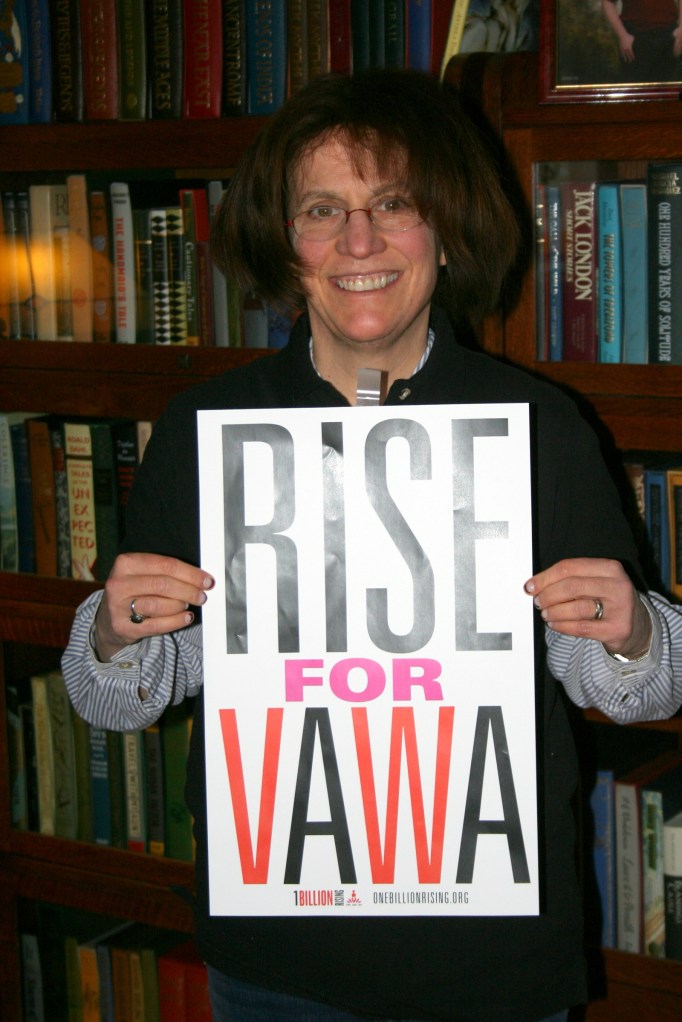
Rising in Celebration of the Passage of VAWA

Rising in Celebration of the Passage of VAWA

Today, the US House of Representatives passed the comprehensive Senate version of the Violence Against Women reauthorization Act of 2013 (VAWA) by a vote of 286-138. The Senate passed the same bill on February 12 by a bipartisan vote of 78-22.  President Obama will sign the bill into law in the next couple of days.

This was my way of celebrating! Yippee!

Update on the Status of VAWA in the US House of Representatives

This is an update from my friend Pat Reuss who wrote yesterday’s blog on the House version of the Violence Against Women Act (VAWA):

Dear Friends,

There has been an important and TIME SENSITIVE development with VAWA.

  • On WEDNESDAY, February 27th, the House will vote on a rule to proceed with consideration of VAWA.  We want them to vote YES on the Rule because that rule allows a vote on the Senate VAWA if the substitute is defeated.
  • On THURSDAY, February 28th, the vote on the actual bill will occur.  We want them to vote NO on the House substitute bill, which will come up first,  and YES on the ensuing Senate version of VAWA.

Your Congress Members are listening to you!  We only have a few hours to act so please call today and tomorrow morning. Members must hear loud and clear that they need to defeat the substitute and pass the bipartisan Senate version of VAWA!  Your work has gotten us this far – let’s get this done!

URGENT ACTION ITEM: 

To reach your Congress Member, call the Capitol switchboard at (202) 224-3121 or look them up here http://www.house.gov/representatives/.   When you’re connected to their offices, ask to speak to the staff person who handles VAWA.

MESSAGE: 

I am a constituent from (city and state) and my name is _________.  I’m calling about the Violence Against Women Act (VAWA).  I urge Congress Member ________ to vote NO on the House substitute bill and then vote YES on the bipartisan Senate version of S. 47.  VAWA can and must protect all victims.

Tweet to your Congress Member:

@[congress person’s handle]: On 2/28 vote NO on the House substitute bill and then vote YES on the bipartisan Senate version of S. 47. #VAWA

Institutional Corruption and the Influence of Money and Politics on People’s Lives

Fountain Pen and SignThis morning, I was scanning Tweets that came into my Twitter account. One of the Tweets said,

“Why the phrase ‘Supreme Court to hear campaign-finance case’ should scare you.”

It contained a link to an article in the Daily Beast. This article said that the US Supreme Court has decided to take another look at campaign financing in a case from the United States District Court in DC called McCutcheon v. Federal Election Commission. I read the article.

And yes this case scares me. McCutcheon argues that there should be no limits at all on campaign financing.  It scares me because I believe that if the Supreme Court rules in favor of McCutchen, there will be more influence and therefore more institutional corruption on our public policy.  This will then allow the creation of more holes in the safety net for people’s lives due to the corrupting influence of big money. For clarification, institutional corruption is defined as:

[T]he consequence of an influence within an economy of influence that illegitimately weakens the effectiveness of an institution especially by weakening the public trust of the institution.

Why? Because I do not trust the members of the current Supreme Court to openly and fairly take into account that elected officials need to answer to their constituents and not to the people and companies and lobbyists that influence them by throwing lots of money and offering consulting jobs to these elected officials (a form of “money”) once they leave office.

My mistrust results from their decision in the 2009 Citizens’ United case.  They held that the First Amendment to the US Constitution prohibits the government from restricting independent political campaign expenditures from corporations and unions.  The aftermath of this decision has been devastating. Immediately after this decision, the DC Circuit Court (which handles cases involving federal regulations) ruled that

“individuals could make unlimited contributions to so-called Super PACs, which supported individual candidates.”

And what did we see?  In the 2010 elections, Super PACs—mostly funded by the mega-rich—assisted conservative Tea Party candidates at all levels of government to win seats that they would not have otherwise been able to win.  This resulted in a lot of gerrymandering around the country for the incumbents’ self-interest.  And in 2012, $6.2 billion was spent on elections; over $10 million of these funds were given to a small number of Super Pacs by a very small number of mega-wealthy individuals—including the Koch brothers—to influence the outcome of the elections.

If this case overturns what few limits on campaign financing are left, the doors for institutional corruption will be thrown wide open.  Candidates will spend even more time chasing money, mostly soliciting funds from large, non-constituent individuals and corporations.  Most of these individuals are heads of corporations whose special interest is their bottom-line profits and not the interests of the “47%.”

Fred Wertheimer is President of Democracy 21. It is a non-partisan group that works to eliminate the undue influence of big money in the public arena.  He agrees with me that big money corrupts our public institutions. In a press statement on February 19, he said that the

“[A]ggregate limit on contributions by individuals is necessary to prevent circumvention of the limits on contributions to candidates and political parties and the prohibition on federal officeholders soliciting huge corrupting contributions.”

And further, if the Supreme Court either completely guts or weakens campaign financing, this decision

“…would open the door to $1 million and $2 million dollar contributions from an individual buying corrupting influence with a powerful officeholder soliciting these contributions, and with the political party and federal candidates benefiting from these seven figure contributions.”

I believe that it is the local constituent who should be influencing their representatives.  Not corporations. Not big money. And not the 1% at the top of the income ladder who do not live or experience the lives of the people who live in each of our communities.

I am one of the 85% of Americans who view Congress unfavorably because of what they have NOT been doing for people’s lives. Like allowing funds for critical domestic programs to be cut due to the budgetary stalling and delays of the Fiscal Cliff and Hurricane Sandy debates and resulting Sequestration that now looks like it will become reality this coming Friday. Like delaying passage of the Violence Against Women Act (VAWA) from being reauthorized for over two years (which, may change tomorrow when and if the House FINALLY votes on the Senate-passed VAWA Act of 2013).  Like talking about but not taking any comprehensive action, so far, to deal with violence and gun safety (for more information on this gun safety issue, read my blogs here and here).

No, I don’t trust the US Supreme Court.  And no, I do not trust Congress. All because of the influence of money on the decisions the do and do not make.

Institutional Corruption is a problem.  We need to reduce that corruption.  We need to empower the small donors.  New York City, as well as Los Angeles and San Francisco have done this.  And in a plan put together by Brennan Center for Justice at New York University School of Law and Democracy 21, we could do the same thing as well across the country. Look at the plan and then lobby your legislator, even if you don’t trust him or her. Vote for candidates in the future who pledge to listen to their constituents and not to big money.

This will take a long time.  But it is necessary. Then and only then do I believe that we can and will be able to trust our elected officials to truly represent us and our concerns.

For More Information on Institutional Corruption

For more information, watch the video below. In this 2009 presentation, Lawrence Lessig defines institutional corruption.  He then discusses the probable effects of this undue influence of money (broadly defined) not only on elected officials but its effect on other institutions, such as the EPA and medical research.