Rising in Celebration of the Passage of VAWA

Rising in Celebration of the Passage of VAWA

Today, the US House of Representatives passed the comprehensive Senate version of the Violence Against Women reauthorization Act of 2013 (VAWA) by a vote of 286-138. The Senate passed the same bill on February 12 by a bipartisan vote of 78-22.  President Obama will sign the bill into law in the next couple of days.

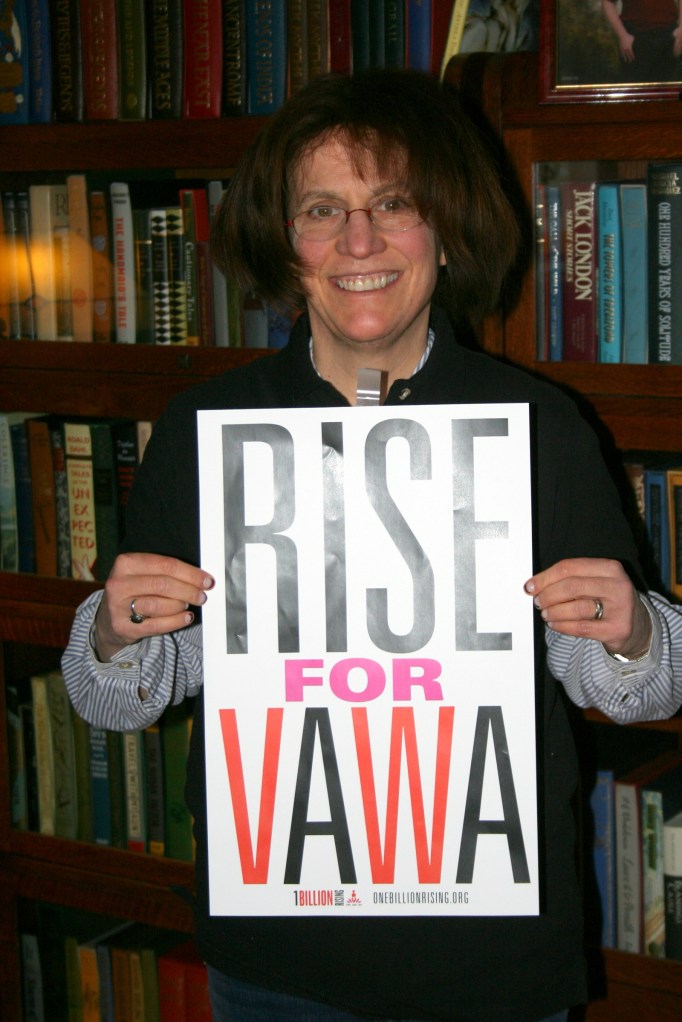
This was my way of celebrating! Yippee!

VAWA Passes Senate: One Step Toward Ending the Climate of Indifference Towards Violence Against Women

The climate of indifference that I talked about in my blog on February 10 is pervasive both here in the US and around the world.  Which is why Eve Ensler has called for a worldwide day of action to recognize and end violence against women around the world.  Thursday, February 14, 2014 is V-Day, aka One Billion Rising. V-Day calls for people around the world to Rise, Strike, and Dance to end violence against women.

Today, the US Senate by an overwhelming majority, passed the comprehensive version of the Violence Against Women ReAuthorization Act of 2013 (VAWA, S.47). We all can speak out. We all can rise and call for the end to this indifference by funding this law and allowing the Office on Violence Against Women to fully do their job in collaboration with advocates and service providers throughout the country.

If you haven’t done so already, do so on February 14. You can find your Representatives phone number here. Call him/her on V-Day.  Say that they need to have a heart, they need to have compassion, and they CAN help end this Climate of Indifference by passing and fully funding VAWA.

We Did It! White House ERA Petition Receives Over 25,000 Signatures

Between 1:30 and 1:54 pm EST today the Equal Rights Amendment (ERA) ratification petition received the required minimum 25,000 signatures that triggers a response from the White House. This means that White House staff will review it, send it to the appropriate policy experts, and issue an official response in the very near future.

Luanne J. Smith, one of the organizers for the petition drive, sent out this congratulations announcement as soon as we passed the 25,000 mark:

Yes!!!! We have passed the 25,000-signature mark, and with 3 1/2 days to spare!!!! Congratulations to Tammy Simkins, who initiated the petition and coordinated the petition drive, and to the entire team of ERA supporters who have worked so hard to see us reach this milestone!!! If you haven’t already joined the team by signing and sharing the petition, please do so NOW! Let’s get the Equal Rights Amendment moving forward! ERA NOW!!!

And here’s a screen shot at 1:54 pm EST today, February 6, 2013 showing 34 signatures over the 25,000 signature threshold.

Screenshot of "We the People" website showing more 25,034 signatures on ERA petition.

Screenshot of “We the People” website showing more than 25,000 signatures on ERA petition.

Signature number 25,000 was from Knoxville, TN.  Which by the way is rather neat.  It was Tennessee’s ratification of 19th amendment on August 24 1920 that gave women the right to vote. And that ratification vote was by a majority of one vote. So having signature 25,000 come from someone from Tennessee is appropriate.

The ERA petition to the White House will remain open for signing until 11:59 pm EST February 9, 2013.  Please add your name to the groundswell for this historic petition. For more information on the petition, check out my earlier blogs here and here.

Congratulations everyone for all your hard work!

White House Petition for the Equal Rights Amendment: Deadline to Sign is February 9

Please go to the White House’s “We the People” website & sign the Equal Rights Amendment (ERA) ratification petition; just 4 days left. Here’s an email I received from NOW and the Feminist Majority indicating that we can make this deadline IF each and every one of us acts now. For more details on why the ERA is needed, check out my earlier blog, “Why We are Pushing for Ratification of the ERA (the Equal Rights Amendment).”

ERA YES antique button

Dear Joanne ,

A petition for Equal Rights Amendment (ERA) ratification is currently collecting signatures through the We the People petition process on the White House website.

The ERA petition has over 18,000 signatures. If the petition has 25,000 signatures by 11:59pm on February 9, the White House staff will review it, send it to the appropriate policy experts, and issue an official response. (Currently, the We the People process requires over 100,000 signatures, but the ERA petition was filed before the increased requirement.)

It is time to get the ERA back high on the national agenda. This petition asks the White House to support lifting the deadline on the original 1972 ERA. Women would only need three more states to get full rights if the deadline was lifted. Thirty-five states have already ratified the ERA. We need you to go to the White House website and sign the petition.

Sign it today. Women have waited long enough for equality.

For equality,

   
Eleanor Smeal
President
Feminist Majority Foundation
  Terry O’Neill
President
National Organization for Women

Paycheck Fairness Act and the ERA

Yesterday, a reporter from the local newspaper contacted me regarding a press conference that was held by Senator Robert Casey, Jr. (D-PA). During that press conference, Senator Casey discussed a report highlighting the fact that women in Pennsylvania earn 18.3 percent less than their male peers.

This earning differential is known as the Pay or Wage Gap.  The commonly used measure to determine the wage gap is the ratio of women’s to men’s median annual earnings for full-time, full-year workers.  Nationally, in 2011, women earned just 77 percent of what men earned.  That’s a national wage gap of 23 percent.  Although Pennsylvania appears to be doing better than the nation on pay equity, we are still being short-changed.

For women of color, the wage gap is even worse.  According to the Institute for Women’s Policy Research, Asian American women have the smallest wage gap, earning 91 percent of what the average white man earned in 2010. White women are next, earning approximately 81 percent of white men’s average income. African-American women (70 percent) and Hispanic women (60 percent) have the largest wage gaps as compared to white men.

So why did Jessica VanderKolk call me for a comment about Senator Casey’s press conference? The message she left on the phone was that she was interested in what I thought of Casey’s stance on pay inequity, partly as a follow-up to an article she did on this issue in May 2012, where I was also quoted.  She wanted to know why I thought there had been almost no change in wage gap in the last year and what I thought needed to happen in order to eliminate this problem.

My first statement to her was that pay inequity is unfair and unjust.  She quoted me in the news article this morning,

“It takes just as much to feed a woman’s family as a man’s family and put a roof over your head,” Tosti-Vasey said. “Gender should have no basis [in determining] your salary.”

We then went on to discuss the main point of Senator Casey’s press conference: his support and co-sponsorship of the Paycheck Fairness Act.  This bill was introduced again for the fourth time on January 23, 2013 (Casey signed on as a co-sponsor on January 30, 2013 right after announcing his support of S.R. 84).

The Paycheck Fairness Act updates and strengthens the Equal Pay Act of 1963. It gives women the tools they need to challenge the wage gap itself.  According to the ACLU, both S.R. 84 and H.R. 377 include the following remedies and programs to help remove pay inequity:

  • Require employers to demonstrate that wage differentials between men and women holding the same position and doing the same work stem from factors other than sex.
  • Prohibit retaliation against workers who inquire about their employers’ wage practices or disclose their own wages.
  • Permit reasonable comparisons between employees within clearly defined geographical areas to determine fair wages.
  • Strengthen penalties for equal pay violations. The bill’s measured approach levels the playing field by ensuring that women can obtain the same remedies as those subject to discrimination on the basis of race or national origin.
  • Encourage proactive enforcement of equal pay laws by re-instating the collection of wage-related data and providing for training for the workers who enforce our equal pay laws.
  • Modernize the Equal Pay Act to make it more in line with the class action procedures available under Title VII. It would not extend class action protections beyond what is available under other anti-discrimination laws.
  • provide important safeguards for businesses, including:
    • providing an exemption for small businesses;
    • instituting a six months waiting period from the time of enactment and requiring the Department of Labor to assist small businesses with compliance; and
    • Recognizing employers for excellence in their pay practices and strengthening federal outreach and assistance to all businesses to help improve equal pay practices.

Yet if people in general understand that paying someone less for doing the same job is unfair, why is this bill now in its fourth iteration? I was asked this question by Jessica Vandervolk during our phone call.  She paraphrased my comment, stating that Senator Casey and I agree on this issue:

[Tosti-Vasey] said the lack of action so far may have to do with the conservative climate, and Casey added that he hopes the 2012 election makes a difference.

The paraphrase is accurate, but somewhat incomplete.  I said that I believed that the lack of passage was mostly due to conservative legislators.  I continued by stating that this is particularly true in the US House of Representatives but also occurs among conservatives in the US Senate.  Why?  Just follow the campaign money.  These legislators listen to lobbyists and business honchos who want full control over how much they pay others. If employers can get away with paying less and discriminating against one segment of their workforce, then they will lobby and work to defeat any effort to change this scenario.  When elected officials’ campaign war-chests depend upon funds from uncaring, well-financed business owners and lobbyists, they vote no.

So I agree with Casey.  We have a slightly more caring House and Senate as a result of the November election and maybe we can get the Paycheck Fairness Act to become law during this session of Congress.  As constituents, let all of your legislators–both Senators and your US Representative—know that you want them to cosponsor (if they are not already a sponsor) and vote for the Paycheck Fairness Act as soon as possible.

You can find out where your representatives stand on the Paycheck Fairness Act by going to http://thomas.loc.gov/home/thomas.php. In the search box in the middle of the page, type in “Paycheck Fairness Act” and click search.  On the next page, 2 bills will show up—SR 84 and HR 377.  If you then click on “cosponsors” for each bill, you can determine if your representatives are publicly supporting the bill or not.

Meanwhile this might never have come up as an issue to fight in Congress OVER and OVER and OVER again if the Equal Rights Amendment (ERA) had been ratified by 38 states and was now part of the US Constitution.  I recently blogged about why having an ERA is important, so check that out as well.  Once you have done that, go to the White House petition site and tell President Obama that you want him to work with Congress to finally get the ERA ratified.

President Barack Obama’s Inauguration Speech: Standing for Equality

This morning, on the holiday celebration of Martin Luther King’s birthday, President Barack Obama was publicly sworn into office for his second term as President of the United States.  His inaugural speech was 2,095 words long. It covered many different issues from the role of government to freedom, poverty, the military, education, international interactions, and climate change.

Its over-arching message to me is that as a country and as individuals, we need come together to stand up for equality for all.

President John F. Kennedy, Jr. said something similar in his 1961 inaugural speech when he asked all Americans to help each other. He said then, “And so, my fellow Americans: ask not what your country can do for you—ask what you can do for your country.”

Martin Luther King expressed similar sentiments in his “I Have a Dream Speech” in 1963:

I have a dream that one day this nation will rise up and live out the true meaning of its creed: ‘We hold these truths to be self-evident, that all men are created equal.’

I have a dream that one day on the red hills of Georgia, the sons of former slaves and the sons of former slave owners will be able to sit down together at the table of brotherhood. I have a dream that one day even the state of Mississippi, a state sweltering with the heat of injustice, sweltering with the heat of oppression, will be transformed into an oasis of freedom and justice. I have a dream that my four little children will one day live in a nation where they will not be judged by the color of their skin but by the content of their character….I have a dream that one day, down in Alabama, with its vicious racists, with its governor having his lips dripping with the words of ‘interposition’ and ‘nullification’ — one day right there in Alabama little black boys and black girls will be able to join hands with little white boys and white girls as sisters and brothers….I have a dream that one day every valley shall be exalted, and every hill and mountain shall be made low, the rough places will be made plain, and the crooked places will be made straight; ‘and the glory of the Lord shall be revealed and all flesh shall see it together.’

I hope that Barack Obama’s words resonate as well. In that vein, here is how I think he best spoke about equality for all. Maybe part of this will become part of the lexicon of great Presidential speeches in the future.

We, the people, declare today that the most evident of truths – that all of us are created equal – is the star that guides us still; just as it guided our forebears through Seneca Falls, and Selma, and Stonewall; just as it guided all those men and women, sung and unsung, who left footprints along this great Mall, to hear a preacher say that we cannot walk alone; to hear a King proclaim that our individual freedom is inextricably bound to the freedom of every soul on Earth.

It is now our generation’s task to carry on what those pioneers began. For our journey is not complete until our wives, our mothers, and daughters can earn a living equal to their efforts. Our journey is not complete until our gay brothers and sisters are treated like anyone else under the law – for if we are truly created equal, then surely the love we commit to one another must be equal as well. Our journey is not complete until no citizen is forced to wait for hours to exercise the right to vote. Our journey is not complete until we find a better way to welcome the striving, hopeful immigrants who still see America as a land of opportunity; until bright young students and engineers are enlisted in our workforce rather than expelled from our country. Our journey is not complete until all our children, from the streets of Detroit to the hills of Appalachia to the quiet lanes of Newtown, know that they are cared for, and cherished, and always safe from harm.

Our journey is not complete until every one is equal, cared for, cherished, and safe from harm.  Thank you for your inspiring words, Mr. President. May all of usfrom you as leader of the US to each of us in our homes and communitieswork together  to create a better, more accepting country and world.

Why We are Pushing for Ratification of the ERA (the Equal Rights Amendment)

Today at noon, President Barack Obama was sworn into office in a private ceremony.  Tomorrow, he will be publicly sworn in for and give his second-term Inaugural speech on the western steps of the US Capitol. He won his second term much to the efforts and votes of women and people of color.

We have come a long way since the 14th Amendment was ratified, ending slavery and adding people of color to full protections under our US Constitution.  Yet after all this time, the women who helped put President Obama into office for his second term do not yet have that same level of protection.

Women worked to end slavery and put men of color on the same constitutional footing as white, land-owning men. It’s now our turn.

I have been working with an amazing online group of women and men dedicated to equality for all. Our current effort is to gain 25,000 signatures on a White House ERA petition by February 10, 2012.  There are now three weeks left before this deadline is reached; so far, we have gathered over one quarter of the necessary signatures required.  When we reach the 25,000 signatures, President Obama’s administration has agreed to respond to our request to

Vigorously support women’s rights by fully engaging in efforts to ratify the 1972 Equal Rights Amendment (ERA).

Many people have asked, “Why this amendment is needed,” or “Isn’t it already part of the US Constitution?”  The bottom-line question being asked, “Why should I sign this in the first place?”

One of my colleagues has put together a well-written, cogent argument to answer these questions and I asked her to submit a guest blog.

Marti J. Sladek graciously agreed.  Ms. Sladek is an attorney in Chicago. She owns “Speaking Up & Speaking Out” through which she speaks, writes and advocates on women’s issues, work, the law and public policy. You can find her on Twitter, Facebook and Linked In. Here’s what she has to say…

Yes, the Equal Rights Amendment is back. No, it is not already the law of the land, although 3/4 of Americans believe it is. A new generation of feminist leaders has joined and breathed new life into the fight to put equality and equal protection for women and girls into the US Constitution. The first version, written in suffragette days and resurrected by the 70s “women’s libbers’, was passed by 2/3 of Congress then fell three states short of the necessary 3/4 for ratification. That is why you see references to the “three-state strategy” in efforts to resurrect the Amendment.

There was very little activity surrounding the effort on this amendment for more than three decades. This raises questions about whether, even if three more states vote for it, the ratification would be valid, because the legislation that began it did not address whether there was a deadline; some say that after such a long dormancy, the issue was DOA. Others, including some formal legal opinions, say if no deadline was part of the law, then the amendment still lives. Note: if you want to refresh your knowledge on how the Constitution gets modified, read Article V.

One way or the other, we have to get it done. Justice Scalia himself underscored the need when he told a legal publication in the fall of 2011 that the 14th Amendment does not protect women as its intent was only racial equality.

Did you know that “gender” was inserted into some civil rights bills in the 60s as a protected class for discrimination purposes primarily in a failed effort to defeat civil rights legislation? So some of the protections we women have are somewhat accidental!

Lately, we have seen serious attacks on gains women have made through legislation such as the Civil Rights Act of 1964–Title VII, employment discrimination; Title IX, discrimination in education at all levels; Title X, gender equity in health care, including reproductive rights–and even laws governing equal pay. Wisconsin rescinded their state Equal Pay Act last year. As we saw during the 2012 campaign season, efforts to limit or gut these and other civil rights laws such as the Voting Rights Act are underway at the state and federal level.

Courts have further eroded the impact of these laws. The Congress is less likely to overturn negative decisions from the Supreme Court than in even the recent past. Some GOP members who used to sponsor ERA have withdrawn support for fear of the Tea Party. New state legislatures could even try to rescind previous ratification of ERA! “Personhood” for embryos and eggs–but of course, not sperm–as well as restrictions on plain vanilla birth control, redefining rape, forced vaginal probes…the list goes on.

The arguments against ERA in the 1970s were speculative then and have been proven silly over the last thirty years. The horror of unisex washrooms? Give me a break: they exist all over the world, both public and in all our homes. Drafting women? No more military draft, and women are serving, yes, even in combat, albeit unofficially. The list goes on. And some bugaboos have been superseded by discrimination cases and the economic reality of women working outside the home. Plus the states that do have equal protection for females in their own constitutions are doing fine, thank you. It will be interesting, entertaining and angering to watch opponents claim, oh so wrongly, that we simply don’t need it.

Why do we need Equal Rights Amendment? Because, as we have seen, state and federal laws can be changed relatively easily. Because the courts do not give as much consideration to gender as they do to race, which is specifically mentioned in the (amended) constitution. When a government body has a policy that tends to treat one race differently than another, there is a high level of scrutiny: they have to have a truly compelling reason to get away with that kind of discrimination, along the lines of legal analysis for violating freedom of speech. Gender only gets “intermediate” scrutiny. Just a pretty good reason for treating women differently suffices. ERA could well change that.

Likewise, that kind of “logic” is reflected in analysis of issues such as sexual harassment, civil cases that generally involve private employers, landlords, etc. When a person is singled out because of race, called names, etc. the cases reflect the presumption that such conduct was unwanted and is inherently offensive (the “N” word for example). In sexual harassment, the victim must meet an initial of burden of proof that the inappropriate behavior (the “B” or even “C” word) is unwelcome and creates a hostile work environment, an extra legal hoop to jump through compared to other kinds of discrimination. The ERA could help change that, too.

So the ERA is NOT “just” symbolic, as important and critical as the symbol is. Think the symbolism is not important? Then think of how we wear religious icons as jewelry, or wave the flag on the Fourth of July. And think of that symbolism as we try to tell emerging democracies to give a fair shake to women. Such hypocrisy when we don’t have equality even on paper here! How do we explain this to them, let alone our own daughters and granddaughters? (I had a tough time trying to explain this in Cuba where women have had legal equality for decades, albeit aligned against cultural machismo; A Cuban legislator advised me, “Keep fighting!”)

The ultimate decision is with the States, generally your state legislatures. Believe it or not, it is buried in committee again if it exists at all in many states and was actually defeated in Arkansas, Florida and Virginia in the last two legislative sessions. The old red herrings about gay agendas, ordaining women as pastors in conservative religions, and, in Virginia, admitting women into the Citadel military academy prevailed. Or simply “too costly” or “not a high priority.” Even in a blue state such as Illinois, it doesn’t get out of committee despite being reintroduced year after year in the General Assembly; ironically, Illinois put gender equality into our new state constitution in 1971 but did not pass the federal one in 1982–go figure!

For those who think all this women’s rights stuff is passé here, think about something that struck me recently. My Mom is still alive, old but going strong, and an active voter in a swing state. (Oh, how we agree to disagree on politics!) Women got to vote in the federal election for the first time in HER lifetime, only one generation back. How far have we really come, baby? I believed back-in-the-day that I would be around long enough to see a woman in the White House, long enough to see the Constitution specifically address my rights. I have waited long enough. Have you?

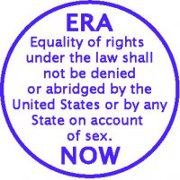
ERA words button

Equality of rights under the law shall not be denied or abridged by the United States or by any State on account of sex.

This is all it says; why such controversy?

So… take a moment, go to http://wh.gov/P6gP, sign in (or create) your White House account, and then sign the petition.  Once done, please spread the word to your friends, colleagues, and family to do the same.

We Can Do It! Alice Paul and a New White House ERA Petition

If she was alive today, Alice Paul would be 138 years old.  Ms. Paul was born on January 11, 1875. After the 19th Amendment to the US Constitution granting women the right to vote was ratified in 1920, many of the suffragettes thought women’s rights were won.  Alice Paul disagreed, saying that until women were fully written into the US Constitution, our rights would always be at risk and we could (and would) be treated as second-class citizens.  In 1923, Ms. Paul introduced and then continued working for passage of what became known as the Equal Rights Amendment (ERA) for the rest of her life.

The ERA passed Congress in 1972. It has not yet been ratified by three-quarters of the state; it needs three more states to sign on.  It is short but to the point:

Section 1. Equality of rights under the law shall not be denied or abridged by the United States or by any state on account of sex.
Section 2. The Congress shall have the power to enforce, by appropriate legislation, the provisions of this article.
Section 3. This amendment shall take effect two years after the date of ratification.

In honor of Alice Paul’s birthday, a group of women supporting the Madison Amendment or “three-state” approach for passage of the Equal Rights Amendment started a second petition on the White House petition website.

I recently wrote about the ERA and the first of these petitions. Unfortunately because of the lack of organization surrounding the first petition, it is highly unlikely that it will receive the 25,000 signatures required by its January 17 deadline in order to get a response from the White House.

This new petition, in contrast, looks like it has a much better chance of reaching the 25,000 signature threshold.  In the first 6 days of this petition drive, there have been over 4800 signatures received.  That’s an average of 800 signatures each day.  With 25 days left (deadline is February 10)—and if the momentum keeps up—we could make it.  Between now and then we need to average a total of 840 additional signatures each day.  Your help is needed.

So I am once more asking people to sign on and tell President Obama that you want him to:

Vigorously support women’s rights by fully engaging in efforts to ratify the 1972 Equal Rights Amendment (ERA).

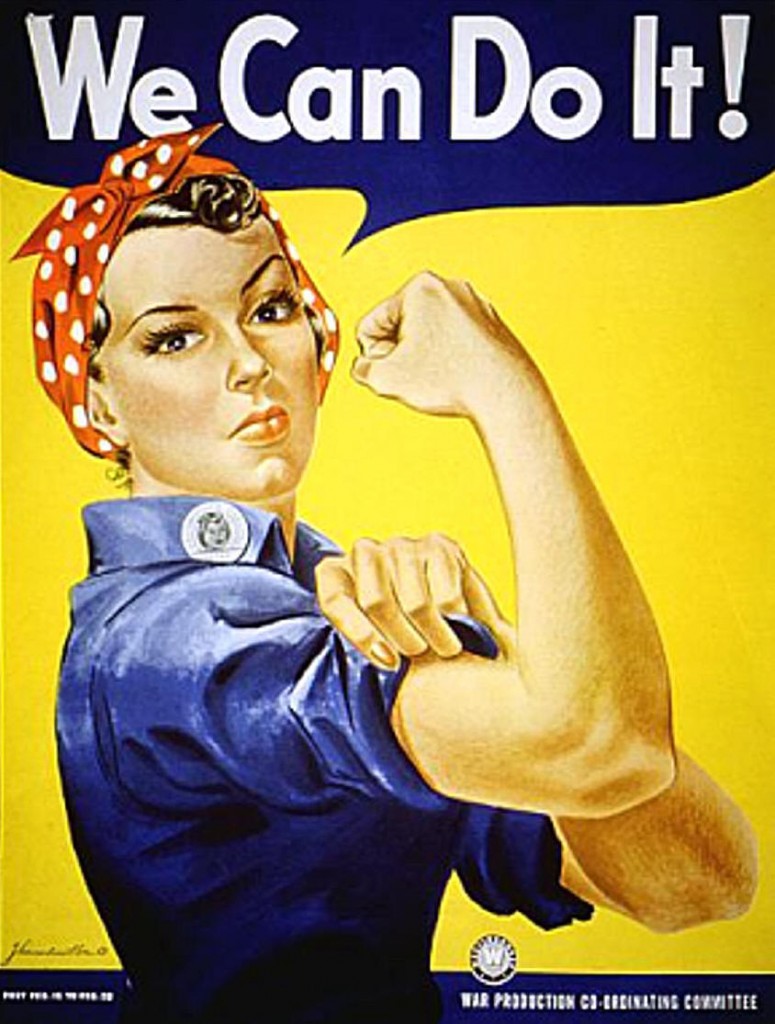
Once you sign the petition, please let your friend, family members, and colleagues know about the petition and ask them to sign as well.  Like the WWII poster says, “WE CAN DO IT!”

We Can Do It poster

“We Can Do It!” poster created by J. Howard Miller for the War Production Co-Ordinating Committee during World War II and later associated with “Rosie the Riveter”

The Washington State Economic Opportunity Institute is absolutely correct. The United States of America needs to join much of the rest of the world and create paid family leave for all employees – both men and women. The current, unpaid family and medical leave guaranteed under the federal Family and Medical Leave Act for employees who work essentially full-time for a minimum of one year for companies with 50 or more employees is untenable.

The current system in the US allows for time off from work when you have a family medical emergency or the birth or adoption of a child. BUT it’s unpaid. For full-time employees only. And only if you work for a large-size company.

For the majority of working people, this is either unworkable (you live pay-check to paycheck and have no backup income if you take unpaid leave) and or is unavailable.

We need to have full income protection for all employees, not just the 11 percent of private sector workers and the 17 percent of public sector workers in the US who do get paid leave.

Let your Congressional delegation know that you want paid medical leave legislation introduced and enacted into law. This law should provide at least partial income replacement when you need time off from work to take care of a child, spouse, or other family member throughout the lifespan.

EOI's avatarWashington Policy Watch

By Lisa Belkin, from the Huffington Post

maternity and paternity leaveAs of this week, a new father in Finland may take 54 days of paid leave to spend with his child. In Australia, a similar law gives new Dads two weeks off to bond.

These are but the two newest countries to provide paternity leave, with pay. All over the world — in places as diverse as Sweden (480 days; yes you read that right), Germany (365), Italy (90), Kenya (14), Switzerland (3) and Indonesia (2) — legislators have realized that time with a child, without worry over a lost paycheck, is a right, not a frill.

And in the US?

You know the answer to that.

As Zach Rosenberg has been highlighting on 8BitDad, companies aren’t required to offer paternity leave here. That is hardly surprising because while other countries are expanding their policies to include Dads, we are essentially the…

View original post 692 more words

White House Petition for the ERA

The Equal Rights Amendment was originally proposed by Alice Paul in 1923 after the 20th Amendment giving women the right to vote.  It has not yet become part of the US Constitution. It is time to put pressure on the White House to help get women included in our premiere document of rights.

What is the full text of the ERA? Here it is:

Section 1. Equality of rights under the law shall not be denied or abridged by the United States or by any state on account of sex.
Section 2. The Congress shall have the power to enforce, by appropriate legislation, the provisions of this article.
Section 3. This amendment shall take effect two years after the date of ratification.

What does the ERA do? Basically, it clarifies the legal status of sex discrimination in the courts and would raise women’s legal status to the same level of constitutional protection that men and people of color receive.

The ERA was introduced into Congress every session since 1923 until it passed in 1972.  Amendments to the Constitution require three-fourths of all states to ratify the amendment before it becomes part of the US Constitution.  It currently sits three states shy of reaching this threshold and has been at that point since June 30, 1982, the date by which Congress said all state ratification had to occur.

Since 1982, the ERA has been reintroduced in every session of Congress. In the 112th Congress (2011-2012), two sets of ERA ratification bills were introduced. S.J.Res. 21 (lead sponsor, Senator Robert Menendez, D-NJ) and H.J.Res. 69 (lead sponsors, Representative Carolyn Maloney, D-NY, and Representative Judy Biggert, R-IL) is the bill  that would have started the process all over from the beginning.

A second bill introduced by Representative, now Senator, Tammy Baldwin (D-WI)—H.J.Res. 47—is a much simpler bill. It would remove the ERA’s ratification deadline and make it part of the Constitution when three more states ratify. There are 15 states that have not ratified the ERA. They are Alabama, Arizona, Arkansas, Florida, Georgia, Illinois, Louisiana, Mississippi, Missouri, Nevada, North Carolina, Oklahoma, South Carolina, Utah, and Virginia.

This route, often called the Madison amendment route or the three-state process, follows the 203 year route taken by the 27th amendment. That amendment was originally introduced by James Madison in 1789 as part of package of the proposed Bill of Rights amendments. There was no time limit placed on passage and in 1992 this amendment became the 27th amendment to the US Constitution.

Legal opinion supports the conclusion that the Constitution does not impose a time limit for ratification of amendments because states only ratify the text of the amendment, not any proposing clauses.  The time limit placed into the ERA bill passed in 1972 and the extension passed in 1979 was one of the proposing clauses. The other proposing clause states that the amendment goes into effect two years after the ERA is ratified by three-quarters’ of the states. With the passage of the Madison Amendment 203 years after it was first proposed, this argument against sun-setting an amendment was strengthened.

Both sets of ERA bills failed to pass once again in the 112th Congress and are expected to be reintroduced in the 113th Congress. As I previously said, getting three more states to ratify the ERA using the Madison amendment route is a shorter and somewhat easier route to place women in the Constitution and to afford them the constitutional protections that men and people of color receive.  President Obama, using his bully pulpit can help make this happen.

President Obama has created a petition on the White House website. He has said that he will respond to any petition that receives 25,000 or more signatures within a one-month period. There is currently a petition on the website calling on President Obama to “Support and Advance the Equal Rights Amendment, originally introduced in 1972.” The petition deadline is January 17,2013.

Here is the link to the petition. Please click, sign in to the website (you will need to create an account if this is your first time here), and then add your name to the petition.

https://petitions.whitehouse.gov/petition/support-and-advance-equal-rights-amendment-originally-introduced-1972/JPFwT541

And once you sign the petition, ask your friends, family, and colleagues to sign as well. If we can get this to go viral, then President Obama will respond.

Thanks.