Montana and Pennsylvania NOW File Judicial Conduct Complaint Against Judge G. Todd Baugh

Today (September 24) at noon MDT, Marian Bradley, President of Montana NOW delivered a complaint to the Montana Judicial Standards Commission calling for the removal of Judge G. Todd Baugh and requesting that the Montana Court System require mandatory sexual-assault training of all judicial employees.

This complaint was created over the last 3 weeks or so by Montana NOW and Pennsylvania NOW, with the assistance of the Women’s Law Project and Legal Momentum.  Marian Bradley, President of MT NOW and I, in my capacity as a member of the Executive Committee of PA NOW worked very closely with Lynn Hecht Schafran, Director of Legal Momentum’s National Judicial Education Program and Carol Tracy, Executive Director; Susan Frietsche, Senior Attorney; and Terry Fromson, Managing Attorney at the Women’s Law Project.  These four women assisted us in crafting the legal wording for this complaint.  We thank them their knowledge and assistance.

We would also like to thank We are Ultra Violet and Fitzgibbon Media for their participation in this effort.  We are so grateful to Ultra Violet for their work in gathering signatures for their petition and sharing those names with us and for the time, energy and unending support they have given us. And our thanks to Fitzgibbon Media for their help with scheduling media, press releases and all things media related.

The complaint focuses on Judge G. Todd Baugh’s judicial mishandling of a highly publicized rape case, his statements blaming the victim, and his failure to follow state law in sentencing Stacey Rambold who plead guilty to one count of sexual intercourse without consent of a 14-year old Hispanic girl who later died from suicide.

In the complaint, we present the background of the case, a summary of Judge G. Todd Baugh’s misconduct, cite the portions of the judicial rules of conduct that were violated, and cite thousands of witnesses.  These witnesses include more than 250,000 people around the world who are calling for either a resignation or removal of Judge Baugh (see here, here, here, and here for the wordings of the four on-line petitions), media reports from two prominent journalists (here and here), and 350 sexual assault survivors who signed a letter calling for the removal of Judge Baugh.  The complaint was delivered to the Commission with copies of the signatures of the petition signers, the letter from the sexual assault survivors, and links to the two news articles condemning Judge Baugh’s actions.

The following is a copy of the complaint that we filed:

Judicial Standards Commission State of Montana COMPLAINT Re: Judge G. Todd Baugh filed September 24, 2013 by Montana NOW and Pennsylvania NOW

Marian Bradley standing next to the boxes of signed petitions calling for the removal of Judge G. Todd Baugh from the bench.

Marian Bradley, President of Montana NOW speaking at the delivery of the NOW complaint to the MT Judicial Standards Commission.

Note that under Montana state law, once a complaint is filed, all proceedings remain confidential unless the matter is referred to the Montana Supreme Court for potential judicial disciplinary action.  So unless the state’s Supreme Court becomes involved, the public will not know the results of our complaint.  But meanwhile you can see what we are demanding.

And a last-minute addition. On Monday afternoon, September 23, Marian Bradley talked to the Montana Attorney General’s office (Tim Fox-R is the AG). She asked about the possibility of NOW filing an amicus brief to the Montana Supreme Court in relation to the Attorney General’s appeal of Judge Baugh’s sentence in the Rambold case. They informed her that anyone is free to seek permission to file such a brief and then directed her to the office of the Clerk of the Montana Supreme Court for more information on that process.

So stay tuned….

Montana’s Judge Baugh Must Go!

Are you upset about Billings (Yellowstone County), Montana Judge G. Todd Baugh’s alleged misuse of his judicial powers in a rape case in Billings, Montana?  Here’s something you can do about it.

A petition has been started on the Ultraviolet website regarding Judge G. Todd Baugh.  In part, it says,

Earlier this week, Montana Judge G. Todd Baugh gave a teacher who raped his 14-year-old student a 30-day jail sentence. Even worse, the judge said the girl was “as much in control of the situation” as her rapist and that she was “older than her chronological age.” THIS is rape culture at its worst.

And here’s an additional piece of information: this young girl committed suicide in 2010 after the 2007 series of rapes perpetrated by Stacey Rambold.

There are several petitions out on this issue. One goes directly to Judge Baugh. A second one goes to the Montana Secretary of State. This one goes to the Montana Supreme Court and the Montana Judicial Standards Commission.

The one going to the Department of State is inappropriately targeted. Oversight for the judicial system in not held within the Department of State. That’s because of our constitutional requirement that we keep separate the duties and responsibilities of the executive and judicial branches of government.

These two judicial-branch entities in Montana have oversight on judicial affairs and the conduct of the judiciary.  So this site is the CORRECT place to go if you want to sign a petition calling on the removal of MT’s Judge Baugh.

Once again, you want to let Montana know that Judge Baugh must go, click here to sign. Thanks!

Good Start on Facebook Guidelines, But More is Needed

This morning, the Huffington Post posted an article about yesterday’s statement from Facebook.  Facebook has agreed to take the following steps to reduce online violence against women and children on their pages:

  • We will complete our review and update the guidelines that our User Operations team uses to evaluate reports of violations of our Community Standards around hate speech.  To ensure that these guidelines reflect best practices, we will solicit feedback from legal experts and others, including representatives of the women’s coalition and other groups that have historically faced discrimination.
  • We will update the training for the teams that review and evaluate reports of hateful speech or harmful content on Facebook. To ensure that our training is robust, we will work with legal experts and others, including members of the women’s coalition to identify resources or highlight areas of particular concern for inclusion in the training. 
  • We will increase the accountability of the creators of content that does not qualify as actionable hate speech but is cruel or insensitive by insisting that the authors stand behind the content they create.  A few months ago we began testing a new requirement that the creator of any content containing cruel and insensitive humor include his or her authentic identity for the content to remain on Facebook.  As a result, if an individual decides to publicly share cruel and insensitive content, users can hold the author accountable and directly object to the content. We will continue to develop this policy based on the results so far, which indicate that it is helping create a better environment for Facebook users.
  • We will establish more formal and direct lines of communications with representatives of groups working in this area, including women’s groups, to assure expedited treatment of content they believe violate our standards. We have invited representatives of the women Everyday Sexism to join the less formal communication channels Facebook has previously established with other groups.
  • We will encourage the Anti-Defamation League’s Anti-Cyberhate working group and other international working groups that we currently work with on these issues to include representatives of the women’s coalition to identify how to balance considerations of free expression, to undertake research on the effect of online hate speech on the online experiences of members of groups that have historically faced discrimination in society, and to evaluate progress on our collective objectives.

What I don’t see in this Facebook statement is an agreement to be more transparent in their monitoring process. I would like to see them report how many and what types of pages/ads that they have monitored, shut down, and/or contacted for possible violation of their regulations.  In addition, in their efforts to “balance the consideration of free expressions,” I believe they need to provide to the public upon request reasons they allow or disallow a particular ad or page that allegedly violates the new anti-rape policy from remaining online.
There were several petition sites where you could raise your voice to call on Facebook to follow through on this statement to end their misogynistic rape ads that they have called “humor.”  The one that gathered the most signatures was called Demand Facebook Remove Pages That Promote Sexual Violence.  It is now closed.  This petition collected signatures that were sent to Facebook. It successfully called upon Facebook to do several things (others are listed on the petition page itself), including

  1. Make a public statement that rape is never acceptable; that promoting sexual violence and violence against women is repugnant; remove content that advocates rape, sexual violence, and violence against women; and that the terms of service/community standards will be updated to specify this.
  2. Be transparent about the content monitoring process; to state publicly if and how many pages are removed that promotes sexual violence or violence against women.  (Note, this was not part of Facebook’s recent statement, but I believe should be part of their new policy).

Since the second issue of transparency was not covered in Facebook’s statement, I would suggest we continue making comments to Facebook about the need for more transparency.  There is another petition on Change.org. It is still open and allows you space to comment on this issue.  In that comment box, you can make your suggestion for more transparency as they craft this new policy.  Here’s what I wrote to them in that comment box:

Thank you for issuing your statement to review and update your policy on any type of hate speech that allegedly condones or promotes violence against women including domestic violence, stalking, and sexual assault (whether it is in ads or on pages).  And thank you for agreeing to “establish more formal and direct lines of communications with representatives of groups working in this area [of domestic violence, sexual assault, and stalking], including women’s groups, to assure expedited treatment of content they believe violate [your new] standards.”
However what I don’t see you your agreement is a willingness to be more transparent about this issue to the public.  I am therefore asking that your efforts to “balance the consideration of free expressions,” that you to provide to the public upon request reasons why you either allow or disallow a particular ad or page that allegedly violates your new anti-violence policy from remaining online.

trp2011's avatarNel's New Day

MySpace was a popular social network several years ago, but it was quickly taken over by Facebook and pretty much disappeared. Now, the most popular social network is showing very bad judgment.

Last week, protesters boycotted Facebook advertising because the network permitted images of domestic violence against women at the same time that it banned ads about women’s health. Companies that pulled their advertising include online bank Nationwide UK, Nissan UK, and J Street. Dove, a Unilever brand running a “self-esteem” ad campaign for women, faces pressure on Twitter although Procter & Gamble responded, “We can’t control what content they [our advertising] pops up next to. Obviously it’s a shame that our ad happened to pop up next to it.”

Zappos replied that users upset by an ad appearing next to a date rape image “click the X to delete the ad.” Zipcar is still advertising but “expressed to Facebook…

View original post 781 more words

Civil Rights Denied: PA’s Proposed Constitutional Same-Sex Marriage Ban

Logo of Freedomt to Marry, Inc.

“working to win the freedom to marry in more states, grow the national majority for marriage, and end federal marriage discrimination. ” http://www.freedomtomarry.org/pages/about-us

A couple of days ago I posted a blog about the dueling marriage equality and same-sex marriage ban bills recently introduced into the Pennsylvania General Assembly.  Today I thought I give a more detailed argument as to how discriminatory the same-sex marriage ban is to gays and straights alike.

As previously stated, on May 7, Pennsylvania State Representative Daryl Metcalfe (R-12 Butler County) introduced his legislation (HB 1349) to create a constitutional amendment defining marriage OR its “substantial equivalent” solely as a union between a man and a woman.  That bill would amend Article I of the Pennsylvania state Constitution – the Declaration of Rights section – to take rights away from unmarried couples in Pennsylvania, whether they are same-sex or heterosexual couples.  Here’s the constitutional amendment as written in HB 1349:

“Marriage is the legal union of only one man and one woman as husband and wife and no other legal union that is treated as marriage or the substantial equivalent thereof shall be valid or recognized.”

Until the spring of 2012, 31 states across the country had created constitutional amendments to outlaw marriage or anything that looks like marriage between same-sex couples. The last successful attempt at this form of discrimination occurred by referendum in North Carolina in the spring of 2012; all other attempts since then to deny marriage equality have failed.

Marriage equality however has had many successes since then. Three states – Delaware, Rhode Island, and Washington – either passed a referendum OR legislation legalizing marriage equality following North Carolina’s referendum. One state – Minnesota—is expected to pass their marriage equality bill today; note, this is only 6 months after the voters in Minnesota by referendum killed their proposed same-sex marriage ban.  And one state – Colorado – passed legislation recognizing civil unions even though they have a constitutional ban on same-sex marriage.

Instead of moving forward, right-wing legislators would like to have Pennsylvania join the 31 other states that constitutionally ban-same sex marriages and/or other legal forms of relationships such as domestic partnerships and civil unions.  These Pennsylvanian legislators are making their fourth attack on same-sex couples and on unmarried people – gay or straight.  If HB 1349 passes, Pennsylvania for the first time in its history would enshrine and mandate discrimination into the state Constitution.

This amendment would take rights away from unmarried couples in Pennsylvania, whether they are same-sex or heterosexual couples.  The way this amendment is written would affect all unmarried couples, victims of domestic violence if they are not married to their abuser, and could threaten Pennsylvania’s anti-discrimination laws

Effect on All Unmarried Couples – Gay or Straight

Currently, Pennsylvania statute recognizes only marriages between one man and one woman.

Pennsylvania does not recognize either (1) same-sex marriages or (2) civil unions, domestic partnerships, or any other coupled-household status—whether entered into by same-sex or opposite-sex couples.  Those affected by this amendment would therefore, for example, include senior citizens who live together but are not married because of economic considerations, couples who believe they have a “common law marriage” (which is no longer recognized in Pennsylvania), and gay or straight couples who have any type of intimate relationship.

It could also threaten the lives of unmarried domestic violence victims and allow unmarried individuals to be discriminated against in housing, employment, and public accommodations.

Effect on Domestic Violence Victims

In 2004, Ohio passed their discriminatory anti-marriage constitutional amendment, which was quickly and unexpectedly used to deny protections to unmarried victims of domestic violence.  Here’s what happened.  Almost immediately, unmarried batterers argued that since they were not married, Ohio could not enforce their domestic violence law because that was treating their relationship with their partner as “equivalent to marriage.” The 2nd District Court of Appeals in Ohio agreed and ruled that the Ohio domestic violence law runs afoul of the “Defense of Marriage” amendment, passed by voters in 2004, and does not apply to “a person living as a spouse.”  As a result, unmarried defendants, who could have faced felony domestic violence charges, only faced misdemeanor assault charges.    It took several years for the Ohio Supreme Court to reverse this ruling.  In the interim, unmarried women were at the mercy of their batterers in several counties in Ohio.

The Ohio amendment is very similar to that of the one proposed for Pennsylvania.   In Ohio, by providing protection to persons living as spouses,” the domestic violence statutes created a legal status for cohabiting relationships that is “equivalent to a marriage,” according to the appeals court. The appeals court decision in Ohio then denied protection from abuse to unmarried individuals – gay or straight – because the domestic violence law gave legal standing to an unconstitutional relationship – that of an unmarried couple. The courts argument overturning these domestic violence protections utilized similar language found in Pennsylvania’s HB 1439, which states that no other legal union… or the substantial equivalent thereof shall be valid or recognized.

We have no way of knowing how the courts would rule on a similar argument should this amendment pass and become part of Pennsylvania’s Constitution.  Who knows if Pennsylvania’s Supreme Court would protect the victim or allow batterers to circumvent Pennsylvania’s Protection From Abuse (PFA) law?  We need to protect all people from domestic violence and sexual assault.  Passage of this amendment could deny the protection offered by Pennsylvania’s domestic violence and protection from abuse laws; it could even risk the very lives of unmarried people–gay or straight–because this constitutional amendment denies the rights, privileges, and protections of law to people who are not legally married or who have a relationship that is “functionally equivalent” to traditional marriage.

Effects on Employment, Education, Housing, and Public Accommodations

It also looks like current and proposed employment, education, housing, and public accommodations anti-discrimination laws at both the state and local levels might be jeopardized for unmarried individuals.  Discrimination based on marital status and family responsibilities is unlawful under a variety of existing laws. With a few exceptions, under current state and federal law, people who experience this form of discrimination must fit their claims into an appropriate legal theory—as discrimination based on gender, a violation of family and medical leave laws, or another legal theory.  In addition, many municipalities throughout Pennsylvania have passed or are considering ordinances that would make it illegal to discriminate in employment, housing, and in some cases, public accommodations specifically based on sexual orientation, gender identity and marital status.   Will the state courts, the PA Human Relations Commission, or local Human Relations Commissions be able to enforce these laws if Pennsylvania’s constitution has been amended to require unmarried couples to be treated differently from married couples?  We do not know.  Passage of HB 1439 as a constitutional amendment could put all of these protections at risk since any person, company, or school could argue that their business is mandated to deny employment, hiring, and benefits to any person who is not married.

Civil Rights Denied, Reiterated

Last, but not least, exclusion, discrimination and inequality are not the principles this state was founded upon. This discriminatory “Marriage Protection Amendment” denies unmarried heterosexual, lesbian, gay, bisexual and transgender families the protections and fairness they deserve. Heterosexual married couples and their families are afforded more than 1,000 legal protections and economic benefits provided through state and federal law, benefits and protections that are currently inaccessible to unmarried couples.  Passage of this amendment would therefore subject same-sex couples and their families to exclusion, discrimination and inequality.

The proposed amendment could also take away existing legal protections for committed long-term couples and their children, such as second parent adoptions, cohabitation agreements, co-parenting agreements, wills, living wills, powers of attorney, etc., regardless of their sexual orientation.

Gay and lesbian Pennsylvanians are our neighbors, co-workers, friends, and family member.  They pay taxes.  LGBT people should not be bullied.  They deserve the same rights, protections, and responsibilities that all residents desire and have.

Let’s all work to stop this bill now!  So I’m once again recommending that you keep up-to-date on this horrible bill as well as other LGBTQ legislation at  Equality Pennsylvania’s website.

Pennsylvania General Assembly Again Attacking Women’s Reproductive Health

Keep Abortion Legal NOW Round

Keep Abortion Legal Safe, Legal and Accessible (http://www.now.org/issues/abortion/)

It’s 2013 and the Pennsylvania General Assembly continues to attack women’s access to reproductive health. According to WeveHadEnoughPA.org, the Pennsylvania legislature has launched and maintained a 2+ year attack on women’s health. There have been numerous bills introduced and in some cases passed that restrict women’s vital access to reproductive health.  Since January 2011, there have been at least 55 votes in the Pennsylvania General Assembly to restrict access from birth control to safe, legal abortions.

The most recent attack is happening this month.  On April 10, the Pennsylvania Senate Insurance and Banking Committee heard and passed out SB 3 by an 8-5 vote; a floor vote could occur any time this month.  This coming Monday, April 15th, the Pennsylvania House Health Committee will be hearing and voting on HB 818, the companion bill to SB 3.

The Additional Burdens on Women Seeking Abortion Care in These Bills

Both of these bills would prohibit insurance companies who provide health care coverage from including abortion coverage within the new healthcare Exchange crafted by the Affordable Care Act (aka Obamacare). The only exceptions to this proposed ban are for women who become pregnant because of rape or incest if they personally report the sexual assault to law enforcement officials and for women who will die without immediate access to abortion services. If a woman doesn’t meet one of these two exceptions, she must completely pay for the abortion totally out of her own pocket, unlike any other medical care she would receive under her health insurance plan.

Currently, about 80% of private insurance companies provide coverage for abortion services. This is important because these very same plans will be offered to people purchasing insurance through the Exchange. As part of the federal law, however, all plans that offer abortion coverage in the Exchange must have a separate payment for that portion of the coverage. This bill would deny women the right to make this separate payment and deny them what is currently available to most people covered by the current private health insurance system. While women would still be able to have abortions in this circumstance, they would be forced to fully pay out-of-pocket all cost for these procedures; their insurance company would be prohibited from paying any portion of this treatment.

This proposed ban places an undue burden on victims of rape and incest and on those women whose lives are in danger health-wise by adding unnecessary barriers to receiving the critical medical attention they need. The two exceptions allowed are extremely limited. These bills require woman who are victims of rape or incest to notify the police and identify the perpetrator prior to seeking abortion treatment.  It also limits women with health issues that complicate their medical treatment to those that are in immediate danger of dying and requires additional medical certification by second, non-attending physician.

This bill places these restrictions on access to health insurance not by mentioning rape or incest or the death aversion clause, but by referring to and expanding Pennsylvania’s version of the Hyde Amendment.  This language is embedded in 18 Pa.C.S. § 3215(c) and would expand restrictions on public funds to all privately paid insurance plans purchased within the Exchange. The law (18 Pa.C.S. § 3215(c))as currently written is a prohibition of the state spending of public funds but not personal funds provided by the person herself for her own health insurance coverage.

The Rape and Incest Exception

Women and minors who are raped would be denied access to abortion services unless they formally report and identify their rapist to the police or child protective services.  Most sexual assaults are not reported to the police. This is even truer when the perpetrator is a family member or acquaintance. According to the Pennsylvania Coalition Against Rape, sexual assault occurs at a much higher rate than is actually reported.

Reasons for not reporting include an initial denial that they have been raped; fear that you won’t be believed or are ashamed for having been raped; or having an ongoing relationship (such as a spouse or parent) with the perpetrator. In order to be safe from further violence by the perpetrator, women and girls may decide not to report the attack to the authorities.  And if you are in denial you are also unlikely to report your rape or the incest of your child to authorities as required in this proposed legislation.

So that means if this bill becomes law and you become pregnant from rape or incest, you are further burdened with the additional costs of fully paying for the abortion. If this bill were not to go into effect, then following the restrictions placed on abortion care under federal law, you would have the abortion services covered based on the insurance rider you purchased in the exchange and you wouldn’t be forced to file a complaint with the police.  This is just one reason why this bill should be voted down.

The “Avert” Death Exception and Need for Expanded Health Exception

In addition, under this proposed law, women who are near death could receive an abortion.  However, say a woman develops cancer or an infection during her pregnancy that will not immediately kill her but would complicate her medical treatment should she continue with the pregnancy.

This health threat/complication is not included in the current bill’s health exception as that exception allows abortions only to “avert” the woman’s death. Any woman with a medical condition that is complicated by the pregnancy but doesn’t immediately place her in danger of death would be forced to bear the additional burden of the full cost of an abortion in addition to the increased threats to her health as well as the additional medical bills for the remaining part of her care.  The medical community, advocates and some legislators are very concerned about this limited exception and have proposed an amendment to both the House and Senate bill to expand this exception from “averting” her death to coverage of the abortion for any pregnancy that poses a substantial risk to the woman’s physical health.

But even if the health exception is expanded to include threats to women’s physical health and care, this bill continues to attack women’s health and lives and should be voted down.

Why this Bill Should be Voted Down

The question of whether abortion will be covered in federally subsidized insurance exchanges has already been settled.  In response to concerns raised by US Senator Ben Nelson, a staunch opponent of abortion, women who want to use their own money to purchase a health insurance plan that covers abortion services must send a separate payment so the funding for abortion coverage is completely separate and paid entirely by the individual. This bill denies women their right to make this separate payment.  And with an estimated 80% of private insurance plans currently covering abortion care, banning abortion coverage in the state exchange would leave women worse off than they were before health care reform began.

Abortion care is a legally authorized and fundamental component of women’s basic health care.  Women should not be denied access to safe, legal, and critical care as part of health care reform implementation.

If abortion coverage is available to some, it should be available to all.  Politicians should not discriminate against women participating in the health insurance exchange.  All women deserve the same peace of mind that they can obtain the health care they need, regardless of where their insurance comes from.

The decision to have an abortion is a private decision between a patient and her physician. It should not be denied by politicians interfering with an insurance company and the policies they offer to the consumer for this procedure.

Banning abortion coverage in transactions between a private company and an individual is governmental activism of the worst kind.  With all of the heated rhetoric over healthcare reform, one would assume that lawmakers would be sensitive about taking any action that suggests government intervention in private healthcare decisions.

Finally, instead of denying Pennsylvania women access to fundamental reproductive health care services, politicians should be working to protect and advance women’s health.

Action Needed

Contact your Pennsylvania Senator and Representative today (find their contact information here).  Tell her/him to support the expanded health exception amendment to both SB 3 and HB 818 and to oppose the entire bill regardless of the inclusion of the amendment.

CNN’s Steubenville rape trial coverage is patriarchal. Rape is a Human Rights violation. All of these media outlets need to apologize.

This is a link to a petition that you can sign and send to CNN to demand that they apologize for their patriarchal coverage of the rape verdict.

If I find other petitions dealing with other media outlets, I’ll post them as well.

trp2011's avatarNel's New Day

Imagine a segment of Law and Order that begins with the scene of an unconscious drugged 16-year-old girl being dragged from one house to another over several hours while large football players stopped to sexually assault her, urinate on her, and spray their semen on her. No one intervened; they just called themselves the “rape crew” and joked while they took videos. The girl woke up the next morning, naked without jewelry and cellphone, in an unfamiliar house.

On this fantasy program, the police would identify the perpetrators, discover that this is a part of the male’s behavior, and then bring justice to the girl. Courts would try the male teenagers as adults and force them to serve actual time in prison. But I did mention that this program is a fantasy.

The first scene actually took place in Steubenville (OH); the rest of the events failed the raped girl…

View original post 1,279 more words

Powerful UN CSW57 Document on Ending Gender-Based Violence Created

On March 14, I wrote a blog entitled “The “Unholy Alliance” that May Defeat Comprehensive UN Call to End Gender-Based Violence.” I talked about an alliance between the Vatican, Iran, Russia and a couple of other countries that were attempting to eviscerate the comprehensive plan being created at the 57th session of the United Nations Commission on the Status of Women (CSW57) to end gender-based violence and fully comply with all of the universally agreed-upon agreements (treaties, resolutions, and statements). These previous agreements include the Women’s Rights Treaty (commonly known as CEDAW or the Convention on the Elimination of Discrimination Against Women (1993)) as well as the Beijing Platform for Action (1995), and UN Security Council Resolution 1325 (2000).

I am happy to say that this didn’t happen.  Thanks to the bloggers, news media, Tweeters, NGO’s attending CSW57, and several official Member States, the amendments to the document were voted down on Friday during the final day of the 2-week convention.

Iran was the only country that voted against the final, comprehensive document. The Vatican did not get to vote because of its status as a “Permanent Observer State” rather than as a voting “Member State”. And Russia backed down and voted for the final document along with all of the remaining UN Member States.

People around the world heard about these attempts to deny women and girls safety from all forms of violence.  We spoke out and acted.

As a result, unlike last year, we FINALLY have a strong document that

“condemns in the strongest terms the pervasive violence against women and girls, and calls for increased attention and accelerated action for prevention and response.” (Source)

This document has a strong prevention focus since the best way to end violence against women and children is to stop it BEFORE it happens.  It also addresses inequalities in the political, economic, and social spheres that engender violence. And it takes action to provide services and justice for victims of violence around the world.

Ms. Michelle Bachelet, United Nations Under-Secretary-General and Executive Director of UN Women summarized the comprehensive coverage of this powerful statement to end this type of human rights violation in her closing statement of the conference:

During the past two weeks, discussions centred on matters of urgency to people around the world — eliminating all forms of violence against women and girls, ending impunity for perpetrators, fully engaging men and boys, and advancing women’s empowerment and gender equality to prevent and end these human rights violations….

Important and timely matters were addressed — ending child and early forced marriage, protecting the rights of persons with disabilities, and providing justice and critical services for survivors of violence.

There were debates on ending sexual violence in conflict, tackling human trafficking, protecting sexual and reproductive rights, and on the role of culture, religion and the family.

You had many intense late-night negotiations, going over every single word and paragraph, debating long and hard in order to come to [this] strong agreement.

UN Secretary-General Ban Ki-moon, immediately after CSW57, released a statement showing the commitment of the United Nations to fully implement this new document. It says, in part:

Violence against women is a heinous human rights violation, global menace, a public health threat and a moral outrage.  No matter where she lives, no matter what her culture, no matter what her society, every woman and girl is entitled to live free of fear.  She has the universal human right to be free from all forms of violence so as to fulfill her full potential and dreams for the future.

States have a corresponding responsibility to turn that right into reality.  The Secretary-General hopes that all the partners who came together at this historic session and others around the world will now translate this agreement into concrete action to prevent and end violence against women and girls.  The United Nations system is fully committed to leading this global effort.

So now I say, THANK YOU! Thank you for creating this statement. It is one more step  towards realizing the rights, dignity, and humanity of girls and women throughout the world.

Picture of Joanne Tosti-Vasey standing with sign that says "I AM Ending Violence"

Joanne Tosti-Vasey “Refusing to be Silent” and calling for an end to gender-based violence

The “Unholy Alliance” that May Defeat Comprehensive UN Call to End Gender-Based Violence

Last week, on International Women’s Day (March 8), I participated in the 24-hour Global Tweet-a-Thon to end gender-based violence.  This event was held in conjunction with the 57th session of the United Nations Commission on the Status of Women (CSW57) that is being held in New York City.  The theme of this year’s session is the “Elimination and prevention of all forms of violence against women and girls.”

I participated as a host for one hour of this event to facilitate the global conversation between people around the world and those attending the unofficial Non-Governmental Organization (NGO) programs at the UN as well as to send a message to the official UN delegation. Our message was that advocates around the world are looking for a strong draft statement calling for the full elimination and prevention of all forms of violence against women and girls as directed by the theme of this two-week conference.

Here are a few of the many tweets I sent out that either addresses the situation of violence in countries around the world OR that calls on governments, including the UN, to create best practices to end gender-based violence:

@JoeBiden “40% of all mass shootings started with the murderer targeting their girlfriend, or their wife, or their ex-wife.” #EndVAW #CSW57 #IWD2013

The first sexual experience for 24% of women in rural Peru was forced. #EndVAW #CSW57 #IWD2013

In Latin America & the Caribbean, abused women reported higher incidents of miscarriage and induced abortion. #EndVAW #CSW57 #IWD2013 (Source)

In South Africa, women who were abused by their partners are 48% more likely to be infected with HIV than those who were not. #EndVAW #CSW57 #IWD2013

To #EndVAW, governments must enact legislation that addresses violence based on sexual orientation and gender identity. #CSW57 #IWD2013

To #EndVAW governments must fully fund health services for survivors of violence, including #HIV screening & emergency contraception. #CSW57 #IWD2013

To #EndVAW, governments must ensure girls and women have access to abortion in cases of rape and incest. #CSW57 #IWD2013

Providing young people with human rights-based, comprehensive sexual and reproductive health services and information helps #EndVAW. #CSW57 #IWD2013

Respecting, protecting, and fulfilling girls’ and women’s sexual rights can minimize the violence they face. #EndVAW #CSW57 #IWD2013

Promoting girls’ and women’s sexual rights is a key tool to #EndVAW, address women’s inequality, and achieve sustainable development. #CSW57 #IWD2013

Domestic laws to #EndVAW should align with international best practice and reinforce the protections found in #humanrights treaties. #CSW57 #IWD2013

And

There is no country where women and men are equal in all spheres of life. You have the power to can change that! #EndVAW #CSW57 #IWD2013

That last tweet is a call for individuals, organizations, countries, and the United Nations to pull together to create and execute a comprehensive plan to end gender-based violence and fully comply with all of the universally agreed-upon agreements (treaties, resolutions, and statements), including the Women’s Rights Treaty (commonly known as CEDAW or the Convention on the Elimination of Discrimination Against Women (1993)) as well as the Beijing Platform for Action (1995), and UN Security Council Resolution 1325 (2000)

I had hoped the draft document that is supposed to be finalized and signed on March 15 – the final day of the two-week deliberation – would help strengthen these treaties.  Instead on Tuesday, March 12, 2013, I received an email from two NGOs – the Center for Women’s Global Leadership (CWGL) at Rutger’s University and International Women’s Rights Action Watch Asia Pacific (IWRAW Asia Pacific)—indicating that

“the United Nations Commission on the Status of Women (CSW) is wavering in its commitment to advance women’s human rights as demonstrated in the constant negotiation of the language in the outcome document.”

The next morning, I saw a New York Times editorial called “Unholy Alliance.”  This article clearly lays out what was going on in the official deliberations.  Apparently, the Vatican (which, btw, is a “Permanent Observer,” not a “Member State”), Iran, Russia, and a few other Member States have spent the their entire time at CSW57 trying to eliminate language in the draft communiqué to “duck” their obligations – and thus the obligations agreed to by most of the world – to eliminate all gender-based violence.

Their excuses?  Religion. Custom. Tradition.

What are they objecting to specifically?  Any reference to abortions or contraception.  Any mention of reproductive or sexual health. Any reference to forced sex as rape by either a spouse or other intimate partner.  And even any reference to women’s rights in general from the aforementioned international agreements; in this case, they claim that either religious or cultural traditions must take precedence over ending any form of gender-based violence.

These “reservations,” by the way, are the same reservations raised by essentially the same countries at the 56th session of the CSW conference in 2012.  As a result, that session ended without any agreement and women, once again, were left without a comprehensive UN plan to help improve their lives.

I am appalled. Gender-based violence is a crime against humanity.  Whether that crime is perpetrated by a government (for example, when military units carry out gang rapes and other gender-based war crimes for ethnic intimidation, ethnic cleansing and terrorizing a community).  Or when that crime of violence is perpetrated by individuals.

After learning all of this, I contacted the National Organization for Women (NOW) chapters in Pennsylvania.  Within 24 hours, Pennsylvania NOW along with South Hills NOW (Pittsburgh area), East End NOW (part of Allegheny County just east of Pittsburgh), Northeast Williamsport NOW, Ni-Ta-Nee NOW (my chapter here in Centre County), and Montgomery County NOW all co-signed the letter created by CWGL and IWRAW Asia Pacific.

This letter was signed by 281 organizations from 57 countries and 129 people from around the world and delivered to the conference on March 14.  FYI, since some of the organizations do not include the country of origin in their names, there may be — and probably are — more than 57 countries represented on this letter.

Here’s the letter that we signed.

IWD Statement on Concerns of Women’s Organizations Over Negotiations on CSW 57 Outcome Document 3-14-13

I along with all of these organizations and individuals want to see a comprehensive UN program to end violence against women and girls.  We want to strong enforcement of all international agreements.

Patriarchy has no right to quash human rights.  Let’s hope that the official delegates hear our voice and stop this “unholy alliance.” If allowed, the result will be more, not less gender-based violence.

If not, then I believe that like last year there should be no UN document signed by the United States or any other Member State participating in the 57th CSW conference.  Going forward with a strong plan to end all forms of violence is the best plan.  Going backwards is appalling and should not be condoned.  Better nothing than something that moves us backwards.

Let’s just hope they hear our voice and “do the right thing.”

US Congress passes Violence Against Women Act: Article via AFP

This article was first posted on Thursday, February 28, 2013 2:12:14 PM.  It gives a very good summary of how the Violence Against Women Act passed and why it took so long.

US Congress passes Violence Against Women Act (via AFP)

After months of partisan delay, the US Congress passed the Violence Against Women Act on Thursday, reauthorizing protections from domestic violence and sexual assault for millions of women. The bill — a reauthorization of legislation first enacted in 1994 but which includes new protections — passed…

About AFP: AFP is a global news agency delivering fast, in-depth coverage of the events shaping our world from wars and conflicts to politics, sports, entertainment and the latest breakthroughs in health, science and technology.

House Republicans Introduce Partisan VAWA that Fails to Protect ALL Victims

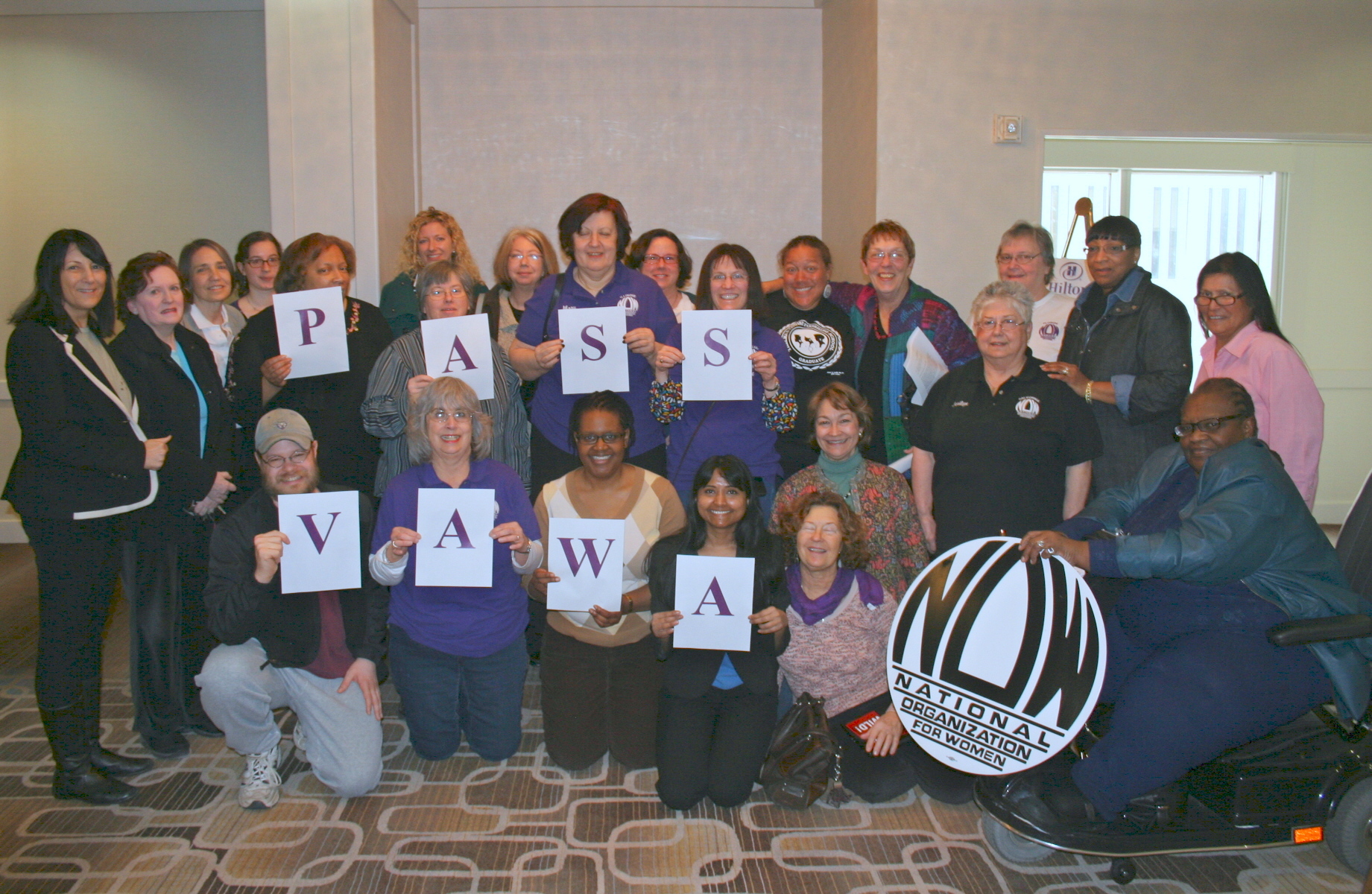
NOW Board Supporting VAWA 2-24-13 editedToday, I am presenting a guest blog by my dear friend and colleague Pat Reuss. Pat describes herself as “a longtime women’s rights activist pretending to be retired and currently serving as a policy adviser to NOW [National Organization for Women] and the National Task Force [to End Sexual and Domestic Violence Against Women].”

Pat has a history several decades-long advocating for a comprehensive Violence Against Women Act (VAWA). She first started working on this issue in the early 1990’s.  At that time, she worked as the policy director for what was then called the NOW Legal Defense and Education Fund (now known as Legal Momentum).  In that capacity, she worked very closely with then Senator, now Vice-President Joe Biden to write the first VAWA passed by Congress and signed into law in 1994.

This is Pat’s statement calling on anti-violence advocates to contact their representative in the US House of Representatives to vote for the comprehensive Senate-passed version to reauthorize VAWA:

The Republican’s version of VAWA, which substitutes the Senate’s inclusive, comprehensive version of S.47 for a bill that excludes effective protections for LGBT, immigrant, tribal and campus victims, will likely be on the House floor this Thursday.  The National Task Force [to End Sexual and Domestic Violence Against Women] (NTF) and NOW oppose this [House substitute] bill.  We need to call our Representatives and firmly ask them to vote against the House Republican Leader’s substitute VAWA and ask them to vote for the field-approved VAWA passed in the Senate.

Tomorrow [February 27], Representatives Issa (R-CA) and Cole (R-OK) will ask the Rules committee to allow them to offer an amendment to replace the House’s flawed tribal provisions with improved language that will provide effective, constitutionally sound protections for Native victims of domestic violence. Call your Representatives and ask them to tell House leadership to accept these amendments.

78 Senators from both parties and over 1,300 local, state and national professional and policy organizations support the Senate-passed bill as do law enforcement officials, health care professionals, community program and service providers, and the tens of millions of survivors and their families, friends and loved ones who rely on and have benefited from and used the services and resources provided by the 19-year-old law.

It must be noted that after months of tireless efforts by advocates working with the Republican leadership staff, there are some small but very important improvements in this substitute and the bill is not the punitive version of last year’s House bill. 

That said, the [House] Republican version of the bill  fails victims in a number of critical ways:

  • Fails to include the LGBT provisions from the Senate bill. 
  • Fails to include “stalking” among the list of crimes covered by the U visa (a critical law enforcement tool that encourages immigrant victims to assist with the investigation or prosecution of certain enumerated crimes); current law already includes domestic violence and sexual assault, among others, and the Senate bill’s inclusion of “stalking” recognizes the serious threat this crime poses to safety.
  • Provides non-tribal batterers with additional tools to manipulate the justice system, takes away existing protections for Native women by limiting existing tribal power to issue civil orders of protection against non-Native abusers, while weakening protections for Native women.
  • Contains harsh administrative penalties and hurdles for small struggling programs and an additional layer of bureaucracy through the office of the Attorney General.
  • Drops important provisions in the Senate bill that deal with improving campus safety and that work toward erasing the rape kit backlog.
  • Weakens protections for victims in public housing.

We must oppose this partisan substitute and pass the Senate version of VAWA.  201 Democrats are sponsors of H.R. 11, the House replica of the Senate bill as introduced. 19 Republican Representatives have asked the House Republican leaders to pass a bipartisan bill that “reaches all victims” and dozens more Republicans support some or all of the Senate provisions that are not included in the Republican VAWA imposter.

BIPARTISAN ACTION ITEM: Call your Democratic House members to ensure that they will oppose the Republican leadership’s substitute and support the “real” S. 47, the Senate passed bill.

Find out if your Republican Representative is one of the 19 who supports a bipartisan, inclusive VAWA and ask them step up and to oppose the Republican leader’s substitute and demand and support a vote on the Senate bill:

  1. Call or email the 19 (Poe R-TX and Ros-Lehtinen R-FL have added their names) who signed the letter to House leadership. See letter and signatories here. Names and contact information here.
  2. Call or email the 7 Members who voted against last years’ harmful, non-inclusive Republican VAWA.
  3. Call or write the 26 House members who have interest in one or some of the Senate’s inclusive provisions.

Update Wednesday evening February 26:

Thanks to your calls and emails and tweets (or however you interacted with your US Rep,), it looks like our push-back to stop the watered-down version of VAWA is starting to work.

A Politico.com report at 6:48 this evening (February 26) states that “House Republicans seem to be resigned that their version of the Violence Against Women Act is a loser with their own members and are likely to pass the Senate bill this week without changes.”

Let’s keep up the pressure. Call your Representative tomorrow and tell him/her to vote for the original Senate version of S.47.