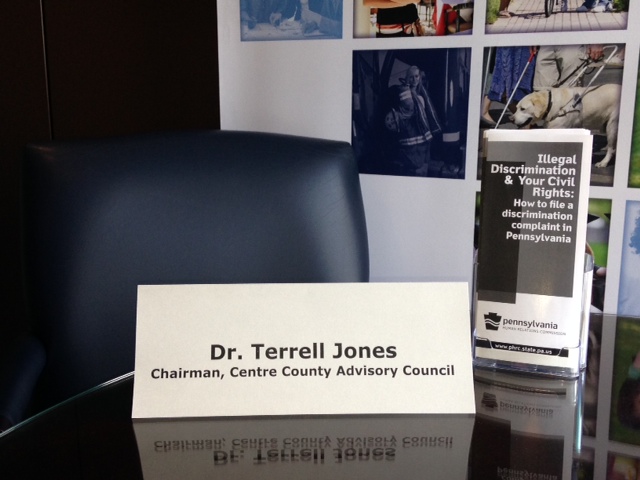
picture of an empty seat at the table for Dr. Jones

An Empty Seat at the Table: In Memory of W. Terrell Jones

On Tuesday, August 19, I received a forwarded email from PSU Executive Vice President and Provost Nicholas P. Jones:

It is with deep sorrow that I’m writing to inform you that our colleague and friend, Dr. Terrell Jones, Vice Provost for Educational Equity passed away this morning.  Terrell had been on medical leave the last few months.  He will be greatly missed across the University not only for the impact of his contributions to Penn State, but also for simply the wonderful person that he was.  We will share with you the details regarding funeral arrangements as they become available.  Please keep Carla [Roser-Jones] and Terrell’s children in your thoughts and prayers.

This short note brought tears to my eyes and a great sense of loss. W. Terrell Jones was a civil rights advocate par excellence both in and out of work. He brought humor and caring to everything he did.
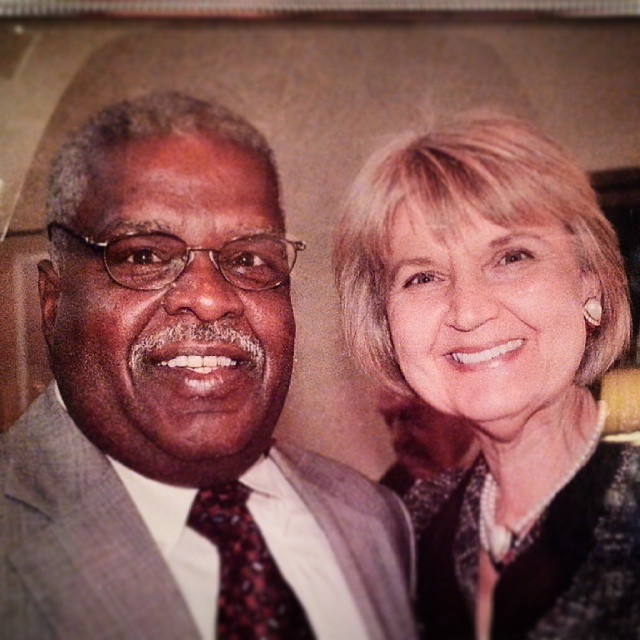
picture of Terrell Jones & Carla Roser-Jones

W. Terrell Jones (pictured with his wife Carla Roser-Jones). A Civil Rights advocate in and out of work.

I first met Terrell in the early 1990’s when I attended a meeting of the Centre County Advisory Council to the Pennsylvania Human Relations Commission (PHRC). Soon after that, I was appointed to this Council and served with Terrell up until his death. Until March of 2013, Terrell chaired the monthly meeting of the Advisory Council. His passion for low-income students of color, concern for community diversity and acceptance, and a love of knowledge was quite apparent.

He was a teacher, a counselor, a fountain of trivia on people and ethnicities across the country and around the world. And did his work—both paid and unpaid with a sense of humor and dignity. Here’s a sampling of his ability to teach with humor in the classroom; this is one of the many classes on race relations and cultural diversity that he taught over his 35 years of work at the Pennsylvania State University and one year at Lock Haven University.

On Thursday, August 21, I attended the bimonthly meeting of the Inter Agency Task Force on Community Activities and Relations in Harrisburg. According to the PHRC,

The task force is made up of [the] PHRC, the PA Attorney General’s Office and the PA State Police, working in conjunction with other state and federal agencies, community organizations, advocacy groups, local government and law enforcement agencies.  The primary function of the group is to quickly and appropriately address civil tension when conflicts occur, and to promote positive community relations among various groups in order to prevent tension.

The meeting was opened at 10:30 am by Tameka Hatcher, Program Analyst for the PHRC. We usually open these meetings by going around the table and introducing ourselves. This morning was slightly different. Tameka held up Terrell’s name plate and announced that he had passed after a four-month battle with cancer. She asked for a moment of silence and then asked Martin Kearney, Investigative Supervisor at the PHRC and me to say a few words about Terrell. We then placed the name plate at the table to honor our missing comrade.

picture of an empty seat at the table for Dr. Jones

An Empty Seat at the Table: In Memory of Dr. W. Terrell Jones

Here’s some of the accomplishments we talked about:

Local Ordinances

Terrell helped organize a community public forum on discrimination in housing and employment based on sexual orientation and gender identity about 8-9 years ago. Based on the feedback from that forum, the State College Borough decided to review their Fair Housing Ordinance that had passed in 1994 and decided to expand it as well as create an employment anti-discrimination ordinance in 2008. Working with the Centre County Advisory Council, Terrell and I worked with the town council to help craft the new ordinances that now contain the broadest anti-discrimination protections in the state. The employment ordinance includes marital status, familial status, family responsibilities, gender identity, and sexual orientation in addition to the state-level protections found in the Pennsylvania Human Relations Act. The public accommodations and fair housing ordinance includes marital status, familial status, gender identity, sexual orientation, and source of income in addition to the state-level protections of the Pennsylvania Human Relations Act.

Tension and Hate

Calming down communities when tensions rise due to religious, racial, gender, or LGBTQIA intolerance, vandalism, and/or hate speech was a forte for Terrell. He created trainings on racial equality, worked with groups to figure out how structurally and organically they could improve their communities to be more accepting and tolerant. He did this for the entire Penn State University community at all of the campuses, within Centre County and across the state. Working with Unity groups, the PHRC, and coalitions, he helped bring together people.

Statewide Leadership

At Penn State University

Seen as an expert on race relations and diversity, Terrell was often called upon to lead programs and organizations dealing with these types of issues. When he started his position as Vice Provost of Educational Equity in 1998, he created “A Framework to Foster Diversity.” According to the Centre Daily Times, this document is a regularly updated plan outlining Penn State University’s diversity and equity goals. As part of his leadership in this position, Terrell oversaw many different offices and commissions to achieve his vision of “an inclusive and welcoming environment for all.” These offices and commissions include:

Units and Programs

College Assistance Migrant Program
Educational Opportunity Center (Philadelphia)
Multicultural Resource Center
Office for Disability Services
Office of Veterans Programs
Student Support Services Program
Talent Search
Talent Search York
Upward Bound
Upward Bound Math and Science Program
Upward Bound Migrant

Commissions and Committees

Equal Opportunity Planning Committee
President’s Equity Commissions
Commission on Lesbian, Gay, Bisexual, and Transgender Equity
Commission on Racial/Ethnic Diversity
Commission for Women

And according to the PSU Office of the President, Terrell led other programs and events throughout his tenure at the University: “He served on the University’s Forum on Black Affairs for many years, and was its president from 1986-87. He also was chair of the Equal Opportunity Planning Committee from 1989-96 and Penn State’s Representative for the Global Sullivan Principles from 2000-2005.”

Community Leadership

As I previously stated, Terrell was appointed to and later led the Centre County Advisory Council to the PA Human Relations Commission for over 20 years. We met 10 out of the 12 months of each year and then held a family picnic for members every August. Our meetings brought together members of the community who act as the “eyes and ears” of diversity in the community. We gathered each month to discuss concerns about injustice and joys of acceptance of people of all backgrounds within Centre County.

Both of us also handled the Blue Pages phone hot line answering questions about unfair treatment and potential discrimination.  As appropriate we gave these individuals information on how to contact the PHRC to file a complaint and/or provided on other resources to assist them in resolving their issues.

Over the years, several different representatives from the Pennsylvania Human Relations Commission would attend these meetings so that we could pass on the news – both good and bad – to help the state monitor issues of inclusion and tension throughout the state.

We also had a good time, always looking forward to Terrell’s “main dish” offerings at our picnics. He fed us with fried turkeys, roasted pork, and tons of catfish over the years – all his own handiwork!

Terrell was also active in his local church – the Jacob Albright-Mary McLeod Bethune United Methodist Church. I understand that he was one of the leaders of this church, having served from 1990 until his death as a member of its Administrative Council. At the funeral, Reverend Kathleen Danley described his leadership by telling about her arrival at the church this past January. She said that members of the church seemed very tense or sad about their former preacher’s departure. Until Terrell arrived. She said with his arrival, the tension left the room and everyone felt better and got to work. Having that kind of presence is rare.

Leadership across the Commonwealth

Terrell also brought his wisdom and expertise to all corners of the Commonwealth. I asked Martin Kearney, the Investigative Supervisor for the Harrisburg Regional Office of the Pennsylvania Human Relations Commission to put this part of Terrell’s leadership into perspective. Here’s the email he wrote in response:

You asked me about Terrell’s work with PHRC.  I have had the pleasure to have worked with Terrell for nearly a decade when he was Chair of the PHRC Advisory Council for Centre County.  Other colleagues, such as Homer Floyd, Kaaba Brunson, and Ann Van Dyke have known and worked with Dr. Jones for three decades or more.  I am grateful I had the opportunity to learn from him and his work.

Essentially, from the state standpoint, Terrell was key in helping make PSU a more welcoming place for persons of all protected classes, particularly but not exclusively students of color, in his career.  He kept the PHRC apprised of these efforts, especially in regard to academic achievement and safe learning environment for these students.  His work in the vineyard has borne fruit, but as we know, more labors need to be made to make education more accessible and affordable for students in need.

Terrell was active with the Pennsylvania Black Conference on Higher Education (PBCOHE) [he served as its President from 2008-2010], which attempted to get all universities in the Commonwealth, public as well as private, achieve equal education opportunity for students of color.  Our Commission was very active in this initiative as well and Terrell’s work helped to increase the numbers of students of color going to college and successfully graduate.  He was also key in helping to investigate and resolve tension situations related to race and ethnicity not only at PSU but on other campuses as well.  For instance, he led an investigation in 2007 at Bloomsburg University campus involving allegations of excessive force and misconduct by campus police toward African American students.  He conducted this investigation with skill, transparency and thoroughness, recommending better communication between students and police and cultural competency training for campus police.

Terrell’s presence in Centre County was well known, especially in his and the Advisory Council’s efforts in State College Borough’s consideration and passage of the Fair Housing (1994) and Human Relations Ordinances (in 2008), efforts of which you know so well (since you were so key in both of these), which had expansive protections beyond Commonwealth law for sexual orientation, marital status and family responsibilities.  Through the work of Terrell and the Council, relationships were built, to create a constituency that supported these ordinances.  It is notable that when the Fair Housing Ordinance was passed, there was [a large and very] vocal opposition to it.  The opposition to the expanded Human Relations Ordinance over a decade later was not only much smaller but much less vocal.  It was consciousness raising of our growing notions of equality, led by Terrell and the Council, that helped to foster this change.

Finally, Terrell not only knew issues of diversity and equality, he knew this state very well.  He pored over the bias reports that the Commission created, reported incidents of which he knew, but also added a historical perspective of these incidents for our state and nation.  In my dealings with him, I always walked away having learned something of value, lessons I carry in my work to this day and which our Commission carries on as well.

A place at the table for our Commission’s Inter-Agency Task Force is missing.  While none of us can fill this space that he leaves, his spirit and the knowledge he passed on will continue for decades to come.

The Farewell Tribute

At Terrell’s funeral on Saturday, August 23, the love for Terrell showed throughout the church. It was overflowing with people. The vestry was full. The room across the hall from the vestry was full. And those who couldn’t find seats in either of these rooms went downstairs to the reception hall. Fortunately all of us got to see the service since the church provided video access to the full service. I think the “Affirmation of Faith” affirms Terrell’s life-long passion for equity and justice. In part, here’s what was proclaimed

Affirmation of Faith by Canaan Banana (edited by Rev. Grey)

I believe in an almighty God

Maker of all people of every color and hue,

Who does not rank people according to their color or gender,…

Who provide[s] abundant resources for

Equitable distribution among all people….

[Who] overturns the iron rule of injustice.

From henceforth He shall continue to judge hatred, racism, sexism,

And every manner of dehumanizing exclusiveness and arrogance.

I believe in the properly placed spirit of reconciliation,…

The Power that overcomes the poverty, abject ghetto life,

Abject rural life, drug and alcohol addiction,

women and children abuse, and pimping, prostitution, and pushing in all of their forms.

And I believe in the … Resurrection of personhood

And equalizing justice, and equality…

Amen


Terrell, we’ll miss you at the table of equality and justice for all. You will be missed greatly. Rest in peace my friend.


Addendum: According to the obituary that appeared in the Centre Daily Times on August 21, the family has requested that in lieu of flowers, memorial contributions may be made to the Albright-Bethune United Methodist Church, P.O. Box 153, State College, PA 16804 or to the Dr. W. Terrell Jones Scholarship Memorial Fund at the Pennsylvania State University, by visiting www.GIveNow.psu.edu/TerrellJonesMemorial.

Throwing Gun Safety Away in PA

Stop Violence Against Women NOW diamond

Stop Violence Against Women NOW

I received an email late last night from CeaseFirePA  regarding pending legislation in the Pennsylvania General Assembly.  Here’s the main part of that email regarding two bills designed to reduce gun safety within the state:

There has been a MAJOR development in our state House that is designed to seriously undermine our safety as Pennsylvanians. IT IS UP TO YOU TO ACT TODAY.

Our state House Judiciary Committee just released a surprise agenda for… March 18 and it’s a doozy. The legislators controlled by the gun lobby are trying to railroad five firearms related bills-at least two of which are extremely dangerous for Pennsylvania-through the legislature without giving the public time to weigh in on them. These dangerous Bills are:

-HB 921, which would eliminate Pennsylvania’s background check system (PICS)–a system that our state police swear by and that contains thousands of records, particularly mental health records and records of PFAs [Protection from Abuse orders]/domestic abuse, that are not included in the National Instant Check System (NICS);

-HB 2011, which would-for the first time EVER in Pennsylvania history-allow a special interest group (in this case, the gun lobby and groups like the NRA) and the interest group’s entire membership base special, automatic standing to sue towns and cities because the group does not like the ordinances that these towns have passed to increase the safety of their citizens, even when the ordinance has not been enforced against any member of that group.

—Rob Conroy, CeaseFirePA, Western PA Regional Director

Based on the Gun Safety resolution that both Pennsylvania NOW and National NOW passed, respectively, in January and February 2013, Pennsylvania NOW decided to oppose both of these bills.  [FYI for disclosure purposes, I serve on both of these organizations’ boards — as a member of the Executive Committee for Pennsylvania NOW and as a member representing the Mid-Atlantic Region on the National NOW Board of Directors]. For more information on this NOW policy, go to the end of this blog to see the text of the resolution passed on February 25, 2013 by the National NOW Board of Directors calling for Sensible Gun Safety Legislation; this policy passed following the many concerns raised by the shootings at Sandy Hook Elementary School on December 14, 2012.  My very first blog on this site was written the day of these shootings.)

Why Pennsylvania NOW Opposes these Bills

Pennsylvania NOW opposes HB 921 that eliminates PA’s background check for gun sales and increases the threat of gun violence to victims of domestic violence who have or want to seek out a Protection From Abuse (PFA) order.

Pennsylvania NOW also opposes HB 2011 since it allows special interest groups without legal standing to sue to overturn any local ordinance they don’t like.  This second bill could overturn not only local gun-related ordinances, but also other ordinances such as local anti-discrimination ordinances that have added marital status, familial status, family responsibilities, gender identity, and/or sexual orientation to the list of protected classes in preventing discrimination in housing, employment, and public accommodations.

Status of these Bills

The members of the Pennsylvania House Judiciary Committee met at 10 am this morning.  I talked to Rep. Thomas Caltagirone’s (D-PA 127) office (he’s the Minority Chair of the House Judiciary Committee).  The woman I talked to said that his entire staff (except herself) was in the Committee meeting and she had no idea as to whether or not these bills had been voted on.  At 2 pm today, I checked the General Assembly’s website.  As of that time, nothing had been posted regarding a committee vote on these bills.

Based on the make-up of the Judiciary Committee, we suspect that both bills will be voted out if they haven’t already been.  So all members of the legislature need to be contacted to tell them to vote no on both bills when they come to the floor.

Be/Become an Activist for Gun Safety

We don’t need to throw away our gun safety laws.  We need, instead, to make sure gun safety rules are in place to protect our loved ones.

So, please take time to contact your legislator.  Here’s where to find your legislator’s contact info. Tell him/her to vote NO on HB 921 and HB 2011 to protect the lives of our loved ones from unsafe gun sales and preemption of local ordinances that improve our local communities.

Addendum

CALL FOR SENSIBLE GUN SAFETY LEGISLATION

WHEREAS, the National Organization for Women (NOW) “[E]nvision[s] a world where non‑violence is the established order”; and

WHEREAS, we, along with the rest of the nation, have witnessed in horror and, with deep sadness, the most recent massacre on December 14, 2012, by an individual with assault weapons, of his mother first, then innocent children and teachers at the Sandy Hook Elementary School in Newtown, Connecticut; and

WHEREAS, this horrific incident is the latest in a string of recent, shocking gun attacks, all of which have been perpetrated by individuals with assault weapons and which have mostly targeted women and children around the country, including at:

  • a shopping mall in Portland, Oregon in December 2012;
  • the movie theater in Aurora, Colorado in July 2012;
  • a shopping mall in Tucson, Arizona in January 2011, where Congresswoman Gabrielle Giffords was grievously injured, and where other casualties included the death of 9-year old Christina Taylor-Green; and
  • an Amish school in Nickel Mines, Pennsylvania in October 2006 where 5 young girls were slaughtered and 5 more girls were seriously injured after the shooter released the boys and the adults; and

WHEREAS, according to the Congressional Research Services, there were more than 310 million firearms in private ownership in the United States in 2009, and another 5.2 million are manufactured annually and another 3.2 million imported annually, and according to the National Center for Health Statistics, more than 30,000 people in the US are killed each year by firearms, and the vast majority of female homicide victims in the U.S. are killed with handguns by intimate partners rather than by strangers; and

WHEREAS, we respect the rights conferred under the Second Amendment but believe that the right to bear arms does not mean that assault weapons—which are designed solely to kill people—should be sold to members of the public; and

WHEREAS, as President Obama said in Newtown, “These tragedies must end;”

THEREFORE BE IT RESOLVED, that NOW calls upon our federal- and state-level elected representatives to protect and defend our children, our communities and our nation from further gun violence by immediately implementing sensible gun safety  legislation, including:

  • Reinstituting the ban on assault weapons that was in effect prior to 2004; and
  • Banning the sale, transfer, transportation and possession of large clips of ammunition containing more than 10 bullets; and
  • Closing the “Gun Show Loophole” which allows individuals to purchase guns without a background check; and
  • Appointing a permanent position as Director of Tobacco & Fire Arms Department; and
  • Retaining the results of all Federal background checks for five years; and
  • Requiring universal background checks, including checks  for domestic violence for the purchase of any legal weapon; and
  • Creating a national gun registry that will allow law enforcement to track weapons; and
  • Requiring devices be added to weapons which would limit the use of any privately-owned gun to the registered owner; and

BE IT FURTHER RESOLVED, that NOW encourages our chapters and members to:

  • Lobby their elected officials for effective legislation to end gun violence, with the NOW Action Center providing educational information to assist in such efforts; and
  • Contact entertainment providers and their sponsors to ask that they do not manufacture or sponsor video games, movies, television shows or music that glorify gratuitous violence; and
  • Lobby and/or protest professional organizations in the entertainment industry that honor exceptionally violent content; and
  • Advocate for programs and their funding in schools to teach tolerance and conflict resolution; and

BE IT FINALLY RESOLVED, that NOW endorses actions advocating for solutions to end gun violence when it can be done in accordance with NOW’s Coalition Guidelines.

—Passed by the National NOW Board of Directors, February 25, 2013

Shenanigans in the PA Senate

Stop Violence Against Women NOW diamond

Stop Violence Against Women NOW

Shenanigans in the Senate. Yesterday, the Pennsylvania Senate Local Government committee added an amendment to HB1796. This bill passed unanimously out of the House of Representatives on January 14, 2014.  As it arrived in the Senate, it was designed to make it illegal for communities to evict a domestic violence victim from her home for calling 911 “too often.” The amendment that was added would outlaw local communities from passing/enforcing local paid or unpaid sick leave ordinances.

The amendment added by the  Senate Local Government Committee—shown in all caps here—basically guts this bill. On one hand, it protects victims of domestic violence from being evicted but, on the other hand, it threatens them with loss of their livelihood if they have to take off from work to protect themselves or their family members and cannot get paid or unpaid sick leave that goes beyond federal or state law.  Note, federal and state law only protect people who take sick leave who are employed by companies with 50 or more full-time equivalent employees.  Since the majority of employers have fewer than 50 employees, this amendment could threaten a victim of domestic violence in two ways:

  1. She could lose both of her livelihood and her home should she be unable to pay the rent as a result of her job loss.
  2. She might be forced into continuing the violent relationship should she want to leave if she fears losing her job and can’t take off time from work to productively deal with the violence and injuries that have been inflicted, even after having emergency service intervention.

Members of the Senate Appropriations Committee need to be contacted asap to ask them to strip the “paid/unpaid sick leave preemption” amendment out of the bill. See note below.

The members of the committee are as follows. You can get their contact info by either going to the Senate Appropriations page or by linking directly to your state Senator below.

Majority Chair of Senate Appropriations Committee

Minority Chair of Senate Appropriations Committee

Minority Members of Senate Appropriations Committee

Thanks for contacting your legislator if she/he is on the Appropriations Committee.  Tell her/him to call for the removal of the paid/unpaid sick leave amendment that was added to the bill in the Senate Local Government Committee and then send the clean bill to the Senate floor for a full vote.

The French Way or the Broken US Way of Healthcare?

Advocates for Single Payer Healthcare Rallying in 2009 in Harrisburg, PA

Advocates for Single Payer Healthcare Rallying in 2009 in Harrisburg, PA

Anya Schriffrin has just written a wonderful piece on universal health care from the French perspective called “The French Way of Cancer Treatment.”  She discusses the differences in the treatment her father received at Sloan Kettering Memorial Hospital v. his treatment at Cochin Hospital, a public hospital in Paris.

The differences she saw in her father’s cancer treatment in both countries included:

Issue

At Sloan Kettering (United States)

At Cochin (France)


Average length of treatment day

7.5 hours

90 minutes

How specialists see patients

Patient traveled to each specialist’s office

All specialists came to see patient either in home or in the hospital room.

Treatment received

Chemo selected based on insurance company’s formulary

Chemo selected based on doctor’s determination of best treatment

Who paid for meals while in hospital

Patient

Hospital: Included in treatment

Who paid for transportation to and from hospital

Patient and/or Insurance Company

Hospital: Included in treatment

Type of medical care

Insurance based, for-profit

Universal Health Care

Average cost/person for medical care in each country (2011)

$8,608

$4,086

% of Country’s Gross Domestic Product for Health Care

17.9%

11.6%


The one statement that stood out for me on the French system was this:

“There were other nice surprises. When my dad needed to see specialists, for example, instead of trekking around the city for appointments, he would stay in one room at Cochin Hospital, a public hospital in the 14th arrondissement where he received his weekly chemo. The specialists would all come to him. The team approach meant the nutritionist, oncologist, general practitioner and pharmacist spoke to each other and coordinated his care. As my dad said, ‘It turns out there are solutions for the all the things we put up with in New York and accept as normal [emphasis added].’

As a cancer survivor, I can attest to similar experiences in the United States just about a quarter century ago.  Nothing has changed.  Like Ms. Schriffrin’s father, my visits to the hospital often took 7-8 hours after getting up way before the break of dawn to travel 3 hours to the hospital to be one of the first people to wait in line to see the doctors and other specialists.  I too had one doctor who wandered in to the clinic for my chemo 7-8 hours AFTER he was scheduled for treating patients. In that particular case, he kept patients and nursing staff waiting until about an hour after the clinic should have closed for the day.  And I had to fight for my life with two insurance companies in order to get the bone-marrow transplant I needed.

My story is similar to many others here in the states.  That’s why I support national universal, single-payer healthcare via Congressman John Conyers’ (D-MI) HR 676 in the United States.  It’s why I support federal legislation to expand the Affordable Healthcare Act to all states to create a state-level single-payer plan like what Vermont has already passed and signed into law. It’s why I support the plan that Senator Bernie Sanders (I-VT) has crafted; it’s called the American Health Security Act of 2013 bill and it creates state-level single-payer healthcare programs with Federal support.   It’s why I am a board member of Health Care for All PA Education Fund.  And it’s why I support the Pennsylvania Health Care Plan proposed by Pennsylvania State Senator Jim Ferlo.

We can do better here in the US.  Better than what Ms. Schriffrin’s father and I have both experienced.

Let’s fix this broken US healthcare system.  Let’s create access to quality healthcare for all via a universal, single-payer healthcare program in the United States.  Check it out.  Let’s do healthcare the French Way in the American style as suggested by Congressman John Conyers Jr. (D-MI), Senator Bernie Sanders (I-VT),  PA Senator Jim Ferlo, the state of Vermont, and Health Care for All PA.

Sample Letter Opposing Sick Leave Preemption Bill

Help Stop ALEC

Help Stop ALEC

Yesterday afternoon, the Pennsylvania House Labor and Industry Committee forwarded a sick leave preemption bill — HB 1960 — to the floor of the Pennsylvania House of Representative without amendment.  I have previously written about this ALEC-initiated bill and a similar one on this blog.

The vote on the amendments and on referral of the bill “as committed” was completely along party lines.  All 15 Republicans voted to limit local control and disallow exceptions to the bill for pregnant women and victims and survivors of domestic violence, sexual assault and stalking; all 10 Democrats voted for the amendments and against the bill.

Now the bill goes to the full floor for debate.  In Pennsylvania, bills can be amended from the floor ONLY on “Second Consideration.”  And that is expected as early as tomorrow, Wednesday, January 29.

Every legislator—Republican and Democrat—needs to know our concerns about this type of  bill.

So in an effort to assist my readers on contacting their representatives about a preemption bill such as this one, I decided to post my letter to Representative Kerry Benninghoff (R-171, Centre & Mifflin Counties) on this blog. FYI, he is a conservative Republican, but is not a member of ALEC.

If you live in Pennsylvania, now is the time for you to write a similar letter OR call your state Representative(click here to find your Representative).

This bill is also being “shopped” around the country by ALEC. So… if you live elsewhere in the country, keep this in mind, as a sick leave preemption bill is likely to show up in your state.

Hi Kerry,

I’m writing to strongly urge that you oppose and vote NO on  HB 1960 when it comes up for second consideration as well as on final consideration.  Voting and debate on several amendments is expected on the House floor tomorrow, January 29 under the rules for Second Consideration.

I want you to vote NO on HB 1960 because:

  1. Laws that preempt local decision-making strip cities and counties of their right to adopt policies that will benefit their communities, in violation of core conservative and democratic principles;
  2. It represents attempts by national businesses to circumvent policy at its most basic level; and
  3. Local innovation is the lifeblood of progress. Preemption efforts, driven by special interests, should not stand in the way of local innovation or self-rule. Bills like this represent an ominous attempt to remove power from locally elected officials and make the voters mere bystanders in the democratic processes that define the character of their communities.

I’m particularly concerned about its effect on victims of domestic violence, sexual assault and stalking.  This proposed law will threaten the lives of victims and survivors of domestic violence, sexual assault, and stalking who need this form of leave to receive critical services to protect their and their families’ lives – like medical treatment, counseling, and dealing with all court and law enforcement related business.  If local communities can’t make laws that allow victims who work for employers with less than 50 employees, you will be potentially sending these victims back into the hands of their violent perpetrators because they will be unable to financially stand on their own two feet.

Even if preemption bills seem to have a narrow focus, passage of this type of legislation could result in preemption of a wide range of local ordinances in municipalities throughout the state. These include efforts to expand protections for those who have experienced domestic violence, laws prohibiting wage theft, consumer protection initiatives, and many more.

Based on all of these concerns, I am therefore also requesting that you vote for any amendment that makes this bill less onerous.  I understand that several such amendments will be offered, including ones that

  • Allow municipalities to have paid or unpaid leave programs with respect to victims of domestic violence, sexual assault or stalking.
  • Allow municipalities to have paid or unpaid leave programs with respect to maternity leave.
  • That grandfather in any existing local ordinance.

Please vote for all of these life-protecting amendments.  And when the bill comes up for a final vote, VOTE NO!  on HB 1960.

Please let me know what you will do regarding this bill. Thank you.

Underhanded Attempt to Pass a Paid/Unpaid ALEC Sick Leave Preemption Bill?

Help Stop ALEC

Help Stop ALEC

In December, I posted a blog about some Pennsylvania legislators’ connections to ALEC, the American Legislative Exchange Council.  Among those legislators is Representative Seth Grove of York County, PA.  In that blog, I focused on his paid and unpaid sick-leave preemption bill that would prohibit any local control over paid or unpaid leave of any type.  His bill – HB 1807 – ran into a lot of opposition after a party-line vote in the House Labor and Industry Committee in mid-December.  This bill has been placed on – and pulled off – of the floor calendar after 14 other Representatives offered at least 24 amendments for floor debate.

So on January 16, 2014, Representative Grove introduced a “new” version of his bill – HB 1960 – in what looks to me like an effort to avoid any changes to his original legislation.  And this bill was introduced without, as far as I can tell from the General Assembly website, any circulation of a “Co-Sponsorship Memo.” I have been reviewing legislation on this website for years.  This is the first time I have ever seen a bill introduced since co-sponsorship memos started being posted that has not included such a memo.  HB 1807 had one; HB 1960 does not.

Differences in the Two Preemption Bills

Upon reading both bills, there appears to be little if no difference at all.  Except for the addition of one new cosponsor (Rep. Fred Keller (R-85, Snyder & Union Counties)), the style of wording to prohibit paid or unpaid sick leave ordinances at the local level is the only change I can see. The result is exactly the same. The original bill – HB 1807 – creates the preemption with a one paragraph “Mandate prohibition.” The new bill – HB 1960 – creates the preemption by changing the prohibition wording to three paragraphs within two subsections titled “General Rule” and “Inconsistent mandate.”  Both bills prohibit any local jurisdictions to pass ordinances that

“mandate requiring an employer to provide an employee or class of employees with vacation or other forms of leave from employment, paid or unpaid, that is not required by Federal or State law.”

Both bills grandfather any currently enacted ordinance but prohibit all future local paid or unpaid sick leave legislation.

So by adding one new cosponsor and reorganizing the way the bill is presented without circulating a co-sponsorship memo allows Representative Grove and his cohorts a “do-over” chance to ram this bill through the House without the current “baggage” of 24+ amendments.

Is there some subterfuge going on here? Is Representative Grove trying to get this ALEC-initiated bill passed under the radar?

If so, this under-the-radar effort doesn’t appear to be working.  Both progressive members of the legislature as well as members of the Coalition of Healthy Families and Healthy Workplaces have found out about this bill and are starting to push back.

Status of Bills

Due to the high number of amendments on HB 1807, the leadership of the Pennsylvania House of Representatives has apparently decided not to bring forth the bill for floor debate.  So the new bill will be a start-over.  And eleven days after its introduction (January 16, 2014), HB 1960 will be heard AND voted on in the House Labor and Industry Committee (scheduled for Monday January 27, 2014).

This bill has no more leadership backing than original. That’s a good thing.  This means that there is not likely to be a GOP caucus push to have all Republicans vote for this bill.

All legislators – Democratic and Republican — can therefore either vote their conscience OR their constituents’ views without fear of repercussion from leadership.

What You Can Do

As of right now, the focus will be to attempt a majority no vote in the House Labor and Industry Committee.  So if you personally know OR are a constituent of a member of this Committee, please contact her/him by Monday morning at 11 am EST.  Tell this legislator that you are a voter and that you want her/him to vote NO on HB 1960 because:

  1. It violates of core conservative and democratic principles,
  2. It represents attempts by national businesses to circumvent policy at its most basic level, and
  3. It will threaten the lives of victims and survivors of domestic violence, sexual assault, and stalking who need this form of leave to receive critical services to protect their and their families lives

For more talking points on this preemption bill, click here.

Here’s a list of the targeted members of the House Labor and Industry Committee. Each link will take you to the legislator’s personal legislative web page where you can find full contact information – addresses, phone numbers, faxes, and email.  And for some of the legislators, you will also have links to either their Facebook and/or Twitter accounts so you can contact them that way as well.

Officers

Scavello, Mario M.

Chair

Keller, William F.

Democratic Chair

Majority

Minority

Thanks for taking time to help stop this bill and to stop this underhanded attempt to ram through a proposed law that threatens, among others, the lives of victims and survivors of domestic violence, sexual assault, and stalking who need time off from work to create a safety plan or obtain needed services and protections.

On Anniversary of ‘Roe v. Wade,’ Women Need Help

This is an excellent summary of what could be a federal Women’s Health and Equity Agenda similar to New Your State’s Women’s Equality Act and Pennsylvania’s Women’s Health Agenda, which I posted about this morning. Bernie Sanders has it right. So does NY Governor Cuomo and the Pennsylvania General Assembly’s Women’s Health Caucus.
If you happen to be in the State College, PA area today, January 22, stop by Webster’s Cafe and Bookstore, 133 E. Beaver Ave., State College at 7 pm to hear PA Representative Mary Jo Daley discuss the Women’s Health Legislative Agenda. If you can’t then drop by my blog  to read about the NY and PA legislatures’ initiatives.
Well written. Thanks Nel.

trp2011's avatarNel's New Day

Today is the 41st anniversary of Roe v. Wade, the U.S. Supreme Court decision that continued to give reproductive rights to the women of the United States. The Court deemed abortion a fundamental right under the United States Constitution and ruled that during the first trimester of pregnancy, the decision to abort must be left to the mother and her physician. Since 1973, both the Supreme Court and individual states have chipped away at women’s reproductive rights as extremists attempt to criminalize the procedure for any reason. This year SCOTUS is hearing a case to decide whether anti-choice people can walk up to people going into a women’s clinic to verbally abuse and threaten them.

Anti-choice arguments in the Supreme Court include the U.S. Constitution not including abortion in any of its terminology. (I’ll repeat my earlier argument that the Constitution also doesn’t address marriage etc.) At the time…

View original post 1,572 more words

Pennsylvania Voter ID Law Ruled Unconstitutional

vote button

PA Voter ID Ruled Unconstitutional by Commonwealth Court.

This morning, Pennsylvania’s Commonwealth Court Judge Bernard McGinley struck down Pennsylvania’s Voter ID Law as unconstitutional.  Judge McGinley’s condemnation of this law is clearly noted in his opinion.  He said, in part,

“[The Voter ID Law is] invalid and unconstitutional on its face as the provision and issuance of compliant identification does not comport with liberal access and unreasonably burdens the right to vote….

Voting laws are designed to assure a free and fair election; the Voter ID Law does not further this goal.”

And most powerfully in my opinion:

“The right to vote, fundamental in Pennsylvania, is irreplaceable, necessitating its protection before any deprivation occurs. Deprivation of the franchise is neither compensable nor reparable by after-the-fact legal remedies, necessitating injunctive and declaratory relief.”

You can read a copy of the full opinion on the Public Interest Law Center of Philadelphia’s website. I am so pleased to see this decision.  I have followed this bill since it’s outset. In 2011, as President of Pennsylvania NOW I wrote about some of the problems with the law before it was enacted; this blog includes a copy of the letter I sent to members of the House State Government Committee detailing problems with the law.

Then after it was enacted in 2012, I was asked to testify in Commonwealth Court about the problems I observed in people attempting to obtain a Voter ID.   I told the Court what I had observed at the PennDOT licensing center in Pleasant Gap regarding problems in obtaining a photo id. These problems included lack of timely public transportation to and from the facility, lack of knowledge of the staff about the voter id law, inaccurate paperwork, long lines, and how women changing their names on their drivers’ licenses could be disenfranchised.

I also mentioned that I had used a photo id that did not meet the state’s Voter ID Law guidelines. Yet, it was accepted without question by the poll workers when I went to vote in the primary during the so-called “soft roll-out period.”

You can read more about that testimony and how accessing a photo id can specifically block access to the ballot for married women in a blog I wrote on this issue last year.

My thanks go to the legal team put together by the Public Interest Law Center of Philadelphia, Advancement Project, the ACLU of Pennsylvania, and the Washington, DC law firm of Arnold & Porter. They successfully argued over the last 18 months that this law was and is unconstitutional under Article I. Section 5 of Pennsylvania’s Constitution.

But the battle may not be over.  Attorney General Kathleen Kane (D) argued in favor of the law before the Commonwealth Court.  News reports indicate that she hasn’t yet decided whether or not to appeal Judge McGinley’s decision to the Supreme Court.

Your voice needs to be heard.  And it can be.  Right after the decision was announced, my colleague, Michael Morrill, Executive Director of Keystone Progress, created a MoveOn petition to AG Kane asking her to let the decision stand and not appeal the case to the Pennsylvania Supreme Court.  I signed and commented that:

I am one of the people who testified in Commonwealth Court in 2012 about the problems I observed in people attempting to obtain a Voter ID and about my testing the knowledge of poll workers in correctly interpreting the law (they accepted an invalid photo id that did not meet the requirements of the law during the testing period before the law was enjoined; I used it again at another election and once again, they told me it was valid).

Don’t play games with our elections. As Judge McGinley stated, “the law is “invalid and unconstitutional on its face as the provision and issuance of compliant identification does not comport with liberal access and unreasonably burdens the right to vote.” Let his ruling stand.

You too can add your voice.  Please do so.  Thanks.

Update 5 pm January 17, 2014

Attorney General Kathleen Kane released a press statement at 4 pm today in response to the Commonwealth Court’s ruling this morning. Here’s what it says,

“I respect Judge McGinley’s very thoughtful decision in this matter. The Office of Attorney General will continue to defend the rights of all Pennsylvanians and we will work with all related Commonwealth agencies to carry out this decision and ensure that all voters have access to free and fair elections.”

Q&A regarding Attorney General Kane’s position:

1. How does this decision affect Attorney General Kane’s previous concerns?

Attorney General Kane’s previous concern and legal analysis mirrored the concern and ultimate decision of the courts in that implementation may not be sufficient to ensure free and fair elections.

2. What happens now in terms of an appeal?

The Office of Attorney General is awaiting direction from its client.”

ALEC and Preemption in Pennsylvania

Help Stop ALEC

Help Stop ALEC (Graphic courtesy of and permission to use by Keystone Progress)

Two days ago, the Guardian released some papers that were leaked from the August 2013 ALEC – American Legislative Exchange Council.  The initial papers that were leaked shows that ALEC is in financial trouble due to some of the mega-corporations having let their memberships lapse due to concerns over ALEC’s lobbying for “stand-your-ground” or “shoot-to-kill” laws and for suppressing voting rights, environmental protections.  Despite this run with the money, ALEC is continuing to push this right-wing agenda throughout the country and here in Pennsylvania.

ALEC’s Funding, Task Forces, and Agenda

Ninety-eight percent of ALEC’s funds come from corporations, corporate trade groups, and corporate foundations.  The remaining funds come from dues paid by conservative Republican legislators.  These funds are then used by the organization to craft so-called model legislation that the corporations believe will positively affect their bottom line.  This legislation is crafted within one of nine task forces.  According to ALEC-Exposed, “The organization boasts 2,000 legislative members and 300 or more corporate members. The unelected corporate representatives (often registered lobbyists) sit as equals with elected representatives on nine task forces where they have a “voice and a vote” on model legislation.” 

These task forces create state-level one-size fits all model bills that are designed to remove regulations on corporations.  Corporations have veto power over any bill that is crafted.  Legislator members are then indoctrinated at regular meetings of the organization (often paid for by ALEC “scholarships” or by the state travel budget for legislators). These legislators then return home and introduce these bills as their own.  Among the types of bills crafted within the task forces are bills to privatize education, limiting access to the voting booth through voter id laws, union-busting bills, and an anti-green agenda that, for example, penalizes homeowners who install solar energy.  One of ALEC’s newest targets is preempting local communities from adopting and enforcing their own laws on paid and unpaid sick days, a higher minimum wage and other workplace standards.

Pennsylvania Legislative Involvement in ALEC

Preemption and Who in the PA Legislature is a Member of ALEC

In Pennsylvania, there are currently 39 Republican state Representatives who are members of ALEC.  One of them is Representative Seth Grove (R-York).  He is a member of ALEC’s Telecommunications and Information Technology Task Force, one of the committees that focuses on limiting local control through preemption bills.  Using ALEC and his membership, Representative Grove introduced a new preemption bill – HB 1807 – that preempts or prohibits county and municipal governments from adopting and enforcing their own laws on paid and unpaid sick days.  The bill specifically prohibits any local control over paid or unpaid leave of any type; it states:

A political subdivision in this Commonwealth may not enact or administer a mandate requiring an employer to provide an employee or class of employees with vacation or other forms of leave from employment, paid or unpaid, that is not required by Federal or State law, and may not require an employer to compensate an employee for any vacation or other forms of leave for which Federal or State law does not require the employee to be compensated.

The other co-sponsors include Representatives R. Lee James (R-Butler & Venango), Ryan P. Aument (R-Lancaster), Tina Pickett (R-Bradford, Sullivan, & Susquehanna), Garth Everett (R-Lycoming), Mindy Fee (R-Lancaster), RoseMarie Swanger (R-Lebanon), Stephen Barrar (R-Chester & Delaware), Ron Miller (R-York), Susan Helm (R-Dauphin), Will Tallman (R-Adams & York), Kurt Masser (R-Columbia, Montour, and Northumberland), Marguerite Quinn (R-Bucks), Duane Milne (R-Chester), Stephen Bloom (R-Cumberland), Ron Marsico (R-Dauphin) and Gordon Denlinger (R-Lancaster).  Five—Barrer, Helm, Marsico, Pickett, and  Ron Miller—of  these sixteen co-sponsors are also members of ALEC.

Status of this Preemption Bill

The bill was introduced into the Pennsylvania House of Representatives and referred to the House Labor and Industry Committee on October 23, 2013 on which Representatives Grove and Aument  sit.    It immediately became one of the fastest moving bills in the legislature. On November 18, this committee amended the bill to grandfather local communities that have already passed a preemption ordinance prior to January 1, 2014 and then passed the bill out of committee along party lines (15-9).  It immediately came up and passed under first consideration and is now set for second consideration where amendments may be offered.

As of today, the House has announced that they are at least temporarily tabling the bill.  Supporters however are saying that they will pass the bill out of the house by the end of the year.    So we need to keep up the pressure and tell our legislators to vote NO on HB 1807.  The following are some talking points you can use when writing or calling your Representative.

Talking Points

The following talking points were created by a coalition of organizations in Pennsylvania concerned about this preemption bill.

  • Across the country, grassroots efforts to enact paid sick days, higher minimum wages and other common sense workplace reforms are gaining momentum. These policies improve the lives of working men and women, their families, communities and local economies.
  •  To stop this progress, corporate lobbyists and the state legislators they control have quietly begun to enact dangerous and undemocratic “preemption” laws.
  •  Preemption” laws passed at the state level prohibit cities and counties within that state from adopting their own laws on paid sick days, a higher minimum wage and other workplace standards.
  •  Laws that preempt local decision-making strip cities and counties of their right to adopt policies that will benefit their communities, in violation of core conservative and democratic principles.
  •  Preemption has been a nationally coordinated, go-to strategy of special interest lobbyists for years, used to undermine and eviscerate smoking bans, nutrition labeling laws and other food safety measures, and gun violence prevention measures. Now this strategy is being used by the National Restaurant Association and the corporate group ALEC, the American Legislative Exchange Council, to target modern economic policies that help working people and their families.
  •  ALEC is the industry-backed organization responsible for “stand-your-ground” or “shoot-to-kill” laws and for suppressing voting rights, environmental protections and more. It is comprised of both lobbyists for multi-million dollar corporations and legislators who are aligned with and take contributions from those corporations.
  •  Preemption is yet another way that ALEC is attempting to “steal” democracy from voters. In addition to trying to control who gets to vote, ALEC also wants to control what citizens can vote on.
  •  Instead of fighting grassroots paid sick days and minimum wage efforts city by city, corporate lobbyists are working with their legislator allies in the state capitals, where they have more influence, to keep local governments from doing what’s best for their people and communities. In fact, they’re pushing paid sick days preemption law in states that don’t even have any municipal efforts to pass the measure – just to head off grassroots momentum before it starts.
  •  Nine states have already passed paid sick days preemption laws – Arizona, Florida, Indiana, Kansas, Louisiana, Mississippi, Tennessee, Georgia and Wisconsin. And the opposition is getting more aggressive: Six of these nine laws were passed in 2013. A tenth state – North Carolina – has passed a narrower preemption bill that affects state contractors. Bills are pending in at least six other states – with more expected in 2014. It’s obvious that they’re being coordinated on a national level.
  •  Local innovation is the lifeblood of progress. Preemption efforts, driven by special interests, should not stand in the way of local innovation or self-rule, which historically has paved the way for meaningful statewide and then federal action on minimum wage, family leave and other issues. Bills like this represent an ominous attempt to remove power from locally elected officials and make the voters mere bystanders in the democratic processes that define the character of their communities.
  •  Strong statewide earned sick days and minimum wage standards are preferable, but in the absence of statewide policies, localities must have the freedom to do what’s best for their people and communities. Millions of workers without paid sick days are too often forced into going to work sick, sending sick kids to school, putting off needed health care, or losing pay and even their jobs if they stay home. Local lawmakers are increasingly recognizing that paid sick days policies are both an economic and a public health imperative, and are learning from the positive experiences with paid sick days standards in San Francisco, Seattle and Connecticut.
  •  Even if preemption bills seem to have a narrow focus, passage of this type of legislation could result in preemption of a wide range of local ordinances, whether passed through voter referendum or by city councils, in municipalities throughout the state. These include efforts to expand protections for those who have experienced domestic violence, laws prohibiting wage theft, consumer protection initiatives, and many more. Corporate lobbyists don’t want any regulations standing in the way of their profits.

What You Can Do to Stop This Bill

We need to have members of the House of Representatives called to tell them to vote NO on this bill.  Keystone Progress has set up a call-in page for us to use. Let’s start getting calls in to legislators right now! Once you make your call, please forward this email to your constituents, members, friends, family – anyone who can make a call. Here’s the contact call page:

You can also tweet about this – here are a few Sample Tweets:

  • PA’s House Labor Cmmte just passed a bill taking local control from YOUR local officials. Tell them what you think: http://bit.ly/1aNdZLe
  • Stop corporate vetoes on our local laws: call your legislators now! http://bit.ly/1aNdZLe #paidsickdays
  • ALEC attempting to preempt local control of paid and unpaid sick leave in PA. Tell #PALegis what you think: http://bit.ly/1aNdZLe
  • ALEC attempting to preempt local control of paid and unpaid sick leave in PA. Tell @PAGOP what you think: http://bit.ly/1aNdZLe
  • #Preemption is another way that ALEC is attempting to “steal” democracy from voters. Tell @PAGOP what you think: http://bit.ly/1aNdZLe
  • #Preemption is another way that ALEC is attempting to “steal” democracy from voters. Tell #PALegis what you think: http://bit.ly/1aNdZLe
  • #Preemption bill threatens local efforts to assist Domestic Violence survivors. Call your legislators now! http://bit.ly/1aNdZLe

You can also let your friends, family, and neighbors know about this corporate threat to local control by talking, emailing, using social media, and/or forwarding this blog on to them. There are several links at the bottom of this blog: choose what works for you.

And thanks!

IRS Ruling a Victory for Married Same-Sex Couples Across the Country!

Thanks to the U.S. Department of the Treasury and the Internal Revenue Service for doing the right thing on August 29. Those of us who live in states, like Pennsylvania, that have their own version of the Defense of Marriage Act (or a constitutional ban in other states on same-sex marriage) will now, at last, have the full federal economic benefits and protections of marriage as long as you were married somewhere that recognizes your marriage. Meanwhile cases challenging state DOMA’s and constitutional bans in federal court on gay marriage need to go forward. The PA ACLU is leading such a case here in Pennsylvania; this groundswell of support for equality WILL succeed. And like in the Loving v. Virginia case, we will eventually have Freedom to Marry for all consenting adults regardless of sexual orientation.

womenslawproject's avatarCome Check out Our NEW Site!

Tara R. Pfeifer, WLP Staff Attorney

The Internal Revenue Service and the Treasury Department announced yesterday that the federal government will recognize the marriages of legally married same-sex couples for all federal tax purposes, regardless of where those couples reside.

This landmark ruling comes on the heels of the United States Supreme Court’s decision in U.S. v. Windsor in which the Court overturned a key provision (Section 3) of the Defense of Marriage Act.  Section 3 defined the terms “marriage” and “spouse” for purposes of federal law as pertaining only to legal unions between one man and one woman.  Yesterday’s announcement clarifies that when it comes to evaluating the federal tax status of same-sex married couples, it is the “place of celebration” – where the wedding took place – that controls, not the state where the couple resides.  Thus, same-sex couples that marry in one of the states where same-sex…

View original post 159 more words