Let’s Strengthen, Not Weaken Social Security

Social Security.  It’s been around for 78 years.  It’s a benefit that everyone (and their family members) who has worked in the United States is eligible to receive. You pay into the system when you are working and then when you retire or become disabled, you, your spouse, and your dependent children receive monthly benefits based on you earned income history.  Currently almost 58 million Americans receive $816 billion annually in Social Security benefits.  Most (70%) are retirees and their family members.  The rest are either disabled (19%) or are survivors (11%) of a deceased spouse or parent who would have otherwise qualified for Social Security.  We all like, expect, and will, if not already, depend upon Social Security to sustain our financial well-being and independence.

Dwight D. Eisenhower Supported Social Security

Yet it is under attack.  And has been for almost a decade.  Until 2005, both political parties fully supported Social Security.  President Dwight D. Eisenhower in a letter to his brother Edgar on November 8, 1954 said:

Should any political party attempt to abolish social security, unemployment insurance, and eliminate labor laws and farm programs, you would not hear of that party again in our political history. There is a tiny splinter group, of course, that believes you can do these things. Among them are H. L. Hunt (you possibly know his background), a few other Texas oil millionaires, and an occasional politician or business man from other areas. Their number is negligible and they are stupid.

This was right after he responded to a letter to a constituent shortly after signing a bill into law expanding Social Security.  In that letter dated September 30, 1954, President Eisenhower said:

The actual fact is that by and large the productivity of a national economy must [emphasis added], at any given time, support the people then living in the nation. This means that, roughly, the people from twenty to sixty bear the burden of supporting themselves, and in addition, support those from birth to twenty years of age, and those from sixty to eighty.

The Three-Legged Stool

At that point in our history, both sides of the aisle fully supported the idea of Social Security as the third leg of the financial stool (the other two legs being pensions and savings).

Over the years fewer and fewer people have had employment that contained a defined benefit pension.  And fewer people have retirement savings. People need all three legs.  With the other two legs being cut or chipped away at, Social Security remains potentially their only source of income should they retire or become disabled.

The Bush Administration Starts the Attacks on Social Security

The attacks on Social Security really started hard and heavy in 2005 when then President George W. Bush called for the privatization of Social Security and a redesign of Medicare that created the so-called “doughnut hole.”  I first started working on this issue that year, organizing a protest rally on the Penn State University-University Park Campus when Bush came to town to try to tell the Future Farmers of America that Social Security was a lost cause.

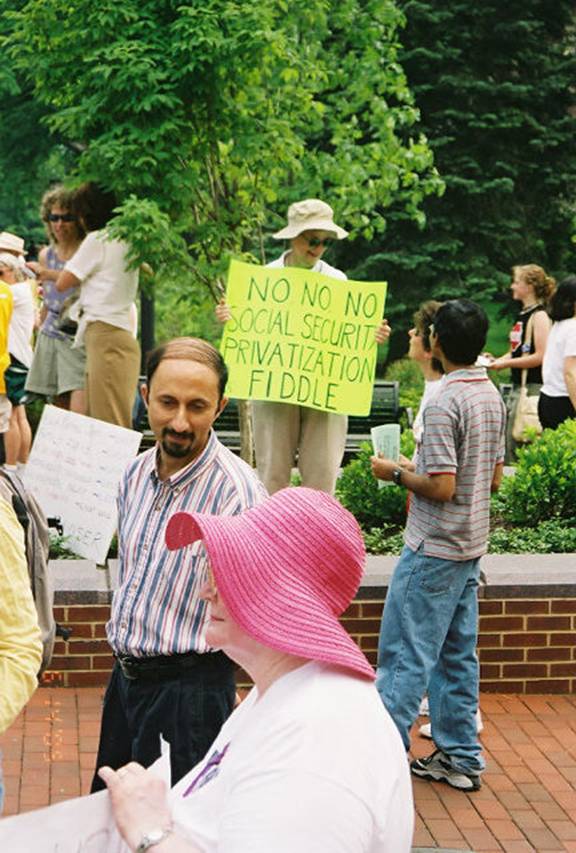
Over 500 people were at that protest.  Holding up signs like:


 2005 Rally at Penn State University Protesting the Privatization of Social Security

Bush is Wrong! Ike was Right! Hands Off My Social Security: 2005 Rally at Penn State University Protesting the Privatization of Social Security

  • Hands Off My Social Security
  • Bush is WRONG!
  • Ike was RIGHT!
Sign at Protest that says: "No! No! No Social Security Privatization Fiddle"

2005 Rally at Penn State University Protesting the Privatization of Social Security

  •  No! No! No Social Security Privatization Fiddle and


Banner at 2005 PSU Protest saying: "Social Security: Don't Gamble with Our Future"

Don’t Gamble with Our Future: 2005 Rally at Penn State University Protesting the Privatization of Social Security

  • Social Security: Don’t Gamble with OUR Future (referring to privatizing and placing Social Security payments in the volatile stock market).

Organizations and individuals fought back and Social Security was not privatized but Medicare was compromised when the prescription drug benefits (Part D) were written into law in 2006. This hole forces individuals on Medicare in 2013 to pay 100% of their drug costs once  you reach their Medicare Part D plan’s initial coverage limit of $2,970 and ends when you spend a total of $4,750.

This was the opening gambit to destroy Social Security. These attacks are continuing to this day.  Now it is the Tea Party Republicans who are doing the attacking.  And if they succeed, women and people of color in particular will pay the penalty.

The Seven Principals to Strengthen Social Security

Rather than decimate our safety net that we all paid for and for which we are due, we should be strengthening rather than weakening Social Security. According to StrengthenSocialSecurity.org – a coalition of over 300 national and state organizations representing over 50 million Americans, there are seven principles to fully support and strengthen our Social Security system:

  1. Social Security did not cause the federal deficit; its benefits should not be cut to reduce the deficit.  And anyone who tells you Social Security is going broke is either misinformed or deliberately trying to mislead. The Social Security Trust Fund is viable through 2033.
  2. Social Security should not be privatized in whole or in part.  Unlike Wall St. and the stock market, Social Security is a reliable, risk free source of income. These benefits are guaranteed every month and are adjusted to the rise in the cost of living.
  3. Social Security should not be means-tested.
  4. Congress should act in the coming few years to close Social Security’s funding gap by requiring those who are most able to afford it to pay somewhat more. This means that the cap on payment into Social Security should be lifted for higher income individuals.
  5. Social Security’s retirement age, already scheduled to increase from 65 to 67, should not be raised further. Increasing the retirement age disproportionately affects low-income women. The life expectancy for low-income women has decreased over the last 25 years and they are more likely to have jobs that compromise their health. Increasing the retirement age would amount to a 15% benefit cut for low-income women workers.
  6. Social Security’s benefits should not be reduced, including [benefit-reducing] changes to the COLA or the benefit formula. Republican leaders want to impose a less accurate COLA formula – the chained-CPI. The current COLA (Cost of Living Alliance) formula is based on the Consumer Price Index (CPI) which estimates the price of stuff we need (like food) changes over time.  The chained-CPI assumes that when the prices of something goes up, people will automatically replace it for something cheaper (e.g., beef would be substituted with chicken and maybe even eventually with dog food); therefore the COLA can be calculated at a lower rising level.  That con only work for the short-term since in some cases (e.g., health care) there are no substitutes and for others (e.g., the food example), people either can’t or won’t go that far without compromising their lives. Over a 30-year retirement, that means that a person would be losing a full month’s worth of Social Security every year. For senior women who often don’t have extra savings or a pension, the gap between their regular expenses and what would be covered over time under a chained-CPI would be disastrous.
  7. Social Security’s benefits should be increased for those who are most disadvantaged. This would include low-income workers, LGBTQ families in states that don’t recognize same-sex marriages, college students whose working parent has died, and people who have to drop out of the workforce to provide caregiving to their family members.

Increasing the Benefits for the Most Disadvantaged

I’d like to look at this last principle in more depth by focusing on women and Social Security because women make up the combined majority of people in these four groups.  So, why should benefits for these four groups be increased?

Low Income Workers

Low Income workers are disproportionately made up of women and people of color. Living hand to mouth, this group of working-age people have little ability to build up any retirement savings.  So one leg of the stool is cut very short.  And unlike high-income workers who worked at a company with full benefits, they are less likely to have any retirement pension at all.  The second leg is also cut very short. As a result, nearly 80% of a low-income worker’s retirement income is made up entirely of Social Security benefits.  And because of the cutbacks in Medicare with the aforementioned doughnut hole, this group of retired people – mostly women who live longer – are further squeezed.  This group of retirees, rather than having their livelihood threatened by a chained-CPI reduction should, instead have and enhanced benefit by creating a Special Minimum amount of Social Security benefits for lifetime low-income earners.

In 2012, the National Organization for Women Foundation, the National Committee to Preserve Social Security and Medicare, and the Institute for Women’s Policy Research released a report called “Breaking the Social Security Glass Ceiling: A Proposal on How to Modernize Women’s Benefits.”  This report presents a proposal to enhance this baseline level of Social Security benefits for low-income workers. They suggest improving the Special Minimum Benefit by:

  • Increasing the benefit to equal 150 percent of the aged poverty level for workers with 30 years of credit;
  • Reducing the wages required to receive a year of credit toward the minimum benefit to the amount required for four Social Security credits;
  • Indexing future increases in the minimum benefit to growth in wages rather than the CPI;
  • Providing up to ten family service years of credit toward the computation of the benefit; and
  • Increasing the Supplemental Security Income (aka SSI) general income exclusion to $100 and adjust it in future years for inflation.

LGBTQ Families

In June, the US Supreme Court, in a case known as United States v. Windsor, overturned the federal Defense of Marriage Act. They declared that committed same-sex couples who have had their relationships legally recognized as marriage must receive all of the federal benefits, including Social Security, associated with legally-recognized marriages.

Same-sex couples, who live in states that don’t recognize their marriages, however are currently out of luck.  In the 37 states without marriage equality, same-sex couples and their families are considered legal strangers. A same-sex household with one wage earner forfeits $675 monthly, the equivalent of two months’ worth of groceries for two people.

The Glass Ceiling report makes the following proposal to address continuing discrimination in these 37 states that don’t recognize same-sex marriages:

  • Amend the Social Security Act to define “wife,” and “husband” so that they no longer rely on gender-specific pronouns;
  • Provide eligibility to spousal benefits to individuals who are members of same-sex marriages, domestic partnerships, civil unions, or any other such relationship as the states, by law, may prescribe;
  • Extend to the children of these relationships, benefits under the same terms and conditions as children of heterosexual couples; and
  • Directly address the issue of disparate state-based DOMA laws by declaring that all federal family eligibility determinations under Social Security be exempted from the provisions of state-based Defense of Marriage Acts.

College Students and their Parents

Up until 1981, students attending college whose working parent had died, become disabled, or retired were eligible for Social Security benefits under their parent’s Social Security until they reached the age of 22.  That year, all post-secondary benefits were eliminated.  Most of the recipients of this benefit were disproportionately children of parents in blue-collar jobs, African-Americans, and those with lower incomes than other college students.  As a result of this change in the law, single parents—again most often women—would often defer saving funds for their own retirement in order to assist their kids through college. This decision results either in a a lower level of retirement funds for his/her parent(s) and/or a reduced likelihood of the student attending college if the parent and child are unable to fund the student’s post-secondary education.

The Glass Ceiling report makes the following proposal to address this issue:

  • Reinstate benefits for children of disabled or deceased workers until age 22 when the child is attending a college or vocational school on a full-time basis.

Caregivers

In addition to the disparity in pay between men and women, one of the main reasons women’s Social Security benefits are lower on average than that of men is that they are more likely to take time off from work to care for children or elderly and sick adult family members (spouses, parents, in-laws, and other family members).  The Social Security Administration uses a calculation known as the “average Indexed Monthly earnings primary insurance amount” (aIMe PIa) to calculate the benefit levels of all beneficiaries. Because of the way that the Social Security Administration calculates the benefit level, any temporary interruption in one’s income can significantly reduce how much Social Security a person can receive.

This affects single women as well as married women since both can and do have children and do have other family members that may need some care. Currently the only way to compensate for this care-giving duty is to provide the caregiver a spousal add-on benefit. This unfair treatment of caregivers in the Social Security formula needs to be changed so that we can continue to care for our family members without jeopardizing the financial security of the caregiver.  The Glass Ceiling report also addresses this issue by recommending a change in the way the aIMe PIa is calculated:

  • Compute the AIME PIA by imputing an annual wage for each family service year so that total earnings for the year would equal 50 percent of that year’s average annual wage index. Family service years would be those in which an individual provides care to children under the age of six or to elderly or disabled family members. Up to five family service years could be granted to any worker.

These Improvements are Affordable: With Some Changes

We can pay for these improvements, and simultaneously ensure the solvency of our Social Security system for 75 years or more. Changes to how Social Security could be funded are well-known. We just need to do it!  The funds for these changes are available IF we:

  • Remove the cap on wages subject to the Social Security payroll tax.  Rather than capping employee, employers, and the self-employed person’s payroll taxes on the first  $113,700 of income, the law should be changed to entirely remove this cap and require millionaires and billionaires to pay the same rate as the rest of us.  This one change would provide most of the needed resources.  According to Virginia Reno and Joni Lavery of the National Academy of Social Insurance, this option [by itself] would eliminate much of Social Security’s current actuarial deficit by producing revenue equal to about 2.17 percent of taxable payroll.”
  • Slowly increase the Social Security contribution rate by 1/20 of one percent over the next 20 years.  This option, according to Reno and Lavery “would provide revenue equal to 1.34 percent of taxable payroll.”
  • Treat all salary deductions like 401(K) plans.  Currently we pay Social Security and Medicare taxes on any retirement plan, such as a 401(K), a 403(b), or a 527 plan.  We do not pay these taxes on that portion of our salary we put aside to pay for any flexible spending account, such as a medical savings account.  If we were to  treat and tax flexible spending accounts just like our retirement plans, Reno and Lavery report that we would provide an about  an additional 0.48 percent of taxable payroll.

These three changes amount to 3.99% of payroll taxes and would fully close the current actuarial deficit (2.67 percent of payroll) according to Reno and Lavery.  The additional 1.32% would fund the proposals to strengthen Social Security as recommended in the Glass Ceiling report without hurting women, people of color, LGBTQ people, caregivers, college student, and low-income families.

The funds are there.  Let’s make it happen. Let’s strengthen, not weaken Social Security for everyone.


King’s Dream in 2013: Interlocking Destinies

It’s been 50 years since Martin Luther King, Jr. gave his iconic “I Have a Dream” speech in front of the Lincoln Memorial in Washington, DC. One of his colleagues at that event was the Rev. Jessie Jackson, Sr.  Rev. Jackson has continued speaking and advocating for that dream of “uniting people on common ground across race, culture, class, gender, and belief.”  This idea of interlocking destinies was presented during his plenary speech at the National NOW Conference held in Chicago on July 5, 2013.

I was in the room during Rev. Jackson’s speech and took several video clips with my smart phone.  One of them came out clear enough to post on this blog.  So after getting back home, participating in a family reunion, and then spending a week and a half looking for a replacement car for our 253,000+ mile vehicle, I was able to upload the video and present it to you.

Video of Jessie Jackson at the 2013 National NOW Conference in Chicago, IL

The following quotes, along with the time tags are some of the best comments, IMHO, that Jessie Jackson made during this speech discussing the intersection between the women’s movement and the civil rights movement, which at 13:59 into this video, Jackson calls a “sharing of interlocking destinies.” He started off by discussing these Interlocking Destinies and shared rights.

3:10 Fifty years after the “I Have a Dream” speech, we still need the ERA [Equal Rights Amendment].

3:52 The right to vote should not be a state right. It’s a constitutional right for everyone.

4:10 Every child should have access to have access to high-quality public education.

4:20 No matter if you are in Mississippi, Maine, or in California, we live under one flag; you should have equal protection under the law.

5:52 Our goal is to learn to live together.

6:20 Civil rights cannot be another word for “black” and NOW cannot be another word for “white women.”  Black women, in big numbers, should be members of NOW now!

7:00 We must pull down the walls [of cultural resistance] that leave us in the shadow of fear…. When the walls come down, we can all grow bigger, better, stronger with greater productivity.  When the walls come down.

9:00 There’s a new South today that can have the Super Bowl, CNN, high-tech universities [showing that we are] learning to live together.  Yet…

At this point, Rev. Jackson starts talking about some of the interlocking issues of racism and sexism still present that need to be addressed in the United States:

9:56 It’s interesting to me that during the Republican Primary, in my [home] state [South Carolina] with an open primary, not one candidate went to a single school or church of the black community.  Not one! 33% black.  Not only did they not go, the media did not challenge them to go.  This instance [of the] reinforcement of apartheid was natural because it’s [still] normal.

Jackson then spends a bit of time framing these interlocking destinies and the problem of economics and access to justice.  He gave several examples of this framework.  The one that resonated with me was the one about the automobile industry, considering that my car had died the weekend before the conference and knowing that I would soon be car shopping. He said,

12:38 What does it mean that there are 21,000 automobile dealerships? 200 black-owned. Almost no women. Pepsi: one black franchise. Coke: zero. When you go get educated. You get your masters and PhD degrees. Business people, you cannot buy one of these franchises, by the way, because they were sold under the laws of perpetuity. Those that got the territories [back in the day] have the territory eternally.  So it’s not about getting on the ball field.  If you get on the ball field, there are no balls left…. Even money can’t buy them.

And finally, just as the battery in my smart phone died, he ended on a high note using history to look towards the future. He said that as in the past, we have not and can never be at loss for continuing to advocate for reform.  This is what I caught on the video as it beeped “bye-bye:”

13:59 The agenda of race and gender equality are inextricably bound.  We share interlocking destinies.  African-Americans won the right to vote in 1879 – 15th Amendment. Women in 1920 – 19th Amendment. We [finally] got the right for blacks to vote in the Deep South in 1965 [with the Voting Rights Act] while women got the right to serve on juries in 1967 – 2 years later [as a result of the US Supreme Court decision in Taylor v. Louisiana]Eighteen year olds got the right to vote in 1970; [before that] those [young people] serving in Vietnam could not vote…

SCOTUS Awards LGBT Rights; Davis Fights for Women’s Rights

A great summary of what’s happened in Texas and Washington, DC today. Like my blog on Senator Wendy Davis this morning, Nel’s New Day highlights two successes within 24 hours – one for women and one of all loving, committed same-sex couples who have had their relationships legally recognized as marriage in now 13 states as well as several countries around the world (since the US Government recognizes marriages that are conducted as a legal marriage in a different country). This has been a day of celebration in the War on Women and against homophobia. THANKS to everyone who made this happen.

trp2011's avatarNel's New Day

Forty years ago, homosexuals were mentally ill. Ten years ago gays and lesbians were criminals. Today LGBT people can legally marry the people they love. Yesterday was the day that my partner and I celebrate as our anniversary because marriage equality is illegal in Oregon. It was our 44th anniversary. Without the same Social Security benefits that legally married people receive, my partner has lost well over $100,000. We don’t know how much we have lost in other benefits because of the discrimination against same-sex couples.

The Stonewall riots, hailed as the dawning of the gay rights movement, started in New York’s Greenwich Village on June 29, 1963, also 44 years ago. But today is a new day because the U.S. Supreme Court overturned the 1996 federal statute defining marriage as between one woman and one man.

Listening to the U.S. Supreme Court as they dribbled out their rulings…

View original post 1,287 more words

War on Women in Pennsylvania: At Least a 20-Year Happening

Last week, Governor Tom “Just Close Your Eyes” Corbett signed into law Act 13 of 2013, also known as HB 818.  This newest attack in the War on Women denies women the ability to use THEIR OWN FUNDS to purchase coverage for an abortion within the new healthcare exchange that Corbett decided to fob off onto the federal government.  Although the state couldn’t be “bothered” with running this exchange, they have no problem in denying women the ability to purchase coverage for an abortion even in cases in which her life is endangered.

At the time of final passage of the bill I sent out an email to several friends listservs. Here are some of the comments I received back:

What is going on in PA?  It’s beginning to sound more & more like a North Dakota or a Kansas [or a Mississippi or an Arizona or a Wisconsin or a Texas or any other state that’s been taken over by misogynists and racists].  Terrible!!

If women aren’t allowed to spend money on their healthcare the way they deem medically necessary, then it’s time to face the fact that we’re not even citizens in our own states.

I agree with all of these sentiments.  Yet, these types of legislative actions have been going on in Pennsylvania for a long time, despite Pennsylvania having an ERA in our state Constitution and having already ratified the national ERA.

Bit of history of the War on Women in Pennsylvania.  We’ve been battling this War for over two decades in our legislature.  The battles started with attacks on reproductive justice and have now spread to other areas of women’s lives.

Reproductive Justice Battles

The Pennsylvania General Assembly has basically been co-opted by the radical right-wing on both sides of the aisle.  The Democrats do have more pro-choice people than the Republicans.  The Senate is a bit better than the House of Representatives.  And this has basically been true since the late 1980’s.

  1. Which is why Governor Bob Casey, Sr. (D) pushed through Pennsylvania’s Abortion Control Act that initially mandated parental consent, spousal consent, a 24-hour waiting period, and a state-mandated script about the “detriments” to health in abortion procedures.  Planned Parenthood contested the law that went all the way to the US Supreme Court in a case called Planned Parenthood of Southeastern Pennsylvania v. Casey. Decided on June 29, 1992, the Court threw out spousal consent as an “undue burden,” but upheld the rest of the law. This was one of the first battles partially won by the emerging War on women.  That was 21 years ago this week.
  2. Which is why Title X and state Family Planning monies are split 50/50 each year in the state budget between crisis pregnancy centers and legitimate family planning clinics.  And this has been happening for over a decade now. And in 2012, Rep. Daryl Metcalfe (R) proposed eliminating ALL funding for family planning for Planned Parenthood or any other clinic that provides abortion services.
  3. Which is why we are losing stand-alone abortion providers due to the TRAP (Targeted Regulations on Abortion Providers) law passed in December 2011 following “Dr.” Gosnell’s arrest and guilty verdict for murdering 9 live-born infants and one woman in a filthy, rat-infested facility that the state had not inspected despite complaints from legitimate providers for about 10 years.
  4. Which is why we almost had a transvaginal ultrasound law last year.  And for Governor Corbett’s “Just close your eyes” statement (Corbett’s comments on the ultrasound bill start at 14:28).  The main reasons I think it ultimately died in committee is thanks to the activists in VA who created the uproar there and because so many people, including doctors were outraged by the invasiveness of this bill and for Corbett’s insensitive statement (of which he is becoming more or more well-known for – he’s his own worst enemy).

Other Battles in the War on Women in Pennsylvania

And on other issues – similar actions have occurred.

Increasing Conservatism in the Legislature and Governorship

In 2010, the Tea Party and the radical right swept into office an even more anti-woman legislature and governor here in Pennsylvania.  The War on Women went into full swing.  Both houses of the General Assembly became even more heavily conservative, with the House switching from a Democratic- to a Republican-controlled majority and the state elected an anti-choice, anti-woman, and in my opinion, racist governor – Governor Tom Corbett (R).

To highlight how conservative the Pennsylvania General Assembly has become, just look at the 2012 ratings of legislators by the American Conservative Union.  They indicated that 51% of members in the combined Assembly are solid conservatives; 105 or 42% are given a score of 100 and an additional 22 or 9% are rated at 63 or higher.  The entire leadership of the majority party in both houses and thus those with the power to deny women, people of color, people with disabilities and people living in poverty their basic rights are listed in their report as so-called “Defenders of Liberty” or “Conservatives” because of their rating of, respectively, either 100 (13 of the 16 leaders) or 80 (the remaining 3 leaders).

Attack on Hate Crimes Protections

An updated hate crimes bill was initially passed in 2002 that added gender, gender identity, national origin, disability, and sexual orientation.  Because the radical right didn’t want to vote against adding sexual orientation coupled with disability and gender and thereby anger multiple constituencies within their district, a member of the House, proposed a late-night, end of session amendment in the 2001-2002 legislative session that substituted the hate crimes bill for an agricultural crimes bill.  The vote was overwhelmingly in favor, mostly because the legislators didn’t want to appear to be supporting hate crimes via a no vote (prior to this the then Republican majority had refused to bring up the bill for a committee vote). The radical right-wing appealed saying that this substitution violated the state’s constitutional mandate that any amendment has to be germane to the original intent of the bill.

The Pennsylvania Supreme Court agreed in July 23, 2008 that this procedure (but not the underlying intent) was unconstitutional and threw out the law.  It has been reintroduced every session since then with no hearing or vote in any committee in either house.

Attacks on Marriage Equality

In addition to having a state-based mini-DOMA (a state-level Defense of Marriage Act) on the books, Pennsylvania has had several attempts at adding this form of discrimination to our state constitution introduced every session for the last decade.  The major reasons they have not passed is that the House is even more conservative than the Senate and the two houses can’t agree on how extreme to make it.  There is another one that has been introduced in the General Assembly this year, but due to increasing support by the public for civil unions and marriage equality (almost 2/3 support throughout the state), they haven’t yet held any hearings.

Budgetary Attacks

One of the spears attacking women, families, and people of color since the takeover of our legislative and executive branches of government here in the state is the budget.

We have had severe cutbacks in state funding for education, health care, and human services since 2011.  According to the Pennsylvania Budget and Policy Center, spending on these three areas in the final budget for 2012-2013 that ends this week was either flat-lined (“welfare” programs) or reduced by 0.3% (for public school education), 15.9% (for higher education), and 37% to 45% (for Medical Assistance inpatient and outpatient care).

The proposed budget plan for 2013-2014 continues these cuts. Here are a couple of examples of this budgetary war:

Attacks to Eliminate Equality for All

In the very first budget introduced by Governor Corbett, every advocacy Commission in the Executive branch was eliminated in the 2011-2012 budget – this includes the Pennsylvania Commission for Women (which I served on until it was abolished), Latino Affairs, Asian-American Affairs, and African-American Affairs.  As you will see from the links to these commissions, there is no public information on who the commissioners are nor is the any information on the services any of these commissions provide.  Prior to the elimination of these commissions in 2011, the Commission for Women, for example, had an extensive web presence which included our mission (the only thing that now remains), hotline contact information, copies of reports written by the Commission, information on the advocacy being conducted by the Commission, and links to programs and services to broadly assist women.  Transparency has disappeared; this is another spear in the attacks with the War on Women here in Pennsylvania.

Like every other state, Pennsylvania has a commission that monitors, reviews and adjudicates alleged acts of discrimination; here in Pennsylvania that is the Pennsylvania Human Relations Commission (PHRC). Severe budgetary cut-backs have occurred in the funding for the PHRC in every budgetary cycle since 2011.  An individual who works within the PHRC told me last month that as a result of these cuts, they are down 50% in staffing and that long-time civil rights advocates in the agency have either retired (some early) or left for other work.  And it’s not getting any better. The PHRC is flat-lined in this year’s budget.  We don’t yet know if this will still be true once the budget is passed, which theoretically must be done this week since our state constitution requires passage by June 30 of each year.

Gerrymandering

Gerrymandering is part of the War on Women due to its impact on legislation directly affecting women’s lives. Gerrymandering here in Pennsylvania, aka the “Gerrymander of the Decade,” has entrenched the right-wing Republicans in both the General Assembly and the Pennsylvania Congressional delegation.  This, despite the fact that there are many more registered Democrats than Republicans in the state.

Being a Democratic legislator, as we all know doesn’t guarantee concern for women’s rights (think Senator Bob Casey, Jr. and his father, former Governor Bob Casey, Sr.). But in these days and times, it’s less likely to cause a problem for us than do the Tea-Party dominated Republicans.

The most recent vote in the General Assembly is a clear example of what gerrymandering has done to the legislature.

Gerrymandering, combined with the elections resulted in the passage of HB 818/Act 13 this month. Tea Party Republican conservatives won many of their races in 2010 and 2012, taking control and leadership of both houses in 2011.  In the House there are 111 Republicans and 92 Democrats.  On April 24, 2013, all but 2 Republicans (98%) voted against and all but 32 Democrats (65%) voted for women’s reproductive justice. In the Senate there are 28 Republicans and 22 Democrats. On June 5, 2013, all but 2 Republicans (93%) voted against and all but 5 Democrats (77%) voted for women’s reproductive justice.

State and Federal ERA

Another comment that was made when I sent out my email was about passing the federal Equal Rights Amendment (ERA). The person said,

This is the reason we need to be included in the Constitution of the United States!  One of main ways to stop bills like this is to pass the ERA and thus be admitted as full-fledged citizens of the US.

Before the War on Women started, Pennsylvania passed a state-based ERA that was voted on by the electorate and placed into Section I of the Pennsylvania Constitution in 1971.

Yet even with this state-based ERA, the War on Women is being raged here in Pennsylvania.  Sometimes the state ERA works and sometimes it doesn’t.  It worked back in the 1980’s when Pat and Twiss Butler worked with Pennsylvania NOW to get gender-based auto insurance rates eliminated.  But it didn’t work in 2008 when a woman sued her employer using the state ERA based on sexually offensive comments made by her supervisor but not stopped by the company.

Many people, in frustration have made statements or created nicknames to replace the official monikers of “City or State of Brotherly Love” and the “Cradle of Independence.”  A couple of the pejoratives include “Pennsyltuky” and “Philadelphia and Pittsburgh with Alabama in the middle” (this latter one is attributed to James Carville)  The progressive parts of the state (for the citizenry, but not necessarily the full legislature) are currently Philadelphia and SE PA, the capital Harrisburg (to some minor extent) and Centre County where I live.  Pittsburgh is still itself progressive, but Allegheny County (where Pittsburgh is located) has become very, very conservative and thus more like the “T” (the term used to describe the rural part of the state outside of the Pittsburgh and Philadelphia regions).

Yes, it is frustrating.  But as a “cock-eyed optimist” (something I’ve often been called), I continue to push back and sometimes we get things that are a bit better than they would have been otherwise.  Much of our work is being done in coalition these days.  I won’t stop my push-back against this War on Women.  I will continue my multi-decade work and will continue to shout from the mountain top whenever and wherever needed.  As will others (see for example, an article in Politico about the War on Women battle for the Pennsylvania governorship gearing up here in Pennsylvania).

Be a “cock-eyed” optimist.  Get the ERA passed and stop this state and national War on Women. As Margaret Mead said,

Never doubt that a small group of thoughtful, committed citizens can change the world. Indeed, it is the only thing that ever has.

Call for Paycheck Fairness Act Co-Sponsorship

The wage gap shows that women, particularly women of color are paid significantly less than white men.

The Wage Gap: Lack of Equal Pay

On April 9, I did a blog on Equal Pay Day discussing the lack of equity in pay between men and women’s work.  In that blog, I discussed the need to pass the federal Paycheck Fairness Act.

Part of the process of obtaining passage of a bill is to get as many legislators as possible to sign on as a co-sponsor of the bill you are interested in.  In the US House of Representatives, there are currently 206 co-sponsors of the House version of the bill – H.R. 377. In the US Senate, there are currently 46 co-sponsors of the Senate version, S. 84.

The main coalition pushing for paycheck fairness and pay equity is the National Committee on Pay Equity.  This morning, I opened up an email from a listserv I’m on regarding the Paycheck Fairness Act. Michele Leber, Chair of the National Committee on Pay Equity sent out the following message, asking everyone to spread the word to their friends and colleagues in Virginia. Here’s what she said:

“We learned yesterday [April 24] from the office of Rosa DeLauro, our pay equity champion in the House of Representatives, that every Democrat in the House is now a PFA cosponsor! To reach that goal in the Senate, we need just a few more Democrats, among them Mark Warner of Virginia.

At a meeting yesterday in Warner’s office, his legislative aide said the best way to get Warner’s cosponsorship was to send the senator messages of support for the bill. So please rally any contacts, groups, or chapters that you have in Virginia, asking persons to contact Sen. Warner’s office by phone at 202-224-2023 and/or by e-mail at http://www.warner.senate.gov/public//index.cfm?p=ContactPage, asking him to cosponsor the Paycheck Fairness Act, S.84.

With the 50th anniversary of the signing of the Equal Pay Act coming up on June 10, this is particularly important now.”

So…

If you live in Virginia and are a constituent, please follow Michelle’s request and contact Senator Warner regarding co-sponsorship.

If you don’t live in Virginia, you can find out where your US legislators stand on the Paycheck Fairness Act by going to http://thomas.loc.gov/home/thomas.php. In the search box in the middle of the page, type in “Paycheck Fairness Act” and click search.  On the next page, two bills will show up—S. 84 and H.R. 377.  This page provides several links to information about both of these bills—text, bill history, co-sponsors, etc. If you click on “cosponsors” for each bill, you can determine if your representatives are publicly supporting the bill or not. If they are a sponsor, thank them and then ask them to call for a hearing and vote on the bill.  If they are not, ask them to sign on.

Thanks.

Powerful UN CSW57 Document on Ending Gender-Based Violence Created

On March 14, I wrote a blog entitled “The “Unholy Alliance” that May Defeat Comprehensive UN Call to End Gender-Based Violence.” I talked about an alliance between the Vatican, Iran, Russia and a couple of other countries that were attempting to eviscerate the comprehensive plan being created at the 57th session of the United Nations Commission on the Status of Women (CSW57) to end gender-based violence and fully comply with all of the universally agreed-upon agreements (treaties, resolutions, and statements). These previous agreements include the Women’s Rights Treaty (commonly known as CEDAW or the Convention on the Elimination of Discrimination Against Women (1993)) as well as the Beijing Platform for Action (1995), and UN Security Council Resolution 1325 (2000).

I am happy to say that this didn’t happen.  Thanks to the bloggers, news media, Tweeters, NGO’s attending CSW57, and several official Member States, the amendments to the document were voted down on Friday during the final day of the 2-week convention.

Iran was the only country that voted against the final, comprehensive document. The Vatican did not get to vote because of its status as a “Permanent Observer State” rather than as a voting “Member State”. And Russia backed down and voted for the final document along with all of the remaining UN Member States.

People around the world heard about these attempts to deny women and girls safety from all forms of violence.  We spoke out and acted.

As a result, unlike last year, we FINALLY have a strong document that

“condemns in the strongest terms the pervasive violence against women and girls, and calls for increased attention and accelerated action for prevention and response.” (Source)

This document has a strong prevention focus since the best way to end violence against women and children is to stop it BEFORE it happens.  It also addresses inequalities in the political, economic, and social spheres that engender violence. And it takes action to provide services and justice for victims of violence around the world.

Ms. Michelle Bachelet, United Nations Under-Secretary-General and Executive Director of UN Women summarized the comprehensive coverage of this powerful statement to end this type of human rights violation in her closing statement of the conference:

During the past two weeks, discussions centred on matters of urgency to people around the world — eliminating all forms of violence against women and girls, ending impunity for perpetrators, fully engaging men and boys, and advancing women’s empowerment and gender equality to prevent and end these human rights violations….

Important and timely matters were addressed — ending child and early forced marriage, protecting the rights of persons with disabilities, and providing justice and critical services for survivors of violence.

There were debates on ending sexual violence in conflict, tackling human trafficking, protecting sexual and reproductive rights, and on the role of culture, religion and the family.

You had many intense late-night negotiations, going over every single word and paragraph, debating long and hard in order to come to [this] strong agreement.

UN Secretary-General Ban Ki-moon, immediately after CSW57, released a statement showing the commitment of the United Nations to fully implement this new document. It says, in part:

Violence against women is a heinous human rights violation, global menace, a public health threat and a moral outrage.  No matter where she lives, no matter what her culture, no matter what her society, every woman and girl is entitled to live free of fear.  She has the universal human right to be free from all forms of violence so as to fulfill her full potential and dreams for the future.

States have a corresponding responsibility to turn that right into reality.  The Secretary-General hopes that all the partners who came together at this historic session and others around the world will now translate this agreement into concrete action to prevent and end violence against women and girls.  The United Nations system is fully committed to leading this global effort.

So now I say, THANK YOU! Thank you for creating this statement. It is one more step  towards realizing the rights, dignity, and humanity of girls and women throughout the world.

Picture of Joanne Tosti-Vasey standing with sign that says "I AM Ending Violence"

Joanne Tosti-Vasey “Refusing to be Silent” and calling for an end to gender-based violence

The “Unholy Alliance” that May Defeat Comprehensive UN Call to End Gender-Based Violence

Last week, on International Women’s Day (March 8), I participated in the 24-hour Global Tweet-a-Thon to end gender-based violence.  This event was held in conjunction with the 57th session of the United Nations Commission on the Status of Women (CSW57) that is being held in New York City.  The theme of this year’s session is the “Elimination and prevention of all forms of violence against women and girls.”

I participated as a host for one hour of this event to facilitate the global conversation between people around the world and those attending the unofficial Non-Governmental Organization (NGO) programs at the UN as well as to send a message to the official UN delegation. Our message was that advocates around the world are looking for a strong draft statement calling for the full elimination and prevention of all forms of violence against women and girls as directed by the theme of this two-week conference.

Here are a few of the many tweets I sent out that either addresses the situation of violence in countries around the world OR that calls on governments, including the UN, to create best practices to end gender-based violence:

@JoeBiden “40% of all mass shootings started with the murderer targeting their girlfriend, or their wife, or their ex-wife.” #EndVAW #CSW57 #IWD2013

The first sexual experience for 24% of women in rural Peru was forced. #EndVAW #CSW57 #IWD2013

In Latin America & the Caribbean, abused women reported higher incidents of miscarriage and induced abortion. #EndVAW #CSW57 #IWD2013 (Source)

In South Africa, women who were abused by their partners are 48% more likely to be infected with HIV than those who were not. #EndVAW #CSW57 #IWD2013

To #EndVAW, governments must enact legislation that addresses violence based on sexual orientation and gender identity. #CSW57 #IWD2013

To #EndVAW governments must fully fund health services for survivors of violence, including #HIV screening & emergency contraception. #CSW57 #IWD2013

To #EndVAW, governments must ensure girls and women have access to abortion in cases of rape and incest. #CSW57 #IWD2013

Providing young people with human rights-based, comprehensive sexual and reproductive health services and information helps #EndVAW. #CSW57 #IWD2013

Respecting, protecting, and fulfilling girls’ and women’s sexual rights can minimize the violence they face. #EndVAW #CSW57 #IWD2013

Promoting girls’ and women’s sexual rights is a key tool to #EndVAW, address women’s inequality, and achieve sustainable development. #CSW57 #IWD2013

Domestic laws to #EndVAW should align with international best practice and reinforce the protections found in #humanrights treaties. #CSW57 #IWD2013

And

There is no country where women and men are equal in all spheres of life. You have the power to can change that! #EndVAW #CSW57 #IWD2013

That last tweet is a call for individuals, organizations, countries, and the United Nations to pull together to create and execute a comprehensive plan to end gender-based violence and fully comply with all of the universally agreed-upon agreements (treaties, resolutions, and statements), including the Women’s Rights Treaty (commonly known as CEDAW or the Convention on the Elimination of Discrimination Against Women (1993)) as well as the Beijing Platform for Action (1995), and UN Security Council Resolution 1325 (2000)

I had hoped the draft document that is supposed to be finalized and signed on March 15 – the final day of the two-week deliberation – would help strengthen these treaties.  Instead on Tuesday, March 12, 2013, I received an email from two NGOs – the Center for Women’s Global Leadership (CWGL) at Rutger’s University and International Women’s Rights Action Watch Asia Pacific (IWRAW Asia Pacific)—indicating that

“the United Nations Commission on the Status of Women (CSW) is wavering in its commitment to advance women’s human rights as demonstrated in the constant negotiation of the language in the outcome document.”

The next morning, I saw a New York Times editorial called “Unholy Alliance.”  This article clearly lays out what was going on in the official deliberations.  Apparently, the Vatican (which, btw, is a “Permanent Observer,” not a “Member State”), Iran, Russia, and a few other Member States have spent the their entire time at CSW57 trying to eliminate language in the draft communiqué to “duck” their obligations – and thus the obligations agreed to by most of the world – to eliminate all gender-based violence.

Their excuses?  Religion. Custom. Tradition.

What are they objecting to specifically?  Any reference to abortions or contraception.  Any mention of reproductive or sexual health. Any reference to forced sex as rape by either a spouse or other intimate partner.  And even any reference to women’s rights in general from the aforementioned international agreements; in this case, they claim that either religious or cultural traditions must take precedence over ending any form of gender-based violence.

These “reservations,” by the way, are the same reservations raised by essentially the same countries at the 56th session of the CSW conference in 2012.  As a result, that session ended without any agreement and women, once again, were left without a comprehensive UN plan to help improve their lives.

I am appalled. Gender-based violence is a crime against humanity.  Whether that crime is perpetrated by a government (for example, when military units carry out gang rapes and other gender-based war crimes for ethnic intimidation, ethnic cleansing and terrorizing a community).  Or when that crime of violence is perpetrated by individuals.

After learning all of this, I contacted the National Organization for Women (NOW) chapters in Pennsylvania.  Within 24 hours, Pennsylvania NOW along with South Hills NOW (Pittsburgh area), East End NOW (part of Allegheny County just east of Pittsburgh), Northeast Williamsport NOW, Ni-Ta-Nee NOW (my chapter here in Centre County), and Montgomery County NOW all co-signed the letter created by CWGL and IWRAW Asia Pacific.

This letter was signed by 281 organizations from 57 countries and 129 people from around the world and delivered to the conference on March 14.  FYI, since some of the organizations do not include the country of origin in their names, there may be — and probably are — more than 57 countries represented on this letter.

Here’s the letter that we signed.

IWD Statement on Concerns of Women’s Organizations Over Negotiations on CSW 57 Outcome Document 3-14-13

I along with all of these organizations and individuals want to see a comprehensive UN program to end violence against women and girls.  We want to strong enforcement of all international agreements.

Patriarchy has no right to quash human rights.  Let’s hope that the official delegates hear our voice and stop this “unholy alliance.” If allowed, the result will be more, not less gender-based violence.

If not, then I believe that like last year there should be no UN document signed by the United States or any other Member State participating in the 57th CSW conference.  Going forward with a strong plan to end all forms of violence is the best plan.  Going backwards is appalling and should not be condoned.  Better nothing than something that moves us backwards.

Let’s just hope they hear our voice and “do the right thing.”

A Further Comment on Violence Against Women and Children on V-Day

I received a comment on LinkedIn this morning in response to my posting titled VAWA Passes Senate: One Step Toward Ending the Climate of Indifference Towards Violence Against Women.  My status statement said, “Feb 14 is V-Day. Rise to end indifference towards violence against women.”  A man in one of the groups I am a member of responded with a question:

So, please explain how we are being “indifferent” towards violence against women. There are laws against violent attacks on any human being – women included. Are these laws being ignored in cases where a woman is the victim?

I think not.

What we see here is another group who wishes to reap the benefits of victim status whether the facts bear them out or not. Beware of those who believe that they deserve special treatment – especially when that special treatment comes at the expense of others.

His question deserves a response.  Which I gave him within LinkedIn.  Since there are many others how might have a similar question but aren’t on LinkedIn, I’m commenting here as well.

The Violence Against Women Re-Authorization Act (VAWA S.47) does not call for special treatment of anyone. VAWA is calling on fair treatment of ALL victims of violence.

A climate of indifference is a climate where attacks against others – sexual assault, acquaintance or domestic violence, sexual harassment, and stalking– are ignored, covered up, or made light of. And in some instances, the climate of indifference is perpetuated when the alleged perpetrator is treated more lightly than someone else who may have committed the assault simply because of his status or affiliation.

That’s what has partially been happening with the Athletics program at Penn State University since 1994 and which helped lead to the situation of the child sexual assaults done by Jerry Sandusky. That’s part of what is happening in Steubenville, OH in the rape case where perpetrators made a video of themselves and others carrying a teenage girl from one house to another and raping her. That’s what led to the DC police refusing to take a police report last week from a friend of mine after a man exposed himself to her and masturbated because she didn’t stay with the man until the police came!

In addition, VAWA’s re-authorization has been delayed for over two years because some legislators – mostly Republican, including the majority of the US House of Representatives – are indifferent to the violence perpetrated on Native Americans, immigrants, and gays, lesbians, bisexual, and transgendered persons. This “indifference” towards violence against specific people is based solely on the victim’s status, is disparate treatment, and IMO is discriminatory.

Yes there are laws in place. Yet, until all victims are treated fairly and in a timely fashion, I will continue to call out people and communities for creating a climate of indifference that allows this to continue. All people need to live in safe communities and homes.

Ending this climate of indifference wherever it occurs is a start towards caring for our loved ones.  PASS VAWA NOW!

We Did It! White House ERA Petition Receives Over 25,000 Signatures

Between 1:30 and 1:54 pm EST today the Equal Rights Amendment (ERA) ratification petition received the required minimum 25,000 signatures that triggers a response from the White House. This means that White House staff will review it, send it to the appropriate policy experts, and issue an official response in the very near future.

Luanne J. Smith, one of the organizers for the petition drive, sent out this congratulations announcement as soon as we passed the 25,000 mark:

Yes!!!! We have passed the 25,000-signature mark, and with 3 1/2 days to spare!!!! Congratulations to Tammy Simkins, who initiated the petition and coordinated the petition drive, and to the entire team of ERA supporters who have worked so hard to see us reach this milestone!!! If you haven’t already joined the team by signing and sharing the petition, please do so NOW! Let’s get the Equal Rights Amendment moving forward! ERA NOW!!!

And here’s a screen shot at 1:54 pm EST today, February 6, 2013 showing 34 signatures over the 25,000 signature threshold.

Screenshot of "We the People" website showing more 25,034 signatures on ERA petition.

Screenshot of “We the People” website showing more than 25,000 signatures on ERA petition.

Signature number 25,000 was from Knoxville, TN.  Which by the way is rather neat.  It was Tennessee’s ratification of 19th amendment on August 24 1920 that gave women the right to vote. And that ratification vote was by a majority of one vote. So having signature 25,000 come from someone from Tennessee is appropriate.

The ERA petition to the White House will remain open for signing until 11:59 pm EST February 9, 2013.  Please add your name to the groundswell for this historic petition. For more information on the petition, check out my earlier blogs here and here.

Congratulations everyone for all your hard work!

White House Petition for the Equal Rights Amendment: Deadline to Sign is February 9

Please go to the White House’s “We the People” website & sign the Equal Rights Amendment (ERA) ratification petition; just 4 days left. Here’s an email I received from NOW and the Feminist Majority indicating that we can make this deadline IF each and every one of us acts now. For more details on why the ERA is needed, check out my earlier blog, “Why We are Pushing for Ratification of the ERA (the Equal Rights Amendment).”

ERA YES antique button

Dear Joanne ,

A petition for Equal Rights Amendment (ERA) ratification is currently collecting signatures through the We the People petition process on the White House website.

The ERA petition has over 18,000 signatures. If the petition has 25,000 signatures by 11:59pm on February 9, the White House staff will review it, send it to the appropriate policy experts, and issue an official response. (Currently, the We the People process requires over 100,000 signatures, but the ERA petition was filed before the increased requirement.)

It is time to get the ERA back high on the national agenda. This petition asks the White House to support lifting the deadline on the original 1972 ERA. Women would only need three more states to get full rights if the deadline was lifted. Thirty-five states have already ratified the ERA. We need you to go to the White House website and sign the petition.

Sign it today. Women have waited long enough for equality.

For equality,

   
Eleanor Smeal
President
Feminist Majority Foundation
  Terry O’Neill
President
National Organization for Women