Update on Wendy Davis’ Filibuster in TX

Late last night, I reblogged a bio of Texas Senator Wendy Davis.  She is the woman who filibustered Texas’s proposed TRAP law – SB 5.  This bill would have contained several burdensome restrictions on a woman’s constitutional right to seek a safe, legal abortion, including:

  • Limit[ing] most abortions to the first 20 weeks of a pregnancy.
  • Requir[ing] that doctors performing abortions have admitting privileges at a hospital within 30 miles.
  • Requir[ing] abortion clinics to meet the standards of an ambulatory surgery center.
  • Put[ting] new rules [into place] around abortion-inducing medications, including requiring that women take such medicines in the presence of a doctor.

Along with over 180,000 people, I watched in real-time the YouTube streaming of the filibuster, parliamentary procedures, and the eruption of voices in the gallery until 1 am Central time (2 am my time here in Pennsylvania) when the YouTube feed was shut down.

NPR has a good report on what happened.

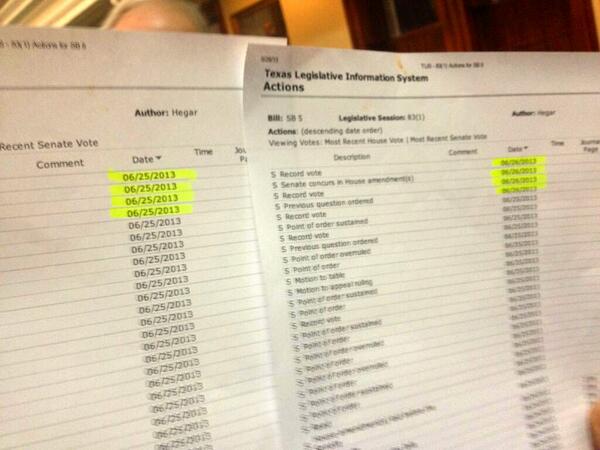
Apparently votes are electronically recorded and time stamped into the legislative journal.  Reporters took pictures of these records immediately after the vote.  The initial record had a time stamp of “June 26, 2013,” which was after the constitutionally mandated shut-down of a special legislative session.

Then a few minutes later, the time stamp mysteriously changed from “June 26, 2013” to “June 25, 2013.” Republicans allegedly changed the time stamp for the SB5 abortion bill vote. Behold the magic from Becca Aarronson, reporter at the Texas Tribune that shows this doctored document.

Picture of the Texas legislative journal on SB 5 before and after  time-stamp change.

Texas legislative journal on SB 5 before and after someone doctored the time stamp.

So why did the Lt. Governor and the radical right-wing concede?  Because of the excellent work of reporters in Texas who were able to show that the recorded vote occurred after midnight.

There was chaos on the floor and outrage when the Lieutenant Governor said that the bill had passed before the midnight deadline.  The Democrats continued to contest the Lt. Governor’s ruling, noting that the voting ended after midnight.  Which was documented  by the automatic time stamp and noticed by the press.

Because the vote actually occurred at 12:02 am on Wednesday rather than before the Tuesday midnight deadline, the Republicans finally conceded that they had lost this fight a little after 4 am Central time when Texas Lt. Gov. David Dewhurst said,

“Regrettably, the constitutional time for the first called session of the 83rd Legislature has expired. Senate Bill 5 cannot be signed in the presence of the Senate at this time. Therefore, it cannot be enrolled. It’s been fun, but seeya soon.

Thank you everyone, especially Senators Wendy Davis (D-Fort Worth) for her filibuster and Senator John Whitmire (D-Houston) for his knowledge of parliamentary procedures.  They helped create this much-needed victory on the war on women in Texas.

Meanwhile, I hope there is an investigation of this attempted tampering of the record in order to circumvent Texas’ Constitution!

And here’s my thank you to Senator Davis:

red heard surrounding Senator Davis' tweet thanking the public for the support of her fillibuster.

My home-made meme to express my heartfelt thanks for Senator Davis’ successful filibustering.

Texas State Senator Wendy Davis – District 10

Way to Go, Senator Davis! Thank you so very much for standing up for women’s lives. For my readers, if you read this before midnight Central time today (June 25), you can watch Senator Davis’ filibuster at http://www.youtube.com/watch?v=2Q8Hr0O20LY.

Update June 26, 2012 – The Lt. Governor says the bill passed just before midnight.  The Democrats on the floor and reporters in the room dispute this statement according to an article in San Francisco Chronicle.

Meanwhile, Texas State Senator and our hero Wendy Davis has an ActBlue page!  Let’s all help her out! #UniteBlue #standwithwendy

War on Women in Pennsylvania: At Least a 20-Year Happening

Last week, Governor Tom “Just Close Your Eyes” Corbett signed into law Act 13 of 2013, also known as HB 818.  This newest attack in the War on Women denies women the ability to use THEIR OWN FUNDS to purchase coverage for an abortion within the new healthcare exchange that Corbett decided to fob off onto the federal government.  Although the state couldn’t be “bothered” with running this exchange, they have no problem in denying women the ability to purchase coverage for an abortion even in cases in which her life is endangered.

At the time of final passage of the bill I sent out an email to several friends listservs. Here are some of the comments I received back:

What is going on in PA?  It’s beginning to sound more & more like a North Dakota or a Kansas [or a Mississippi or an Arizona or a Wisconsin or a Texas or any other state that’s been taken over by misogynists and racists].  Terrible!!

If women aren’t allowed to spend money on their healthcare the way they deem medically necessary, then it’s time to face the fact that we’re not even citizens in our own states.

I agree with all of these sentiments.  Yet, these types of legislative actions have been going on in Pennsylvania for a long time, despite Pennsylvania having an ERA in our state Constitution and having already ratified the national ERA.

Bit of history of the War on Women in Pennsylvania.  We’ve been battling this War for over two decades in our legislature.  The battles started with attacks on reproductive justice and have now spread to other areas of women’s lives.

Reproductive Justice Battles

The Pennsylvania General Assembly has basically been co-opted by the radical right-wing on both sides of the aisle.  The Democrats do have more pro-choice people than the Republicans.  The Senate is a bit better than the House of Representatives.  And this has basically been true since the late 1980’s.

  1. Which is why Governor Bob Casey, Sr. (D) pushed through Pennsylvania’s Abortion Control Act that initially mandated parental consent, spousal consent, a 24-hour waiting period, and a state-mandated script about the “detriments” to health in abortion procedures.  Planned Parenthood contested the law that went all the way to the US Supreme Court in a case called Planned Parenthood of Southeastern Pennsylvania v. Casey. Decided on June 29, 1992, the Court threw out spousal consent as an “undue burden,” but upheld the rest of the law. This was one of the first battles partially won by the emerging War on women.  That was 21 years ago this week.
  2. Which is why Title X and state Family Planning monies are split 50/50 each year in the state budget between crisis pregnancy centers and legitimate family planning clinics.  And this has been happening for over a decade now. And in 2012, Rep. Daryl Metcalfe (R) proposed eliminating ALL funding for family planning for Planned Parenthood or any other clinic that provides abortion services.
  3. Which is why we are losing stand-alone abortion providers due to the TRAP (Targeted Regulations on Abortion Providers) law passed in December 2011 following “Dr.” Gosnell’s arrest and guilty verdict for murdering 9 live-born infants and one woman in a filthy, rat-infested facility that the state had not inspected despite complaints from legitimate providers for about 10 years.
  4. Which is why we almost had a transvaginal ultrasound law last year.  And for Governor Corbett’s “Just close your eyes” statement (Corbett’s comments on the ultrasound bill start at 14:28).  The main reasons I think it ultimately died in committee is thanks to the activists in VA who created the uproar there and because so many people, including doctors were outraged by the invasiveness of this bill and for Corbett’s insensitive statement (of which he is becoming more or more well-known for – he’s his own worst enemy).

Other Battles in the War on Women in Pennsylvania

And on other issues – similar actions have occurred.

Increasing Conservatism in the Legislature and Governorship

In 2010, the Tea Party and the radical right swept into office an even more anti-woman legislature and governor here in Pennsylvania.  The War on Women went into full swing.  Both houses of the General Assembly became even more heavily conservative, with the House switching from a Democratic- to a Republican-controlled majority and the state elected an anti-choice, anti-woman, and in my opinion, racist governor – Governor Tom Corbett (R).

To highlight how conservative the Pennsylvania General Assembly has become, just look at the 2012 ratings of legislators by the American Conservative Union.  They indicated that 51% of members in the combined Assembly are solid conservatives; 105 or 42% are given a score of 100 and an additional 22 or 9% are rated at 63 or higher.  The entire leadership of the majority party in both houses and thus those with the power to deny women, people of color, people with disabilities and people living in poverty their basic rights are listed in their report as so-called “Defenders of Liberty” or “Conservatives” because of their rating of, respectively, either 100 (13 of the 16 leaders) or 80 (the remaining 3 leaders).

Attack on Hate Crimes Protections

An updated hate crimes bill was initially passed in 2002 that added gender, gender identity, national origin, disability, and sexual orientation.  Because the radical right didn’t want to vote against adding sexual orientation coupled with disability and gender and thereby anger multiple constituencies within their district, a member of the House, proposed a late-night, end of session amendment in the 2001-2002 legislative session that substituted the hate crimes bill for an agricultural crimes bill.  The vote was overwhelmingly in favor, mostly because the legislators didn’t want to appear to be supporting hate crimes via a no vote (prior to this the then Republican majority had refused to bring up the bill for a committee vote). The radical right-wing appealed saying that this substitution violated the state’s constitutional mandate that any amendment has to be germane to the original intent of the bill.

The Pennsylvania Supreme Court agreed in July 23, 2008 that this procedure (but not the underlying intent) was unconstitutional and threw out the law.  It has been reintroduced every session since then with no hearing or vote in any committee in either house.

Attacks on Marriage Equality

In addition to having a state-based mini-DOMA (a state-level Defense of Marriage Act) on the books, Pennsylvania has had several attempts at adding this form of discrimination to our state constitution introduced every session for the last decade.  The major reasons they have not passed is that the House is even more conservative than the Senate and the two houses can’t agree on how extreme to make it.  There is another one that has been introduced in the General Assembly this year, but due to increasing support by the public for civil unions and marriage equality (almost 2/3 support throughout the state), they haven’t yet held any hearings.

Budgetary Attacks

One of the spears attacking women, families, and people of color since the takeover of our legislative and executive branches of government here in the state is the budget.

We have had severe cutbacks in state funding for education, health care, and human services since 2011.  According to the Pennsylvania Budget and Policy Center, spending on these three areas in the final budget for 2012-2013 that ends this week was either flat-lined (“welfare” programs) or reduced by 0.3% (for public school education), 15.9% (for higher education), and 37% to 45% (for Medical Assistance inpatient and outpatient care).

The proposed budget plan for 2013-2014 continues these cuts. Here are a couple of examples of this budgetary war:

Attacks to Eliminate Equality for All

In the very first budget introduced by Governor Corbett, every advocacy Commission in the Executive branch was eliminated in the 2011-2012 budget – this includes the Pennsylvania Commission for Women (which I served on until it was abolished), Latino Affairs, Asian-American Affairs, and African-American Affairs.  As you will see from the links to these commissions, there is no public information on who the commissioners are nor is the any information on the services any of these commissions provide.  Prior to the elimination of these commissions in 2011, the Commission for Women, for example, had an extensive web presence which included our mission (the only thing that now remains), hotline contact information, copies of reports written by the Commission, information on the advocacy being conducted by the Commission, and links to programs and services to broadly assist women.  Transparency has disappeared; this is another spear in the attacks with the War on Women here in Pennsylvania.

Like every other state, Pennsylvania has a commission that monitors, reviews and adjudicates alleged acts of discrimination; here in Pennsylvania that is the Pennsylvania Human Relations Commission (PHRC). Severe budgetary cut-backs have occurred in the funding for the PHRC in every budgetary cycle since 2011.  An individual who works within the PHRC told me last month that as a result of these cuts, they are down 50% in staffing and that long-time civil rights advocates in the agency have either retired (some early) or left for other work.  And it’s not getting any better. The PHRC is flat-lined in this year’s budget.  We don’t yet know if this will still be true once the budget is passed, which theoretically must be done this week since our state constitution requires passage by June 30 of each year.

Gerrymandering

Gerrymandering is part of the War on Women due to its impact on legislation directly affecting women’s lives. Gerrymandering here in Pennsylvania, aka the “Gerrymander of the Decade,” has entrenched the right-wing Republicans in both the General Assembly and the Pennsylvania Congressional delegation.  This, despite the fact that there are many more registered Democrats than Republicans in the state.

Being a Democratic legislator, as we all know doesn’t guarantee concern for women’s rights (think Senator Bob Casey, Jr. and his father, former Governor Bob Casey, Sr.). But in these days and times, it’s less likely to cause a problem for us than do the Tea-Party dominated Republicans.

The most recent vote in the General Assembly is a clear example of what gerrymandering has done to the legislature.

Gerrymandering, combined with the elections resulted in the passage of HB 818/Act 13 this month. Tea Party Republican conservatives won many of their races in 2010 and 2012, taking control and leadership of both houses in 2011.  In the House there are 111 Republicans and 92 Democrats.  On April 24, 2013, all but 2 Republicans (98%) voted against and all but 32 Democrats (65%) voted for women’s reproductive justice. In the Senate there are 28 Republicans and 22 Democrats. On June 5, 2013, all but 2 Republicans (93%) voted against and all but 5 Democrats (77%) voted for women’s reproductive justice.

State and Federal ERA

Another comment that was made when I sent out my email was about passing the federal Equal Rights Amendment (ERA). The person said,

This is the reason we need to be included in the Constitution of the United States!  One of main ways to stop bills like this is to pass the ERA and thus be admitted as full-fledged citizens of the US.

Before the War on Women started, Pennsylvania passed a state-based ERA that was voted on by the electorate and placed into Section I of the Pennsylvania Constitution in 1971.

Yet even with this state-based ERA, the War on Women is being raged here in Pennsylvania.  Sometimes the state ERA works and sometimes it doesn’t.  It worked back in the 1980’s when Pat and Twiss Butler worked with Pennsylvania NOW to get gender-based auto insurance rates eliminated.  But it didn’t work in 2008 when a woman sued her employer using the state ERA based on sexually offensive comments made by her supervisor but not stopped by the company.

Many people, in frustration have made statements or created nicknames to replace the official monikers of “City or State of Brotherly Love” and the “Cradle of Independence.”  A couple of the pejoratives include “Pennsyltuky” and “Philadelphia and Pittsburgh with Alabama in the middle” (this latter one is attributed to James Carville)  The progressive parts of the state (for the citizenry, but not necessarily the full legislature) are currently Philadelphia and SE PA, the capital Harrisburg (to some minor extent) and Centre County where I live.  Pittsburgh is still itself progressive, but Allegheny County (where Pittsburgh is located) has become very, very conservative and thus more like the “T” (the term used to describe the rural part of the state outside of the Pittsburgh and Philadelphia regions).

Yes, it is frustrating.  But as a “cock-eyed optimist” (something I’ve often been called), I continue to push back and sometimes we get things that are a bit better than they would have been otherwise.  Much of our work is being done in coalition these days.  I won’t stop my push-back against this War on Women.  I will continue my multi-decade work and will continue to shout from the mountain top whenever and wherever needed.  As will others (see for example, an article in Politico about the War on Women battle for the Pennsylvania governorship gearing up here in Pennsylvania).

Be a “cock-eyed” optimist.  Get the ERA passed and stop this state and national War on Women. As Margaret Mead said,

Never doubt that a small group of thoughtful, committed citizens can change the world. Indeed, it is the only thing that ever has.

The Conservative Pot of Anger

IRS Form 990 non-profit form

Form 990 – the IRS tax form used by recognized 501(c) non-profit organizations

For over a week now we have been hearing about the “scandal” within the IRS’s Tax-Exempt division.  Congress has been holding hearings, calling on current and past Commissioners to testify about the additional scrutiny given to Tea Party organizations.  A couple of days ago, I asked if this additional scrutiny was a scandal or not.

In addition to my comments that day, the Guardian has now brought up another issue that may be adding fuel to the conservative f(ire).  That fuel is a four-decade simmering anger at the IRS by the conservative religious right.  An anger fueled by both segregation and religion.

In 1954, the US Supreme Court declared in Brown v. Board of Education that segregation in education was unconstitutional. In 1964, Congress passed the Civil Rights Act that, which among other issues makes discrimination based on race in public accommodations and employment illegal. In 1967, the US Supreme Court declared in Loving v. Virginia that bans on interracial marriage were unconstitutional.  In 1970, the IRS changed their tax-exempt regulation on private schools to reflect these policies.

Bob Jones University had, under pre-1970 regulations been granted tax-exempt status.  In 1970, as a result of the change in regulations, the IRS notified Bob Jones University that they intended to revoke the university’s tax-exempt status because of their segregationist policy of initially not admitting blacks and then, later of not admitting or expelling students who entered into, engaged in, or advocated for interracial marriage or dating.

Bob Jones University felt that they had a “biblical” right to discriminate.  So they filed case after case to overturn the IRS revocation.  Finally in 1983, in Bob Jones University v. United States, the US Supreme upheld the IRS revocation of Bob Jones University’s tax-exempt status because of its segregationist policies.

The Justices disagreed with Bob Jones’ biblical interpretation of the competing First and Fourteenth amendments to the US Constitution.  In looking at both amendments, they first declared that there is strong governmental interest in ending discrimination:

[The] Government has a fundamental, overriding interest in eradicating racial discrimination in education 29 – discrimination that prevailed, with official approval, for the first 165 years of this Nation’s constitutional history. That governmental interest substantially outweighs whatever burden denial of tax benefits places on petitioners’ exercise of their religious beliefs.

Then, citing the aforementioned cases (and others), the Court held stated:

An unbroken line of cases following Brown v. Board of Education establishes beyond doubt this Court’s view that racial discrimination in education violates a most fundamental national public policy, as well as rights of individuals.

The Court then pointed out that this IRS regulation was still constitutional even after Bob Jones University opened its doors to people of all races.  The Justices reiterated the lower court decision, stating that the University remained racially discriminatory in its policies at the university in violation of the tax-exempt regulations:

Petitioner Bob Jones University, however, contends that it is not racially discriminatory. It emphasizes that it now allows all races to enroll, subject only to its restrictions on the conduct of all students, including its prohibitions of association between men and women of different races, and of interracial marriage. 31 Although a ban on intermarriage or interracial dating applies to all races, decisions of this Court firmly establish that discrimination on the basis of racial affiliation and association is a form of racial discrimination, see, e. g., Loving v. Virginia, 388 U.S. 1 (1967); McLaughlin v. Florida, 379 U.S. 184 (1964); Tillman v. Wheaton-Haven Recreation Assn., 410 U.S. 431 (1973). We therefore find that the IRS properly applied Revenue Ruling 71-447 to Bob Jones University. 32

The judgments of the Court of Appeals are, accordingly,

Affirmed.

I think that this article in the Guardian is correct.  It might just be another reason for the current tax-exempt status furor.  It seems that pulling the tax-exempt status of a religiously-based institution for its violation of our country’s stance for equality under the 14th Amendment of the US Constitution resulted in a simmering pot of anger just waiting for a bit more fire to bring conservatives to a full boil.

What do you think?  Please comment.  I’d be interested in hearing your opinion.

Civil Rights Denied: PA’s Proposed Constitutional Same-Sex Marriage Ban

Logo of Freedomt to Marry, Inc.

“working to win the freedom to marry in more states, grow the national majority for marriage, and end federal marriage discrimination. ” http://www.freedomtomarry.org/pages/about-us

A couple of days ago I posted a blog about the dueling marriage equality and same-sex marriage ban bills recently introduced into the Pennsylvania General Assembly.  Today I thought I give a more detailed argument as to how discriminatory the same-sex marriage ban is to gays and straights alike.

As previously stated, on May 7, Pennsylvania State Representative Daryl Metcalfe (R-12 Butler County) introduced his legislation (HB 1349) to create a constitutional amendment defining marriage OR its “substantial equivalent” solely as a union between a man and a woman.  That bill would amend Article I of the Pennsylvania state Constitution – the Declaration of Rights section – to take rights away from unmarried couples in Pennsylvania, whether they are same-sex or heterosexual couples.  Here’s the constitutional amendment as written in HB 1349:

“Marriage is the legal union of only one man and one woman as husband and wife and no other legal union that is treated as marriage or the substantial equivalent thereof shall be valid or recognized.”

Until the spring of 2012, 31 states across the country had created constitutional amendments to outlaw marriage or anything that looks like marriage between same-sex couples. The last successful attempt at this form of discrimination occurred by referendum in North Carolina in the spring of 2012; all other attempts since then to deny marriage equality have failed.

Marriage equality however has had many successes since then. Three states – Delaware, Rhode Island, and Washington – either passed a referendum OR legislation legalizing marriage equality following North Carolina’s referendum. One state – Minnesota—is expected to pass their marriage equality bill today; note, this is only 6 months after the voters in Minnesota by referendum killed their proposed same-sex marriage ban.  And one state – Colorado – passed legislation recognizing civil unions even though they have a constitutional ban on same-sex marriage.

Instead of moving forward, right-wing legislators would like to have Pennsylvania join the 31 other states that constitutionally ban-same sex marriages and/or other legal forms of relationships such as domestic partnerships and civil unions.  These Pennsylvanian legislators are making their fourth attack on same-sex couples and on unmarried people – gay or straight.  If HB 1349 passes, Pennsylvania for the first time in its history would enshrine and mandate discrimination into the state Constitution.

This amendment would take rights away from unmarried couples in Pennsylvania, whether they are same-sex or heterosexual couples.  The way this amendment is written would affect all unmarried couples, victims of domestic violence if they are not married to their abuser, and could threaten Pennsylvania’s anti-discrimination laws

Effect on All Unmarried Couples – Gay or Straight

Currently, Pennsylvania statute recognizes only marriages between one man and one woman.

Pennsylvania does not recognize either (1) same-sex marriages or (2) civil unions, domestic partnerships, or any other coupled-household status—whether entered into by same-sex or opposite-sex couples.  Those affected by this amendment would therefore, for example, include senior citizens who live together but are not married because of economic considerations, couples who believe they have a “common law marriage” (which is no longer recognized in Pennsylvania), and gay or straight couples who have any type of intimate relationship.

It could also threaten the lives of unmarried domestic violence victims and allow unmarried individuals to be discriminated against in housing, employment, and public accommodations.

Effect on Domestic Violence Victims

In 2004, Ohio passed their discriminatory anti-marriage constitutional amendment, which was quickly and unexpectedly used to deny protections to unmarried victims of domestic violence.  Here’s what happened.  Almost immediately, unmarried batterers argued that since they were not married, Ohio could not enforce their domestic violence law because that was treating their relationship with their partner as “equivalent to marriage.” The 2nd District Court of Appeals in Ohio agreed and ruled that the Ohio domestic violence law runs afoul of the “Defense of Marriage” amendment, passed by voters in 2004, and does not apply to “a person living as a spouse.”  As a result, unmarried defendants, who could have faced felony domestic violence charges, only faced misdemeanor assault charges.    It took several years for the Ohio Supreme Court to reverse this ruling.  In the interim, unmarried women were at the mercy of their batterers in several counties in Ohio.

The Ohio amendment is very similar to that of the one proposed for Pennsylvania.   In Ohio, by providing protection to persons living as spouses,” the domestic violence statutes created a legal status for cohabiting relationships that is “equivalent to a marriage,” according to the appeals court. The appeals court decision in Ohio then denied protection from abuse to unmarried individuals – gay or straight – because the domestic violence law gave legal standing to an unconstitutional relationship – that of an unmarried couple. The courts argument overturning these domestic violence protections utilized similar language found in Pennsylvania’s HB 1439, which states that no other legal union… or the substantial equivalent thereof shall be valid or recognized.

We have no way of knowing how the courts would rule on a similar argument should this amendment pass and become part of Pennsylvania’s Constitution.  Who knows if Pennsylvania’s Supreme Court would protect the victim or allow batterers to circumvent Pennsylvania’s Protection From Abuse (PFA) law?  We need to protect all people from domestic violence and sexual assault.  Passage of this amendment could deny the protection offered by Pennsylvania’s domestic violence and protection from abuse laws; it could even risk the very lives of unmarried people–gay or straight–because this constitutional amendment denies the rights, privileges, and protections of law to people who are not legally married or who have a relationship that is “functionally equivalent” to traditional marriage.

Effects on Employment, Education, Housing, and Public Accommodations

It also looks like current and proposed employment, education, housing, and public accommodations anti-discrimination laws at both the state and local levels might be jeopardized for unmarried individuals.  Discrimination based on marital status and family responsibilities is unlawful under a variety of existing laws. With a few exceptions, under current state and federal law, people who experience this form of discrimination must fit their claims into an appropriate legal theory—as discrimination based on gender, a violation of family and medical leave laws, or another legal theory.  In addition, many municipalities throughout Pennsylvania have passed or are considering ordinances that would make it illegal to discriminate in employment, housing, and in some cases, public accommodations specifically based on sexual orientation, gender identity and marital status.   Will the state courts, the PA Human Relations Commission, or local Human Relations Commissions be able to enforce these laws if Pennsylvania’s constitution has been amended to require unmarried couples to be treated differently from married couples?  We do not know.  Passage of HB 1439 as a constitutional amendment could put all of these protections at risk since any person, company, or school could argue that their business is mandated to deny employment, hiring, and benefits to any person who is not married.

Civil Rights Denied, Reiterated

Last, but not least, exclusion, discrimination and inequality are not the principles this state was founded upon. This discriminatory “Marriage Protection Amendment” denies unmarried heterosexual, lesbian, gay, bisexual and transgender families the protections and fairness they deserve. Heterosexual married couples and their families are afforded more than 1,000 legal protections and economic benefits provided through state and federal law, benefits and protections that are currently inaccessible to unmarried couples.  Passage of this amendment would therefore subject same-sex couples and their families to exclusion, discrimination and inequality.

The proposed amendment could also take away existing legal protections for committed long-term couples and their children, such as second parent adoptions, cohabitation agreements, co-parenting agreements, wills, living wills, powers of attorney, etc., regardless of their sexual orientation.

Gay and lesbian Pennsylvanians are our neighbors, co-workers, friends, and family member.  They pay taxes.  LGBT people should not be bullied.  They deserve the same rights, protections, and responsibilities that all residents desire and have.

Let’s all work to stop this bill now!  So I’m once again recommending that you keep up-to-date on this horrible bill as well as other LGBTQ legislation at  Equality Pennsylvania’s website.

Update on Pittsburgh’s Domestic Violence Policies

Last week I wrote a blog about an attempt by Pittsburgh City Councilman Ricky Burgess  to backtrack on the city’s domestic violence policies.

There has been a week of outrage among advocates for the back-handed attempt to eliminate the police-perpetrated domestic violence ordinance that was created in 2007.

Yesterday, three people, including former City Council President Douglas Shields and my friend Audrey Glickman (both of whom were quoted in last Friday’s blog), spoke out in committee to not backtrack.  Then today, advocates came out in mass to oppose the commingling of police-perpetrated domestic violence with police responses to domestic violence in the community.

Most of the advocates who spoke were given three minutes to express their concerns. Jeanne Clark (candidate for Pittsburgh City Council, long-time NOW member and a women’s rights advocate), Shirl Regan (Executive Director of Women’s Center & Shelter of Greater Pittsburgh), Beth Pittinger (Executive Director of Pittsburgh’s Citizen Police Review Board), and Maryellen Deckard (State Campaign and Development Director for  Action United—a membership organization of low and moderate income Pennsylvanians that employed Ka’Sandra Wade before her death—and the convener of ANEW WOMEN—a group of women who have experienced domestic abuse and want to work for change) were given seats at the Council table to discuss the issues in more depth.

Following the concerns raised about domestic violence and with Jeanne’s call for a public hearing, Pittsburgh City Council quashed the attempt to eliminate the police-perpetrated domestic violence ordinance.  They placed a hold on the proposed Domestic Violence Task Force ordinance until after a post-agenda hearing is held.  And they passed the resolution that allows funds to be expended to start the Maryland Lethality Assessment Training program.

The final vote on this resolution and the amendments made in committee today will be finalized on Tuesday, May 14 during the official business meeting of city Council.   Here’s a news article on what happened, along with some quotes.

After the Council met and voted down Burgess’ proposal to eliminate the zero-tolerance policy, Councilman Bill Peduto sent me the following email:

Joanne –

I wanted to let you know that Councilwoman [Natalia] Rudiak, Councilman [Bruce] Kraus and I were able to lobby Council to successfully pass the Police-response DV bills today while stopping the amendments offered by Reverend Burgess that would have weakened the Police-perpetrated DV legislation we worked so hard on back in 2007.

It is unfortunate that politics entered into this debate at all but I am thankful for the many women and men who wrote in to Council and came to Council Chambers today.  With your help we were able to stop the games and pass this important legislation to protect victims of domestic violence.  Thank you.

Thanks Council members Peduto, Rudiak, and Kraus for your leadership on this issue.  Additional thanks to Councilman Danielle Lavelle for your comments and Councilman Corey O’Connor for your clarification on the differences between a resolution and an ordinance.

A final decision on the Domestic Violence Task Force ordinance will occur only after the post-agenda hearing and public hearing are held.

Thanks all for all of your work.

Picture of Joanne Tosti-Vasey standing with sign that says "I AM Ending Violence"

Joanne Tosti-Vasey “Refusing to be Silent” and calling for an end to gender-based violence

Call for Paycheck Fairness Act Co-Sponsorship

The wage gap shows that women, particularly women of color are paid significantly less than white men.

The Wage Gap: Lack of Equal Pay

On April 9, I did a blog on Equal Pay Day discussing the lack of equity in pay between men and women’s work.  In that blog, I discussed the need to pass the federal Paycheck Fairness Act.

Part of the process of obtaining passage of a bill is to get as many legislators as possible to sign on as a co-sponsor of the bill you are interested in.  In the US House of Representatives, there are currently 206 co-sponsors of the House version of the bill – H.R. 377. In the US Senate, there are currently 46 co-sponsors of the Senate version, S. 84.

The main coalition pushing for paycheck fairness and pay equity is the National Committee on Pay Equity.  This morning, I opened up an email from a listserv I’m on regarding the Paycheck Fairness Act. Michele Leber, Chair of the National Committee on Pay Equity sent out the following message, asking everyone to spread the word to their friends and colleagues in Virginia. Here’s what she said:

“We learned yesterday [April 24] from the office of Rosa DeLauro, our pay equity champion in the House of Representatives, that every Democrat in the House is now a PFA cosponsor! To reach that goal in the Senate, we need just a few more Democrats, among them Mark Warner of Virginia.

At a meeting yesterday in Warner’s office, his legislative aide said the best way to get Warner’s cosponsorship was to send the senator messages of support for the bill. So please rally any contacts, groups, or chapters that you have in Virginia, asking persons to contact Sen. Warner’s office by phone at 202-224-2023 and/or by e-mail at http://www.warner.senate.gov/public//index.cfm?p=ContactPage, asking him to cosponsor the Paycheck Fairness Act, S.84.

With the 50th anniversary of the signing of the Equal Pay Act coming up on June 10, this is particularly important now.”

So…

If you live in Virginia and are a constituent, please follow Michelle’s request and contact Senator Warner regarding co-sponsorship.

If you don’t live in Virginia, you can find out where your US legislators stand on the Paycheck Fairness Act by going to http://thomas.loc.gov/home/thomas.php. In the search box in the middle of the page, type in “Paycheck Fairness Act” and click search.  On the next page, two bills will show up—S. 84 and H.R. 377.  This page provides several links to information about both of these bills—text, bill history, co-sponsors, etc. If you click on “cosponsors” for each bill, you can determine if your representatives are publicly supporting the bill or not. If they are a sponsor, thank them and then ask them to call for a hearing and vote on the bill.  If they are not, ask them to sign on.

Thanks.

Pennsylvania General Assembly Again Attacking Women’s Reproductive Health

Keep Abortion Legal NOW Round

Keep Abortion Legal Safe, Legal and Accessible (http://www.now.org/issues/abortion/)

It’s 2013 and the Pennsylvania General Assembly continues to attack women’s access to reproductive health. According to WeveHadEnoughPA.org, the Pennsylvania legislature has launched and maintained a 2+ year attack on women’s health. There have been numerous bills introduced and in some cases passed that restrict women’s vital access to reproductive health.  Since January 2011, there have been at least 55 votes in the Pennsylvania General Assembly to restrict access from birth control to safe, legal abortions.

The most recent attack is happening this month.  On April 10, the Pennsylvania Senate Insurance and Banking Committee heard and passed out SB 3 by an 8-5 vote; a floor vote could occur any time this month.  This coming Monday, April 15th, the Pennsylvania House Health Committee will be hearing and voting on HB 818, the companion bill to SB 3.

The Additional Burdens on Women Seeking Abortion Care in These Bills

Both of these bills would prohibit insurance companies who provide health care coverage from including abortion coverage within the new healthcare Exchange crafted by the Affordable Care Act (aka Obamacare). The only exceptions to this proposed ban are for women who become pregnant because of rape or incest if they personally report the sexual assault to law enforcement officials and for women who will die without immediate access to abortion services. If a woman doesn’t meet one of these two exceptions, she must completely pay for the abortion totally out of her own pocket, unlike any other medical care she would receive under her health insurance plan.

Currently, about 80% of private insurance companies provide coverage for abortion services. This is important because these very same plans will be offered to people purchasing insurance through the Exchange. As part of the federal law, however, all plans that offer abortion coverage in the Exchange must have a separate payment for that portion of the coverage. This bill would deny women the right to make this separate payment and deny them what is currently available to most people covered by the current private health insurance system. While women would still be able to have abortions in this circumstance, they would be forced to fully pay out-of-pocket all cost for these procedures; their insurance company would be prohibited from paying any portion of this treatment.

This proposed ban places an undue burden on victims of rape and incest and on those women whose lives are in danger health-wise by adding unnecessary barriers to receiving the critical medical attention they need. The two exceptions allowed are extremely limited. These bills require woman who are victims of rape or incest to notify the police and identify the perpetrator prior to seeking abortion treatment.  It also limits women with health issues that complicate their medical treatment to those that are in immediate danger of dying and requires additional medical certification by second, non-attending physician.

This bill places these restrictions on access to health insurance not by mentioning rape or incest or the death aversion clause, but by referring to and expanding Pennsylvania’s version of the Hyde Amendment.  This language is embedded in 18 Pa.C.S. § 3215(c) and would expand restrictions on public funds to all privately paid insurance plans purchased within the Exchange. The law (18 Pa.C.S. § 3215(c))as currently written is a prohibition of the state spending of public funds but not personal funds provided by the person herself for her own health insurance coverage.

The Rape and Incest Exception

Women and minors who are raped would be denied access to abortion services unless they formally report and identify their rapist to the police or child protective services.  Most sexual assaults are not reported to the police. This is even truer when the perpetrator is a family member or acquaintance. According to the Pennsylvania Coalition Against Rape, sexual assault occurs at a much higher rate than is actually reported.

Reasons for not reporting include an initial denial that they have been raped; fear that you won’t be believed or are ashamed for having been raped; or having an ongoing relationship (such as a spouse or parent) with the perpetrator. In order to be safe from further violence by the perpetrator, women and girls may decide not to report the attack to the authorities.  And if you are in denial you are also unlikely to report your rape or the incest of your child to authorities as required in this proposed legislation.

So that means if this bill becomes law and you become pregnant from rape or incest, you are further burdened with the additional costs of fully paying for the abortion. If this bill were not to go into effect, then following the restrictions placed on abortion care under federal law, you would have the abortion services covered based on the insurance rider you purchased in the exchange and you wouldn’t be forced to file a complaint with the police.  This is just one reason why this bill should be voted down.

The “Avert” Death Exception and Need for Expanded Health Exception

In addition, under this proposed law, women who are near death could receive an abortion.  However, say a woman develops cancer or an infection during her pregnancy that will not immediately kill her but would complicate her medical treatment should she continue with the pregnancy.

This health threat/complication is not included in the current bill’s health exception as that exception allows abortions only to “avert” the woman’s death. Any woman with a medical condition that is complicated by the pregnancy but doesn’t immediately place her in danger of death would be forced to bear the additional burden of the full cost of an abortion in addition to the increased threats to her health as well as the additional medical bills for the remaining part of her care.  The medical community, advocates and some legislators are very concerned about this limited exception and have proposed an amendment to both the House and Senate bill to expand this exception from “averting” her death to coverage of the abortion for any pregnancy that poses a substantial risk to the woman’s physical health.

But even if the health exception is expanded to include threats to women’s physical health and care, this bill continues to attack women’s health and lives and should be voted down.

Why this Bill Should be Voted Down

The question of whether abortion will be covered in federally subsidized insurance exchanges has already been settled.  In response to concerns raised by US Senator Ben Nelson, a staunch opponent of abortion, women who want to use their own money to purchase a health insurance plan that covers abortion services must send a separate payment so the funding for abortion coverage is completely separate and paid entirely by the individual. This bill denies women their right to make this separate payment.  And with an estimated 80% of private insurance plans currently covering abortion care, banning abortion coverage in the state exchange would leave women worse off than they were before health care reform began.

Abortion care is a legally authorized and fundamental component of women’s basic health care.  Women should not be denied access to safe, legal, and critical care as part of health care reform implementation.

If abortion coverage is available to some, it should be available to all.  Politicians should not discriminate against women participating in the health insurance exchange.  All women deserve the same peace of mind that they can obtain the health care they need, regardless of where their insurance comes from.

The decision to have an abortion is a private decision between a patient and her physician. It should not be denied by politicians interfering with an insurance company and the policies they offer to the consumer for this procedure.

Banning abortion coverage in transactions between a private company and an individual is governmental activism of the worst kind.  With all of the heated rhetoric over healthcare reform, one would assume that lawmakers would be sensitive about taking any action that suggests government intervention in private healthcare decisions.

Finally, instead of denying Pennsylvania women access to fundamental reproductive health care services, politicians should be working to protect and advance women’s health.

Action Needed

Contact your Pennsylvania Senator and Representative today (find their contact information here).  Tell her/him to support the expanded health exception amendment to both SB 3 and HB 818 and to oppose the entire bill regardless of the inclusion of the amendment.

What is Equal Pay Day and Why Should I Care?

For the last three years, my local NOW chapter—Ni-Ta-Nee NOW—has organized community education events surrounding Equal Pay Day and paycheck fairness.

A frequent question we have is, “What’s Equal Pay Day and why should I care?”  To help answer that question, we have done op-eds and interviews with the local press (See here and here).  We also create a flyer that we update each year.  As President of Pennsylvania NOW, I wrote another blog on this issue in 2011. And elsewhere on my blog site, I have commented on the need for fairness in pay.

Today, we will once again be distributing Equal Pay Day flyers in front of the gates of The Pennsylvania State University over the dinner hour today.

Why today? Because Equal Pay Day moves from year to year. For 2013, that day is April 9.

The following is a web-based version of this flyer.  The hard-copy version focuses on Pennsylvania.  I have kept that information here; I’ve also added commentary and links for information and contacts in other states.

TUESDAY APRIL 9TH 2013

EQUAL PAY DAY

IT’S THE DAY ON WHICH WOMEN’S WAGES CATCH UP WITH MEN’S WAGES FROM THE PREVIOUS YEAR.

Equal Pay Day symbolizes how far into the year a woman must work full-time, on average, to earn as much as a man earned the previous year.  In 2013, it took 2 days MORE than in 2011 and 8 days LESS than in 2012 for a woman to earn as much as a man earned in the entire year.

THE WAGE GAP

National Perspective

The wage gap shows that women, particularly women of color are paid significantly less than white men.

The Wage Gap: Lack of Equal Pay

The wage gap is the ratio of women’s to men’s median annual earnings for full-time, full-year workers. Based on these earnings, women earned just 82% of what men earned (US Bureau of Labor Statistics, 2013).

Nationally, Asian American women have the smallest wage gap, earning 88% of what the average white man earned in 2012. White women are next, earning approximately 81% of white men’s average income. African-American women (68%) and Hispanic women (59%) have the largest wage gaps compared to white men (Institute for Women’s Policy Research, March 2013).

A typical woman earns $431,000 less in pay over 40 years due to this wage gap. (Center for American Progress, 2012)

At the current rate of progress, the Institute for Women’s Policy Research estimates that it will be 2057 before women’s wages reach parity and Equal Pay Day will finally be on December 31 rather than somewhere in April of the following year!

Pennsylvania Perspective

The wage gap is just as bad, if not worse, in our state. When ranked among the other 50 states, the District of Columbia, and Puerto Rico, Pennsylvania’s wage gap placed it 34th (Women’s Law Center calculation based on American Community Survey Briefs, April 2013).  You can look up your state’s pay equity ranking at this site as well if you don’t live in Pennsylvania.

The median annual income for a woman working full-time, year round in Pennsylvania in 2011 was $37,089, compared to men’s $47,956. This is a wage gap of 77% (Women’s Law Center calculation based on American Community Survey Briefs, April 2013). A typical woman in PA earns $459,000 less in pay over 40 years due to this wage gap. This gap rises to $722,000 for women who have earned college degrees. (Center for American Progress, 2010)

WHAT CAN I DO??

If You are an Employer

If you are an employer, you can get help in examining pay practices by conducting an equal pay self-audit using the guidelines from the US Department of Labor (available at www.pay-equity.org/cando-audit.html).

If You Believe You Are Experiencing Wage-Based Discrimination

Tell your employer if you are being paid less than your male co-workers. Click here for some tips on negotiating for pay equity.

If there’s a union, ask for their help.

If discrimination persists: There are three places to file complaints – at the federal level, at the state level, and at the local level.

At the Federal Level

You can file under federal law with the Equal Employment Opportunity Commission (EEOC). Go to this link and follow the instructions.

At the State Level

You can find your state’s anti-discrimination agency website and contact information in a pdf file created by Legal Momentum starting on page 28.  Most of the agencies have a website address that you can copy and paste into your browser.  All of the agencies have a phone number that you can call for assistance.

If you live in Pennsylvania, you can file a complaint with the Pennsylvania Human Relations Commission in Harrisburg.  Contact information is available by region.  Just go to their website and look for your county’s name.  The phone number and address for your regional office is listed directly above the names of the counties served by each office.

At the Local Level

There are a few communities throughout the country that have created local ordinances that include the state-based anti-discrimination protections and have also expanded coverage to other areas (such as protections based on sexual orientation, family status, and/or family responsibilities across the life-span).

You should therefore check to see if your local county, city, or community has an ordinance providing similar protections for wage-based discrimination. If so, you can more conveniently file a wage-based complaint at the local level.  Check with your state’s anti-discrimination agency (see info above under “At the State Level”) to see if there is a local ordinance in your community.

In Pennsylvania, there are about 30 communities with such an ordinance. Your regional office of the Pennsylvania Human Relations Commission can give you this information, along with whom to contact.

One of these 30 communities in Pennsylvania is State College, PA, where the main campus of The Pennsylvania State University is located. Their ordinance covers wage-based discrimination based on sex as well as color (race), religion, ancestry, national origin, sexual orientation, gender identity or expression, familial status, marital status, age, mental or physical disability, use of guide or support animals and/or mechanical aids.  If you work within the State College, PA borough, you can file a complaint with them under their Employment Anti-Discrimination Ordinance at 814.234.7110 (Side note: I was one of the people instrumental in crafting this ordinance).

Supporting and Advocating for Paycheck Fairness

Ask your Congressional representatives to co-sponsor the Paycheck Fairness Act – HR 377 in the US House of Representatives and S 84 in the US Senate).  The Paycheck Fairness Act updates and strengthens the Equal Pay Act of 1963. It gives women the tools they need to challenge the wage gap itself.

You can find out where your representatives stand on the Paycheck Fairness Act by going to http://thomas.loc.gov/home/thomas.php. In the search box in the middle of the page, type in “Paycheck Fairness Act” and click search.  On the next page, two bills will show up—SR 84 and HR 377.  This page provides several links to information about both of these bills—text, bill history, co-sponsors, etc. If you click on “cosponsors” for each bill, you can determine if your representatives are publicly supporting the bill or not. If they are a sponsor, thank them and then ask them to call for a hearing on vote on the bill.  If they are not, ask them to sign on.

And For More Information

Visit http://www.pay-equity.org – the website created by the National Committee on Pay Equity (NCPE).  NCPE is a coalition of women’s and civil rights organizations; labor unions; religious, professional, legal, and educational associations, commissions on women, state and local pay equity coalitions and individuals.”  They are dedicated to ending wage-based discrimination and achieving pay equity. If you like what they are doing, you can join and become a member.

North Carolina: What Have You Been Drinking?

As a long-time activist, I’ve been watching the news around the country on many different issues.  Climate change. Racial equality. Gender equality. Same-sex marriage. Separation of church and state.  States rights.

Yesterday it really hit me.  What kind of Kool-Aid have the legislators and many of the citizens in North Carolina been drinking?  Whatever it is, it appears to have greatly impaired their view of the world and how we all fit (or don’t fit) together.  Here are three actions taken within the state in the last year that stretch credulity and appear to be sending the state back at least two centuries.

First, on May 8, 2012, the citizens of the state once again added discrimination to their constitution when they approved Amendment One. This amendment denies gays and lesbians the right to marry.  Fortunately it was the last state to do this and is now being questioned in the US Supreme Court in two cases – Hollinsgworth v. Perry and United States v. Windsor.

This is the second time North Carolina has written discrimination into the state constitution. The last time discrimination reared its ugly head was in 1875 when a miscegenation ban was added to the state constitution that made it a crime for people of color and whites to marry each other.  That anti-miscegenation ban lasted until 1967 when the Supreme Court unanimously overturned all anti-miscegenation laws around the country in a case known as Loving v. Virginia.

Then in June 2012, legislators decided that reality doesn’t need to be acknowledged.  Climate change, in their opinion, doesn’t exist and must be publicly denied or ignored.  In this case, scientists within the state are banned from accurately predicting sea-level rise. Replacement House Bill 819 states that scientists would be required to predict sea level rise by just using a linear model based on trends seen since 1900.  This bill  specifically says in section 2, paragraph e:

 “These rates [in sea level rise] shall only be determined using historical data, and these data shall be limited to the time period following the year 1900. Rates of seas-level rise may be extrapolated linearly. …”

Let’s bring this down to something concrete. Say it’s been sunny for the last three weeks with one day of rain and very little wind on two of those 21 days. Using a linear, straight-line model, one would predict that it will continue to be sunny and calm into the foreseeable future.  Even if Doppler radar and satellite pictures show a growing storm with 75 mile-per-hour winds headed in the direction of the NC coast.  This is ludicrous.  Where is the reality here? And where is the reality in North Carolina’s ban on accurate sea level rise predictions?

And now this week, two legislators who sponsored and/or voted for both of these thoughtless actions have taken another poisonous sip.  This time Reps. Carl Ford (R-China Grove) and H. Warren (R-Salisbury)—a co-sponsor of the house companion bill to the senate bill that became Amendment One—have introduced another constitutional amendment proposal.  If they get their way, North Carolina will declare that the state is exempt from the US Constitution and all court rulings regarding establishment of a religion.  The text of this amendment reads:

SECTION 1. The North Carolina General Assembly asserts that the Constitution of the United States of America does not prohibit states or their subsidiaries from making laws respecting an establishment of religion.

SECTION 2. The North Carolina General Assembly does not recognize federal court rulings which prohibit and otherwise regulate the State of North Carolina, its public schools, or any political subdivisions of the State from making laws respecting an establishment of religion.

This proposal goes hand-in-hand with another part of the NC Constitution that says that people who do not believe in God cannot hold public office. And that part of their Constitution is unenforceable because of a 1961 Supreme Court decision in Torcaso v. Watkins that bans such prohibitions.  Why? Because such a ban

“unconstitutionally invades [one’s] freedom of belief and religion guaranteed by the First Amendment and protected by the Fourteenth Amendment from infringement by the States.”

So would this newest proposal.

Sounds to me like North Carolina is setting the stage to try once again to secede from the United States of America.

Shades of the 19th Century, the Civil War and Post-Civil War era.  Climate change. Marriage rights. Religious freedom.

North Carolina. Really! What Kool-Aid HAVE you been drinking?!