Pennsylvania for Women’s Health Agenda Update

Logo for the Pennsylvania Agenda for Women's Health

Logo for the Pennsylvania Agenda for Women’s Health

Last September, a bicameral, bipartisan caucus was created in the Pennsylvania General Assembly to review, discuss, and propose legislation to improve the health of women in the Commonwealth by addressing the genuine needs and concerns of women in the state. The Pennsylvania Agenda for Women’s Health was created as a comprehensive plan to address the real-life stories and concerns of women in terms of protecting and expanding women’s reproductive health, improving women’s economic security, and improving safety in their lives.

The First Set of Bills

On December 11, the first five bills were presented and introduced into both the House of Representatives and the Senate. The first set of bills addressed a variety of concerns for women by:

  • Making sure that women receive pregnancy accommodations in their workplace;
  • Creating a 15-foot buffer zone around entrances to health to make sure women seeking reproductive healthcare are able to access it in an orderly and safe manner;
  • Addressing “pay secrecy” and the “factor other than sex” loophole will help to end practices that have enabled employers to pay women less than men for the same work;
  • Expanding access to cervical cancer treatment. This bill is a state Pay Equity bill similar to the federal Paycheck Fairness Act;
  • Eliminating local ordinances that penalize landlords and/or tenants who call the police or emergency services “too frequently;” and
  • Outlawing “revenge porn,” a form of digital intimate-partner violence.

Of the first six set of bills, four have had some movement since my first detailed look at the bills on January 22.

Pregnant Workers’ Fairness Act

The House version of the Pennsylvania Pregnant Workers’ Fairness Act (HB 1892) was formally introduced and referred to the House Labor and Industry Committee where it is still awaiting a hearing. The companion Senate bill (SB 1209) was introduced on March 31 and was referred to the Senate Labor and Industry Committee; it too is awaiting its first hearing.

Pay Equity

The Pay Equity Bill basically hasn’t moved since being introduced. The House version (HB 1890) was introduced and referred to House Labor and Industry Committee on February 19. The Senate version (SB 1209) was introduced and referred to Senate Labor and Industry Committee on March 31; it has not moved since its introduction. However, the House sponsors of HB 1890 have filed a “Resolution to discharge committee from further consideration.” This was filed on April 7. This type of resolution is a rarely used tactic to force debate on a bill when the chair of the committee the bill is assigned to refuses to hold hearings on the bill. We are now waiting to see how the full House will respond to this resolution.

Victims of Crime

The bill protecting victims of crime by eliminating local ordinances that penalize landlords and/or tenants who call the police or emergency services “too frequently” (HB 1796) was introduced on October 22. After its introduction, the House Local Government Committee amended the bill to clarify that bill only applies to cases that involve victims of violence, abuse, or “individuals in an emergency” if the person making the call had a reasonable belief that police intervention or emergency assistance was needed. It unanimously passed House January 14, 2014. It was then referred to Senate Local Government Committee. January 21, 2014. Unfortunately, on March 11 the Senate Local Government Committee was tacked on an ALEC bill as an amendment, turning this good bill into a bad bill. This local ordinance sick-leave preemption bill undermines the safety of domestic violence victims. Under the amendment, local governments would lose their authority to require employers to offer paid or unpaid leave to victims of domestic violence and sexual assault. Leave from employment is often critical to a victim’s survival in both the short- and long-term. This amendment adds another purpose and intent to HB 1796 that conflicts with its original commitment to protect victims. Advocates, including but not limited to the Pennsylvania Coalition Against Domestic Violence, the Women’s Law Project, and Pennsylvania NOW, are urging the legislature to support the version of HB 1796 that was passed by the House of Representatives and to remove the problematic language that was adopted in Senate Local Government Committee. We still support the portion of HB 1796 that would eliminate local nuisance ordinances that penalize a victim for seeking help from emergency services. As a result of our subsequent lobbying to remove this amendment, the Senate has temporarily tabled the bill.

Revenge Porn Prohibition

The “Revenge Porn” bill is the most successful of this first round of bills. The Senate version (SB 1167) was amended in Senate Judiciary Committee January 14, 2014 and sent to the floor for 1st consideration. It unanimously passed the Senate on January 28, 2014 and is now residing in the House Judiciary Committee alongside HB 1901.

The Second Set of Bills

Today, the Women’s Health Agenda Caucus announced the second package of bills to be introduced. They include five bills intended to:

  • Curb political interference in providers’ medical decisions. This bill protects the doctor-patient relationship from directives to practice care in a manner that is not in accordance with standards of care;
  • Identify gaps in health care for women veterans by establishing the Task Force on Women Veterans’ Health Care to study health issues facing women veterans;
  • Fight deep poverty among women with children. This bill Includes a study of family work support programs in the Commonwealth, increases the monthly Temporary Assistance to Needy Families (TANF) benefits for women in need; and increases in the TANF Earned Income Disregard;
  • Ensure that widows of state and municipal employees get fair pensions by requiring public employees to obtain spousal consent for benefit payment structures that do not provide at least a 50% survivor benefit; and
  • Protect all employees against sexual harassment by extending the prohibition on sexual harassment to all employers in the state.

Pennsylvania NOW is one of the organizations supporting this full agenda to improve women’s health. I am their lobbyist. At the press conference this morning, I handed out our statement of support. In that statement, I supported each of these bills, saying, “It’s high time that doctors were supported in their right to refuse to provide medically inaccurate information. The increases to TANF cash assistance grant levels and the eligibility asset limit will encourage saving and financial independence. We’re also glad to see sexual harassment protections extended to all workers, and see that female veteran’s health concerns finally get the attention it deserves.”

As advocates for women’s health and equity we are pleased to see the legislature taking a pro-active stance to help improve the lives of women here in Pennsylvania. As Caryn Hunt said in the Pennsylvania NOW press release, ““The women of Pennsylvania need – and now finally have – champions in the legislature who recognize that government must work for all of the people, women included.” We are pleased and “strongly support this Agenda that puts the health and well-being of women and their families first.”

(note: The bill numbers associated with each of these bills will be announced on this blog as soon as I know what they are or will be.)


Marriage Equality! Pennsylvania is now t

Marriage Equality! Pennsylvania is now the 19th state to grant same-sex couples the Freedom To Marry. http://ow.ly/x7d6F I’m looking forward to celebrating with my friends in PA once they set the date! Yahoo!

Montana! Again! More Victim Blaming

Stop Violence Against Women NOW diamond

Stop Violence Against Women NOW

In several earlier blogs, I’ve written about the minimal sentence given to convicted rapist Stacey Rambold. This sentence was overturned by the Montana Supreme Court at the end of April. The case was remanded back to Yellowstone County District Court to a new judge for resentencing for a minimum of two years. At the end of last week, Rambold’s attorney, Jay Lansing, appealed the decision calling for a rehearing in the case. And what was his argument? “It was her fault.” In other words, more victim-blaming.

Attorney Jay Lansing is appealing the MT Supreme Court’s decision to re-sentence Stacey Rambold for raping Cherise Morales, a 14 year old student he taught at the high school. She later died from suicide.

Lansing said in the appeal filed with the Court on May 14:

In the Opinion in this case … the Court held that Judge Baugh’s statements reflected an improper basis for his sentencing decision. Specifically, the Court stated that consideration of any control that C.M. could have had of the situation is directly at odds with the law which holds that a youth is incapable of consent and therefore lacks any control over the situation; and that there was no basis in the law for the District Court’s distinction between C.M.’s chronological age and the District Court’s perception of her maturity.

Mr. Rambold interprets this ruling by the Court to mean that a sentencing court may not consider the victim’s role in the offense, the victim’s level of participation in the offense, or the victim’s actual consent in determining a reasonable sentence for a defendant.

Mr. Rambold contends that such a decision is in direct conflict with [previous decisions] where the Court stated the established rule that a sentencing court may consider any relevant information relating to the nature and circumstances of the crime, the defendant’s character, background, history, and mental and physical condition, and any other information that the court considers to have probative force.

Lansing then goes on to say that his argument “is not ‘victim blaming.’”

I completely disagree with this. Lansing, just like Judge Baugh, minimizes the rape of C.M. He says that Cherise knew her teacher and accepted his advances, and that this isn’t as “bad” as stranger rape. He suggests that the court should consider a victim’s “role, level of participation, or consent” [emphasis added]- in a crime against the victim. This truly flies in the face of the law and absolutely is victim blaming. To compound this upside down view of the law, he then goes on to present two hypothetical situations — one  between a 19 year old and his 14 year old “girlfriend” and a second one dealing with stranger rape.

Lansing then concludes that Rambold and Cherise share the blame for the rape. He seems to say that the circumstances surrounding this rape of a minor to her teacher’s advances isn’t all that bad and therefore no change in the original sentence should be made.

He states:

One point that must be clearly stated and emphasized is that there is a distinction between consideration of C.M.’s role and participation as a defense to the charge and consideration of C.M.’s role and participation in determining a reasonable and appropriate sentence. … C.M.’s role, level of participation, and consent are relevant information relating to the nature and circumstances of the offense and are to be considered in fashioning a reasonable sentence.

In justifying his victim blaming, Lansing uses this truly twisted argument that is nothing but victim blaming. Yes, a court may consider relevant evidence for purposes of determining guilt or sentencing. But then to say that the blame is shared and therefore the rape is, in some sense justifiable, is outrageous and appalling.

Judge Baugh’s original victim-blaming comments were bad enough. Just like Baugh, Lansing uses similar rape myths in his argument to the Court. He first blames the victim (while denying this in the same breath). Then he goes on with his hypothetical relationship and stranger rape examples to imply that this rape was non-violent—thus using the myth of the Nonviolent Rapist and Implied Consent to justify the minimal sentence given to Rambold last summer. Rambold’s lawyer’s attempt to use these myths to somehow justify both the rape and the minimal sentence originally handed down are, IMHO, stupendously horrendous.

In this case, both Judge Baugh and Attorney Lansing use outdated, victim-blaming myths about women and sexual assault in order to justify both their actions and the actions of the defendant. They both represent parts of the legal justice system. If they are representative of the Montana judicial system, our judicial system is failing our communities.

Gender bias in the courts is unacceptable. Whether that is in Montana, where this case is occurring; in Pennsylvania where I live and where the Gerry Sandusky child sexual assaults happened; or anywhere else in the country.

In Montana NOW’s and Pennsylvania NOW’s original complaint to the Montana Judicial Standards Commission, we asked that the Court implement a mandatory educational program for the judiciary. We stated in that complaint that we want the Montana Supreme Court to:

Implement a mandatory judicial education program for the judiciary on the fair adjudication of sexual assault cases to help the Montana justice system develop techniques to minimize victim re-traumatization while safeguarding the rights of the defendant. – See more at: http://www.legalmomentum.org/national-judicial-education-program#sthash.hxAEGz8p.dpuf.

I believe that this proposed mandatory educational program should be extended to all of the participants within the legal justice system – judges, lawyers, law enforcement and anyone else within the system that could impact the treatment of victims and survivors of sexual assault. Then and only then will we start addressing this problem of victim blaming. Let’s stop it now.

Seeking Justice for Cherise

In August 2013, Yellowstone County (Billings), Montana Judge G. Todd Baugh sentenced ex-teacher Stacey Rambold to thirty days in jail for raping one of his 14-year-old students . Baugh had followed a recommendation from Rambold’s lawyer by giving Rambold a sentence of 15 years in prison with all but 31 days suspended and a one day credit for time served. Even worse, the judge showed gender and racial bias against Cherise Morales—the 14 year old, Hispanic girl who Rambold raped. During the sentencing hearing, Baugh stated that  the girl was “as much in control of the situation” as her rapist and that she was “older than her chronological age.”

Upon hearing about this incident, Joanne Tosti-Vasey, former PA NOW president and current member of the PA NOW Executive Committee contacted Montana NOW President Marian Bradley. After consulting with each other, Montana NOW and Pennsylvania NOW decided to coordinate a state and national action to push back against this egregious behavior and use of rape myths.

We focused on both the unethical behavior of Judge Baugh and on working to overturn the illegal sentence handed down on Rambold.

The Ethics Complaint Against Judge Baugh

First, we focused on a petition to sanction Judge Baugh. The first step was to help get a groundswell of people calling for the Montana Judicial Standards Commission to review and sanction Judge Baugh for his behavior. Working with We are Ultraviolet and Fitzgibbon Media we gathered over 130,000 signatures calling for the state to sanction Judge Baugh. Meanwhile we contacted Legal Momentum (a national women’s advocacy organization that houses the National Judicial Education Program on Gender Bias in the Courts) and Pennsylvania’s Women’s Law Project to assist us in crafting our complaint.

Marian Bradley standing next to the boxes of signed petitions calling for the removal of Judge G. Todd Baugh from the bench.

Marian Bradley, President of Montana NOW delivering the NOW complaint to the MT Judicial Standards Commission on September 24, 2013.

Using these petition signatures, we publicly delivered our complaint on September 24, 2013 against Baugh urging the Montana Judicial Standards Commission and the Montana Supreme Court to

  • Remove Judge Baugh from the bench for his misconduct related to his handling of and speech about the rape case involving the sentencing of Stacey Rambold; and
  • Implement a mandatory judicial education program for the judiciary on the fair adjudication of sexual assault cases to help the Montana justice system develop techniques to minimize victim re-traumatization while safeguarding the rights of the defendant.

As a result of this complaint and several others, Judge Baugh acknowledged on December 7, 2013 that he violated one of the three ethics rules we alleged he had violated. He said that he had failed to “promote public confidence in the independence, integrity,and impartiality of the judiciary,” and did not “avoid impropriety and the appearance of impropriety.” But he refused to acknowledge that  he used racial and gender bias in handing down the sentence and as a result, did not uphold the law. So we submitted a response detailing the rape myths he used in creating the sentence and in not following the law with the minimum, mandatory two-year sentence.

Then Baugh, in an effort to avoid the sanctions he could see coming, announced in January that he would not be seeking reelection in 2014. A couple of weeks after this announcement, the Montana Judicial Standards Commission announced that they were sending a recommendation to the Montana Supreme Court to use their oversight powers to sanction Judge Baugh.

The Amicus Brief

Meanwhile, on December 6, 2013, the Montana Attorney General’s office filed an appeal before the Montana Supreme Court. They are asking the court to remand the case back to the Yellowstone County District Court for sentencing that would follow the state law’s mandatory minimum sentencing guidelines.  They are asking for, at minimum, a four-year sentence.

NOW once again weighed in. Knowing that it is possible for advocacy groups to file “friend of the court” amicus curiae briefs, we contacted two members of our network of women’s legal advocacy organizations—The Women’s Law Project and Legal Momentum—to see if there was any interest in pursuing this amicus.  They put us in contact with Legal Voice and the Sexual Violence Law Center. Both of these organizations are based in Seattle, Washington and serve women in Montana.  As a result, all six organizations agreed to file an amicus.Attorney Vanessa Soriano Power and other members of the law firm Stoel Rives LLP took the lead in writing our brief and petitioning the Court to add our brief to their review of this case.

Montana’s Supreme Court rarely accepts amicus briefs, but did in this case. The amicus brief we filed focuses on rape myths and their inappropriate impact in adjudicating and sentencing in sexual-assault cases.  We are asking the court to take the effect of these types of myths into account when making their decision in this case and, upon remand, to assign the case of Stacey Rambold to a new judge for appropriate and legal re-sentencing.

What’s Happening Now?

Both cases were sent to the Montana Supreme Court for review. We heard on April 25 (the 10th anniversary of the March for Women’s Lives in Washington DC that brought out over one million people) that the decisions on what type of sanctioning Judge Baugh will receive and whether or not Stacey Rambold will be re-sentenced is pending.

This morning, the Montana Supreme Court handed down their decision in the Montana v. Rambold case (copy of the opinion can be seen here). The Court listened to the arguments presented by both the Attorney General’s office and by NOW. They overturned (“vacated”) the 30-day sentence and remanded the case back to the Yellowstone County Courts for re-sentencing in line with the minimum mandatory sentencing guidelines. In addition, they have ordered the county to assign the case to another judge for Rambold’s re-sentencing.

The last two paragraphs of the opinion indicate that the Court heavily relied on our amicus in ordering the remand:

¶21 On remand for resentencing, we further instruct the court to reassign the case to a different judge to impose sentence. We have considered several factors to decide whether a new judge should be assigned to resentence a defendant in a particular case, among them; whether the original judge would reasonably be expected to have substantial difficulty in putting out of his or her mind previously-expressed views determined to be erroneous, whether reassignment is advisable to preserve the appearance of justice, and whether reassignment would entail waste and duplication out of proportion to any gain in preserving the appearance of fairness. Coleman v. Risley, 203 Mont. 237, 249, 663 P.2d 1154 (1983) 10 (citations omitted). In State v. Smith, 261 Mont. 419, 445-46, 863 P.2d 1000, 1016-17 (1993), we remanded for resentencing to a new judge when the judge’s statement at trial evidenced bias against the defendant. Even where bias did not require reassignment to a new judge, we have reassigned where media coverage and public outrage “have snowballed to create an appearance of impropriety.” Washington v. Montana Mining Properties, 243 Mont. 509, 516, 795 P.2d 460, 464 (1990).

¶22 In the present case, Judge Baugh’s statements reflected an improper basis for his decision and cast serious doubt on the appearance of justice. The idea that C.M. could have “control” of the situation is directly at odds with the law, which holds that a youth is incapable of consent and, therefore, lacks any control over the situation whatsoever. That statement also disregards the serious power disparity that exists between an adult teacher and his minor pupil. In addition, there is no basis in the law for the court’s distinction between the victim’s “chronological age” and the court’s perception of her maturity. Judge Baugh’s comments have given rise to several complaints before the Judicial Standards Commission, which has recommended disciplinary action by this Court. Those complaints will be addressed in a separate proceeding. Under these circumstances, we conclude that reassignment to a new judge is necessary to preserve the appearance of fairness and justice in this matter.

Meanwhile the sanctions against Judge Baugh are still pending. This was confirmed in this morning’s opinion announced by the Montana Supreme Court: Judge Baugh’s comments have given rise to several complaints before the Judicial Standards Commission, which has recommended disciplinary action by this Court. Those complaints will be addressed in a separate proceeding.

We feel strongly that our work on this case shows our commitment to looking out for the women, children and families of our states and our nation. This behavior by our teachers and our judiciary should not and will not be tolerated. Our vigilance will continue.

— blog written by Joanne Tosti-Vasey and Marian Bradley

Fearless Feminist Awards

On Friday evening, April 25, 2014, Pennsylvania NOW, Inc. gave out their first six “Fearless Feminist Awards” in Pittsburgh. The awardees were given at a party to honor

3 Great NOW Leaders

2 Courageous State Legislators

1 Amazing Community Leader

[To] GO! and help Pennsylvania Women


Caryn Hunt, President of Pennsylvania NOW released the following statement as part of the awards ceremony:

The Pennsylvania State Chapter of the National Organization for Women (PA NOW) welcomes you to our Fearless Feminists Awards Ceremony and Fundraiser!

Tonight we hone six “Fearless Feminist” leaders for their vision, courage, and outspoken advocacy for women’s rights. As Chair of the House Women Heath Caucus, Representative Dan Frankel spearheaded the Pennsylvania Agenda for Women’s Health, a package of bills that seeks to broadly and comprehensively address women’s health concerns in the Commonwealth.

picture of Rep. Dan Frankel

Representative Dan Frankel after receiving his Fearless Feminist Award

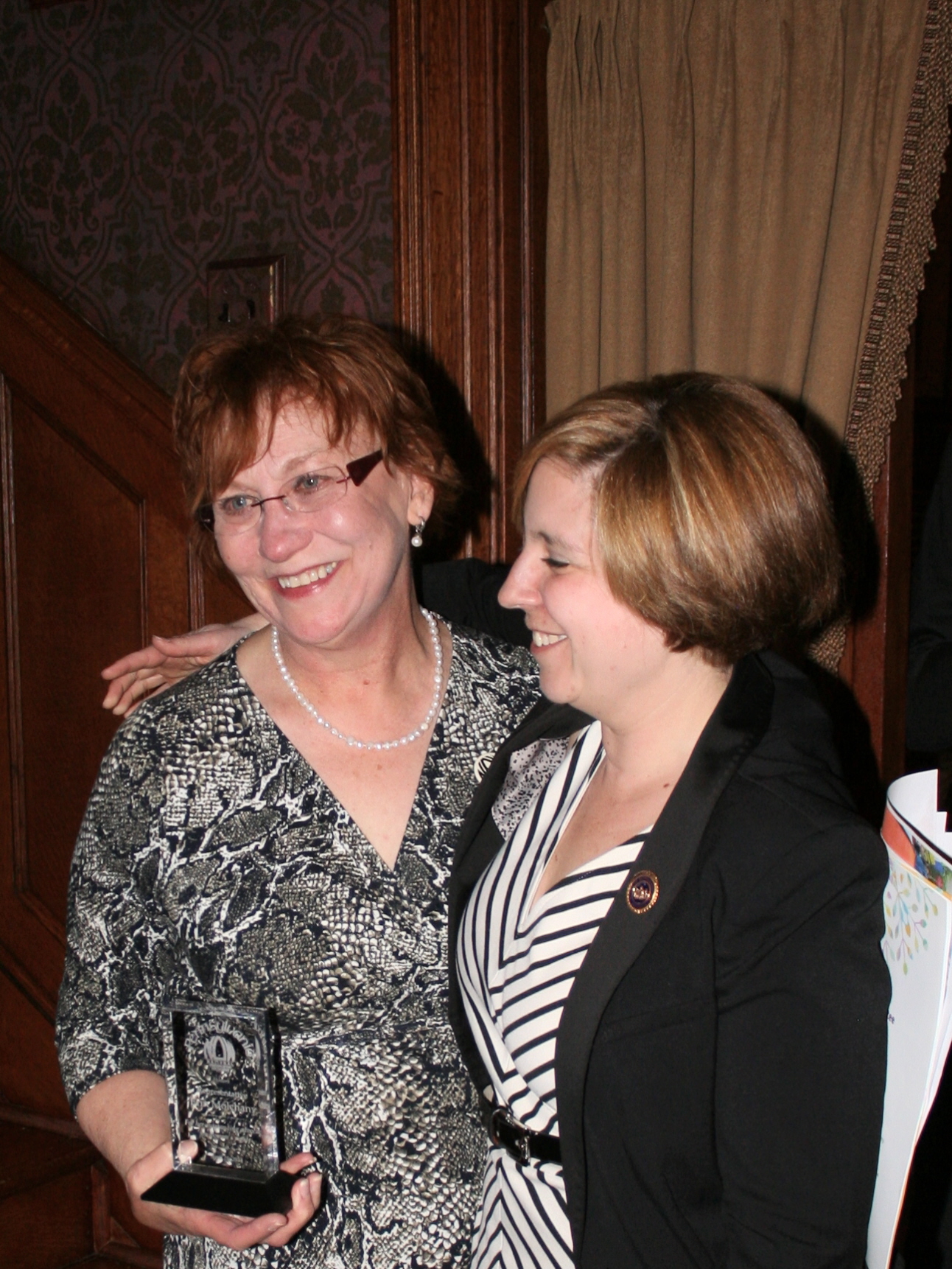
Representative Erin Molchany is a proud member of the Women’s Health Caucus and recently introduced, along with Representative Brian Sims of Philadelphia, a pay equity bill in the House that would close longstanding loopholes in existing laws, and end pay secrecy.

Picture of Jeanne Clark and Rep. Erin Molchany

Jeanne Clark presenting Fearless Feminist Award to Representative Erin Molchany

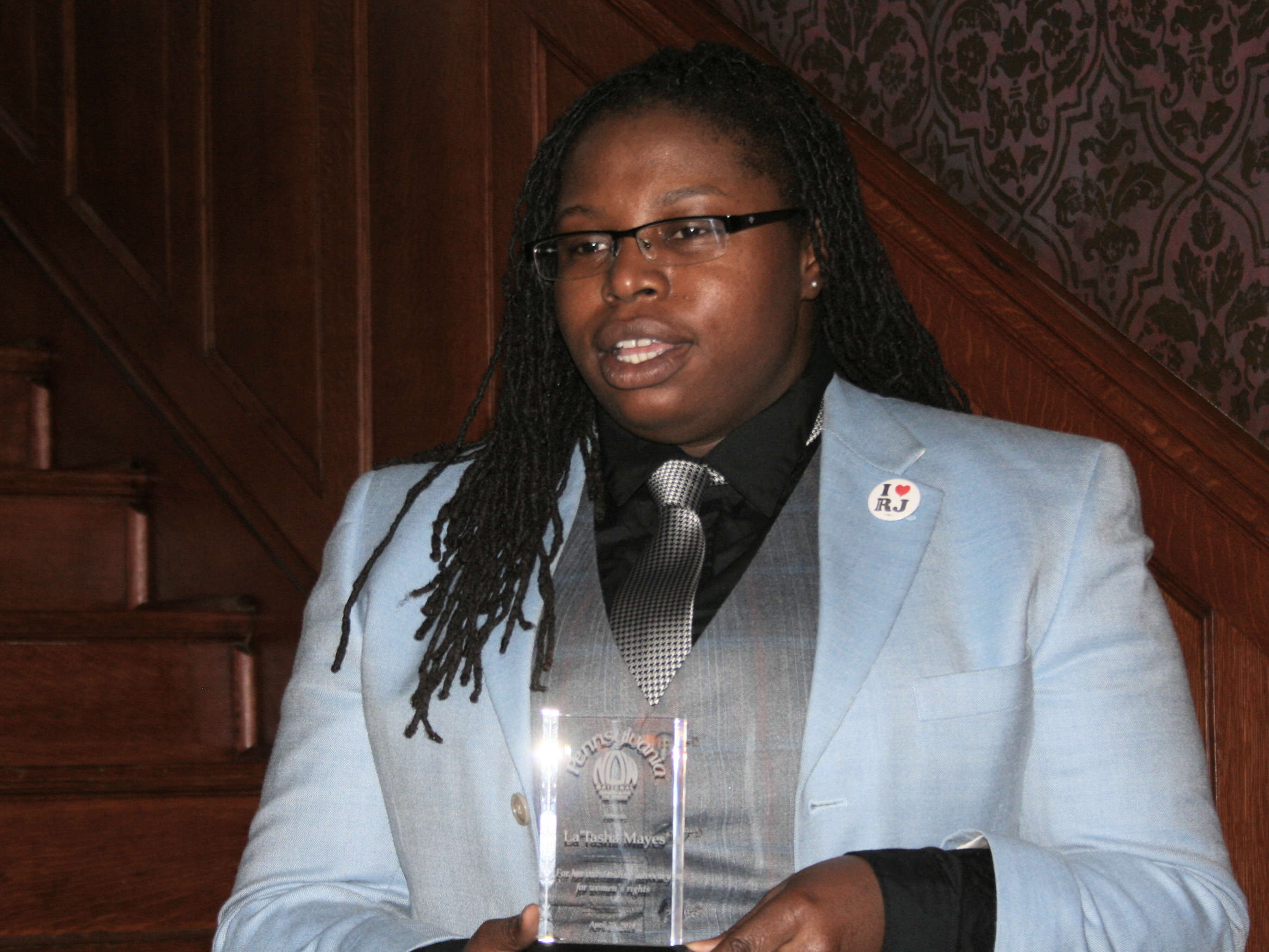
Local activist and nationally recognized reproductive rights leader La’Tasha Mayes founded and developed New Voices Pittsburgh to advocate for women and girls of color in Pittsburgh and beyond.

Picture of La'Tasha Mayes

La’Tasha Mayes thanking PA NOW for Fearless Feminist Award

And Pennsylvania NOW has long benefitted from the contributions of Pamela Macklin, former PA NOW Treasurer, and long-time East End NOW co-President; Joanne Tosti-Vasey, past PA NOW President, current Executive Board member, and Mid-Atlantic Representative to the National NOW Board; and Phyllis Wetherby, First Pittsburgh NOW Chapter President, who has worked for over 45 years to build the organization.

Picture of Pamela Macklin

Pamela Macklin thanking PA NOW for her Fearless Feminist Award

Picture of Joanne Tosti-Vasey

Joanne Tosti-Vasey thanking NOW for her Fearless Feminist Award

picture of Phyllis Wetherby

Phyllis Wetherby thanking PA NOW for her Fearless Feminist Award


Supporting the work of these people, developing feminist leadership, whether in the Capitol of Harrisburg or the neighborhoods of Pittsburgh, is what Pennsylvania NOW is all about. Your support helps us fund our programs to educate and inform and to bring women into full and equal participation in their community and their government. Find out more about Pennsylvania NOW on our website at PennsylvaniaNOW.org.

Thank You!

I would like to thank Pennsylvania NOW for granting me one of these awards and for holding this fundraiser.

picture of the 6 Fearless Feminist Award trophies

The Fearless Feminist Awards

It is a great honor to have stood beside the other five awardees. Congratulations to every one of you.

This award has a special meaning for me as it comes from friends and colleagues with whom I have worked with over the past twenty years. Being able to advocate for equality and fairness is my passion, vocation, and avocation. The support of my friends and family in this work means a great deal to me. Thank you everyone.

Enjoy Tax Day!

Yesterday was Tax Day. I paid my taxes without complaint. Why? Because these taxes help pay for our democracy. Nel’s New Day gives a very good background on why we shouldn’t complain about our taxes. In addition to what she presents, you can find out, using your actual income, how much of your money goes to different parts of the federal government using the White House’s “2013 Federal Taxpayer Receipt” calculator.
And following Nel’s suggestion, I took a selfie in honor of #TaxPayerPride Day and sent it to the Network Education Program (aka the Nuns on the Bus) to post on their FLICKR #TaxPayerPride page with other proud supporters who also want to pay their fair share of taxes.

Joanne Tosti-Vasey's #TaxpayerPride selfie

My taxes help pay for many important things to me. That includes my son’s education, a vibrant multicultural community, the local library, and our access to fair and open elections.

Check out Nel’s blog, find out where your federal tax dollars go, and tell others that you are proud to pay your fair share of taxes to run our country.

trp2011's avatarNel's New Day

Every year, April 15 brings moaning and groaning amid complaints about taxes. Yet if progressives suggest greater equity in taxes for the wealthy, as billionaire Warren Buffet has, Republicans tell us that we can make a gift to the U.S. Treasury. New Jersey governor, Chris Christie, said, “He should just write a check and shut up.” A letter-writer to our local newspaper sneered at me for claiming that taxes went to help people and gave me the address where I could send my money.

Somehow, conservatives don’t mind sending their money to the wealthy hedge-fund managers from Wall Street or the bankers, but they resent contributing to a badly-needed safety net for the poor. They ignore the facts that people in the United States pay a smaller share of their income in taxes than almost all other wealthy Western nations and that taxes as a share of GDP are at a 50-year…

View original post 1,252 more words

Great Nonprofit Boards I Have Known

I’ve served or have served on 3 different non-profit boards over the last two decades. All of them use a Presidential, rather than a CEO style of leadership. Two of them have term limits while the third one has a self-limiting leadership model based on the belief that the leader members New leaders and then moves on. Other than this one difference, all three have the other three characteristics mentioned in this blog. And all three are and continue to be successful.

eugenefram's avatarNonprofit Management

Here are three “greats” among the nonprofits of my past. Their characteristics: (1) Long tenured CEOs, 15 years or more: (2) Boards and CEOs who can embrace change and act on it; (3) Boards who take pride in their CEO’s dynamic achievements internally and externally; (4) CEOs who can work with a continual parade of different board chairs and board members. (5) Boards who can support dynamic entrepreneurial CEOs and who understand the need for strategic planning.

http://www.huffingtonpost.com/eugene-fram/great-nonprofit-boards-i_b_5139669.html?utm_hp_ref=impact&ir=Impact

View original post

Equal Pay Day 2014: Another Year of Inequity

For the last three years, my local NOW chapter—Ni-Ta-Nee NOW—has organized community education events surrounding Equal Pay Day and paycheck fairness.  We have focused on this issue because of the continuing inequity in women’s wages as compared to the male coworkers.

A frequent question we have is, “What’s Equal Pay Day and why should I care?”  To help answer that question, we have done op-eds and interviews with the local press (See here and here).  We also create a flyer that we update each year.  As President of Pennsylvania NOW, I wrote another blog on this issue in 2011. And last year, I commented on Equal Pay Day 2013 as well as the need for fairness in pay.

Like last year, my local NOW chapter will once again be distributing Equal Pay Day flyers in front of the gates of The Pennsylvania State University over the dinner hour.

Why today? Because Equal Pay Day moves from year to year. For 2014, that day is April 8.

The following is a web-based version of this flyer updated from 2013 to reflect today’s stats and information. The hard-copy version focuses on Pennsylvania. I have kept that information here and added additional commentary and links for information and contacts in other states.

TUESDAY APRIL 8, 2014 is EQUAL PAY DAY

IT’S THE DAY ON WHICH WOMEN’S WAGES CATCH UP WITH MEN’S WAGES FROM THE PREVIOUS YEAR.

The wage gap is the ratio of women’s to men’s median annual earnings for full-time, full-year workers. Based on these earnings, women across the US earned just 77% of what men earned (AAUW, 2014).

Equal Pay Day symbolizes how far into the year a woman must work, on average, to earn as much as a man earned the previous year. In 2014, it took 1 day LESS than in 2013, 9 days LESS than in 2012, and 2 day MORE than in 2011 for a woman to earn as much as a man earned in the entire year. At the current rate of progress, the Institute for Women’s Policy Research estimates that it will be 2057 before women’s wages reach parity and Equal Pay Day will finally be on December 31 rather than somewhere in April of the following year!

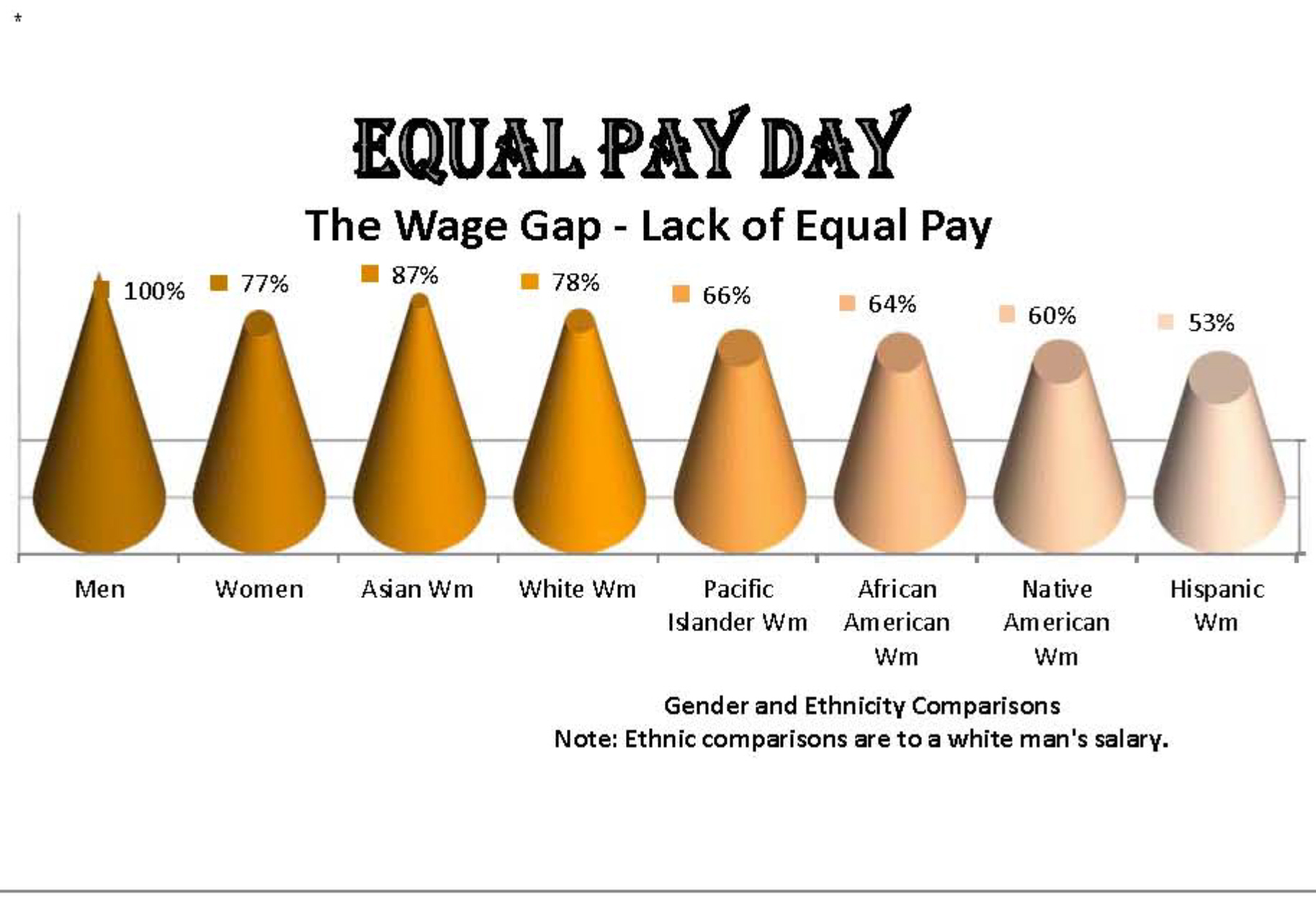
 THE WAGE GAP

The Wage Gap - Lack of Equal Pay

The Wage Gap – Lack of Equal Pay

Nationally, Asian American women have the smallest wage gap, earning 87 percent of what the average white man earned in 2012. White women are next, earning approximately 78 percent of white men’s average income. Hawaiian and Asian Pacific women (65 percent), African-American women (64 percent), Native American and Alaskan Native women (60 percent), and Hispanic women (53 percent) have the largest wage gaps as compared to white men (AAUW, 2014). A typical woman earns $431,000 less in pay over 40 years due to this wage gap. (Center for American Progress, 2012)

THE WAGE GAP IN PENNSYLVANIA

The wage gap is even worse, in Pennsylvania. When ranked among the other 50 states plus the District of Columbia, Pennsylvania’s wage gap placed the state at 40out of 51 states. The median annual income for a woman working full-time, year round in Pennsylvania in 2012 was $37,414, compared to men’s $49,330 or 76% of what a man earns. This is a wage gap of 24%.

Of the 50 largest metropolitan areas in the nation, only Seattle ranks worse than Pittsburgh (with a gap of 27%); Philadelphia fairs better than the state with a gap of just 20%. A typical woman in PA earns $459,000 less in pay over 40 years due to this wage gap. This gap rises to $722,000 for women who have earned college degrees (Center for American Progress, 2010)

WHAT CAN I DO??

If You are an Employer

If you are an employer, you can get help in examining pay practices by conducting an equal pay self-audit using the guidelines from the US Department of Labor (available at www.pay-equity.org/cando-audit.html).

If You Believe You Are Experiencing Wage-Based Discrimination

Tell your employer if you are being paid less than your male co-workers. Click here for some tips on negotiating for pay equity.

If there’s a union at your place of work, ask for their help.

If discrimination persists: There are three places to file complaints – at the federal level, at the state level, and at the local level.

At the Federal Level

You can file under federal law with the Equal Employment Opportunity Commission (EEOC). Go to this link and follow the instructions.

At the State Level

You can find your state’s anti-discrimination agency website and contact information in a pdf file created by Legal Momentum starting on page 28. Most of the agencies have a website address that you can copy and paste into your browser. All of the agencies have a phone number that you can call for assistance.

If you live in Pennsylvania, you can file a complaint with the PA Human Relations Commission in Harrisburg. Contact information is available by region.  Just go to their website and look for your county’s name.  The phone number and address for your regional office is listed directly above the names of the counties served by each office.

You should also check to see if your local county, city, or community has an ordinance providing similar protections for wage-based discrimination. You can also file under federal law with the Equal Employment Opportunity Commission (EEOC).

At the Local Level

There are a few communities throughout the country that have created local ordinances that include the state-based anti-discrimination protections and have also expanded coverage to other areas (such as protections based on sexual orientation, family status, and/or family responsibilities across the life-span). If so, you can more conveniently file a wage-based complaint at the local level. Check with your state’s anti-discrimination agency to see if there is a local ordinance in your community.

In Pennsylvania, there are about 30 communities with such an ordinance. Your regional office of the Pennsylvania Human Relations Commission can give you this information, along with whom to contact. Check with your state’s anti-discrimination office if you live in another state to determine if your state allows such local ordinances and if such an ordinance exists in your community.

As I just stated, there are about 30 communities in Pennsylvania that have such a local ordinance. One of the most progressive and expansive ordinances is in State College, PA, home of the main campus of The Pennsylvania State University. Their ordinance covers wage-based discrimination based on sex as well as color (race), religion, ancestry, national origin, sexual orientation, gender identity or expression, familial status, marital status, age, mental or physical disability, use of guide or support animals and/or mechanical aids. Four of these categories – sexual orientation, gender identity or expression, familial status and family responsibilities across the lifespan, and marital status—are not covered under state law. State College is the only locality in Pennsylvania (and one of only a handful nationwide) that protects you in employment if you have family responsibilities for adult members of your family whether or not they live in the home with you. If you work within the State College, PA borough, you can file a complaint with the State College Borough under their Employment Anti-Discrimination Ordinance at 814.234.7110814.234.7110 (Side note: I was one of the people instrumental in crafting this ordinance).

If You Want to Support and Advocate for Pay Equity

Both the federal and many state legislatures—including New York and Pennsylvania—are attempting to address the issue of pay equity. I previously summarized what happened in New York with its Women’s Equality Act. The following summarizes the current status of the bills currently moving through Congress and the Pennsylvania General Assembly.

The Federal Paycheck Fairness Act

Ask your Congressional representatives to co-sponsor the Paycheck Fairness Act – HR 377 in the US House of Representatives and both S 84 and S 2199 in the US Senate). The Paycheck Fairness Act updates and strengthens the Equal Pay Act of 1963. It gives women the tools they need to challenge the wage gap itself. HR 377 was introduced in January 2013 and currently has 207 cosponsors; S 84 was introduced in 2013 and has 55 cosponsors; and S 2199 was introduced on 5 days ago and cosponsors are being sought by Senator Barbara Mikulski.

These bills have several different but related requirements. These include:

  • limiting wage differentials to bona fide work-related factors such as education, training, or experience;
  • prohibiting employer retaliation against employees who discuss their wages with each other or who supports and cooperates with a wage discrimination investigation;
  • authorizing the US Secretary of Labor to provide wage negotiation training grants for women and girls;
  • requiring employer-level data collection wages broken down by sex, race, and national origin; and
  • directing the Secretary of Labor and the Equal Employment Opportunity Commission to provide technical assistance to small businesses so that they can comply with this paycheck fairness law.

You can find out where your representatives stand on the Paycheck Fairness Act by going to http://thomas.loc.gov/home/thomas.php. In the search box in the middle of the page, type in “Paycheck Fairness Act” and click search.  On the next page, three bills will show up—SR 84, S 2199, and HR 377.  If you then click on “cosponsors” for each bill, you can determine if your representatives are publicly supporting the bill or not. If they are a sponsor, thank them and then ask them to call for a hearing on vote on the bill. If they are not, ask them to sign on.

Pennsylvania’s Workplace Opportunity Act

This bill is a smaller version of the federal Paycheck Fairness Act. Current Pennsylvania law prohibits sex-based wage discrimination between men and women but it suffers from several deficiencies that continue to allow for sex-based wage discrimination. There are two bills in the Pennsylvania General Assembly – HB 1890 and SB 1212. This two bills help to close these loopholes in current state law. Like the federal bill, the Workplace Opportunity Act requires equal pay for equal work. Employers would have to show that that the wage differential is legal if and only if they can demonstrate that the wage differences:

  •  Are not based upon or derived from a sex-based difference in compensation;
  • Are job-related with respect to the position in question, and
  • Are consistent with business necessity.

And again like the Federal bills, retaliation against employees who discuss their wages with each other or who support and cooperate with a wage discrimination investigation would be prohibited

HB 1890 has 54 cosponsors. It was introduced on January 2, 2014 and sent to the House Labor and Industry Committee. Yesterday the prime sponsors of the House bill – Representatives Erin Molchany and Brian Sims—along with Representative Frankel and several of their colleagues held a press conference on this bill. Here’s three short videos from that media event.

During that conference (but not stated in these videos), they announced  that they have introduced a Resolution Petition to Discharge Committee from Further Consideration of this Bill. This is being done because the ranking committee chair is refusing to hold hearings or hold a vote on this bill. Such a resolution is relatively rare, but is used when legislators believe that there is support for the bill by the members of the legislature despite a committee chair’s refusal to consider the bill.

SB 1212 has 18 cosponsors. It was introduces on February 4, 2014. It is currently sitting in the Senate Labor and Industry. Like the HB 1890, it has had no movement in committee. But like most bills, it has not had a “Resolution to Discharge” petition as of today.

If you live in Pennsylvania, you can contact your PA representative and senator regarding pay equity. So, please take time to contact your legislator.  Here’s where to find your legislator’s contact info. And then tell them to bring both of these bills to the floor for a vote.

Finally…For More Information

Visit http://www.pay-equity.org – the website created by the National Committee on Pay Equity (NCPE). NCPE is a coalition of women’s and civil rights organizations; labor unions; religious, professional, legal, and educational associations, commissions on women, state and local pay equity coalitions and individuals.” They are dedicated to ending wage-based discrimination and achieving pay equity.

Fearless Feminist Fundraiser

Pennsylvania NOW, Inc. is honoring six people, including myself on Friday, April 25 in Pittsburgh. Here’s my version of the invitation along with a link to the Eventbrite.com website for tickets. Come help celebrate with me and help out Pennsylvania NOW’s work to achieve equality in women’s lives in Pennsylvania. Thanks.

PA NOW Logo

Pennsylvania NOW logo

JOIN the PARTY to HONOR
3 Great NOW Leaders

2 Courageous State Legislators

1 Amazing Community Leader

GO! and help Pennsylvania Women

Join Pennsylvania NOW on Friday, April 25th, from 5:30-7:30PM

for our

FEARLESS FEMINIST FUNDRAISER

***

Festivities will be held at the home of

Ron Graham & Scott Cavanaugh

6101 5th Ave.

Pittsburgh, PA 15206

Friday, April 25 from 5:30 – 7:30PM

All proceeds to benefit Pennsylvania NOW

and our programs to bring women into equal participation

in their communities and their government.

Tickets are $50.

Register through Eventbrite:

https://www.eventbrite.com/e/pennsylvania-now-fearless-feminists-awards-tickets-10491980797

or send check payable to:

Pennsylvania NOW, Inc.

P. O. Box 4

Ft. Washington, PA 19034

Contact PennsylvaniaNOW@gmail.com to sponsor or place an ad in the program.  The deadline for inclusion in the program is April 9.