No woman in the public eye symbolizes the tremendous change in opportunities for women more than Hillary Clinton. It is not in spite of this, but because of this, that she inspires passion and deep ambivalence. People love her, or people hate her. The media reports on and questions her style as if the entire credibility of constitutional democracy might rest on her cleavage, her hair, her pantsuits, her scrunchies, and now, her logo.
On substance, feminists are frequently told to judge her by the sexual mores of the man she married. Someone has yet to credibly explain how judging a woman by the actions of her partner, rather than her own actions, is feminist.
In the 2008 elections, the Democratic Party failed to treat Hillary with the respect she deserved. She was surrounded with calls to get out of the race while she was still ahead in the primary.
These type of comments are creepy, sexist and occur in all fields of occupation, particularly in non-traditional work. Cat calls are the most blatant. Ones like these that put down women for their brains that are also be accompanied by what she looks like are just as demeaning and are a from of sexual harassment, imho. They create a hostile work environment based on gender.
On Tuesday, August 19, I received a forwarded email from PSU Executive Vice President and Provost Nicholas P. Jones:
It is with deep sorrow that I’m writing to inform you that our colleague and friend, Dr. Terrell Jones, Vice Provost for Educational Equity passed away this morning. Terrell had been on medical leave the last few months. He will be greatly missed across the University not only for the impact of his contributions to Penn State, but also for simply the wonderful person that he was. We will share with you the details regarding funeral arrangements as they become available. Please keep Carla [Roser-Jones] and Terrell’s children in your thoughts and prayers.
This short note brought tears to my eyes and a great sense of loss. W. Terrell Jones was a civil rights advocate par excellence both in and out of work. He brought humor and caring to everything he did.
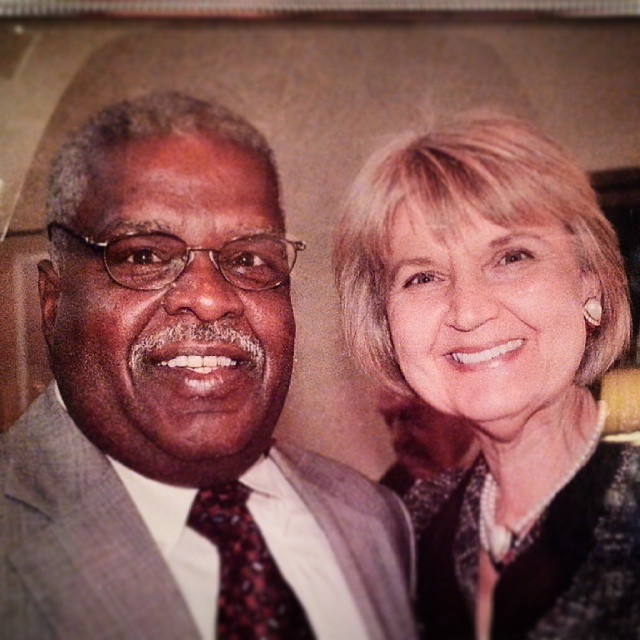
W. Terrell Jones (pictured with his wife Carla Roser-Jones). A Civil Rights advocate in and out of work.
I first met Terrell in the early 1990’s when I attended a meeting of the Centre County Advisory Council to the Pennsylvania Human Relations Commission (PHRC). Soon after that, I was appointed to this Council and served with Terrell up until his death. Until March of 2013, Terrell chaired the monthly meeting of the Advisory Council. His passion for low-income students of color, concern for community diversity and acceptance, and a love of knowledge was quite apparent.
He was a teacher, a counselor, a fountain of trivia on people and ethnicities across the country and around the world. And did his work—both paid and unpaid with a sense of humor and dignity. Here’s a sampling of his ability to teach with humor in the classroom; this is one of the many classes on race relations and cultural diversity that he taught over his 35 years of work at the Pennsylvania State University and one year at Lock Haven University.
On Thursday, August 21, I attended the bimonthly meeting of the Inter Agency Task Force on Community Activities and Relations in Harrisburg. According to the PHRC,
The task force is made up of [the] PHRC, the PA Attorney General’s Office and the PA State Police, working in conjunction with other state and federal agencies, community organizations, advocacy groups, local government and law enforcement agencies. The primary function of the group is to quickly and appropriately address civil tension when conflicts occur, and to promote positive community relations among various groups in order to prevent tension.
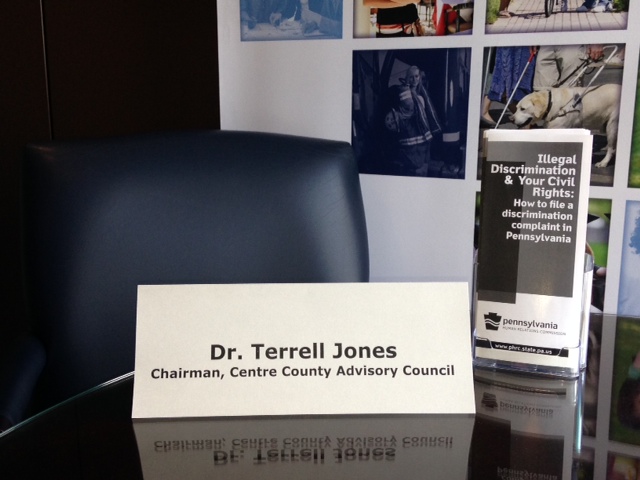
The meeting was opened at 10:30 am by Tameka Hatcher, Program Analyst for the PHRC. We usually open these meetings by going around the table and introducing ourselves. This morning was slightly different. Tameka held up Terrell’s name plate and announced that he had passed after a four-month battle with cancer. She asked for a moment of silence and then asked Martin Kearney, Investigative Supervisor at the PHRC and me to say a few words about Terrell. We then placed the name plate at the table to honor our missing comrade.
An Empty Seat at the Table: In Memory of Dr. W. Terrell Jones
Here’s some of the accomplishments we talked about:
Local Ordinances
Terrell helped organize a community public forum on discrimination in housing and employment based on sexual orientation and gender identity about 8-9 years ago. Based on the feedback from that forum, the State College Borough decided to review their Fair Housing Ordinance that had passed in 1994 and decided to expand it as well as create an employment anti-discrimination ordinance in 2008. Working with the Centre County Advisory Council, Terrell and I worked with the town council to help craft the new ordinances that now contain the broadest anti-discrimination protections in the state. The employment ordinance includes marital status, familial status, family responsibilities, gender identity, and sexual orientation in addition to the state-level protections found in the Pennsylvania Human Relations Act. The public accommodations and fair housing ordinance includes marital status, familial status, gender identity, sexual orientation, and source of income in addition to the state-level protections of the Pennsylvania Human Relations Act.
Tension and Hate
Calming down communities when tensions rise due to religious, racial, gender, or LGBTQIA intolerance, vandalism, and/or hate speech was a forte for Terrell. He created trainings on racial equality, worked with groups to figure out how structurally and organically they could improve their communities to be more accepting and tolerant. He did this for the entire Penn State University community at all of the campuses, within Centre County and across the state. Working with Unity groups, the PHRC, and coalitions, he helped bring together people.
Statewide Leadership
At Penn State University
Seen as an expert on race relations and diversity, Terrell was often called upon to lead programs and organizations dealing with these types of issues. When he started his position as Vice Provost of Educational Equity in 1998, he created “A Framework to Foster Diversity.” According to the Centre Daily Times, this document is a regularly updated plan outlining Penn State University’s diversity and equity goals. As part of his leadership in this position, Terrell oversaw many different offices and commissions to achieve his vision of “an inclusive and welcoming environment for all.” These offices and commissions include:
And according to the PSU Office of the President, Terrell led other programs and events throughout his tenure at the University: “He served on the University’s Forum on Black Affairs for many years, and was its president from 1986-87. He also was chair of the Equal Opportunity Planning Committee from 1989-96 and Penn State’s Representative for the Global Sullivan Principles from 2000-2005.”
Community Leadership
As I previously stated, Terrell was appointed to and later led the Centre County Advisory Council to the PA Human Relations Commission for over 20 years. We met 10 out of the 12 months of each year and then held a family picnic for members every August. Our meetings brought together members of the community who act as the “eyes and ears” of diversity in the community. We gathered each month to discuss concerns about injustice and joys of acceptance of people of all backgrounds within Centre County.
Both of us also handled the Blue Pages phone hot line answering questions about unfair treatment and potential discrimination. As appropriate we gave these individuals information on how to contact the PHRC to file a complaint and/or provided on other resources to assist them in resolving their issues.
Over the years, several different representatives from the Pennsylvania Human Relations Commission would attend these meetings so that we could pass on the news – both good and bad – to help the state monitor issues of inclusion and tension throughout the state.
We also had a good time, always looking forward to Terrell’s “main dish” offerings at our picnics. He fed us with fried turkeys, roasted pork, and tons of catfish over the years – all his own handiwork!
Terrell was also active in his local church – the Jacob Albright-Mary McLeod Bethune United Methodist Church. I understand that he was one of the leaders of this church, having served from 1990 until his death as a member of its Administrative Council. At the funeral, Reverend Kathleen Danley described his leadership by telling about her arrival at the church this past January. She said that members of the church seemed very tense or sad about their former preacher’s departure. Until Terrell arrived. She said with his arrival, the tension left the room and everyone felt better and got to work. Having that kind of presence is rare.
Leadership across the Commonwealth
Terrell also brought his wisdom and expertise to all corners of the Commonwealth. I asked Martin Kearney, the Investigative Supervisor for the Harrisburg Regional Office of the Pennsylvania Human Relations Commission to put this part of Terrell’s leadership into perspective. Here’s the email he wrote in response:
You asked me about Terrell’s work with PHRC. I have had the pleasure to have worked with Terrell for nearly a decade when he was Chair of the PHRC Advisory Council for Centre County. Other colleagues, such as Homer Floyd, Kaaba Brunson, and Ann Van Dyke have known and worked with Dr. Jones for three decades or more. I am grateful I had the opportunity to learn from him and his work.
Essentially, from the state standpoint, Terrell was key in helping make PSU a more welcoming place for persons of all protected classes, particularly but not exclusively students of color, in his career. He kept the PHRC apprised of these efforts, especially in regard to academic achievement and safe learning environment for these students. His work in the vineyard has borne fruit, but as we know, more labors need to be made to make education more accessible and affordable for students in need.
Terrell was active with the Pennsylvania Black Conference on Higher Education (PBCOHE) [he served as its President from 2008-2010], which attempted to get all universities in the Commonwealth, public as well as private, achieve equal education opportunity for students of color. Our Commission was very active in this initiative as well and Terrell’s work helped to increase the numbers of students of color going to college and successfully graduate. He was also key in helping to investigate and resolve tension situations related to race and ethnicity not only at PSU but on other campuses as well. For instance, he led an investigation in 2007 at Bloomsburg University campus involving allegations of excessive force and misconduct by campus police toward African American students. He conducted this investigation with skill, transparency and thoroughness, recommending better communication between students and police and cultural competency training for campus police.
Terrell’s presence in Centre County was well known, especially in his and the Advisory Council’s efforts in State College Borough’s consideration and passage of the Fair Housing (1994) and Human Relations Ordinances (in 2008), efforts of which you know so well (since you were so key in both of these), which had expansive protections beyond Commonwealth law for sexual orientation, marital status and family responsibilities. Through the work of Terrell and the Council, relationships were built, to create a constituency that supported these ordinances. It is notable that when the Fair Housing Ordinance was passed, there was [a large and very] vocal opposition to it. The opposition to the expanded Human Relations Ordinance over a decade later was not only much smaller but much less vocal. It was consciousness raising of our growing notions of equality, led by Terrell and the Council, that helped to foster this change.
Finally, Terrell not only knew issues of diversity and equality, he knew this state very well. He pored over the bias reports that the Commission created, reported incidents of which he knew, but also added a historical perspective of these incidents for our state and nation. In my dealings with him, I always walked away having learned something of value, lessons I carry in my work to this day and which our Commission carries on as well.
A place at the table for our Commission’s Inter-Agency Task Force is missing. While none of us can fill this space that he leaves, his spirit and the knowledge he passed on will continue for decades to come.
The Farewell Tribute
At Terrell’s funeral on Saturday, August 23, the love for Terrell showed throughout the church. It was overflowing with people. The vestry was full. The room across the hall from the vestry was full. And those who couldn’t find seats in either of these rooms went downstairs to the reception hall. Fortunately all of us got to see the service since the church provided video access to the full service. I think the “Affirmation of Faith” affirms Terrell’s life-long passion for equity and justice. In part, here’s what was proclaimed
Affirmation of Faith by Canaan Banana (edited by Rev. Grey)
I believe in an almighty God
Maker of all people of every color and hue,
Who does not rank people according to their color or gender,…
Who provide[s] abundant resources for
Equitable distribution among all people….
[Who] overturns the iron rule of injustice.
From henceforth He shall continue to judge hatred, racism, sexism,
And every manner of dehumanizing exclusiveness and arrogance.
I believe in the properly placed spirit of reconciliation,…
The Power that overcomes the poverty, abject ghetto life,
Abject rural life, drug and alcohol addiction,
women and children abuse, and pimping, prostitution, and pushing in all of their forms.
And I believe in the … Resurrection of personhood
And equalizing justice, and equality…
Amen
Terrell, we’ll miss you at the table of equality and justice for all. You will be missed greatly. Rest in peace my friend.
Addendum: According to the obituary that appeared in the Centre Daily Times on August 21, the family has requested that in lieu of flowers, memorial contributions may be made to the Albright-Bethune United Methodist Church, P.O. Box 153, State College, PA 16804 or to the Dr. W. Terrell Jones Scholarship Memorial Fund at the Pennsylvania State University, by visiting www.GIveNow.psu.edu/TerrellJonesMemorial.
In August 2013, Yellowstone County (Billings), Montana Judge G. Todd Baugh sentenced ex-teacher Stacey Rambold to thirty days in jail for raping one of his 14-year-old students . Baugh had followed a recommendation from Rambold’s lawyer by giving Rambold a sentence of 15 years in prison with all but 31 days suspended and a one day credit for time served. Even worse, the judge showed gender and racial bias against Cherise Morales—the 14 year old, Hispanic girl who Rambold raped. During the sentencing hearing, Baugh stated that the girl was “as much in control of the situation” as her rapist and that she was “older than her chronological age.”
Upon hearing about this incident, Joanne Tosti-Vasey, former PA NOW president and current member of the PA NOW Executive Committee contacted Montana NOW President Marian Bradley. After consulting with each other, Montana NOW and Pennsylvania NOW decided to coordinate a state and national action to push back against this egregious behavior and use of rape myths.
We focused on both the unethical behavior of Judge Baugh and on working to overturn the illegal sentence handed down on Rambold.
The Ethics Complaint Against Judge Baugh
First, we focused on a petition to sanction Judge Baugh. The first step was to help get a groundswell of people calling for the Montana Judicial Standards Commission to review and sanction Judge Baugh for his behavior. Working with We are Ultraviolet and Fitzgibbon Media we gathered over 130,000 signatures calling for the state to sanction Judge Baugh. Meanwhile we contacted Legal Momentum (a national women’s advocacy organization that houses the National Judicial Education Program on Gender Bias in the Courts) and Pennsylvania’s Women’s Law Project to assist us in crafting our complaint.
Marian Bradley, President of Montana NOW delivering the NOW complaint to the MT Judicial Standards Commission on September 24, 2013.
Using these petition signatures, we publicly delivered our complaint on September 24, 2013 against Baugh urging the Montana Judicial Standards Commission and the Montana Supreme Court to
Remove Judge Baugh from the bench for his misconduct related to his handling of and speech about the rape case involving the sentencing of Stacey Rambold; and
Implement a mandatory judicial education program for the judiciary on the fair adjudication of sexual assault cases to help the Montana justice system develop techniques to minimize victim re-traumatization while safeguarding the rights of the defendant.
As a result of this complaint and several others, Judge Baugh acknowledged on December 7, 2013 that he violated one of the three ethics rules we alleged he had violated. He said that he had failed to “promote public confidence in the independence, integrity,and impartiality of the judiciary,” and did not “avoid impropriety and the appearance of impropriety.” But he refused to acknowledge that he used racial and gender bias in handing down the sentence and as a result, did not uphold the law. So we submitted a response detailing the rape myths he used in creating the sentence and in not following the law with the minimum, mandatory two-year sentence.
Meanwhile, on December 6, 2013, the Montana Attorney General’s office filed an appeal before the Montana Supreme Court. They are asking the court to remand the case back to the Yellowstone County District Court for sentencing that would follow the state law’s mandatory minimum sentencing guidelines. They are asking for, at minimum, a four-year sentence.
NOW once again weighed in. Knowing that it is possible for advocacy groups to file “friend of the court” amicus curiae briefs, we contacted two members of our network of women’s legal advocacy organizations—The Women’s Law Project and Legal Momentum—to see if there was any interest in pursuing this amicus. They put us in contact with Legal Voice and the Sexual Violence Law Center. Both of these organizations are based in Seattle, Washington and serve women in Montana. As a result, all six organizations agreed to file an amicus.Attorney Vanessa Soriano Power and other members of the law firm Stoel Rives LLP took the lead in writing our brief and petitioning the Court to add our brief to their review of this case.
Montana’s Supreme Court rarely accepts amicus briefs, but did in this case. The amicus brief we filed focuses on rape myths and their inappropriate impact in adjudicating and sentencing in sexual-assault cases. We are asking the court to take the effect of these types of myths into account when making their decision in this case and, upon remand, to assign the case of Stacey Rambold to a new judge for appropriate and legal re-sentencing.
What’s Happening Now?
Both cases were sent to the Montana Supreme Court for review. We heard on April 25 (the 10th anniversary of the March for Women’s Lives in Washington DC that brought out over one million people) that the decisions on what type of sanctioning Judge Baugh will receive and whether or not Stacey Rambold will be re-sentenced is pending.
This morning, the Montana Supreme Court handed down their decision in the Montana v. Rambold case (copy of the opinion can be seen here). The Court listened to the arguments presented by both the Attorney General’s office and by NOW. They overturned (“vacated”) the 30-day sentence and remanded the case back to the Yellowstone County Courts for re-sentencing in line with the minimum mandatory sentencing guidelines. In addition, they have ordered the county to assign the case to another judge for Rambold’s re-sentencing.
The last two paragraphs of the opinion indicate that the Court heavily relied on our amicus in ordering the remand:
¶21 On remand for resentencing, we further instruct the court to reassign the case to a different judge to impose sentence. We have considered several factors to decide whether a new judge should be assigned to resentence a defendant in a particular case, among them; whether the original judge would reasonably be expected to have substantial difficulty in putting out of his or her mind previously-expressed views determined to be erroneous, whether reassignment is advisable to preserve the appearance of justice, and whether reassignment would entail waste and duplication out of proportion to any gain in preserving the appearance of fairness. Coleman v. Risley, 203 Mont. 237, 249, 663 P.2d 1154 (1983) 10 (citations omitted). In State v. Smith, 261 Mont. 419, 445-46, 863 P.2d 1000, 1016-17 (1993), we remanded for resentencing to a new judge when the judge’s statement at trial evidenced bias against the defendant. Even where bias did not require reassignment to a new judge, we have reassigned where media coverage and public outrage “have snowballed to create an appearance of impropriety.” Washington v. Montana Mining Properties, 243 Mont. 509, 516, 795 P.2d 460, 464 (1990).
¶22 In the present case, Judge Baugh’s statements reflected an improper basis for his decision and cast serious doubt on the appearance of justice. The idea that C.M. could have “control” of the situation is directly at odds with the law, which holds that a youth is incapable of consent and, therefore, lacks any control over the situation whatsoever. That statement also disregards the serious power disparity that exists between an adult teacher and his minor pupil. In addition, there is no basis in the law for the court’s distinction between the victim’s “chronological age” and the court’s perception of her maturity. Judge Baugh’s comments have given rise to several complaints before the Judicial Standards Commission, which has recommended disciplinary action by this Court. Those complaints will be addressed in a separate proceeding. Under these circumstances, we conclude that reassignment to a new judge is necessary to preserve the appearance of fairness and justice in this matter.
Meanwhile the sanctions against Judge Baugh are still pending. This was confirmed in this morning’s opinion announced by the Montana Supreme Court: Judge Baugh’s comments have given rise to several complaints before the Judicial Standards Commission, which has recommended disciplinary action by this Court. Those complaints will be addressed in a separate proceeding.
We feel strongly that our work on this case shows our commitment to looking out for the women, children and families of our states and our nation. This behavior by our teachers and our judiciary should not and will not be tolerated. Our vigilance will continue.
— blog written by Joanne Tosti-Vasey and Marian Bradley
There are two fronts occurring in the War on Women. The first front is combines ALEC (that’s the conservative American Legislative Exchange Council—click here for an expose on ALEC) with right-wing legislatures to create bills and laws, among their many attacks, that impinge on women’s reproductive justice, economic sustainability, marriage, etc., etc., etc. I have done several blogs on this issue; the most comprehensive one focused on the 20+ years of attacks on women’s lives in Pennsylvania. The second front is the use of right-wing rhetoric that uses misogynistic language resulting over time in the oppression of women. This rhetoric includes pejorative words that focus on “lady parts” and statements that either degrade women and their position in society or place them on a paternalistic pedestal where these women need to be “protected.” People on both the left and the right—sometimes without awareness—incorporate this rhetoric into their everyday language. Which then feeds into the first front I mentioned: legislating rights away from women.
About a year ago, Muslim Reverie, a blogger who advocates for an “anti-racist, anti-colonial feminism,” wrote this blog on how men on the left of the political spectrum refuse to see or acknowledge their sexism. This blog I’m re-posting today focuses on this second front of rhetoric in the war on women. It includes several ideas for thought – use of white privilege; use of misogynistic language without taking into account its effects on women, particularly women of color; and how this rhetoric perpetuates the sexist oppression of women.
Take a moment to read this thought-provoking blog. I think this is a great summary of this second frontal attack on women’s lives.
TRIGGER WARNING: This post cites examples of misogynistic language, gender slurs, sexual objectification, and other forms of sexist oppression.
A couple of weeks ago, I came across an article on Vice that was oddly titled, “You’re a Pussy If You Think There’s a War on Men.” It seemed clear that the author, Harry Cheadle, was referring to an awful “reverse sexist” and anti-feminist article about “The War on Men,” which asserts that women are to blame for the “dearth of good men” and must “surrender to their nature” while letting “men surrender to theirs.” Cheadle writes in defense of feminism and exposes the absurdity of claiming that men are “oppressed” by women. While I agree with his arguments that men need to stop blaming and fearing women, the sexist use of the word “pussy” in his title couldn’t be overlooked. After a brief conversation with friends who also found it…
It’s been 50 years since Martin Luther King, Jr. gave his iconic “I Have a Dream” speech in front of the Lincoln Memorial in Washington, DC. One of his colleagues at that event was the Rev. Jessie Jackson, Sr. Rev. Jackson has continued speaking and advocating for that dream of “uniting people on common ground across race, culture, class, gender, and belief.” This idea of interlocking destinies was presented during his plenary speech at the National NOW Conference held in Chicago on July 5, 2013.
I was in the room during Rev. Jackson’s speech and took several video clips with my smart phone. One of them came out clear enough to post on this blog. So after getting back home, participating in a family reunion, and then spending a week and a half looking for a replacement car for our 253,000+ mile vehicle, I was able to upload the video and present it to you.
Video of Jessie Jackson at the 2013 National NOW Conference in Chicago, IL
The following quotes, along with the time tags are some of the best comments, IMHO, that Jessie Jackson made during this speech discussing the intersection between the women’s movement and the civil rights movement, which at 13:59 into this video, Jackson calls a “sharing of interlocking destinies.” He started off by discussing these Interlocking Destinies and shared rights.
3:10 Fifty years after the “I Have a Dream” speech, we still need the ERA [Equal Rights Amendment].
3:52 The right to vote should not be a state right. It’s a constitutional right for everyone.
4:10 Every child should have access to have access to high-quality public education.
4:20 No matter if you are in Mississippi, Maine, or in California, we live under one flag; you should have equal protection under the law.
5:52 Our goal is to learn to live together.
6:20 Civil rights cannot be another word for “black” and NOW cannot be another word for “white women.” Black women, in big numbers, should be members of NOW now!
7:00 We must pull down the walls [of cultural resistance] that leave us in the shadow of fear…. When the walls come down, we can all grow bigger, better, stronger with greater productivity. When the walls come down.
9:00 There’s a new South today that can have the Super Bowl, CNN, high-tech universities [showing that we are] learning to live together. Yet…
At this point, Rev. Jackson starts talking about some of the interlocking issues of racism and sexism still present that need to be addressed in the United States:
9:56 It’s interesting to me that during the Republican Primary, in my [home] state [South Carolina] with an open primary, not one candidate went to a single school or church of the black community. Not one! 33% black. Not only did they not go, the media did not challenge them to go. This instance [of the] reinforcement of apartheid was natural because it’s [still] normal.
Jackson then spends a bit of time framing these interlocking destinies and the problem of economics and access to justice. He gave several examples of this framework. The one that resonated with me was the one about the automobile industry, considering that my car had died the weekend before the conference and knowing that I would soon be car shopping. He said,
12:38 What does it mean that there are 21,000 automobile dealerships? 200 black-owned. Almost no women. Pepsi: one black franchise. Coke: zero. When you go get educated. You get your masters and PhD degrees. Business people, you cannot buy one of these franchises, by the way, because they were sold under the laws of perpetuity. Those that got the territories [back in the day] have the territory eternally. So it’s not about getting on the ball field. If you get on the ball field, there are no balls left…. Even money can’t buy them.
And finally, just as the battery in my smart phone died, he ended on a high note using history to look towards the future. He said that as in the past, we have not and can never be at loss for continuing to advocate for reform. This is what I caught on the video as it beeped “bye-bye:”
13:59 The agenda of race and gender equality are inextricably bound. We share interlocking destinies. African-Americans won the right to vote in 1879 – 15th Amendment. Women in 1920 – 19th Amendment. We [finally] got the right for blacks to vote in the Deep South in 1965 [with the Voting Rights Act] while women got the right to serve on juries in 1967 – 2 years later [as a result of the US Supreme Court decision inTaylor v. Louisiana]. Eighteen year olds got the right to vote in 1970; [before that] those [young people] serving in Vietnam could not vote…
Americans are a melting pot of people from all over. We come from everywhere. Some are indigenous to the American continent. Most of us are not and in fact are a blend of many different ethnicities.
In response to the senseless bombing that occurred last week in Boston, I became concerned that we might have a hate-filled backlash against Muslims and Arab people much like what happened after 9-11.
I was beginning to put together a new blog posting on our multiethnic, multiracial society in response to the bombing and the aftermath to say that we need to be accepting of people no matter yours or anyone else’s ethnicity, race, or religion. Just as I began my writing, I got an email noting that Erin Matson had said essentially what I was writing.
So instead, I decided to reblog her posting with some additional comments for all of my readers.
Most religions talk about peace, equality, integrity, and stewardship or caring for others. My personal perspective is in agreement with these religions. That is, no matter what your race, gender, religion (or non-religion), ability or disability, gender identity, or sexual orientation, we all can agree to accept each other in peace and racial harmony.
So take a moment, look at all of your neighbors and all of the people you come in contact with. Take a breath. Smile. Welcome them. And embrace them.
Our diversity is what makes us human. Accepting, celebrating, and embracing others just for whom they are rather than showing hate and fear should be the mantra for all of us.
Welcome everyone. Take care of yourself and those whom you come into contact with either face to face or in any other way.
Who didn’t watch the news coverage of the senseless terrorist bombings in Boston with a mixture of horror and sadness? After coverage shifted from deaths and injuries to the Federal Bureau of Investigation releasing photographs of the suspects, some news anchors suggested that you couldn’t tell by the pictures if they were American or not.
Clearly, this needs to be said: Americans look like everyone.
Americans come in every skin color, hue, and shade that pigment and sunlight know how to put together.
Americans are girls, women, boys, and men. There is not a gender identity or sexual orientation that doesn’t look American – in military uniform, in scouting uniform, or in casual clothes.
Americans have faith. Americans don’t have faith. The Constitution contains a declaration of faith that “Congress shall make no law respecting an establishment of religion, or prohibiting the free exercise thereof.” This means that Atheists, Christians…
DIY Resource for those wishing to have their Italian citizenship recognized through Italy's "jure sanguinis" birthright citizenship & “Jure matrimonii” by marriage
Progressive commentary from Gainesville, Florida, once called the Berkeley of the South. Potano was the chief of and the only known name of the Native American tribe inhabiting the area around what is now Gainesville at the time the Europeans arrived.
“It takes no compromise to give people their rights…it takes no money to respect the individual. It takes no political deal to give people freedom. It takes no survey to remove repression.” – Harvey Milk
a feminist habit. thinking broadly about life and art. at peak. sometimes broadspoken. not a translation program. crushing the doublespeak. seeking free speech.
The views depicted here are my own, do not represent the views of anyone/anything else, and cannot be reproduced in whole or in part without my express written consent.
Learn more about the state laws being introduced and passed around the U.S. that is limiting Women's rights. Did you know that the Women's Equal Right Amendment from 1983 still needs to be ratified by 3 more states before it goes into effect?




 Civil Rights Advocacy