Pennsylvania’s Proposed Women’s Health Agenda

Kate Michelman

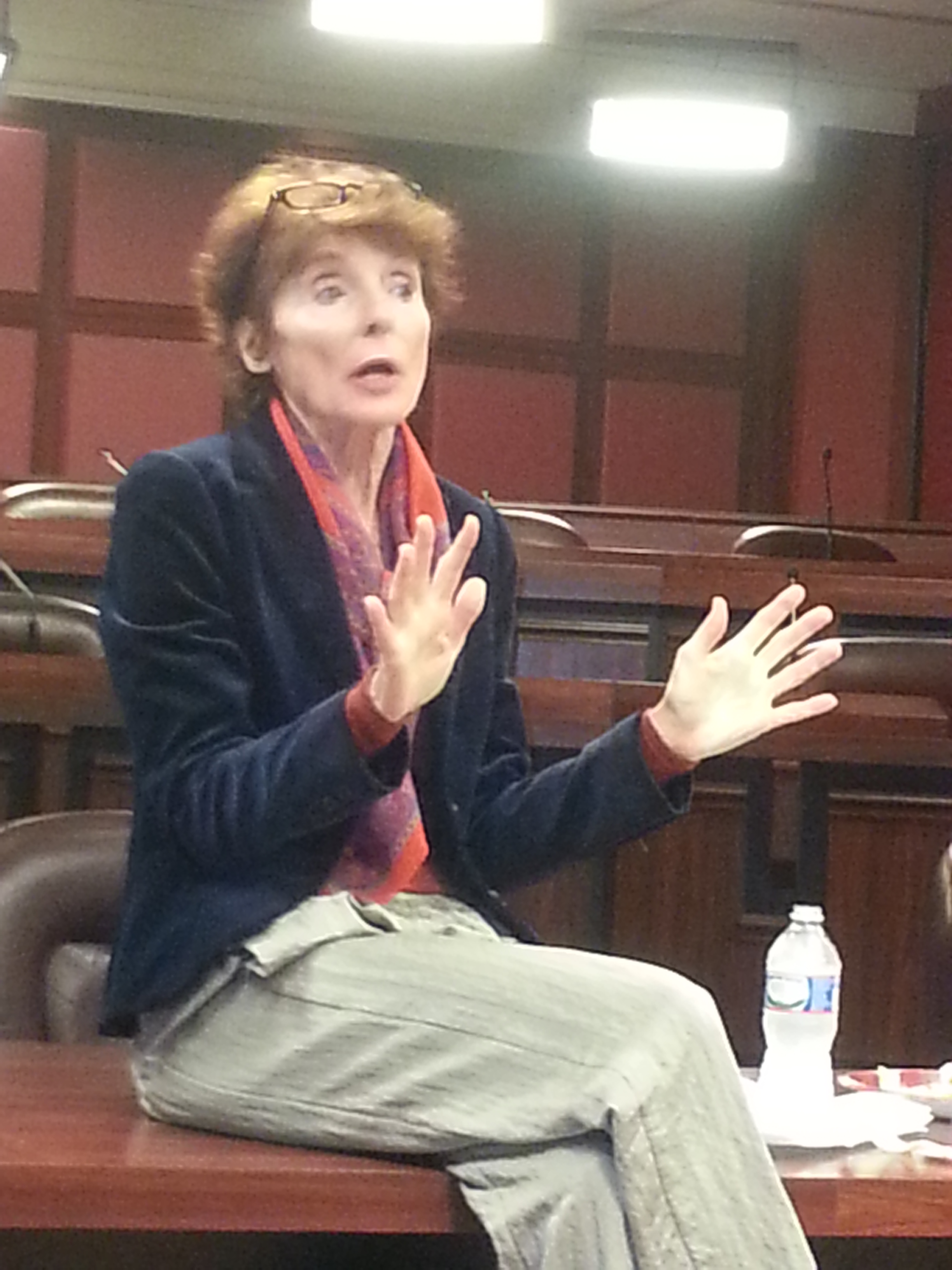
Kate Michelman discussing strategy with women’s health care advocates and members of the General Assembly Health Care Agenda Caucus.

Yesterday (Monday, September 30, 2013), I attended a two-hour meeting with Pennsylvania’s House and Senate members of the joint Women’s Health Agenda Caucus led by Representative Dan Frankel of Pittsburgh. Some of the advocacy groups attending the meeting included the Women’s Law Project (WLP), Women Vote PA, and members of the Pennsylvanians for Choice coalition including Pennsylvania NOW whom I represented.

For a very long time Pennsylvania has focused on restricting women’s access to abortion services – currently accounting for over 1270 pages of legislation and regulations in the state.  This wrong-headed approach to health assumes that women’s sole need is to protect them from safe, legal access to decent abortion care services.  In other words, the state has wrong-headedly been crafting laws and regulations to deny access to abortion, sending more and more women to the back alleys similar to the Gosnell clinic and ignoring the broader issues of women’s health equity.

Women’s concerns about their health are broadly based in bias based on gender. Terry L. Fromson, Amal Bass, Carol E. Tracy, Susan Frietsche of the Women’s Law Project  created a report entitled Through the Lens of Equality: Eliminating Sex Bias to Improve the Health of Pennsylvania’s Women in 2012.  The WLP is Pennsylvania’s feminist legal organization that engages in litigation, advocacy, and education to ensure women’s equality and treatment in Pennsylvania. This report set the context for yesterday’s meeting.  The WLP framed the health care agenda as follows in this report and in the meeting this morning:

The legal and social status of American women has changed dramatically in the last fifty years. Half a century ago, it was legal to segregate jobs by sex, to refuse to hire or promote on the basis of a person’s sex, to fire women who became pregnant, and to limit the number of women admitted to professional schools such as law and medicine. Sexual and domestic violence were hidden from public view and public policy. Abortion was illegal and the birth control pill was not yet on the market. Today, women have taken their place in the working world and educational opportunities for women have expanded exponentially. Sexual and domestic violence are recognized as crimes and some resources are available to its victims. Abortion is legal and birth control is available.

Despite these advances, deeply embedded cultural biases and stereotypes about women’s place in society continue to impede women’s equal participation in society. In our homes and communities women are subjected to violence, poverty, and the burden of care taking responsibilities. In the workplace, women are paid less than men for the same work, remain concentrated in stereotypically female low-paying occupations, are subjected to sexual harassment and discrimination on the basis of pregnancy and care giving, and are denied advancement to managerial and higher paying positions. In school, young women are denied their fair share of sports opportunities and are sexually harassed and violated. Women are denied essential reproductive health care and subjected to discrimination in access to insurance coverage. Women pay more than men for the same coverage, and pregnancy is a preexisting condition that often denies pregnant women access to insurance coverage and therefore maternity care.  Access to abortion has been limited by burdensome legislative requirements, and providers and patients have been terrorized by an increasingly violent opposition. Attacks on access to contraceptive services have grown.

While many laws have been adopted to eliminate sex discrimination at work and at school, gaps persist that must be filled and enforcement needs to be strengthened. This is particularly true in Pennsylvania. While some Pennsylvania cities have outlawed employment discrimination on the basis of care-giving responsibilities and provide other accommodations for women who work, the Pennsylvania legislature has failed to adopt a statewide prohibition on discrimination on the basis of caregiver status or to provide family leave for caregivers. In Pennsylvania, the law permits insurers to price the cost of health insurance higher for women than for men, resulting in women paying more for individual health insurance policies and small employers paying more for health insurance for a predominantly female workforce. Pennsylvania’s sexual assault laws have for the most part eliminated discriminatory provisions, but the myths and stereotypes that continue to infect the criminal justice system hinder the investigation and prosecution of these crimes. The health care perspective on domestic violence and sexual assault is far too limited. Sexual assault is treated as a health care matter primarily in the immediate aftermath of a rape, even though the physical and emotional health consequences can be long lasting. Although a number of health care providers recognize that domestic violence is also a health issue, screening for domestic violence in health care settings is not universal. Poverty, which disproportionately impacts women, exacerbates the impact of sex bias in all of these realms….

Pennsylvania, with 6.5 million women, has consistently been found deficient in national studies on women’s health care measures. In their 2010 health report card, the National Women’s Law Center and Oregon Health & Science University placed Pennsylvania 32 among the 50 states and graded it unsatisfactory with respect to the status of women’s health….

To alleviate women’s health problems, it is necessary to eliminate adverse experiences — discrimination and bias — early in life and throughout life — and to improve access to health care, with an emphasis on care essential to women (pp. x-xii).

Representative Frankel heard this call to refocus the legislature from attacking women’s reproductive health to focusing — just like New York state’s “10 Point Plan for Women’s Equality” — on redirecting legislation in the General Assembly towards a women’s health equity agenda. So yesterday, almost 20 legislators from both houses attended a meeting with advocates seeking to improve women’s lives and health through a broad review and revision of Pennsylvania law.  The agenda covers reproductive health, women’s economic security, and women’s safety.

The ideas for change come from real-life stories of women in the state.  Calls to service agencies. Cries for help on hot lines. Requests for advocacy. And of course lots of research to back up the anecdotal stories.  The 24 suggested changes to Pennsylvania law that were presented are in areas where either no legislation has been introduced or where legislation to improve the bias are lagging or need to be revisited.  We, as advocates, understand that there are other areas of concern, but believe these health care agenda items are a good start.

Some of these ideas are conceptual at this point. Some have some preliminary model wording for new legislation, and some are already in the works.  Here’s the agenda:

Protect and Expand Women’s Reproductive Health Rights

  1. Pregnancy Accommodations:  Require employers to provide accommodations to pregnant employees with temporary pregnancy-related conditions to allow workers to remain employed throughout their pregnancies while imposing minimal burdens on employers.
  2. Support for Breastfeeding Mothers in the Workplace: Require all employers to provide compensated break time and a private, sanitary (not a bathroom) for all employees who need to express milk.
  3. Buffer Zones:  Enact a statewide reproductive health care clinic buffer zone statute to protect safe access to essential health care.
  4. Inmate Shackling: Strengthen pregnant inmate shackling law (Act 45 of 2010) to cover the entire pregnancy and a reasonable post-partum period for mother-child bonding and to eliminate the tasering of any woman known to be pregnant.
  5. Medical Professional Conscientious Right to Refuse to Deliver Medically Inaccurate Information: Protect physician-patient relationships from political intrusion.

    Improve Women’s Economic Security

  6. TANF (Temporary Assistance to Needy Families) Grant Amount: Increase TANF cash assistance grant levels.
  7. TANF Asset Limit: Increase the TANF eligibility asset limit to encourage saving and financial independence.
  8. Earned Income Disregard: Increase the earned income disregard and apply it to applicants as well as recipients.  FYI, the earned income disregard allows very-low income workers to continue receiving TANF, food stamps, and Medicaid if they make 50% or less of the poverty level.  This proposed legislation would raise this “disregard” level to 75% and would apply to applicants as well as recipients.
  9. Childcare Works Waiting List: Eliminate the childcare works waiting list.
  10. TANF Pre-Application Job Search: Eliminate or modify the TANF pre-application job search requirements.
  11. Minimum Wage: Increase Pennsylvania’s minimum wage from $7.25 to $9.00/hour.
  12. Gender Wage Gap: Strengthen Pennsylvania law to eliminate the 24% gender wage gap by prohibiting retaliation against employees for discussing wages (“pay secrecy”) and closing the “factor other than sex” defense to apply only to bona fide business-related factors.
  13. Family Responsibilities Employment Discrimination: Prohibit family responsibilities discrimination in employment by amending the Pennsylvania Human Relations Act to prohibit family status discrimination in employment pursuant to an expanded definition of familial status to encompass the true scope of familial responsibilities shouldered by employees.
  14. Paid Family and Sick Leave: Require all employers to provide employees with paid family and sick leave
  15. Spousal Pension Benefits: Require spousal consent when a retiring state employee chooses how his or her pension benefits should be paid consistent with federal law protecting each spouse from his or her spouse’s selection of a pension benefit in all privately-sponsored pension plans and laws adopted by other states.
  16. Domestic Worker Protection: Amend Pennsylvania anti-discrimination laws to provide domestic workers protection from employment discrimination
  17. Sexual Harassment: Extend the prohibition on sexual harassment in employment to all employers, even small employers.

    Protect Women’s Personal Safety

  18. Paid Leave for Domestic Violence, Sexual Violence, and Stalking Victims: Require employers to provide paid leave to obtain assistance for and pursue legal protection against domestic and sexual violence and stalking.
  19. Housing Discrimination: Prohibit private and public housing discrimination against domestic violence victims.
  20. Civil Orders of Protection for Sexual Violence and Stalking Victims: Authorize courts to issue civil orders of protection for sex crime and stalking victims.
  21. Absolute Privilege for Student Victims: Protect victims/witnesses of sexual assault who testify in school grievance proceedings from being sued by their harassers.
  22. Human Trafficking: Strengthen Pennsylvania’s criminal statute on human trafficking.
  23. Veterans’ Real Estate Tax Exemption: Amend Pennsylvania law to provide veterans real estate tax exemption for veterans suffering from PTSD (Post-Traumatic Stress Disorder) due to sexual victimization during service and appoint women representatives to the House and Senate Committees on Veteran Affairs and to the Pennsylvania State Veterans Commission.
  24. Voting Reform: Reform voting rules to provide online registration, same day in person registration, early voting, including early in person voting on weekends.

These ideas will be discussed in continuing meetings between members of the General Assembly’s Health Care Agenda Caucus and advocates for women’s equality.  I’ll post more on these issues as this legislative program becomes better defined.

ALICE PAUL – CRUSADER FOR WOMEN – JANUARY 11 BIRTHDAY

In honor of Women’s Equality Day (August 26). Alice Paul spearheaded the final long-time nationwide effort to get the 19th amendment to the US Constitution passed. And once that occurred in 1920, she wrote the Equal Rights Amendment; yet, almost a century later, it has yet to become part of the US Constitution. It’s time for women to achieve full legal equality.

King’s Dream in 2013: Interlocking Destinies

It’s been 50 years since Martin Luther King, Jr. gave his iconic “I Have a Dream” speech in front of the Lincoln Memorial in Washington, DC. One of his colleagues at that event was the Rev. Jessie Jackson, Sr.  Rev. Jackson has continued speaking and advocating for that dream of “uniting people on common ground across race, culture, class, gender, and belief.”  This idea of interlocking destinies was presented during his plenary speech at the National NOW Conference held in Chicago on July 5, 2013.

I was in the room during Rev. Jackson’s speech and took several video clips with my smart phone.  One of them came out clear enough to post on this blog.  So after getting back home, participating in a family reunion, and then spending a week and a half looking for a replacement car for our 253,000+ mile vehicle, I was able to upload the video and present it to you.

Video of Jessie Jackson at the 2013 National NOW Conference in Chicago, IL

The following quotes, along with the time tags are some of the best comments, IMHO, that Jessie Jackson made during this speech discussing the intersection between the women’s movement and the civil rights movement, which at 13:59 into this video, Jackson calls a “sharing of interlocking destinies.” He started off by discussing these Interlocking Destinies and shared rights.

3:10 Fifty years after the “I Have a Dream” speech, we still need the ERA [Equal Rights Amendment].

3:52 The right to vote should not be a state right. It’s a constitutional right for everyone.

4:10 Every child should have access to have access to high-quality public education.

4:20 No matter if you are in Mississippi, Maine, or in California, we live under one flag; you should have equal protection under the law.

5:52 Our goal is to learn to live together.

6:20 Civil rights cannot be another word for “black” and NOW cannot be another word for “white women.”  Black women, in big numbers, should be members of NOW now!

7:00 We must pull down the walls [of cultural resistance] that leave us in the shadow of fear…. When the walls come down, we can all grow bigger, better, stronger with greater productivity.  When the walls come down.

9:00 There’s a new South today that can have the Super Bowl, CNN, high-tech universities [showing that we are] learning to live together.  Yet…

At this point, Rev. Jackson starts talking about some of the interlocking issues of racism and sexism still present that need to be addressed in the United States:

9:56 It’s interesting to me that during the Republican Primary, in my [home] state [South Carolina] with an open primary, not one candidate went to a single school or church of the black community.  Not one! 33% black.  Not only did they not go, the media did not challenge them to go.  This instance [of the] reinforcement of apartheid was natural because it’s [still] normal.

Jackson then spends a bit of time framing these interlocking destinies and the problem of economics and access to justice.  He gave several examples of this framework.  The one that resonated with me was the one about the automobile industry, considering that my car had died the weekend before the conference and knowing that I would soon be car shopping. He said,

12:38 What does it mean that there are 21,000 automobile dealerships? 200 black-owned. Almost no women. Pepsi: one black franchise. Coke: zero. When you go get educated. You get your masters and PhD degrees. Business people, you cannot buy one of these franchises, by the way, because they were sold under the laws of perpetuity. Those that got the territories [back in the day] have the territory eternally.  So it’s not about getting on the ball field.  If you get on the ball field, there are no balls left…. Even money can’t buy them.

And finally, just as the battery in my smart phone died, he ended on a high note using history to look towards the future. He said that as in the past, we have not and can never be at loss for continuing to advocate for reform.  This is what I caught on the video as it beeped “bye-bye:”

13:59 The agenda of race and gender equality are inextricably bound.  We share interlocking destinies.  African-Americans won the right to vote in 1879 – 15th Amendment. Women in 1920 – 19th Amendment. We [finally] got the right for blacks to vote in the Deep South in 1965 [with the Voting Rights Act] while women got the right to serve on juries in 1967 – 2 years later [as a result of the US Supreme Court decision in Taylor v. Louisiana]Eighteen year olds got the right to vote in 1970; [before that] those [young people] serving in Vietnam could not vote…

Texas State Senator Wendy Davis – District 10

Way to Go, Senator Davis! Thank you so very much for standing up for women’s lives. For my readers, if you read this before midnight Central time today (June 25), you can watch Senator Davis’ filibuster at http://www.youtube.com/watch?v=2Q8Hr0O20LY.

Update June 26, 2012 – The Lt. Governor says the bill passed just before midnight.  The Democrats on the floor and reporters in the room dispute this statement according to an article in San Francisco Chronicle.

Meanwhile, Texas State Senator and our hero Wendy Davis has an ActBlue page!  Let’s all help her out! #UniteBlue #standwithwendy

War on Women in Pennsylvania: At Least a 20-Year Happening

Last week, Governor Tom “Just Close Your Eyes” Corbett signed into law Act 13 of 2013, also known as HB 818.  This newest attack in the War on Women denies women the ability to use THEIR OWN FUNDS to purchase coverage for an abortion within the new healthcare exchange that Corbett decided to fob off onto the federal government.  Although the state couldn’t be “bothered” with running this exchange, they have no problem in denying women the ability to purchase coverage for an abortion even in cases in which her life is endangered.

At the time of final passage of the bill I sent out an email to several friends listservs. Here are some of the comments I received back:

What is going on in PA?  It’s beginning to sound more & more like a North Dakota or a Kansas [or a Mississippi or an Arizona or a Wisconsin or a Texas or any other state that’s been taken over by misogynists and racists].  Terrible!!

If women aren’t allowed to spend money on their healthcare the way they deem medically necessary, then it’s time to face the fact that we’re not even citizens in our own states.

I agree with all of these sentiments.  Yet, these types of legislative actions have been going on in Pennsylvania for a long time, despite Pennsylvania having an ERA in our state Constitution and having already ratified the national ERA.

Bit of history of the War on Women in Pennsylvania.  We’ve been battling this War for over two decades in our legislature.  The battles started with attacks on reproductive justice and have now spread to other areas of women’s lives.

Reproductive Justice Battles

The Pennsylvania General Assembly has basically been co-opted by the radical right-wing on both sides of the aisle.  The Democrats do have more pro-choice people than the Republicans.  The Senate is a bit better than the House of Representatives.  And this has basically been true since the late 1980’s.

  1. Which is why Governor Bob Casey, Sr. (D) pushed through Pennsylvania’s Abortion Control Act that initially mandated parental consent, spousal consent, a 24-hour waiting period, and a state-mandated script about the “detriments” to health in abortion procedures.  Planned Parenthood contested the law that went all the way to the US Supreme Court in a case called Planned Parenthood of Southeastern Pennsylvania v. Casey. Decided on June 29, 1992, the Court threw out spousal consent as an “undue burden,” but upheld the rest of the law. This was one of the first battles partially won by the emerging War on women.  That was 21 years ago this week.
  2. Which is why Title X and state Family Planning monies are split 50/50 each year in the state budget between crisis pregnancy centers and legitimate family planning clinics.  And this has been happening for over a decade now. And in 2012, Rep. Daryl Metcalfe (R) proposed eliminating ALL funding for family planning for Planned Parenthood or any other clinic that provides abortion services.
  3. Which is why we are losing stand-alone abortion providers due to the TRAP (Targeted Regulations on Abortion Providers) law passed in December 2011 following “Dr.” Gosnell’s arrest and guilty verdict for murdering 9 live-born infants and one woman in a filthy, rat-infested facility that the state had not inspected despite complaints from legitimate providers for about 10 years.
  4. Which is why we almost had a transvaginal ultrasound law last year.  And for Governor Corbett’s “Just close your eyes” statement (Corbett’s comments on the ultrasound bill start at 14:28).  The main reasons I think it ultimately died in committee is thanks to the activists in VA who created the uproar there and because so many people, including doctors were outraged by the invasiveness of this bill and for Corbett’s insensitive statement (of which he is becoming more or more well-known for – he’s his own worst enemy).

Other Battles in the War on Women in Pennsylvania

And on other issues – similar actions have occurred.

Increasing Conservatism in the Legislature and Governorship

In 2010, the Tea Party and the radical right swept into office an even more anti-woman legislature and governor here in Pennsylvania.  The War on Women went into full swing.  Both houses of the General Assembly became even more heavily conservative, with the House switching from a Democratic- to a Republican-controlled majority and the state elected an anti-choice, anti-woman, and in my opinion, racist governor – Governor Tom Corbett (R).

To highlight how conservative the Pennsylvania General Assembly has become, just look at the 2012 ratings of legislators by the American Conservative Union.  They indicated that 51% of members in the combined Assembly are solid conservatives; 105 or 42% are given a score of 100 and an additional 22 or 9% are rated at 63 or higher.  The entire leadership of the majority party in both houses and thus those with the power to deny women, people of color, people with disabilities and people living in poverty their basic rights are listed in their report as so-called “Defenders of Liberty” or “Conservatives” because of their rating of, respectively, either 100 (13 of the 16 leaders) or 80 (the remaining 3 leaders).

Attack on Hate Crimes Protections

An updated hate crimes bill was initially passed in 2002 that added gender, gender identity, national origin, disability, and sexual orientation.  Because the radical right didn’t want to vote against adding sexual orientation coupled with disability and gender and thereby anger multiple constituencies within their district, a member of the House, proposed a late-night, end of session amendment in the 2001-2002 legislative session that substituted the hate crimes bill for an agricultural crimes bill.  The vote was overwhelmingly in favor, mostly because the legislators didn’t want to appear to be supporting hate crimes via a no vote (prior to this the then Republican majority had refused to bring up the bill for a committee vote). The radical right-wing appealed saying that this substitution violated the state’s constitutional mandate that any amendment has to be germane to the original intent of the bill.

The Pennsylvania Supreme Court agreed in July 23, 2008 that this procedure (but not the underlying intent) was unconstitutional and threw out the law.  It has been reintroduced every session since then with no hearing or vote in any committee in either house.

Attacks on Marriage Equality

In addition to having a state-based mini-DOMA (a state-level Defense of Marriage Act) on the books, Pennsylvania has had several attempts at adding this form of discrimination to our state constitution introduced every session for the last decade.  The major reasons they have not passed is that the House is even more conservative than the Senate and the two houses can’t agree on how extreme to make it.  There is another one that has been introduced in the General Assembly this year, but due to increasing support by the public for civil unions and marriage equality (almost 2/3 support throughout the state), they haven’t yet held any hearings.

Budgetary Attacks

One of the spears attacking women, families, and people of color since the takeover of our legislative and executive branches of government here in the state is the budget.

We have had severe cutbacks in state funding for education, health care, and human services since 2011.  According to the Pennsylvania Budget and Policy Center, spending on these three areas in the final budget for 2012-2013 that ends this week was either flat-lined (“welfare” programs) or reduced by 0.3% (for public school education), 15.9% (for higher education), and 37% to 45% (for Medical Assistance inpatient and outpatient care).

The proposed budget plan for 2013-2014 continues these cuts. Here are a couple of examples of this budgetary war:

Attacks to Eliminate Equality for All

In the very first budget introduced by Governor Corbett, every advocacy Commission in the Executive branch was eliminated in the 2011-2012 budget – this includes the Pennsylvania Commission for Women (which I served on until it was abolished), Latino Affairs, Asian-American Affairs, and African-American Affairs.  As you will see from the links to these commissions, there is no public information on who the commissioners are nor is the any information on the services any of these commissions provide.  Prior to the elimination of these commissions in 2011, the Commission for Women, for example, had an extensive web presence which included our mission (the only thing that now remains), hotline contact information, copies of reports written by the Commission, information on the advocacy being conducted by the Commission, and links to programs and services to broadly assist women.  Transparency has disappeared; this is another spear in the attacks with the War on Women here in Pennsylvania.

Like every other state, Pennsylvania has a commission that monitors, reviews and adjudicates alleged acts of discrimination; here in Pennsylvania that is the Pennsylvania Human Relations Commission (PHRC). Severe budgetary cut-backs have occurred in the funding for the PHRC in every budgetary cycle since 2011.  An individual who works within the PHRC told me last month that as a result of these cuts, they are down 50% in staffing and that long-time civil rights advocates in the agency have either retired (some early) or left for other work.  And it’s not getting any better. The PHRC is flat-lined in this year’s budget.  We don’t yet know if this will still be true once the budget is passed, which theoretically must be done this week since our state constitution requires passage by June 30 of each year.

Gerrymandering

Gerrymandering is part of the War on Women due to its impact on legislation directly affecting women’s lives. Gerrymandering here in Pennsylvania, aka the “Gerrymander of the Decade,” has entrenched the right-wing Republicans in both the General Assembly and the Pennsylvania Congressional delegation.  This, despite the fact that there are many more registered Democrats than Republicans in the state.

Being a Democratic legislator, as we all know doesn’t guarantee concern for women’s rights (think Senator Bob Casey, Jr. and his father, former Governor Bob Casey, Sr.). But in these days and times, it’s less likely to cause a problem for us than do the Tea-Party dominated Republicans.

The most recent vote in the General Assembly is a clear example of what gerrymandering has done to the legislature.

Gerrymandering, combined with the elections resulted in the passage of HB 818/Act 13 this month. Tea Party Republican conservatives won many of their races in 2010 and 2012, taking control and leadership of both houses in 2011.  In the House there are 111 Republicans and 92 Democrats.  On April 24, 2013, all but 2 Republicans (98%) voted against and all but 32 Democrats (65%) voted for women’s reproductive justice. In the Senate there are 28 Republicans and 22 Democrats. On June 5, 2013, all but 2 Republicans (93%) voted against and all but 5 Democrats (77%) voted for women’s reproductive justice.

State and Federal ERA

Another comment that was made when I sent out my email was about passing the federal Equal Rights Amendment (ERA). The person said,

This is the reason we need to be included in the Constitution of the United States!  One of main ways to stop bills like this is to pass the ERA and thus be admitted as full-fledged citizens of the US.

Before the War on Women started, Pennsylvania passed a state-based ERA that was voted on by the electorate and placed into Section I of the Pennsylvania Constitution in 1971.

Yet even with this state-based ERA, the War on Women is being raged here in Pennsylvania.  Sometimes the state ERA works and sometimes it doesn’t.  It worked back in the 1980’s when Pat and Twiss Butler worked with Pennsylvania NOW to get gender-based auto insurance rates eliminated.  But it didn’t work in 2008 when a woman sued her employer using the state ERA based on sexually offensive comments made by her supervisor but not stopped by the company.

Many people, in frustration have made statements or created nicknames to replace the official monikers of “City or State of Brotherly Love” and the “Cradle of Independence.”  A couple of the pejoratives include “Pennsyltuky” and “Philadelphia and Pittsburgh with Alabama in the middle” (this latter one is attributed to James Carville)  The progressive parts of the state (for the citizenry, but not necessarily the full legislature) are currently Philadelphia and SE PA, the capital Harrisburg (to some minor extent) and Centre County where I live.  Pittsburgh is still itself progressive, but Allegheny County (where Pittsburgh is located) has become very, very conservative and thus more like the “T” (the term used to describe the rural part of the state outside of the Pittsburgh and Philadelphia regions).

Yes, it is frustrating.  But as a “cock-eyed optimist” (something I’ve often been called), I continue to push back and sometimes we get things that are a bit better than they would have been otherwise.  Much of our work is being done in coalition these days.  I won’t stop my push-back against this War on Women.  I will continue my multi-decade work and will continue to shout from the mountain top whenever and wherever needed.  As will others (see for example, an article in Politico about the War on Women battle for the Pennsylvania governorship gearing up here in Pennsylvania).

Be a “cock-eyed” optimist.  Get the ERA passed and stop this state and national War on Women. As Margaret Mead said,

Never doubt that a small group of thoughtful, committed citizens can change the world. Indeed, it is the only thing that ever has.

Call for Paycheck Fairness Act Co-Sponsorship

The wage gap shows that women, particularly women of color are paid significantly less than white men.

The Wage Gap: Lack of Equal Pay

On April 9, I did a blog on Equal Pay Day discussing the lack of equity in pay between men and women’s work.  In that blog, I discussed the need to pass the federal Paycheck Fairness Act.

Part of the process of obtaining passage of a bill is to get as many legislators as possible to sign on as a co-sponsor of the bill you are interested in.  In the US House of Representatives, there are currently 206 co-sponsors of the House version of the bill – H.R. 377. In the US Senate, there are currently 46 co-sponsors of the Senate version, S. 84.

The main coalition pushing for paycheck fairness and pay equity is the National Committee on Pay Equity.  This morning, I opened up an email from a listserv I’m on regarding the Paycheck Fairness Act. Michele Leber, Chair of the National Committee on Pay Equity sent out the following message, asking everyone to spread the word to their friends and colleagues in Virginia. Here’s what she said:

“We learned yesterday [April 24] from the office of Rosa DeLauro, our pay equity champion in the House of Representatives, that every Democrat in the House is now a PFA cosponsor! To reach that goal in the Senate, we need just a few more Democrats, among them Mark Warner of Virginia.

At a meeting yesterday in Warner’s office, his legislative aide said the best way to get Warner’s cosponsorship was to send the senator messages of support for the bill. So please rally any contacts, groups, or chapters that you have in Virginia, asking persons to contact Sen. Warner’s office by phone at 202-224-2023 and/or by e-mail at http://www.warner.senate.gov/public//index.cfm?p=ContactPage, asking him to cosponsor the Paycheck Fairness Act, S.84.

With the 50th anniversary of the signing of the Equal Pay Act coming up on June 10, this is particularly important now.”

So…

If you live in Virginia and are a constituent, please follow Michelle’s request and contact Senator Warner regarding co-sponsorship.

If you don’t live in Virginia, you can find out where your US legislators stand on the Paycheck Fairness Act by going to http://thomas.loc.gov/home/thomas.php. In the search box in the middle of the page, type in “Paycheck Fairness Act” and click search.  On the next page, two bills will show up—S. 84 and H.R. 377.  This page provides several links to information about both of these bills—text, bill history, co-sponsors, etc. If you click on “cosponsors” for each bill, you can determine if your representatives are publicly supporting the bill or not. If they are a sponsor, thank them and then ask them to call for a hearing and vote on the bill.  If they are not, ask them to sign on.

Thanks.

Pennsylvania General Assembly Again Attacking Women’s Reproductive Health

Keep Abortion Legal NOW Round

Keep Abortion Legal Safe, Legal and Accessible (http://www.now.org/issues/abortion/)

It’s 2013 and the Pennsylvania General Assembly continues to attack women’s access to reproductive health. According to WeveHadEnoughPA.org, the Pennsylvania legislature has launched and maintained a 2+ year attack on women’s health. There have been numerous bills introduced and in some cases passed that restrict women’s vital access to reproductive health.  Since January 2011, there have been at least 55 votes in the Pennsylvania General Assembly to restrict access from birth control to safe, legal abortions.

The most recent attack is happening this month.  On April 10, the Pennsylvania Senate Insurance and Banking Committee heard and passed out SB 3 by an 8-5 vote; a floor vote could occur any time this month.  This coming Monday, April 15th, the Pennsylvania House Health Committee will be hearing and voting on HB 818, the companion bill to SB 3.

The Additional Burdens on Women Seeking Abortion Care in These Bills

Both of these bills would prohibit insurance companies who provide health care coverage from including abortion coverage within the new healthcare Exchange crafted by the Affordable Care Act (aka Obamacare). The only exceptions to this proposed ban are for women who become pregnant because of rape or incest if they personally report the sexual assault to law enforcement officials and for women who will die without immediate access to abortion services. If a woman doesn’t meet one of these two exceptions, she must completely pay for the abortion totally out of her own pocket, unlike any other medical care she would receive under her health insurance plan.

Currently, about 80% of private insurance companies provide coverage for abortion services. This is important because these very same plans will be offered to people purchasing insurance through the Exchange. As part of the federal law, however, all plans that offer abortion coverage in the Exchange must have a separate payment for that portion of the coverage. This bill would deny women the right to make this separate payment and deny them what is currently available to most people covered by the current private health insurance system. While women would still be able to have abortions in this circumstance, they would be forced to fully pay out-of-pocket all cost for these procedures; their insurance company would be prohibited from paying any portion of this treatment.

This proposed ban places an undue burden on victims of rape and incest and on those women whose lives are in danger health-wise by adding unnecessary barriers to receiving the critical medical attention they need. The two exceptions allowed are extremely limited. These bills require woman who are victims of rape or incest to notify the police and identify the perpetrator prior to seeking abortion treatment.  It also limits women with health issues that complicate their medical treatment to those that are in immediate danger of dying and requires additional medical certification by second, non-attending physician.

This bill places these restrictions on access to health insurance not by mentioning rape or incest or the death aversion clause, but by referring to and expanding Pennsylvania’s version of the Hyde Amendment.  This language is embedded in 18 Pa.C.S. § 3215(c) and would expand restrictions on public funds to all privately paid insurance plans purchased within the Exchange. The law (18 Pa.C.S. § 3215(c))as currently written is a prohibition of the state spending of public funds but not personal funds provided by the person herself for her own health insurance coverage.

The Rape and Incest Exception

Women and minors who are raped would be denied access to abortion services unless they formally report and identify their rapist to the police or child protective services.  Most sexual assaults are not reported to the police. This is even truer when the perpetrator is a family member or acquaintance. According to the Pennsylvania Coalition Against Rape, sexual assault occurs at a much higher rate than is actually reported.

Reasons for not reporting include an initial denial that they have been raped; fear that you won’t be believed or are ashamed for having been raped; or having an ongoing relationship (such as a spouse or parent) with the perpetrator. In order to be safe from further violence by the perpetrator, women and girls may decide not to report the attack to the authorities.  And if you are in denial you are also unlikely to report your rape or the incest of your child to authorities as required in this proposed legislation.

So that means if this bill becomes law and you become pregnant from rape or incest, you are further burdened with the additional costs of fully paying for the abortion. If this bill were not to go into effect, then following the restrictions placed on abortion care under federal law, you would have the abortion services covered based on the insurance rider you purchased in the exchange and you wouldn’t be forced to file a complaint with the police.  This is just one reason why this bill should be voted down.

The “Avert” Death Exception and Need for Expanded Health Exception

In addition, under this proposed law, women who are near death could receive an abortion.  However, say a woman develops cancer or an infection during her pregnancy that will not immediately kill her but would complicate her medical treatment should she continue with the pregnancy.

This health threat/complication is not included in the current bill’s health exception as that exception allows abortions only to “avert” the woman’s death. Any woman with a medical condition that is complicated by the pregnancy but doesn’t immediately place her in danger of death would be forced to bear the additional burden of the full cost of an abortion in addition to the increased threats to her health as well as the additional medical bills for the remaining part of her care.  The medical community, advocates and some legislators are very concerned about this limited exception and have proposed an amendment to both the House and Senate bill to expand this exception from “averting” her death to coverage of the abortion for any pregnancy that poses a substantial risk to the woman’s physical health.

But even if the health exception is expanded to include threats to women’s physical health and care, this bill continues to attack women’s health and lives and should be voted down.

Why this Bill Should be Voted Down

The question of whether abortion will be covered in federally subsidized insurance exchanges has already been settled.  In response to concerns raised by US Senator Ben Nelson, a staunch opponent of abortion, women who want to use their own money to purchase a health insurance plan that covers abortion services must send a separate payment so the funding for abortion coverage is completely separate and paid entirely by the individual. This bill denies women their right to make this separate payment.  And with an estimated 80% of private insurance plans currently covering abortion care, banning abortion coverage in the state exchange would leave women worse off than they were before health care reform began.

Abortion care is a legally authorized and fundamental component of women’s basic health care.  Women should not be denied access to safe, legal, and critical care as part of health care reform implementation.

If abortion coverage is available to some, it should be available to all.  Politicians should not discriminate against women participating in the health insurance exchange.  All women deserve the same peace of mind that they can obtain the health care they need, regardless of where their insurance comes from.

The decision to have an abortion is a private decision between a patient and her physician. It should not be denied by politicians interfering with an insurance company and the policies they offer to the consumer for this procedure.

Banning abortion coverage in transactions between a private company and an individual is governmental activism of the worst kind.  With all of the heated rhetoric over healthcare reform, one would assume that lawmakers would be sensitive about taking any action that suggests government intervention in private healthcare decisions.

Finally, instead of denying Pennsylvania women access to fundamental reproductive health care services, politicians should be working to protect and advance women’s health.

Action Needed

Contact your Pennsylvania Senator and Representative today (find their contact information here).  Tell her/him to support the expanded health exception amendment to both SB 3 and HB 818 and to oppose the entire bill regardless of the inclusion of the amendment.

What is Equal Pay Day and Why Should I Care?

For the last three years, my local NOW chapter—Ni-Ta-Nee NOW—has organized community education events surrounding Equal Pay Day and paycheck fairness.

A frequent question we have is, “What’s Equal Pay Day and why should I care?”  To help answer that question, we have done op-eds and interviews with the local press (See here and here).  We also create a flyer that we update each year.  As President of Pennsylvania NOW, I wrote another blog on this issue in 2011. And elsewhere on my blog site, I have commented on the need for fairness in pay.

Today, we will once again be distributing Equal Pay Day flyers in front of the gates of The Pennsylvania State University over the dinner hour today.

Why today? Because Equal Pay Day moves from year to year. For 2013, that day is April 9.

The following is a web-based version of this flyer.  The hard-copy version focuses on Pennsylvania.  I have kept that information here; I’ve also added commentary and links for information and contacts in other states.

TUESDAY APRIL 9TH 2013

EQUAL PAY DAY

IT’S THE DAY ON WHICH WOMEN’S WAGES CATCH UP WITH MEN’S WAGES FROM THE PREVIOUS YEAR.

Equal Pay Day symbolizes how far into the year a woman must work full-time, on average, to earn as much as a man earned the previous year.  In 2013, it took 2 days MORE than in 2011 and 8 days LESS than in 2012 for a woman to earn as much as a man earned in the entire year.

THE WAGE GAP

National Perspective

The wage gap shows that women, particularly women of color are paid significantly less than white men.

The Wage Gap: Lack of Equal Pay

The wage gap is the ratio of women’s to men’s median annual earnings for full-time, full-year workers. Based on these earnings, women earned just 82% of what men earned (US Bureau of Labor Statistics, 2013).

Nationally, Asian American women have the smallest wage gap, earning 88% of what the average white man earned in 2012. White women are next, earning approximately 81% of white men’s average income. African-American women (68%) and Hispanic women (59%) have the largest wage gaps compared to white men (Institute for Women’s Policy Research, March 2013).

A typical woman earns $431,000 less in pay over 40 years due to this wage gap. (Center for American Progress, 2012)

At the current rate of progress, the Institute for Women’s Policy Research estimates that it will be 2057 before women’s wages reach parity and Equal Pay Day will finally be on December 31 rather than somewhere in April of the following year!

Pennsylvania Perspective

The wage gap is just as bad, if not worse, in our state. When ranked among the other 50 states, the District of Columbia, and Puerto Rico, Pennsylvania’s wage gap placed it 34th (Women’s Law Center calculation based on American Community Survey Briefs, April 2013).  You can look up your state’s pay equity ranking at this site as well if you don’t live in Pennsylvania.

The median annual income for a woman working full-time, year round in Pennsylvania in 2011 was $37,089, compared to men’s $47,956. This is a wage gap of 77% (Women’s Law Center calculation based on American Community Survey Briefs, April 2013). A typical woman in PA earns $459,000 less in pay over 40 years due to this wage gap. This gap rises to $722,000 for women who have earned college degrees. (Center for American Progress, 2010)

WHAT CAN I DO??

If You are an Employer

If you are an employer, you can get help in examining pay practices by conducting an equal pay self-audit using the guidelines from the US Department of Labor (available at www.pay-equity.org/cando-audit.html).

If You Believe You Are Experiencing Wage-Based Discrimination

Tell your employer if you are being paid less than your male co-workers. Click here for some tips on negotiating for pay equity.

If there’s a union, ask for their help.

If discrimination persists: There are three places to file complaints – at the federal level, at the state level, and at the local level.

At the Federal Level

You can file under federal law with the Equal Employment Opportunity Commission (EEOC). Go to this link and follow the instructions.

At the State Level

You can find your state’s anti-discrimination agency website and contact information in a pdf file created by Legal Momentum starting on page 28.  Most of the agencies have a website address that you can copy and paste into your browser.  All of the agencies have a phone number that you can call for assistance.

If you live in Pennsylvania, you can file a complaint with the Pennsylvania Human Relations Commission in Harrisburg.  Contact information is available by region.  Just go to their website and look for your county’s name.  The phone number and address for your regional office is listed directly above the names of the counties served by each office.

At the Local Level

There are a few communities throughout the country that have created local ordinances that include the state-based anti-discrimination protections and have also expanded coverage to other areas (such as protections based on sexual orientation, family status, and/or family responsibilities across the life-span).

You should therefore check to see if your local county, city, or community has an ordinance providing similar protections for wage-based discrimination. If so, you can more conveniently file a wage-based complaint at the local level.  Check with your state’s anti-discrimination agency (see info above under “At the State Level”) to see if there is a local ordinance in your community.

In Pennsylvania, there are about 30 communities with such an ordinance. Your regional office of the Pennsylvania Human Relations Commission can give you this information, along with whom to contact.

One of these 30 communities in Pennsylvania is State College, PA, where the main campus of The Pennsylvania State University is located. Their ordinance covers wage-based discrimination based on sex as well as color (race), religion, ancestry, national origin, sexual orientation, gender identity or expression, familial status, marital status, age, mental or physical disability, use of guide or support animals and/or mechanical aids.  If you work within the State College, PA borough, you can file a complaint with them under their Employment Anti-Discrimination Ordinance at 814.234.7110 (Side note: I was one of the people instrumental in crafting this ordinance).

Supporting and Advocating for Paycheck Fairness

Ask your Congressional representatives to co-sponsor the Paycheck Fairness Act – HR 377 in the US House of Representatives and S 84 in the US Senate).  The Paycheck Fairness Act updates and strengthens the Equal Pay Act of 1963. It gives women the tools they need to challenge the wage gap itself.

You can find out where your representatives stand on the Paycheck Fairness Act by going to http://thomas.loc.gov/home/thomas.php. In the search box in the middle of the page, type in “Paycheck Fairness Act” and click search.  On the next page, two bills will show up—SR 84 and HR 377.  This page provides several links to information about both of these bills—text, bill history, co-sponsors, etc. If you click on “cosponsors” for each bill, you can determine if your representatives are publicly supporting the bill or not. If they are a sponsor, thank them and then ask them to call for a hearing on vote on the bill.  If they are not, ask them to sign on.

And For More Information

Visit http://www.pay-equity.org – the website created by the National Committee on Pay Equity (NCPE).  NCPE is a coalition of women’s and civil rights organizations; labor unions; religious, professional, legal, and educational associations, commissions on women, state and local pay equity coalitions and individuals.”  They are dedicated to ending wage-based discrimination and achieving pay equity. If you like what they are doing, you can join and become a member.

Powerful UN CSW57 Document on Ending Gender-Based Violence Created

On March 14, I wrote a blog entitled “The “Unholy Alliance” that May Defeat Comprehensive UN Call to End Gender-Based Violence.” I talked about an alliance between the Vatican, Iran, Russia and a couple of other countries that were attempting to eviscerate the comprehensive plan being created at the 57th session of the United Nations Commission on the Status of Women (CSW57) to end gender-based violence and fully comply with all of the universally agreed-upon agreements (treaties, resolutions, and statements). These previous agreements include the Women’s Rights Treaty (commonly known as CEDAW or the Convention on the Elimination of Discrimination Against Women (1993)) as well as the Beijing Platform for Action (1995), and UN Security Council Resolution 1325 (2000).

I am happy to say that this didn’t happen.  Thanks to the bloggers, news media, Tweeters, NGO’s attending CSW57, and several official Member States, the amendments to the document were voted down on Friday during the final day of the 2-week convention.

Iran was the only country that voted against the final, comprehensive document. The Vatican did not get to vote because of its status as a “Permanent Observer State” rather than as a voting “Member State”. And Russia backed down and voted for the final document along with all of the remaining UN Member States.

People around the world heard about these attempts to deny women and girls safety from all forms of violence.  We spoke out and acted.

As a result, unlike last year, we FINALLY have a strong document that

“condemns in the strongest terms the pervasive violence against women and girls, and calls for increased attention and accelerated action for prevention and response.” (Source)

This document has a strong prevention focus since the best way to end violence against women and children is to stop it BEFORE it happens.  It also addresses inequalities in the political, economic, and social spheres that engender violence. And it takes action to provide services and justice for victims of violence around the world.

Ms. Michelle Bachelet, United Nations Under-Secretary-General and Executive Director of UN Women summarized the comprehensive coverage of this powerful statement to end this type of human rights violation in her closing statement of the conference:

During the past two weeks, discussions centred on matters of urgency to people around the world — eliminating all forms of violence against women and girls, ending impunity for perpetrators, fully engaging men and boys, and advancing women’s empowerment and gender equality to prevent and end these human rights violations….

Important and timely matters were addressed — ending child and early forced marriage, protecting the rights of persons with disabilities, and providing justice and critical services for survivors of violence.

There were debates on ending sexual violence in conflict, tackling human trafficking, protecting sexual and reproductive rights, and on the role of culture, religion and the family.

You had many intense late-night negotiations, going over every single word and paragraph, debating long and hard in order to come to [this] strong agreement.

UN Secretary-General Ban Ki-moon, immediately after CSW57, released a statement showing the commitment of the United Nations to fully implement this new document. It says, in part:

Violence against women is a heinous human rights violation, global menace, a public health threat and a moral outrage.  No matter where she lives, no matter what her culture, no matter what her society, every woman and girl is entitled to live free of fear.  She has the universal human right to be free from all forms of violence so as to fulfill her full potential and dreams for the future.

States have a corresponding responsibility to turn that right into reality.  The Secretary-General hopes that all the partners who came together at this historic session and others around the world will now translate this agreement into concrete action to prevent and end violence against women and girls.  The United Nations system is fully committed to leading this global effort.

So now I say, THANK YOU! Thank you for creating this statement. It is one more step  towards realizing the rights, dignity, and humanity of girls and women throughout the world.

Picture of Joanne Tosti-Vasey standing with sign that says "I AM Ending Violence"

Joanne Tosti-Vasey “Refusing to be Silent” and calling for an end to gender-based violence

The “Unholy Alliance” that May Defeat Comprehensive UN Call to End Gender-Based Violence

Last week, on International Women’s Day (March 8), I participated in the 24-hour Global Tweet-a-Thon to end gender-based violence.  This event was held in conjunction with the 57th session of the United Nations Commission on the Status of Women (CSW57) that is being held in New York City.  The theme of this year’s session is the “Elimination and prevention of all forms of violence against women and girls.”

I participated as a host for one hour of this event to facilitate the global conversation between people around the world and those attending the unofficial Non-Governmental Organization (NGO) programs at the UN as well as to send a message to the official UN delegation. Our message was that advocates around the world are looking for a strong draft statement calling for the full elimination and prevention of all forms of violence against women and girls as directed by the theme of this two-week conference.

Here are a few of the many tweets I sent out that either addresses the situation of violence in countries around the world OR that calls on governments, including the UN, to create best practices to end gender-based violence:

@JoeBiden “40% of all mass shootings started with the murderer targeting their girlfriend, or their wife, or their ex-wife.” #EndVAW #CSW57 #IWD2013

The first sexual experience for 24% of women in rural Peru was forced. #EndVAW #CSW57 #IWD2013

In Latin America & the Caribbean, abused women reported higher incidents of miscarriage and induced abortion. #EndVAW #CSW57 #IWD2013 (Source)

In South Africa, women who were abused by their partners are 48% more likely to be infected with HIV than those who were not. #EndVAW #CSW57 #IWD2013

To #EndVAW, governments must enact legislation that addresses violence based on sexual orientation and gender identity. #CSW57 #IWD2013

To #EndVAW governments must fully fund health services for survivors of violence, including #HIV screening & emergency contraception. #CSW57 #IWD2013

To #EndVAW, governments must ensure girls and women have access to abortion in cases of rape and incest. #CSW57 #IWD2013

Providing young people with human rights-based, comprehensive sexual and reproductive health services and information helps #EndVAW. #CSW57 #IWD2013

Respecting, protecting, and fulfilling girls’ and women’s sexual rights can minimize the violence they face. #EndVAW #CSW57 #IWD2013

Promoting girls’ and women’s sexual rights is a key tool to #EndVAW, address women’s inequality, and achieve sustainable development. #CSW57 #IWD2013

Domestic laws to #EndVAW should align with international best practice and reinforce the protections found in #humanrights treaties. #CSW57 #IWD2013

And

There is no country where women and men are equal in all spheres of life. You have the power to can change that! #EndVAW #CSW57 #IWD2013

That last tweet is a call for individuals, organizations, countries, and the United Nations to pull together to create and execute a comprehensive plan to end gender-based violence and fully comply with all of the universally agreed-upon agreements (treaties, resolutions, and statements), including the Women’s Rights Treaty (commonly known as CEDAW or the Convention on the Elimination of Discrimination Against Women (1993)) as well as the Beijing Platform for Action (1995), and UN Security Council Resolution 1325 (2000)

I had hoped the draft document that is supposed to be finalized and signed on March 15 – the final day of the two-week deliberation – would help strengthen these treaties.  Instead on Tuesday, March 12, 2013, I received an email from two NGOs – the Center for Women’s Global Leadership (CWGL) at Rutger’s University and International Women’s Rights Action Watch Asia Pacific (IWRAW Asia Pacific)—indicating that

“the United Nations Commission on the Status of Women (CSW) is wavering in its commitment to advance women’s human rights as demonstrated in the constant negotiation of the language in the outcome document.”

The next morning, I saw a New York Times editorial called “Unholy Alliance.”  This article clearly lays out what was going on in the official deliberations.  Apparently, the Vatican (which, btw, is a “Permanent Observer,” not a “Member State”), Iran, Russia, and a few other Member States have spent the their entire time at CSW57 trying to eliminate language in the draft communiqué to “duck” their obligations – and thus the obligations agreed to by most of the world – to eliminate all gender-based violence.

Their excuses?  Religion. Custom. Tradition.

What are they objecting to specifically?  Any reference to abortions or contraception.  Any mention of reproductive or sexual health. Any reference to forced sex as rape by either a spouse or other intimate partner.  And even any reference to women’s rights in general from the aforementioned international agreements; in this case, they claim that either religious or cultural traditions must take precedence over ending any form of gender-based violence.

These “reservations,” by the way, are the same reservations raised by essentially the same countries at the 56th session of the CSW conference in 2012.  As a result, that session ended without any agreement and women, once again, were left without a comprehensive UN plan to help improve their lives.

I am appalled. Gender-based violence is a crime against humanity.  Whether that crime is perpetrated by a government (for example, when military units carry out gang rapes and other gender-based war crimes for ethnic intimidation, ethnic cleansing and terrorizing a community).  Or when that crime of violence is perpetrated by individuals.

After learning all of this, I contacted the National Organization for Women (NOW) chapters in Pennsylvania.  Within 24 hours, Pennsylvania NOW along with South Hills NOW (Pittsburgh area), East End NOW (part of Allegheny County just east of Pittsburgh), Northeast Williamsport NOW, Ni-Ta-Nee NOW (my chapter here in Centre County), and Montgomery County NOW all co-signed the letter created by CWGL and IWRAW Asia Pacific.

This letter was signed by 281 organizations from 57 countries and 129 people from around the world and delivered to the conference on March 14.  FYI, since some of the organizations do not include the country of origin in their names, there may be — and probably are — more than 57 countries represented on this letter.

Here’s the letter that we signed.

IWD Statement on Concerns of Women’s Organizations Over Negotiations on CSW 57 Outcome Document 3-14-13

I along with all of these organizations and individuals want to see a comprehensive UN program to end violence against women and girls.  We want to strong enforcement of all international agreements.

Patriarchy has no right to quash human rights.  Let’s hope that the official delegates hear our voice and stop this “unholy alliance.” If allowed, the result will be more, not less gender-based violence.

If not, then I believe that like last year there should be no UN document signed by the United States or any other Member State participating in the 57th CSW conference.  Going forward with a strong plan to end all forms of violence is the best plan.  Going backwards is appalling and should not be condoned.  Better nothing than something that moves us backwards.

Let’s just hope they hear our voice and “do the right thing.”