ALEC and Preemption in Pennsylvania

Help Stop ALEC

Help Stop ALEC (Graphic courtesy of and permission to use by Keystone Progress)

Two days ago, the Guardian released some papers that were leaked from the August 2013 ALEC – American Legislative Exchange Council.  The initial papers that were leaked shows that ALEC is in financial trouble due to some of the mega-corporations having let their memberships lapse due to concerns over ALEC’s lobbying for “stand-your-ground” or “shoot-to-kill” laws and for suppressing voting rights, environmental protections.  Despite this run with the money, ALEC is continuing to push this right-wing agenda throughout the country and here in Pennsylvania.

ALEC’s Funding, Task Forces, and Agenda

Ninety-eight percent of ALEC’s funds come from corporations, corporate trade groups, and corporate foundations.  The remaining funds come from dues paid by conservative Republican legislators.  These funds are then used by the organization to craft so-called model legislation that the corporations believe will positively affect their bottom line.  This legislation is crafted within one of nine task forces.  According to ALEC-Exposed, “The organization boasts 2,000 legislative members and 300 or more corporate members. The unelected corporate representatives (often registered lobbyists) sit as equals with elected representatives on nine task forces where they have a “voice and a vote” on model legislation.” 

These task forces create state-level one-size fits all model bills that are designed to remove regulations on corporations.  Corporations have veto power over any bill that is crafted.  Legislator members are then indoctrinated at regular meetings of the organization (often paid for by ALEC “scholarships” or by the state travel budget for legislators). These legislators then return home and introduce these bills as their own.  Among the types of bills crafted within the task forces are bills to privatize education, limiting access to the voting booth through voter id laws, union-busting bills, and an anti-green agenda that, for example, penalizes homeowners who install solar energy.  One of ALEC’s newest targets is preempting local communities from adopting and enforcing their own laws on paid and unpaid sick days, a higher minimum wage and other workplace standards.

Pennsylvania Legislative Involvement in ALEC

Preemption and Who in the PA Legislature is a Member of ALEC

In Pennsylvania, there are currently 39 Republican state Representatives who are members of ALEC.  One of them is Representative Seth Grove (R-York).  He is a member of ALEC’s Telecommunications and Information Technology Task Force, one of the committees that focuses on limiting local control through preemption bills.  Using ALEC and his membership, Representative Grove introduced a new preemption bill – HB 1807 – that preempts or prohibits county and municipal governments from adopting and enforcing their own laws on paid and unpaid sick days.  The bill specifically prohibits any local control over paid or unpaid leave of any type; it states:

A political subdivision in this Commonwealth may not enact or administer a mandate requiring an employer to provide an employee or class of employees with vacation or other forms of leave from employment, paid or unpaid, that is not required by Federal or State law, and may not require an employer to compensate an employee for any vacation or other forms of leave for which Federal or State law does not require the employee to be compensated.

The other co-sponsors include Representatives R. Lee James (R-Butler & Venango), Ryan P. Aument (R-Lancaster), Tina Pickett (R-Bradford, Sullivan, & Susquehanna), Garth Everett (R-Lycoming), Mindy Fee (R-Lancaster), RoseMarie Swanger (R-Lebanon), Stephen Barrar (R-Chester & Delaware), Ron Miller (R-York), Susan Helm (R-Dauphin), Will Tallman (R-Adams & York), Kurt Masser (R-Columbia, Montour, and Northumberland), Marguerite Quinn (R-Bucks), Duane Milne (R-Chester), Stephen Bloom (R-Cumberland), Ron Marsico (R-Dauphin) and Gordon Denlinger (R-Lancaster).  Five—Barrer, Helm, Marsico, Pickett, and  Ron Miller—of  these sixteen co-sponsors are also members of ALEC.

Status of this Preemption Bill

The bill was introduced into the Pennsylvania House of Representatives and referred to the House Labor and Industry Committee on October 23, 2013 on which Representatives Grove and Aument  sit.    It immediately became one of the fastest moving bills in the legislature. On November 18, this committee amended the bill to grandfather local communities that have already passed a preemption ordinance prior to January 1, 2014 and then passed the bill out of committee along party lines (15-9).  It immediately came up and passed under first consideration and is now set for second consideration where amendments may be offered.

As of today, the House has announced that they are at least temporarily tabling the bill.  Supporters however are saying that they will pass the bill out of the house by the end of the year.    So we need to keep up the pressure and tell our legislators to vote NO on HB 1807.  The following are some talking points you can use when writing or calling your Representative.

Talking Points

The following talking points were created by a coalition of organizations in Pennsylvania concerned about this preemption bill.

  • Across the country, grassroots efforts to enact paid sick days, higher minimum wages and other common sense workplace reforms are gaining momentum. These policies improve the lives of working men and women, their families, communities and local economies.
  •  To stop this progress, corporate lobbyists and the state legislators they control have quietly begun to enact dangerous and undemocratic “preemption” laws.
  •  Preemption” laws passed at the state level prohibit cities and counties within that state from adopting their own laws on paid sick days, a higher minimum wage and other workplace standards.
  •  Laws that preempt local decision-making strip cities and counties of their right to adopt policies that will benefit their communities, in violation of core conservative and democratic principles.
  •  Preemption has been a nationally coordinated, go-to strategy of special interest lobbyists for years, used to undermine and eviscerate smoking bans, nutrition labeling laws and other food safety measures, and gun violence prevention measures. Now this strategy is being used by the National Restaurant Association and the corporate group ALEC, the American Legislative Exchange Council, to target modern economic policies that help working people and their families.
  •  ALEC is the industry-backed organization responsible for “stand-your-ground” or “shoot-to-kill” laws and for suppressing voting rights, environmental protections and more. It is comprised of both lobbyists for multi-million dollar corporations and legislators who are aligned with and take contributions from those corporations.
  •  Preemption is yet another way that ALEC is attempting to “steal” democracy from voters. In addition to trying to control who gets to vote, ALEC also wants to control what citizens can vote on.
  •  Instead of fighting grassroots paid sick days and minimum wage efforts city by city, corporate lobbyists are working with their legislator allies in the state capitals, where they have more influence, to keep local governments from doing what’s best for their people and communities. In fact, they’re pushing paid sick days preemption law in states that don’t even have any municipal efforts to pass the measure – just to head off grassroots momentum before it starts.
  •  Nine states have already passed paid sick days preemption laws – Arizona, Florida, Indiana, Kansas, Louisiana, Mississippi, Tennessee, Georgia and Wisconsin. And the opposition is getting more aggressive: Six of these nine laws were passed in 2013. A tenth state – North Carolina – has passed a narrower preemption bill that affects state contractors. Bills are pending in at least six other states – with more expected in 2014. It’s obvious that they’re being coordinated on a national level.
  •  Local innovation is the lifeblood of progress. Preemption efforts, driven by special interests, should not stand in the way of local innovation or self-rule, which historically has paved the way for meaningful statewide and then federal action on minimum wage, family leave and other issues. Bills like this represent an ominous attempt to remove power from locally elected officials and make the voters mere bystanders in the democratic processes that define the character of their communities.
  •  Strong statewide earned sick days and minimum wage standards are preferable, but in the absence of statewide policies, localities must have the freedom to do what’s best for their people and communities. Millions of workers without paid sick days are too often forced into going to work sick, sending sick kids to school, putting off needed health care, or losing pay and even their jobs if they stay home. Local lawmakers are increasingly recognizing that paid sick days policies are both an economic and a public health imperative, and are learning from the positive experiences with paid sick days standards in San Francisco, Seattle and Connecticut.
  •  Even if preemption bills seem to have a narrow focus, passage of this type of legislation could result in preemption of a wide range of local ordinances, whether passed through voter referendum or by city councils, in municipalities throughout the state. These include efforts to expand protections for those who have experienced domestic violence, laws prohibiting wage theft, consumer protection initiatives, and many more. Corporate lobbyists don’t want any regulations standing in the way of their profits.

What You Can Do to Stop This Bill

We need to have members of the House of Representatives called to tell them to vote NO on this bill.  Keystone Progress has set up a call-in page for us to use. Let’s start getting calls in to legislators right now! Once you make your call, please forward this email to your constituents, members, friends, family – anyone who can make a call. Here’s the contact call page:

You can also tweet about this – here are a few Sample Tweets:

  • PA’s House Labor Cmmte just passed a bill taking local control from YOUR local officials. Tell them what you think: http://bit.ly/1aNdZLe
  • Stop corporate vetoes on our local laws: call your legislators now! http://bit.ly/1aNdZLe #paidsickdays
  • ALEC attempting to preempt local control of paid and unpaid sick leave in PA. Tell #PALegis what you think: http://bit.ly/1aNdZLe
  • ALEC attempting to preempt local control of paid and unpaid sick leave in PA. Tell @PAGOP what you think: http://bit.ly/1aNdZLe
  • #Preemption is another way that ALEC is attempting to “steal” democracy from voters. Tell @PAGOP what you think: http://bit.ly/1aNdZLe
  • #Preemption is another way that ALEC is attempting to “steal” democracy from voters. Tell #PALegis what you think: http://bit.ly/1aNdZLe
  • #Preemption bill threatens local efforts to assist Domestic Violence survivors. Call your legislators now! http://bit.ly/1aNdZLe

You can also let your friends, family, and neighbors know about this corporate threat to local control by talking, emailing, using social media, and/or forwarding this blog on to them. There are several links at the bottom of this blog: choose what works for you.

And thanks!

IRS Ruling a Victory for Married Same-Sex Couples Across the Country!

Thanks to the U.S. Department of the Treasury and the Internal Revenue Service for doing the right thing on August 29. Those of us who live in states, like Pennsylvania, that have their own version of the Defense of Marriage Act (or a constitutional ban in other states on same-sex marriage) will now, at last, have the full federal economic benefits and protections of marriage as long as you were married somewhere that recognizes your marriage. Meanwhile cases challenging state DOMA’s and constitutional bans in federal court on gay marriage need to go forward. The PA ACLU is leading such a case here in Pennsylvania; this groundswell of support for equality WILL succeed. And like in the Loving v. Virginia case, we will eventually have Freedom to Marry for all consenting adults regardless of sexual orientation.

womenslawproject's avatarCome Check out Our NEW Site!

Tara R. Pfeifer, WLP Staff Attorney

The Internal Revenue Service and the Treasury Department announced yesterday that the federal government will recognize the marriages of legally married same-sex couples for all federal tax purposes, regardless of where those couples reside.

This landmark ruling comes on the heels of the United States Supreme Court’s decision in U.S. v. Windsor in which the Court overturned a key provision (Section 3) of the Defense of Marriage Act.  Section 3 defined the terms “marriage” and “spouse” for purposes of federal law as pertaining only to legal unions between one man and one woman.  Yesterday’s announcement clarifies that when it comes to evaluating the federal tax status of same-sex married couples, it is the “place of celebration” – where the wedding took place – that controls, not the state where the couple resides.  Thus, same-sex couples that marry in one of the states where same-sex…

View original post 159 more words

Montana’s Judge Baugh Must Go!

Are you upset about Billings (Yellowstone County), Montana Judge G. Todd Baugh’s alleged misuse of his judicial powers in a rape case in Billings, Montana?  Here’s something you can do about it.

A petition has been started on the Ultraviolet website regarding Judge G. Todd Baugh.  In part, it says,

Earlier this week, Montana Judge G. Todd Baugh gave a teacher who raped his 14-year-old student a 30-day jail sentence. Even worse, the judge said the girl was “as much in control of the situation” as her rapist and that she was “older than her chronological age.” THIS is rape culture at its worst.

And here’s an additional piece of information: this young girl committed suicide in 2010 after the 2007 series of rapes perpetrated by Stacey Rambold.

There are several petitions out on this issue. One goes directly to Judge Baugh. A second one goes to the Montana Secretary of State. This one goes to the Montana Supreme Court and the Montana Judicial Standards Commission.

The one going to the Department of State is inappropriately targeted. Oversight for the judicial system in not held within the Department of State. That’s because of our constitutional requirement that we keep separate the duties and responsibilities of the executive and judicial branches of government.

These two judicial-branch entities in Montana have oversight on judicial affairs and the conduct of the judiciary.  So this site is the CORRECT place to go if you want to sign a petition calling on the removal of MT’s Judge Baugh.

Once again, you want to let Montana know that Judge Baugh must go, click here to sign. Thanks!

Save Centre Crest: A Public Nursing Home and Long-Term Care Facility

Here in Centre County, we have a county-run nursing home facility.  It is located in the county seat of Bellefonte, PA.  Centre Crest Nursing Home in Bellefonte has been county-owned and operated for 73 years. On June 18, Commissioners Steve Dershem (R) and Chris Exarchos (R) called for a surprise and unannounced vote (which may have violated Pennsylvania’s Sunshine Law) to transfer the facility to a private organization to be run as a non-profit.  If the transfer goes through:

  • We, citizens of Centre Co., will lose our say in the operation and funding of Centre Crest;
  • Our tax investments could be subsidizing a private company through a rent-free agreement, yet we’d have no say in how Centre Crest would be run;
  • Current Centre Crest employees will have their benefits and pensions cut;
  • The Bellefonte community would lose over $1 million when employees lose benefits and when jobs involving payroll, purchasing, and benefit administration services are outsourced to a private company based in outside of Centre County; and
  • We expect that costs will rise for the residents, most of who are lower-income and cannot afford any of the very expensive private nursing home care that is elsewhere available in the county.

Most of the citizens in the county are opposed to this transfer.  Some oppose the transfer because of the inability for citizens to have a continued say in how the nursing home should be run.  Some oppose the transfer for fear that their loved ones will no longer be able to afford the care and will be forced to move.  Some oppose the transfer because of the expected loss of benefits, including a defined pension plan, should the nursing home be turned into either a non-profit or for-profit nursing home. And some oppose the transfer due to the costs involved.

In 2012, the cost to the average household (not taxpayer, but household) to operate Centre Crest was $25 (5.6% of the county taxes) and it was less than that in each of the four years before that.  The third commissioner, Commissioner Michael Pipe (D) spent several months doing a cost-benefit analysis of either keeping Centre Crest as a fully county-run facility or selling it off.  The cost of Commissioners Pipe’s proposal to upgrade facilities at Centre Crest is less than $11.50 for the average household.  The cost of a suggested subsidy to the county to turn it into a nonprofit is $3 million.  In addition, the proposed plan involves this non-profit receiving the current and proposed new site rent free.  Should the facility be moved, the county could incur an additional cost of $700,000 to $900,000 to acquire the suggested new location (Bellefonte Armory) with no reimbursement from the non-profit.

The current set up, according to Commissioner Pike is a win-win for the county and for seniors.  As he argued before the vote, keeping Centre Crest as an upgraded county-run facility is both an “excellent use of our investments (taxes)” and “provides a home and medical care to our most vulnerable citizens–our seniors.”

The transfer is NOT A DONE DEAL.  Although the initial vote was taken to transfer the home, none of the legal paperwork has yet to be signed and there are some legal actions that are being considered to stop what has happened so far.

There is a better alternative.  Commissioner Pipe presented a plan to keep Centre Crest county owned and upgrade the facility for only $11.50 per year for the average household.

Together we can make this alternative happen.

If you live in Centre County, PA; have family in Centre County; or are concerned about the idea of profit over compassionate care for vulnerable seniors, then you can help stop this decision from coming to fruition.

  1. If you live in Centre County, attend the County Commissioners’ meetings.  They occur at 10:00 am every Tuesday morning. Voice your objection to the transfer during the public comment session at the beginning of each meeting;
  2. No matter where you live, you can donate $5 or $50 to “Centre County Citizens for Fiscal Responsibility.” Mail to: 148 Thornton Rd., State College. PA  16801;
  3. Write a letter to the editor. The local papers include the Centre Daily Times, Voices of Central PA, the Lock Haven Express, the Progress News, and the Centre County Gazette;
  4. Contact the Commissioners directly:
    • Via Letter*: Commissioners Steve Dershem, Chris Exarchos, and Michael Pipe, 420 Holmes St., Bellefonte, PA  16823
    • Email*:  BOC@centrecountypa.gov
    • Phone*:  814-355-6700
  5. Go to http://saveCentreCrest.org, click on “petition,” download, print and then sign it.  You can then, if you desire, you can gather more signatures.  Once your petition is complete, mail it to: Save Centre Crest, P.O. Box 262, Bellefonte, PA  16823

You can also obtain more information and background on Centre Crest, what’s happening, and what you can do by visiting the Save Centre Crest website.

Update on Wendy Davis’ Filibuster in TX

Late last night, I reblogged a bio of Texas Senator Wendy Davis.  She is the woman who filibustered Texas’s proposed TRAP law – SB 5.  This bill would have contained several burdensome restrictions on a woman’s constitutional right to seek a safe, legal abortion, including:

  • Limit[ing] most abortions to the first 20 weeks of a pregnancy.
  • Requir[ing] that doctors performing abortions have admitting privileges at a hospital within 30 miles.
  • Requir[ing] abortion clinics to meet the standards of an ambulatory surgery center.
  • Put[ting] new rules [into place] around abortion-inducing medications, including requiring that women take such medicines in the presence of a doctor.

Along with over 180,000 people, I watched in real-time the YouTube streaming of the filibuster, parliamentary procedures, and the eruption of voices in the gallery until 1 am Central time (2 am my time here in Pennsylvania) when the YouTube feed was shut down.

NPR has a good report on what happened.

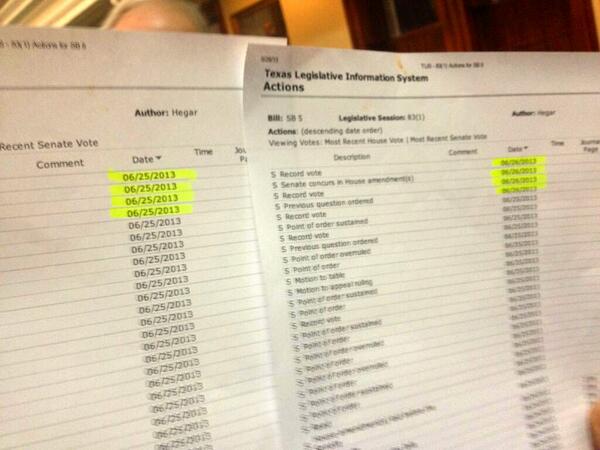
Apparently votes are electronically recorded and time stamped into the legislative journal.  Reporters took pictures of these records immediately after the vote.  The initial record had a time stamp of “June 26, 2013,” which was after the constitutionally mandated shut-down of a special legislative session.

Then a few minutes later, the time stamp mysteriously changed from “June 26, 2013” to “June 25, 2013.” Republicans allegedly changed the time stamp for the SB5 abortion bill vote. Behold the magic from Becca Aarronson, reporter at the Texas Tribune that shows this doctored document.

Picture of the Texas legislative journal on SB 5 before and after  time-stamp change.

Texas legislative journal on SB 5 before and after someone doctored the time stamp.

So why did the Lt. Governor and the radical right-wing concede?  Because of the excellent work of reporters in Texas who were able to show that the recorded vote occurred after midnight.

There was chaos on the floor and outrage when the Lieutenant Governor said that the bill had passed before the midnight deadline.  The Democrats continued to contest the Lt. Governor’s ruling, noting that the voting ended after midnight.  Which was documented  by the automatic time stamp and noticed by the press.

Because the vote actually occurred at 12:02 am on Wednesday rather than before the Tuesday midnight deadline, the Republicans finally conceded that they had lost this fight a little after 4 am Central time when Texas Lt. Gov. David Dewhurst said,

“Regrettably, the constitutional time for the first called session of the 83rd Legislature has expired. Senate Bill 5 cannot be signed in the presence of the Senate at this time. Therefore, it cannot be enrolled. It’s been fun, but seeya soon.

Thank you everyone, especially Senators Wendy Davis (D-Fort Worth) for her filibuster and Senator John Whitmire (D-Houston) for his knowledge of parliamentary procedures.  They helped create this much-needed victory on the war on women in Texas.

Meanwhile, I hope there is an investigation of this attempted tampering of the record in order to circumvent Texas’ Constitution!

And here’s my thank you to Senator Davis:

red heard surrounding Senator Davis' tweet thanking the public for the support of her fillibuster.

My home-made meme to express my heartfelt thanks for Senator Davis’ successful filibustering.

War on Women in Pennsylvania: At Least a 20-Year Happening

Last week, Governor Tom “Just Close Your Eyes” Corbett signed into law Act 13 of 2013, also known as HB 818.  This newest attack in the War on Women denies women the ability to use THEIR OWN FUNDS to purchase coverage for an abortion within the new healthcare exchange that Corbett decided to fob off onto the federal government.  Although the state couldn’t be “bothered” with running this exchange, they have no problem in denying women the ability to purchase coverage for an abortion even in cases in which her life is endangered.

At the time of final passage of the bill I sent out an email to several friends listservs. Here are some of the comments I received back:

What is going on in PA?  It’s beginning to sound more & more like a North Dakota or a Kansas [or a Mississippi or an Arizona or a Wisconsin or a Texas or any other state that’s been taken over by misogynists and racists].  Terrible!!

If women aren’t allowed to spend money on their healthcare the way they deem medically necessary, then it’s time to face the fact that we’re not even citizens in our own states.

I agree with all of these sentiments.  Yet, these types of legislative actions have been going on in Pennsylvania for a long time, despite Pennsylvania having an ERA in our state Constitution and having already ratified the national ERA.

Bit of history of the War on Women in Pennsylvania.  We’ve been battling this War for over two decades in our legislature.  The battles started with attacks on reproductive justice and have now spread to other areas of women’s lives.

Reproductive Justice Battles

The Pennsylvania General Assembly has basically been co-opted by the radical right-wing on both sides of the aisle.  The Democrats do have more pro-choice people than the Republicans.  The Senate is a bit better than the House of Representatives.  And this has basically been true since the late 1980’s.

  1. Which is why Governor Bob Casey, Sr. (D) pushed through Pennsylvania’s Abortion Control Act that initially mandated parental consent, spousal consent, a 24-hour waiting period, and a state-mandated script about the “detriments” to health in abortion procedures.  Planned Parenthood contested the law that went all the way to the US Supreme Court in a case called Planned Parenthood of Southeastern Pennsylvania v. Casey. Decided on June 29, 1992, the Court threw out spousal consent as an “undue burden,” but upheld the rest of the law. This was one of the first battles partially won by the emerging War on women.  That was 21 years ago this week.
  2. Which is why Title X and state Family Planning monies are split 50/50 each year in the state budget between crisis pregnancy centers and legitimate family planning clinics.  And this has been happening for over a decade now. And in 2012, Rep. Daryl Metcalfe (R) proposed eliminating ALL funding for family planning for Planned Parenthood or any other clinic that provides abortion services.
  3. Which is why we are losing stand-alone abortion providers due to the TRAP (Targeted Regulations on Abortion Providers) law passed in December 2011 following “Dr.” Gosnell’s arrest and guilty verdict for murdering 9 live-born infants and one woman in a filthy, rat-infested facility that the state had not inspected despite complaints from legitimate providers for about 10 years.
  4. Which is why we almost had a transvaginal ultrasound law last year.  And for Governor Corbett’s “Just close your eyes” statement (Corbett’s comments on the ultrasound bill start at 14:28).  The main reasons I think it ultimately died in committee is thanks to the activists in VA who created the uproar there and because so many people, including doctors were outraged by the invasiveness of this bill and for Corbett’s insensitive statement (of which he is becoming more or more well-known for – he’s his own worst enemy).

Other Battles in the War on Women in Pennsylvania

And on other issues – similar actions have occurred.

Increasing Conservatism in the Legislature and Governorship

In 2010, the Tea Party and the radical right swept into office an even more anti-woman legislature and governor here in Pennsylvania.  The War on Women went into full swing.  Both houses of the General Assembly became even more heavily conservative, with the House switching from a Democratic- to a Republican-controlled majority and the state elected an anti-choice, anti-woman, and in my opinion, racist governor – Governor Tom Corbett (R).

To highlight how conservative the Pennsylvania General Assembly has become, just look at the 2012 ratings of legislators by the American Conservative Union.  They indicated that 51% of members in the combined Assembly are solid conservatives; 105 or 42% are given a score of 100 and an additional 22 or 9% are rated at 63 or higher.  The entire leadership of the majority party in both houses and thus those with the power to deny women, people of color, people with disabilities and people living in poverty their basic rights are listed in their report as so-called “Defenders of Liberty” or “Conservatives” because of their rating of, respectively, either 100 (13 of the 16 leaders) or 80 (the remaining 3 leaders).

Attack on Hate Crimes Protections

An updated hate crimes bill was initially passed in 2002 that added gender, gender identity, national origin, disability, and sexual orientation.  Because the radical right didn’t want to vote against adding sexual orientation coupled with disability and gender and thereby anger multiple constituencies within their district, a member of the House, proposed a late-night, end of session amendment in the 2001-2002 legislative session that substituted the hate crimes bill for an agricultural crimes bill.  The vote was overwhelmingly in favor, mostly because the legislators didn’t want to appear to be supporting hate crimes via a no vote (prior to this the then Republican majority had refused to bring up the bill for a committee vote). The radical right-wing appealed saying that this substitution violated the state’s constitutional mandate that any amendment has to be germane to the original intent of the bill.

The Pennsylvania Supreme Court agreed in July 23, 2008 that this procedure (but not the underlying intent) was unconstitutional and threw out the law.  It has been reintroduced every session since then with no hearing or vote in any committee in either house.

Attacks on Marriage Equality

In addition to having a state-based mini-DOMA (a state-level Defense of Marriage Act) on the books, Pennsylvania has had several attempts at adding this form of discrimination to our state constitution introduced every session for the last decade.  The major reasons they have not passed is that the House is even more conservative than the Senate and the two houses can’t agree on how extreme to make it.  There is another one that has been introduced in the General Assembly this year, but due to increasing support by the public for civil unions and marriage equality (almost 2/3 support throughout the state), they haven’t yet held any hearings.

Budgetary Attacks

One of the spears attacking women, families, and people of color since the takeover of our legislative and executive branches of government here in the state is the budget.

We have had severe cutbacks in state funding for education, health care, and human services since 2011.  According to the Pennsylvania Budget and Policy Center, spending on these three areas in the final budget for 2012-2013 that ends this week was either flat-lined (“welfare” programs) or reduced by 0.3% (for public school education), 15.9% (for higher education), and 37% to 45% (for Medical Assistance inpatient and outpatient care).

The proposed budget plan for 2013-2014 continues these cuts. Here are a couple of examples of this budgetary war:

Attacks to Eliminate Equality for All

In the very first budget introduced by Governor Corbett, every advocacy Commission in the Executive branch was eliminated in the 2011-2012 budget – this includes the Pennsylvania Commission for Women (which I served on until it was abolished), Latino Affairs, Asian-American Affairs, and African-American Affairs.  As you will see from the links to these commissions, there is no public information on who the commissioners are nor is the any information on the services any of these commissions provide.  Prior to the elimination of these commissions in 2011, the Commission for Women, for example, had an extensive web presence which included our mission (the only thing that now remains), hotline contact information, copies of reports written by the Commission, information on the advocacy being conducted by the Commission, and links to programs and services to broadly assist women.  Transparency has disappeared; this is another spear in the attacks with the War on Women here in Pennsylvania.

Like every other state, Pennsylvania has a commission that monitors, reviews and adjudicates alleged acts of discrimination; here in Pennsylvania that is the Pennsylvania Human Relations Commission (PHRC). Severe budgetary cut-backs have occurred in the funding for the PHRC in every budgetary cycle since 2011.  An individual who works within the PHRC told me last month that as a result of these cuts, they are down 50% in staffing and that long-time civil rights advocates in the agency have either retired (some early) or left for other work.  And it’s not getting any better. The PHRC is flat-lined in this year’s budget.  We don’t yet know if this will still be true once the budget is passed, which theoretically must be done this week since our state constitution requires passage by June 30 of each year.

Gerrymandering

Gerrymandering is part of the War on Women due to its impact on legislation directly affecting women’s lives. Gerrymandering here in Pennsylvania, aka the “Gerrymander of the Decade,” has entrenched the right-wing Republicans in both the General Assembly and the Pennsylvania Congressional delegation.  This, despite the fact that there are many more registered Democrats than Republicans in the state.

Being a Democratic legislator, as we all know doesn’t guarantee concern for women’s rights (think Senator Bob Casey, Jr. and his father, former Governor Bob Casey, Sr.). But in these days and times, it’s less likely to cause a problem for us than do the Tea-Party dominated Republicans.

The most recent vote in the General Assembly is a clear example of what gerrymandering has done to the legislature.

Gerrymandering, combined with the elections resulted in the passage of HB 818/Act 13 this month. Tea Party Republican conservatives won many of their races in 2010 and 2012, taking control and leadership of both houses in 2011.  In the House there are 111 Republicans and 92 Democrats.  On April 24, 2013, all but 2 Republicans (98%) voted against and all but 32 Democrats (65%) voted for women’s reproductive justice. In the Senate there are 28 Republicans and 22 Democrats. On June 5, 2013, all but 2 Republicans (93%) voted against and all but 5 Democrats (77%) voted for women’s reproductive justice.

State and Federal ERA

Another comment that was made when I sent out my email was about passing the federal Equal Rights Amendment (ERA). The person said,

This is the reason we need to be included in the Constitution of the United States!  One of main ways to stop bills like this is to pass the ERA and thus be admitted as full-fledged citizens of the US.

Before the War on Women started, Pennsylvania passed a state-based ERA that was voted on by the electorate and placed into Section I of the Pennsylvania Constitution in 1971.

Yet even with this state-based ERA, the War on Women is being raged here in Pennsylvania.  Sometimes the state ERA works and sometimes it doesn’t.  It worked back in the 1980’s when Pat and Twiss Butler worked with Pennsylvania NOW to get gender-based auto insurance rates eliminated.  But it didn’t work in 2008 when a woman sued her employer using the state ERA based on sexually offensive comments made by her supervisor but not stopped by the company.

Many people, in frustration have made statements or created nicknames to replace the official monikers of “City or State of Brotherly Love” and the “Cradle of Independence.”  A couple of the pejoratives include “Pennsyltuky” and “Philadelphia and Pittsburgh with Alabama in the middle” (this latter one is attributed to James Carville)  The progressive parts of the state (for the citizenry, but not necessarily the full legislature) are currently Philadelphia and SE PA, the capital Harrisburg (to some minor extent) and Centre County where I live.  Pittsburgh is still itself progressive, but Allegheny County (where Pittsburgh is located) has become very, very conservative and thus more like the “T” (the term used to describe the rural part of the state outside of the Pittsburgh and Philadelphia regions).

Yes, it is frustrating.  But as a “cock-eyed optimist” (something I’ve often been called), I continue to push back and sometimes we get things that are a bit better than they would have been otherwise.  Much of our work is being done in coalition these days.  I won’t stop my push-back against this War on Women.  I will continue my multi-decade work and will continue to shout from the mountain top whenever and wherever needed.  As will others (see for example, an article in Politico about the War on Women battle for the Pennsylvania governorship gearing up here in Pennsylvania).

Be a “cock-eyed” optimist.  Get the ERA passed and stop this state and national War on Women. As Margaret Mead said,

Never doubt that a small group of thoughtful, committed citizens can change the world. Indeed, it is the only thing that ever has.

The Conservative Pot of Anger

IRS Form 990 non-profit form

Form 990 – the IRS tax form used by recognized 501(c) non-profit organizations

For over a week now we have been hearing about the “scandal” within the IRS’s Tax-Exempt division.  Congress has been holding hearings, calling on current and past Commissioners to testify about the additional scrutiny given to Tea Party organizations.  A couple of days ago, I asked if this additional scrutiny was a scandal or not.

In addition to my comments that day, the Guardian has now brought up another issue that may be adding fuel to the conservative f(ire).  That fuel is a four-decade simmering anger at the IRS by the conservative religious right.  An anger fueled by both segregation and religion.

In 1954, the US Supreme Court declared in Brown v. Board of Education that segregation in education was unconstitutional. In 1964, Congress passed the Civil Rights Act that, which among other issues makes discrimination based on race in public accommodations and employment illegal. In 1967, the US Supreme Court declared in Loving v. Virginia that bans on interracial marriage were unconstitutional.  In 1970, the IRS changed their tax-exempt regulation on private schools to reflect these policies.

Bob Jones University had, under pre-1970 regulations been granted tax-exempt status.  In 1970, as a result of the change in regulations, the IRS notified Bob Jones University that they intended to revoke the university’s tax-exempt status because of their segregationist policy of initially not admitting blacks and then, later of not admitting or expelling students who entered into, engaged in, or advocated for interracial marriage or dating.

Bob Jones University felt that they had a “biblical” right to discriminate.  So they filed case after case to overturn the IRS revocation.  Finally in 1983, in Bob Jones University v. United States, the US Supreme upheld the IRS revocation of Bob Jones University’s tax-exempt status because of its segregationist policies.

The Justices disagreed with Bob Jones’ biblical interpretation of the competing First and Fourteenth amendments to the US Constitution.  In looking at both amendments, they first declared that there is strong governmental interest in ending discrimination:

[The] Government has a fundamental, overriding interest in eradicating racial discrimination in education 29 – discrimination that prevailed, with official approval, for the first 165 years of this Nation’s constitutional history. That governmental interest substantially outweighs whatever burden denial of tax benefits places on petitioners’ exercise of their religious beliefs.

Then, citing the aforementioned cases (and others), the Court held stated:

An unbroken line of cases following Brown v. Board of Education establishes beyond doubt this Court’s view that racial discrimination in education violates a most fundamental national public policy, as well as rights of individuals.

The Court then pointed out that this IRS regulation was still constitutional even after Bob Jones University opened its doors to people of all races.  The Justices reiterated the lower court decision, stating that the University remained racially discriminatory in its policies at the university in violation of the tax-exempt regulations:

Petitioner Bob Jones University, however, contends that it is not racially discriminatory. It emphasizes that it now allows all races to enroll, subject only to its restrictions on the conduct of all students, including its prohibitions of association between men and women of different races, and of interracial marriage. 31 Although a ban on intermarriage or interracial dating applies to all races, decisions of this Court firmly establish that discrimination on the basis of racial affiliation and association is a form of racial discrimination, see, e. g., Loving v. Virginia, 388 U.S. 1 (1967); McLaughlin v. Florida, 379 U.S. 184 (1964); Tillman v. Wheaton-Haven Recreation Assn., 410 U.S. 431 (1973). We therefore find that the IRS properly applied Revenue Ruling 71-447 to Bob Jones University. 32

The judgments of the Court of Appeals are, accordingly,

Affirmed.

I think that this article in the Guardian is correct.  It might just be another reason for the current tax-exempt status furor.  It seems that pulling the tax-exempt status of a religiously-based institution for its violation of our country’s stance for equality under the 14th Amendment of the US Constitution resulted in a simmering pot of anger just waiting for a bit more fire to bring conservatives to a full boil.

What do you think?  Please comment.  I’d be interested in hearing your opinion.

Civil Rights Denied: PA’s Proposed Constitutional Same-Sex Marriage Ban

Logo of Freedomt to Marry, Inc.

“working to win the freedom to marry in more states, grow the national majority for marriage, and end federal marriage discrimination. ” http://www.freedomtomarry.org/pages/about-us

A couple of days ago I posted a blog about the dueling marriage equality and same-sex marriage ban bills recently introduced into the Pennsylvania General Assembly.  Today I thought I give a more detailed argument as to how discriminatory the same-sex marriage ban is to gays and straights alike.

As previously stated, on May 7, Pennsylvania State Representative Daryl Metcalfe (R-12 Butler County) introduced his legislation (HB 1349) to create a constitutional amendment defining marriage OR its “substantial equivalent” solely as a union between a man and a woman.  That bill would amend Article I of the Pennsylvania state Constitution – the Declaration of Rights section – to take rights away from unmarried couples in Pennsylvania, whether they are same-sex or heterosexual couples.  Here’s the constitutional amendment as written in HB 1349:

“Marriage is the legal union of only one man and one woman as husband and wife and no other legal union that is treated as marriage or the substantial equivalent thereof shall be valid or recognized.”

Until the spring of 2012, 31 states across the country had created constitutional amendments to outlaw marriage or anything that looks like marriage between same-sex couples. The last successful attempt at this form of discrimination occurred by referendum in North Carolina in the spring of 2012; all other attempts since then to deny marriage equality have failed.

Marriage equality however has had many successes since then. Three states – Delaware, Rhode Island, and Washington – either passed a referendum OR legislation legalizing marriage equality following North Carolina’s referendum. One state – Minnesota—is expected to pass their marriage equality bill today; note, this is only 6 months after the voters in Minnesota by referendum killed their proposed same-sex marriage ban.  And one state – Colorado – passed legislation recognizing civil unions even though they have a constitutional ban on same-sex marriage.

Instead of moving forward, right-wing legislators would like to have Pennsylvania join the 31 other states that constitutionally ban-same sex marriages and/or other legal forms of relationships such as domestic partnerships and civil unions.  These Pennsylvanian legislators are making their fourth attack on same-sex couples and on unmarried people – gay or straight.  If HB 1349 passes, Pennsylvania for the first time in its history would enshrine and mandate discrimination into the state Constitution.

This amendment would take rights away from unmarried couples in Pennsylvania, whether they are same-sex or heterosexual couples.  The way this amendment is written would affect all unmarried couples, victims of domestic violence if they are not married to their abuser, and could threaten Pennsylvania’s anti-discrimination laws

Effect on All Unmarried Couples – Gay or Straight

Currently, Pennsylvania statute recognizes only marriages between one man and one woman.

Pennsylvania does not recognize either (1) same-sex marriages or (2) civil unions, domestic partnerships, or any other coupled-household status—whether entered into by same-sex or opposite-sex couples.  Those affected by this amendment would therefore, for example, include senior citizens who live together but are not married because of economic considerations, couples who believe they have a “common law marriage” (which is no longer recognized in Pennsylvania), and gay or straight couples who have any type of intimate relationship.

It could also threaten the lives of unmarried domestic violence victims and allow unmarried individuals to be discriminated against in housing, employment, and public accommodations.

Effect on Domestic Violence Victims

In 2004, Ohio passed their discriminatory anti-marriage constitutional amendment, which was quickly and unexpectedly used to deny protections to unmarried victims of domestic violence.  Here’s what happened.  Almost immediately, unmarried batterers argued that since they were not married, Ohio could not enforce their domestic violence law because that was treating their relationship with their partner as “equivalent to marriage.” The 2nd District Court of Appeals in Ohio agreed and ruled that the Ohio domestic violence law runs afoul of the “Defense of Marriage” amendment, passed by voters in 2004, and does not apply to “a person living as a spouse.”  As a result, unmarried defendants, who could have faced felony domestic violence charges, only faced misdemeanor assault charges.    It took several years for the Ohio Supreme Court to reverse this ruling.  In the interim, unmarried women were at the mercy of their batterers in several counties in Ohio.

The Ohio amendment is very similar to that of the one proposed for Pennsylvania.   In Ohio, by providing protection to persons living as spouses,” the domestic violence statutes created a legal status for cohabiting relationships that is “equivalent to a marriage,” according to the appeals court. The appeals court decision in Ohio then denied protection from abuse to unmarried individuals – gay or straight – because the domestic violence law gave legal standing to an unconstitutional relationship – that of an unmarried couple. The courts argument overturning these domestic violence protections utilized similar language found in Pennsylvania’s HB 1439, which states that no other legal union… or the substantial equivalent thereof shall be valid or recognized.

We have no way of knowing how the courts would rule on a similar argument should this amendment pass and become part of Pennsylvania’s Constitution.  Who knows if Pennsylvania’s Supreme Court would protect the victim or allow batterers to circumvent Pennsylvania’s Protection From Abuse (PFA) law?  We need to protect all people from domestic violence and sexual assault.  Passage of this amendment could deny the protection offered by Pennsylvania’s domestic violence and protection from abuse laws; it could even risk the very lives of unmarried people–gay or straight–because this constitutional amendment denies the rights, privileges, and protections of law to people who are not legally married or who have a relationship that is “functionally equivalent” to traditional marriage.

Effects on Employment, Education, Housing, and Public Accommodations

It also looks like current and proposed employment, education, housing, and public accommodations anti-discrimination laws at both the state and local levels might be jeopardized for unmarried individuals.  Discrimination based on marital status and family responsibilities is unlawful under a variety of existing laws. With a few exceptions, under current state and federal law, people who experience this form of discrimination must fit their claims into an appropriate legal theory—as discrimination based on gender, a violation of family and medical leave laws, or another legal theory.  In addition, many municipalities throughout Pennsylvania have passed or are considering ordinances that would make it illegal to discriminate in employment, housing, and in some cases, public accommodations specifically based on sexual orientation, gender identity and marital status.   Will the state courts, the PA Human Relations Commission, or local Human Relations Commissions be able to enforce these laws if Pennsylvania’s constitution has been amended to require unmarried couples to be treated differently from married couples?  We do not know.  Passage of HB 1439 as a constitutional amendment could put all of these protections at risk since any person, company, or school could argue that their business is mandated to deny employment, hiring, and benefits to any person who is not married.

Civil Rights Denied, Reiterated

Last, but not least, exclusion, discrimination and inequality are not the principles this state was founded upon. This discriminatory “Marriage Protection Amendment” denies unmarried heterosexual, lesbian, gay, bisexual and transgender families the protections and fairness they deserve. Heterosexual married couples and their families are afforded more than 1,000 legal protections and economic benefits provided through state and federal law, benefits and protections that are currently inaccessible to unmarried couples.  Passage of this amendment would therefore subject same-sex couples and their families to exclusion, discrimination and inequality.

The proposed amendment could also take away existing legal protections for committed long-term couples and their children, such as second parent adoptions, cohabitation agreements, co-parenting agreements, wills, living wills, powers of attorney, etc., regardless of their sexual orientation.

Gay and lesbian Pennsylvanians are our neighbors, co-workers, friends, and family member.  They pay taxes.  LGBT people should not be bullied.  They deserve the same rights, protections, and responsibilities that all residents desire and have.

Let’s all work to stop this bill now!  So I’m once again recommending that you keep up-to-date on this horrible bill as well as other LGBTQ legislation at  Equality Pennsylvania’s website.

PA’s Dueling Marriage Equality and Gay Marriage Ban Bills

Logo of Freedomt to Marry, Inc.

“working to win the freedom to marry in more states, grow the national majority for marriage, and end federal marriage discrimination. ” http://www.freedomtomarry.org/pages/about-us

On April 15, Pennsylvania State Representative Mark Cohen (D-102 Philadelphia) introduced legislation (HB 1178) that would legalize civil unions and extend all state laws applicable to marriage to any civil union created anywhere and to any marriage performed and recognized outside of the state.  Less than one month later, on May 7, Pennsylvania State Representative Daryl Metcalfe (R-12 Butler County) introduced his legislation (HB 1349) to create a constitutional amendment defining marriage OR its “substantial equivalent” solely as a union between a man and a woman.

So we once again have a legislative dual going on in Pennsylvania between those that believe in equality for all and those that want to enshrine discrimination into the state Constitution.

Side 1: For Equality

What does Cohen’s bill do?  Very simply, it takes us on the path toward equality for lesbian and gays.  As Rep. Cohen says,

 “This bill would define a civil union as a union between two members of the same sex.  It would make all state laws applicable to marriage also applicable to a civil union.  The bill would also provide for reciprocity of civil unions performed legally in other states and the recognition of same sex marriage in other states as civil unions in Pennsylvania.”

Civil unions represent the middle-of-the-road compromise position between constitutionally banning and permitting gay marriages and have been embraced by both advocates for LGBT rights and a growing number of conservatives.

Nothing in this bill would require any religion or any clergyman to perform any ceremony uniting people in a civil union.  This legislation will merely offer committed gay couples the same legal rights that are bestowed upon married people without the status of marriage.”

I would prefer full marriage equality.  Just like all gay and straight couples in 10 states (plus Minnesota and Delaware if their legislatures pass their marriage equality bills as expected) already have.  And  just like the majority of people in Pennsylvania desire.

In a poll released on May 8 by Franklin and Marshal University, 54% of Pennsylvanians “generally” support while 41% “generally” oppose legalizing same-sex marriage.  In that same poll, 65% support passage of a state law that would allow same-sex couples to legally form civil unions that give them some, if not all, of the marriage rights given to heterosexual couples who marry.

This bill is a compromise.  It currently has 28 cosponsors and was referred to the House Judiciary Committee when it was introduced on April 15.

Side 2: For Discrimination

Meanwhile, Daryl Metcalfe has seen fit to once again try to enshrine discrimination into the state constitution.  It is a one-sentence amendment that has severe ramifications.  Here’s the constitutional amendment as written in HB 1349:

“Marriage is the legal union of only one man and one woman as husband and wife and no other legal union that is treated as marriage or the substantial equivalent thereof shall be valid or recognized.”

Metcalfe justifies this discrimination by invoking partisan politics, a right-wing encroachment on the separation of church and state, and a denial of the protections given to us under the US Constitution:

Pennsylvania does not need to wait for the United States Supreme Court to rule on what natural law already declares as self-evident … Marriage is a sacred bond that can only be fulfilled by one man and one woman, as established by God. Final passage of my legislation will allow state lawmakers to exercise their rightful responsibility and obligation to uphold the rule of law and the will of the people.

The definition of marriage as ‘the union of one man and one woman,’ defended and upheld by this legislation, is the traditional definition of marriage that has been recognized and accepted throughout history and the world for centuries. Neither homosexual special interests gathered under the immoral umbrella of the ACLU, nor the Obama administration’s Department of Justice or any activist court should decide this critical issue for our Commonwealth.  House Bill 1349 is specifically written to empower Pennsylvania voters, and only Pennsylvania voters, with the authority to decide how marriage will be defined in the Keystone State.

News reports indicate that Metcalfe may be on the downside of this battle and that combined with the aforementioned Franklin and March poll, there is now less support for this discrimination.  According to the Philly Magazine,

His support system is fleeting. In the last session, the bill had 40 supporters, but today [May 8], according to a rep from [Rep] Brian Sims’ office, there are only 27. And this is the first time it’s been introduced with zero Democratic backers. To top it off, his bill’s lackluster show of support comes on the heels of yesterday’s announcement that a record number of legislators on both sides of the fence sponsor[ed] legislation that ban[s] discrimination against LGBT people in the workplace and housing and public accommodations [emphasis in original].

Discrimination and inequality are not the principles Pennsylvania was founded upon.

Discrimination and inequality are not the principles this state was founded upon. Metcalfe’s discriminatory amendment, in contrast to Cohen’s call for equality and respect for recognizing loving relationships, denies unmarried heterosexual, lesbian, gay, bisexual and transgender families the protections and fairness they deserve.

Heterosexual married couples and their families are afforded more than 1,000 legal protections and economic benefits provided through state and federal law, benefits and protections that are currently inaccessible to unmarried couples.  Passage of Metcalfe’s amendment would therefore subject same-sex couples and their families to exclusion, discrimination and inequality.

Gay and lesbian Pennsylvanians are our neighbors, co-workers, friends, and family member.  They pay taxes.  LGBT people should not be bullied.  They deserve the same rights, protections, and responsibilities that all residents desire and have.

If the US Supreme Court declares this summer that marriage is a right across the country just like they did in Loving v. Virginia in 1967 (see my earlier blogs here and here on this issue) then we won’t need this interim step of civil unions and Metcalfe’s bill will immediately become moot.  A great way, in my opinion to end this duel.  In Pennsylvania and across the country.

So, let’s hope that the US Supreme Court overturns Proposition 8 this summer under the equal protection and due process protections given to us under the US Constitution’s 14th amendment and therefore—like Loving v. Commonwealth of Virginia in 1967—protect marriage rights for everyone. If they stop short of that, then let’s hope and advocate for the passage of Representative Cohen’s civil union bill.

Meanwhile, to keep up-to-date on these dueling bills as well as other LGBTQ legislation, check out Equality Pennsylvania’s website.

Call for Paycheck Fairness Act Co-Sponsorship

The wage gap shows that women, particularly women of color are paid significantly less than white men.

The Wage Gap: Lack of Equal Pay

On April 9, I did a blog on Equal Pay Day discussing the lack of equity in pay between men and women’s work.  In that blog, I discussed the need to pass the federal Paycheck Fairness Act.

Part of the process of obtaining passage of a bill is to get as many legislators as possible to sign on as a co-sponsor of the bill you are interested in.  In the US House of Representatives, there are currently 206 co-sponsors of the House version of the bill – H.R. 377. In the US Senate, there are currently 46 co-sponsors of the Senate version, S. 84.

The main coalition pushing for paycheck fairness and pay equity is the National Committee on Pay Equity.  This morning, I opened up an email from a listserv I’m on regarding the Paycheck Fairness Act. Michele Leber, Chair of the National Committee on Pay Equity sent out the following message, asking everyone to spread the word to their friends and colleagues in Virginia. Here’s what she said:

“We learned yesterday [April 24] from the office of Rosa DeLauro, our pay equity champion in the House of Representatives, that every Democrat in the House is now a PFA cosponsor! To reach that goal in the Senate, we need just a few more Democrats, among them Mark Warner of Virginia.

At a meeting yesterday in Warner’s office, his legislative aide said the best way to get Warner’s cosponsorship was to send the senator messages of support for the bill. So please rally any contacts, groups, or chapters that you have in Virginia, asking persons to contact Sen. Warner’s office by phone at 202-224-2023 and/or by e-mail at http://www.warner.senate.gov/public//index.cfm?p=ContactPage, asking him to cosponsor the Paycheck Fairness Act, S.84.

With the 50th anniversary of the signing of the Equal Pay Act coming up on June 10, this is particularly important now.”

So…

If you live in Virginia and are a constituent, please follow Michelle’s request and contact Senator Warner regarding co-sponsorship.

If you don’t live in Virginia, you can find out where your US legislators stand on the Paycheck Fairness Act by going to http://thomas.loc.gov/home/thomas.php. In the search box in the middle of the page, type in “Paycheck Fairness Act” and click search.  On the next page, two bills will show up—S. 84 and H.R. 377.  This page provides several links to information about both of these bills—text, bill history, co-sponsors, etc. If you click on “cosponsors” for each bill, you can determine if your representatives are publicly supporting the bill or not. If they are a sponsor, thank them and then ask them to call for a hearing and vote on the bill.  If they are not, ask them to sign on.

Thanks.